The latest U.S. Treasury bond auction will see the U.S. government sell $22 billion of 30-year bonds, providing a key test of investor confidence in long-term economic growth, inflation expectations, and fiscal sustainability. Market participants will closely watch demand indicators such as the bid-to-cover ratio, auction tail, and participation from foreign investors.
Key Overview
- The U.S. Treasury is auctioning $22 billion in 30-year bonds.
- The sale is the final coupon auction of the week.
- Earlier auctions included a 3-year note sale and a 10-year note auction.
- The 10-year auction attracted strong international demand.
- The 30-year Treasury bond reflects expectations for long-term growth and inflation.
- Investors will monitor the auction tail and bid-to-cover ratio.
- The six-auction average bid-to-cover ratio stands at 2.41 times.
- Foreign investors typically account for the majority of indirect bidding activity.
- The six-auction average for indirect bidders is 66.7%.
- Auction results can influence broader Treasury yields and financial markets.
U.S. Treasury 30-Year Bond Auction Tests Long-Term Investor Confidence
The latest U.S. Treasury 30-year bond auction is expected to attract significant attention from investors, economists, and policymakers as markets assess the outlook for inflation, economic growth, and government borrowing.
The Treasury plans to sell $22 billion of long-term bonds, completing a series of coupon auctions conducted during the week. The auction follows a mixed performance from earlier Treasury sales, with the three-year note auction receiving average demand while the ten-year auction benefited from strong international participation.
Because the 30-year bond represents one of the longest maturities issued by the U.S. government, demand for the security often provides valuable insights into investor expectations regarding the economy over the coming decades.
The results could influence Treasury yields, borrowing costs, and broader financial market sentiment.
U.S. Treasury Bond Auction Completes Weekly Debt Sales
The upcoming U.S. Treasury bond auction is the third and final coupon auction conducted this week.
The Treasury regularly auctions securities to finance government operations and refinance existing obligations. These auctions include shorter-term notes as well as long-term bonds that help establish benchmark interest rates across financial markets.
Earlier in the week, the Treasury sold three-year notes and ten-year notes.
The three-year auction was generally viewed as receiving average demand from investors.
By contrast, the ten-year auction generated strong international interest, producing a favorable result characterized by a strong bid-to-cover ratio, minimal dealer participation requirements, and pricing that exceeded expectations.
Market participants will now evaluate whether similar demand extends to the longest maturity being offered.
Context is everything. Stay ahead of shifting trends with today’s market updates, and uncover emerging opportunities using the Serrari Group Market Index and Marketplace. Then, take control of your own financial future by exploring our Money & Life Reset Transformation Blueprint ™ to build stronger habits, create better systems, and design a path toward lasting wealth.
Why 30-Year Treasury Bonds Matter
The performance of 30-year Treasury bonds provides important information about investor expectations for the future.
While shorter-term securities are heavily influenced by Federal Reserve policy and near-term economic conditions, long-term Treasury bonds reflect broader views regarding inflation, economic growth, government finances, and overall financial stability.
Investors purchasing 30-year bonds are effectively making judgments about economic conditions over several decades.
As a result, strong demand can indicate confidence that inflation will remain manageable and that long-term economic conditions will remain relatively stable.
Conversely, weaker demand may suggest concerns about inflationary pressures, fiscal deficits, or future borrowing needs.
For this reason, economists often view long-term bond auctions as important indicators of market sentiment.
Treasury Yields Remain a Key Focus
Movements in Treasury yields are among the most closely watched outcomes of any government debt auction.
Yields represent the return investors require to hold Treasury securities and serve as benchmarks for borrowing costs throughout the economy.
Mortgage rates, corporate borrowing costs, and other lending rates are often influenced by Treasury market performance.
Strong auction demand generally supports lower yields because investors are willing to accept lower returns in exchange for the perceived safety of government bonds.
Weak demand can have the opposite effect, pushing yields higher as investors require greater compensation for holding long-term debt.
The 30-year bond is particularly important because it reflects long-term inflation and fiscal expectations rather than short-term monetary policy considerations.
Government Debt Auction Metrics Investors Watch
Several indicators help investors evaluate a government debt auction.
One of the most important measures is the auction tail.
The tail represents the difference between the auction’s final high yield and the yield where the bond was trading immediately before the sale. A negative tail generally indicates stronger demand because investors accepted lower yields than expected.
Another key metric is the bid-to-cover ratio.
This measure compares total bids submitted with the amount of securities offered for sale. Higher ratios indicate stronger demand and greater competition among investors.
The six-auction average bid-to-cover ratio for 30-year Treasury bonds currently stands at 2.41 times.
Investors will compare the latest results against this benchmark to assess overall demand conditions.
Foreign Investors Play Major Role
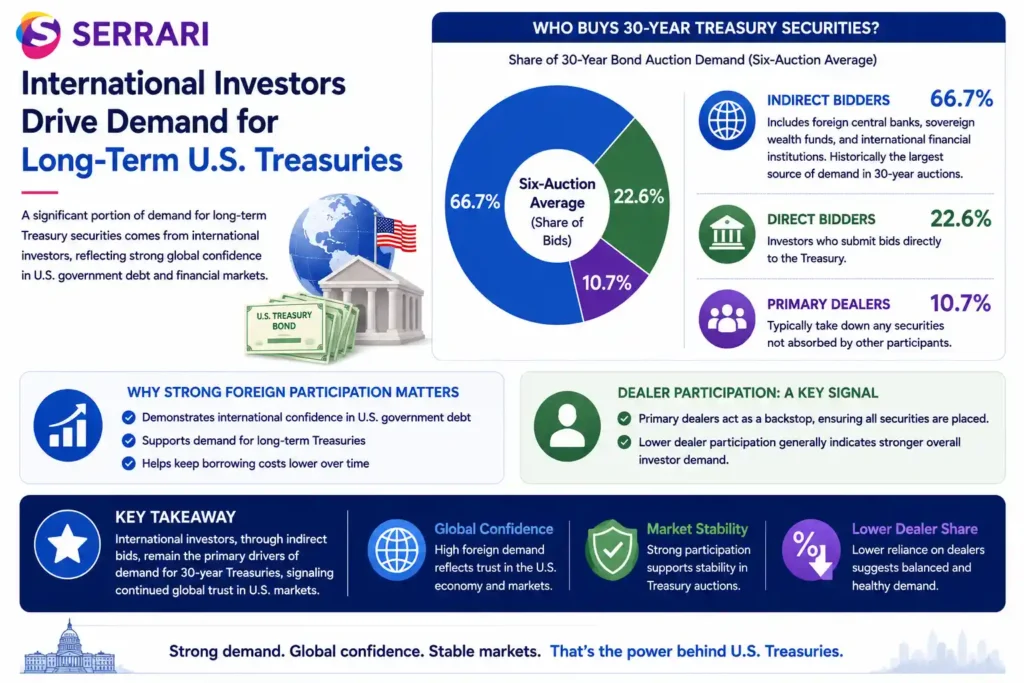
A significant portion of demand for long-term Treasury securities comes from international investors.
Indirect bidders, a category that typically includes foreign central banks, sovereign wealth funds, and international financial institutions, have historically accounted for the majority of participation in 30-year bond auctions.
The six-auction average for indirect bidders currently stands at approximately 66.7%.
Strong foreign participation is often viewed positively because it demonstrates international confidence in U.S. government debt and financial markets.
Direct bidders, who submit bids directly to the Treasury, account for approximately 22.6% on average.
Primary dealers typically represent the remaining demand and are obligated to purchase any securities not absorbed by other participants.
Lower dealer participation generally indicates stronger overall investor demand.
U.S. Bond Market Watches Inflation and Fiscal Outlook
The broader U.S. bond market remains focused on inflation expectations and fiscal sustainability.
Long-term Treasury securities are particularly sensitive to concerns about future government borrowing requirements and economic growth prospects.
Investors continue monitoring inflation data, Federal Reserve policy signals, and government spending trends as they evaluate long-term fixed-income investments.
Recent Treasury auctions have generally demonstrated resilient demand despite ongoing uncertainty surrounding interest rates and economic conditions.
The strong performance of the recent ten-year auction suggests investors remain willing to hold U.S. government debt, although the longer maturity profile of the 30-year bond presents a different risk profile.
The auction results may therefore provide valuable information regarding market confidence in the long-term outlook.
What the Auction Could Signal
The outcome of the auction may offer several important signals.
A strong result featuring a high bid-to-cover ratio, robust foreign participation, and a favorable tail would suggest continued investor confidence in long-term Treasury securities.
Such an outcome could support lower yields and reinforce perceptions of stability within the Treasury market.
A weaker result could indicate growing concerns regarding inflation, government debt levels, or long-term economic conditions.
Either way, the auction is likely to influence financial market sentiment because of its role as a benchmark for long-term interest rates.
Conclusion
The U.S. Treasury 30-year bond auction represents an important test of investor confidence in the long-term economic and fiscal outlook of the United States. With $22 billion in bonds being offered, market participants will closely examine demand indicators such as the bid-to-cover ratio, auction tail, and foreign participation levels.
Following a strong ten-year Treasury auction earlier in the week, investors will be watching to see whether long-term Treasury securities continue attracting robust demand. The results could influence Treasury yields, borrowing costs, and broader financial market expectations in the weeks ahead.
FAQs
1. Why is the U.S. Treasury 30-year bond auction important?
The 30-year Treasury bond reflects investor expectations regarding long-term economic growth, inflation, and government finances. Because of its long maturity, the auction provides valuable insight into how investors view the U.S. economy over the coming decades.
2. What is a bid-to-cover ratio?
The bid-to-cover ratio measures the total amount of bids received relative to the amount of securities offered. A higher ratio indicates stronger demand because more investors are competing to purchase the bonds being auctioned.
3. Who buys 30-year Treasury bonds?
Buyers include foreign central banks, sovereign wealth funds, pension funds, insurance companies, asset managers, and individual investors. International institutions often represent a significant share of demand through indirect bidding channels.
4. How do Treasury auctions affect financial markets?
Treasury auctions influence government borrowing costs and broader interest rates across the economy. Strong demand can help keep yields lower, while weaker demand may push yields higher and affect mortgage rates, corporate borrowing costs, and investor sentiment.
Sources: Investing Live, Trading View
Your financial future isn’t something you wait for—it’s something you build.
The real question is: when do you begin?
Move beyond simply staying informed.
Navigate the markets with clarity—track trends through the Serrari Group Market Index, uncover opportunities in the Serrari Marketplace, and build practical knowledge with our Curated Wealth Builder Platform.
Stay connected to what truly matters.
Get daily insights on macro trends and financial movements across Kenya, Africa, and global markets—delivered through the Serrari Newsletter.
Growth opens doors.
Advance your career through professional programs including ACCA, HESI A2, ATI TEAS 7 , HESI EXIT , NCLEX – RN and NCLEX – PN, Financial Literacy!🌟—designed to move you forward with confidence.
See where money is flowing—clearly and in real time.
Track Money Market Funds, Treasury Bills, Treasury Bonds, Green Bonds, and Fixed Deposits, alongside global and African indexes, key economic indicators, and the evolving Crypto and stablecoin landscape—all within Serrari’s Market Index.