India’s latest sovereign green bond settles on 17 August 2026 after the government sold ₹50 billion of long-dated green debt at a cut-off yield of 7.3169%.
Reuters reports that the bond priced with a market-implied 4-basis-point greenium relative to comparable conventional government securities.
That means investors were willing to accept slightly less yield for the green bond—potentially lowering the government’s financing cost.
Key Overview
- Issue size: ₹50 billion
- Cut-off yield: 7.3169%
- Reported greenium: 4 basis points
- Settlement: 17 August 2026
- Maturity: 27 April 2056
- Sovereign green bonds outstanding: approximately ₹877 billion
- Primary-dealer devolvement: nil
India Sovereign Green Bond Locks In a 4bp Greenium
India’s sovereign green-bond market has delivered another sign that investors may be willing to accept slightly lower yields for government debt tied to environmental spending.
The latest RBI sovereign green auction raised ₹50 billion through a bond maturing on 27 April 2056, with a cut-off yield of 7.3169%.
Reuters estimates the bond carried a 4-basis-point greenium.
That greenium is the real investor story.
What Is a Greenium?
A greenium occurs when investors accept a lower yield on a green bond than on a comparable conventional bond from the same issuer.
For the Indian government, that is positive: lower yield means slightly cheaper borrowing.
For the investor, it means accepting slightly less income in exchange for holding a security whose proceeds are allocated toward eligible green expenditure.
The Government of India green-bond framework sets out eligible uses including renewable energy, energy efficiency, clean transport, climate adaptation and sustainable water and waste management.
A greenium therefore does not create additional credit protection. Both green and conventional sovereign bonds ultimately depend on the Government of India’s ability to meet its obligations.
Why the Latest Result Matters
India has struggled at times to generate a meaningful and persistent greenium.
That picture began improving earlier this year. In April, another long-dated sovereign green bond achieved a reported 6-basis-point greenium, according to Reuters.
The latest 4-basis-point differential is smaller, but its importance lies in repetition.
One successful auction can reflect temporary market conditions.
Repeated greeniums suggest a dedicated buyer base may be emerging.
Insurers Help Explain the Demand
Long-duration bonds are particularly relevant to insurance companies because insurers often have liabilities extending decades into the future.
Indian sovereign green bonds also benefit from their infrastructure classification. Reuters has previously reported strong insurer demand for these securities, particularly when supply of ultra-long conventional government debt is limited.
That creates a natural buyer base.
The government’s first-half borrowing calendar planned only ₹15,000 crore of sovereign green bonds, while ultra-long conventional issuance was also reduced compared with the previous year.
Scarcity therefore matters alongside environmental demand.
Context is everything. Stay ahead of shifting trends with today’s market updates, and uncover emerging opportunities using the Serrari Group Market Index and Marketplace. Then, take control of your own financial future by exploring our Money & Life Reset Transformation Blueprint ™ to build stronger habits, create better systems, and design a path toward lasting wealth.
A Greenium Is Good for Government—But Not Automatically for Investors
Investors need to view the greenium from both sides.
A 4-basis-point greenium represents a financing benefit to the government.
But it also means the investor receives slightly less yield than on an otherwise comparable conventional security.
Whether that sacrifice is worthwhile depends on the investor’s sustainability objectives, regulatory requirements and portfolio constraints.
For long-term investors, duration risk may be much more important than the greenium itself.
A bond running until 2056 can experience substantial price changes when market yields move.
If yields rise, the bond’s market value can fall sharply even though the government continues making promised payments.
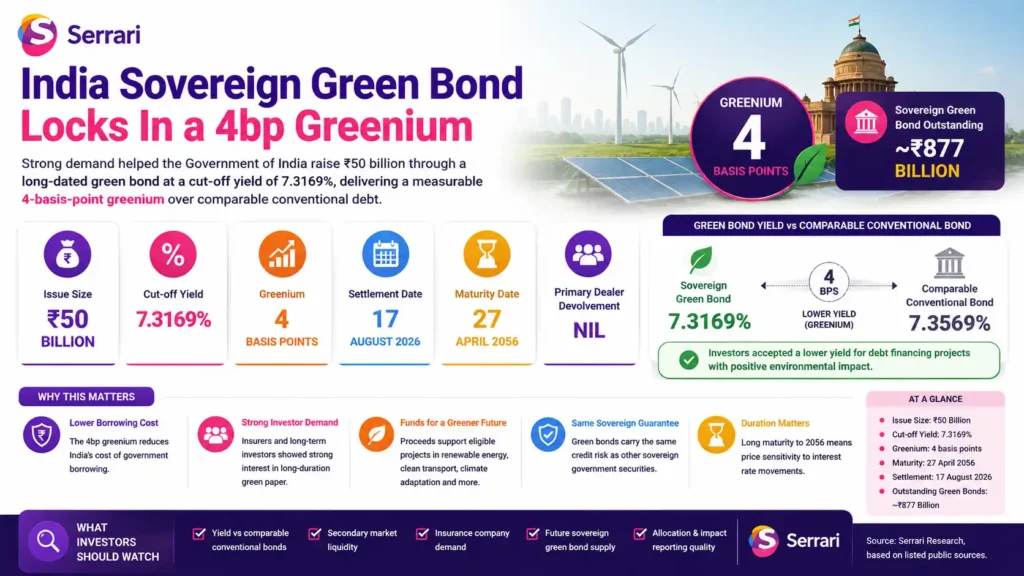
India’s sovereign green bond scorecard shows a ₹50 billion issue, a 7.3169% cut-off yield and a reported four-basis-point greenium. The graphic compares the lower green-bond yield with conventional government debt and explains why long-duration bonds appeal to insurers while exposing investors to significant interest-rate risk.
India’s Green Market Is Becoming Larger
Following the latest auction, Reuters places outstanding Indian sovereign green bonds at approximately ₹877 billion.
India’s wider framework requires proceeds to be used for eligible green expenditure, with allocation and impact reporting providing investors with transparency on how funds are applied.
That follows the principles of use-of-proceeds green financing rather than changing the underlying sovereign guarantee.
What Investors Should Watch
The next question is whether the greenium survives in secondary trading and future auctions.
Investors should monitor:
- Yield versus comparable conventional government bonds;
- Secondary-market liquidity;
- Insurance-company demand;
- Future sovereign-green-bond supply;
- Allocation and impact reports; and
- Movements in India’s long-term interest rates.
A persistent greenium across several auctions would provide much stronger evidence of structural green demand than a single successful transaction.
Conclusion
India’s latest sovereign green bond gives investors something the market has often struggled to demonstrate clearly: a measurable pricing difference between green and conventional government debt.
The reported 4-basis-point greenium follows an earlier 6-basis-point greenium in April.
That does not yet prove the premium is permanent.
But it suggests India may finally be developing a more dependable investor base willing to pay slightly more—and accept slightly less yield—for sovereign green debt.
FAQs
Is the 4bp greenium an official RBI figure?
No. RBI publishes the auction yield and results. The greenium is a market comparison reported by Reuters against comparable conventional government securities.
What yield did the bond receive?
The RBI auction result shows a cut-off yield of 7.3169%.
Does a greenium make the bond safer?
No. The green label determines how proceeds are allocated. Sovereign credit risk and interest-rate risk remain.
Why do insurers like these bonds?
Long maturities can help insurers match long-term liabilities, while the infrastructure and sustainability characteristics can also fit their investment requirements.
Sources: RBI sovereign green bond auction announcement, RBI sovereign green bond auction result, Government Sovereign Green Bond Framework, Government securities issuance calendar, Reuters greenium analysis via Business Recorder, ICMA Green Bond Principles.
Your financial future isn’t something you wait for—it’s something you build.
The real question is: when do you begin?
Move beyond simply staying informed.
Navigate the markets with clarity—track trends through the Serrari Group Market Index, uncover opportunities in the Serrari Marketplace, and build practical knowledge with our Curated Wealth Builder Platform.
Stay connected to what truly matters.
Get daily insights on macro trends and financial movements across Kenya, Africa, and global markets—delivered through the Serrari Newsletter.
Growth opens doors.
Advance your career through professional programs including ACCA, HESI A2, ATI TEAS 7 , HESI EXIT , NCLEX – RN and NCLEX – PN, Financial Literacy!🌟—designed to move you forward with confidence.
See where money is flowing—clearly and in real time.
Track Money Market Funds, Treasury Bills, Treasury Bonds, Green Bonds, and Fixed Deposits, alongside global and African indexes, key economic indicators, and the evolving Crypto and stablecoin landscape—all within Serrari’s Market Index.