Kenya has moved closer to securing longer-term preferential access to the U.S. market after the Senate approved legislation that would extend the African Growth and Opportunity Act through December 31, 2028. The Senate passed the amended measure by 90 votes to six on August 8, strengthening prospects for continued tariff preferences for eligible Kenyan exports.
However, the extension is not yet final law. AGOA is already legally authorised through December 31, 2026 after a one-year renewal signed in February. Because the Senate amended H.R. 6500 before passing it, the revised legislation must still clear the House of Representatives before it can be sent to President Donald Trump for signature.
For Kenya, the biggest immediate beneficiary would be the apparel industry, which relies heavily on U.S. demand and the third-country fabric rule that allows qualifying garments made in Kenya from fabric sourced outside Africa to receive AGOA preferences.
Key Overview
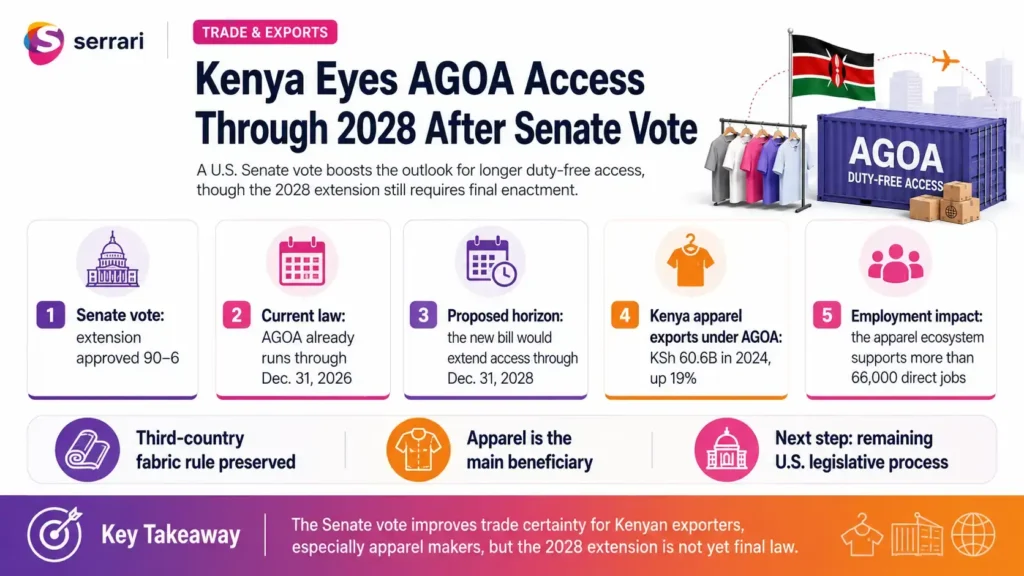
- The U.S. Senate approved the amended AGOA legislation by 90-6 on August 8, 2026.
- The proposal would extend AGOA preferences through December 31, 2028.
- Current law already keeps AGOA in force through December 31, 2026.
- The Senate-approved text must still complete the remaining U.S. legislative process before the 2028 extension becomes law.
- Kenya’s apparel exports under AGOA reached about KSh 60.6 billion in 2024, up from KSh 50.8 billion in 2023.
- The Kenyan apparel and AGOA export ecosystem supports more than 66,000 direct jobs.
- The proposed extension preserves the third-country fabric provision, a critical rule for Kenyan garment manufacturers.
Senate Vote Brings Kenya Closer to Longer Trade Certainty
The latest development gives Kenyan manufacturers greater visibility beyond the end of 2026. The official roll call shows lawmakers approved H.R. 6500, as amended, by 90 votes to six, demonstrating broad bipartisan support for keeping the trade preference programme alive.
The legislative text would extend the programme through December 31, 2028 and continue both the regional apparel programme and the third-country fabric provision. The latter is particularly important to Kenya because manufacturers in Export Processing Zones can source yarn and fabric from non-AGOA countries, manufacture garments locally and still qualify for preferential treatment when exporting to the United States.
The extension nevertheless should not yet be described as fully enacted. The United States already renewed AGOA earlier this year through the end of 2026, with the February law applying retroactively to the programme’s September 30, 2025 expiry. The Senate’s latest action would add another two years beyond that existing deadline if the amended legislation completes the remaining process.
Apparel Is at the Centre of Kenya’s AGOA Exposure
Kenya has built one of Africa’s most significant export-oriented apparel industries around access to the U.S. market. Government figures cited with the announcement show apparel exports under AGOA increasing to KSh 60.6 billion in 2024 from KSh 50.8 billion in 2023, growth of roughly 19%.
The sector supports more than 66,000 direct jobs, particularly in Export Processing Zones, while a wider network of logistics companies, suppliers and service businesses also benefits from export manufacturing.
The United States is a significant market for Kenya beyond garments. Kenya exported about $737 million of goods to the U.S. in 2024, equivalent to roughly 10% of its total merchandise exports. Agricultural products including tea, coffee, flowers and macadamia nuts have also benefited from preferential access where they meet programme requirements.
For manufacturers, a 2028 extension would reduce the risk that factories make investments in machinery, recruitment and training only to face another near-term expiry of the trade arrangement.
Context is everything. Stay ahead of shifting trends with today’s market updates, and uncover emerging opportunities using the Serrari Group Market Index and Marketplace. Then, take control of your own financial future by exploring our Money & Life Reset Transformation Blueprint ™ to build stronger habits, create better systems, and design a path toward lasting wealth.
Third-Country Fabric Rule Remains Critical
One of the most commercially important parts of the proposed extension is the continuation of the third-country fabric programme through 2028.
Kenya does not produce all the yarn and fabric required by its export garment factories at competitive scale. The rule therefore allows eligible manufacturers to source inputs internationally while carrying out cutting, sewing, finishing and other value-adding production in Kenya.
Without the provision, Kenyan factories could face higher input costs or lose tariff preferences on garments made with imported fabric. Preserving it gives manufacturers more flexibility to compete with major apparel exporters in Asia while maintaining production and employment in Kenya.
Refund Provisions Protect Trade During the Earlier Gap
The legislation also includes retroactive customs provisions for qualifying goods entered after AGOA’s September 30, 2025 expiry and before the relevant renewal took effect.
Under the statutory framework, eligible importers can request liquidation or reliquidation of affected entries. The legislation provides a 180-day filing window after enactment for qualifying requests and requires amounts owed following an approved customs adjustment to be paid within 90 days of liquidation or reliquidation.
This mechanism is designed to prevent eligible trade conducted during a legislative gap from permanently losing the preference simply because Congress renewed the programme later.
Kenya Still Needs a Longer-Term Trade Strategy
Even if the 2028 extension becomes law, it remains a temporary bridge rather than a permanent settlement. Kenya and the United States have continued pursuing bilateral trade discussions aimed at creating a more predictable framework beyond repeated AGOA renewals.
For Kenya, that makes the next two years strategically important. Exporters have an opportunity to expand production and deepen value addition, while policymakers can work on a longer-term U.S. trade arrangement and diversify export markets.
The Senate vote therefore offers significant reassurance, but the immediate priority is completing the legislative process. Until that happens, Kenya’s guaranteed AGOA access remains anchored to the existing December 31, 2026 expiry date.
Sources: United States Senate / U.S. Government Publishing Office / Office of the United States Trade Representative / Reuters / Kenya Ministry of Investments, Trade and Industry / Kenya National Bureau of Statistics
Your financial future isn’t something you wait for—it’s something you build.
The real question is: when do you begin?
Move beyond simply staying informed.
Navigate the markets with clarity—track trends through the Serrari Group Market Index, uncover opportunities in the Serrari Marketplace, and build practical knowledge with our Curated Wealth Builder Platform.
Stay connected to what truly matters.
Get daily insights on macro trends and financial movements across Kenya, Africa, and global markets—delivered through the Serrari Newsletter.
Growth opens doors.
Advance your career through professional programs including ACCA, HESI A2, ATI TEAS 7 , HESI EXIT , NCLEX – RN and NCLEX – PN, Financial Literacy!🌟—designed to move you forward with confidence.
See where money is flowing—clearly and in real time.
Track Money Market Funds, Treasury Bills, Treasury Bonds, Green Bonds, and Fixed Deposits, alongside global and African indexes, key economic indicators, and the evolving Crypto and stablecoin landscape—all within Serrari’s Market Index.