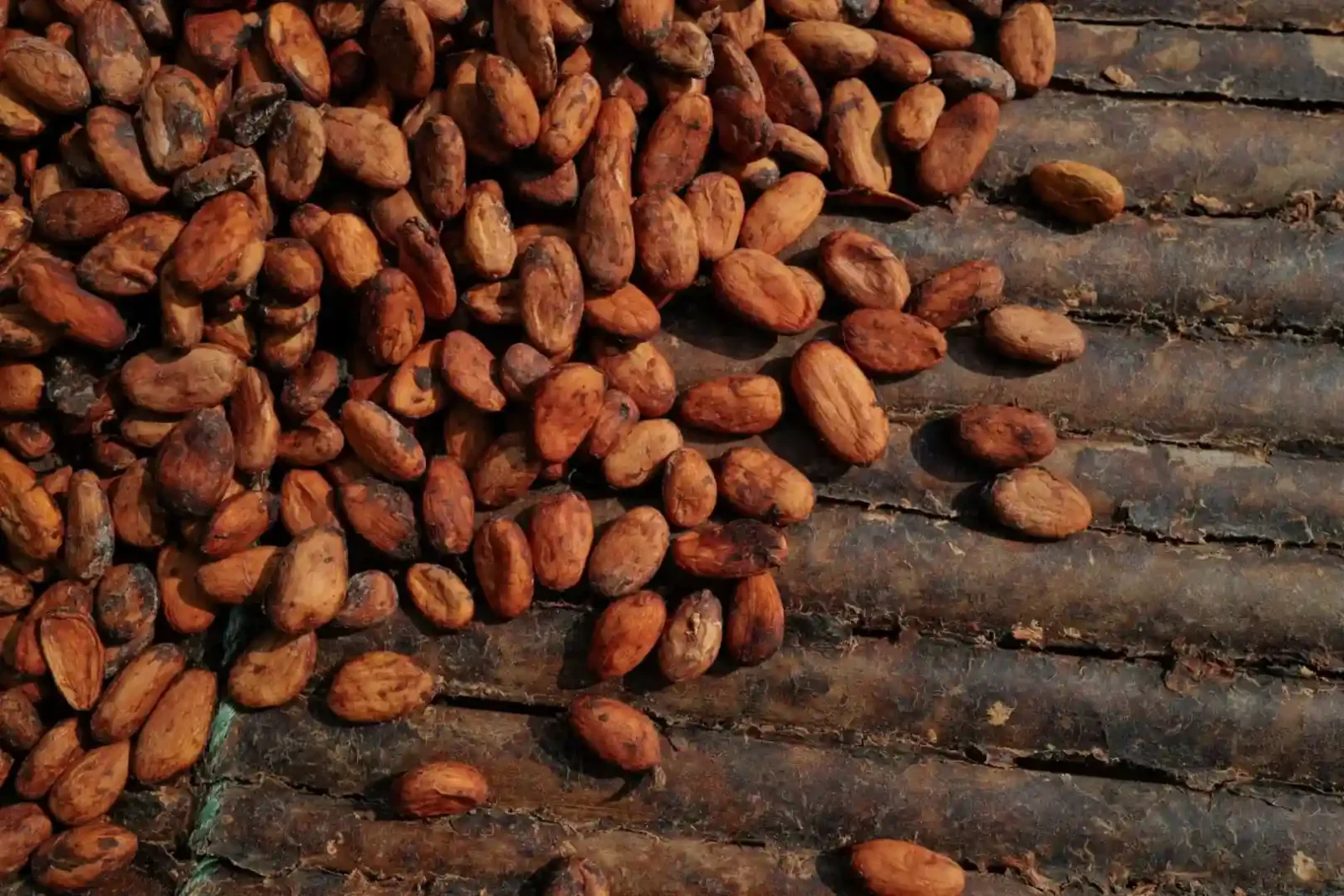
Ghana’s cocoa harvest could fall sharply in the 2026/27 season as adverse weather, ageing trees, crop disease and unusual pollination problems deepen longstanding structural pressures in one of the world’s most important cocoa-producing countries.
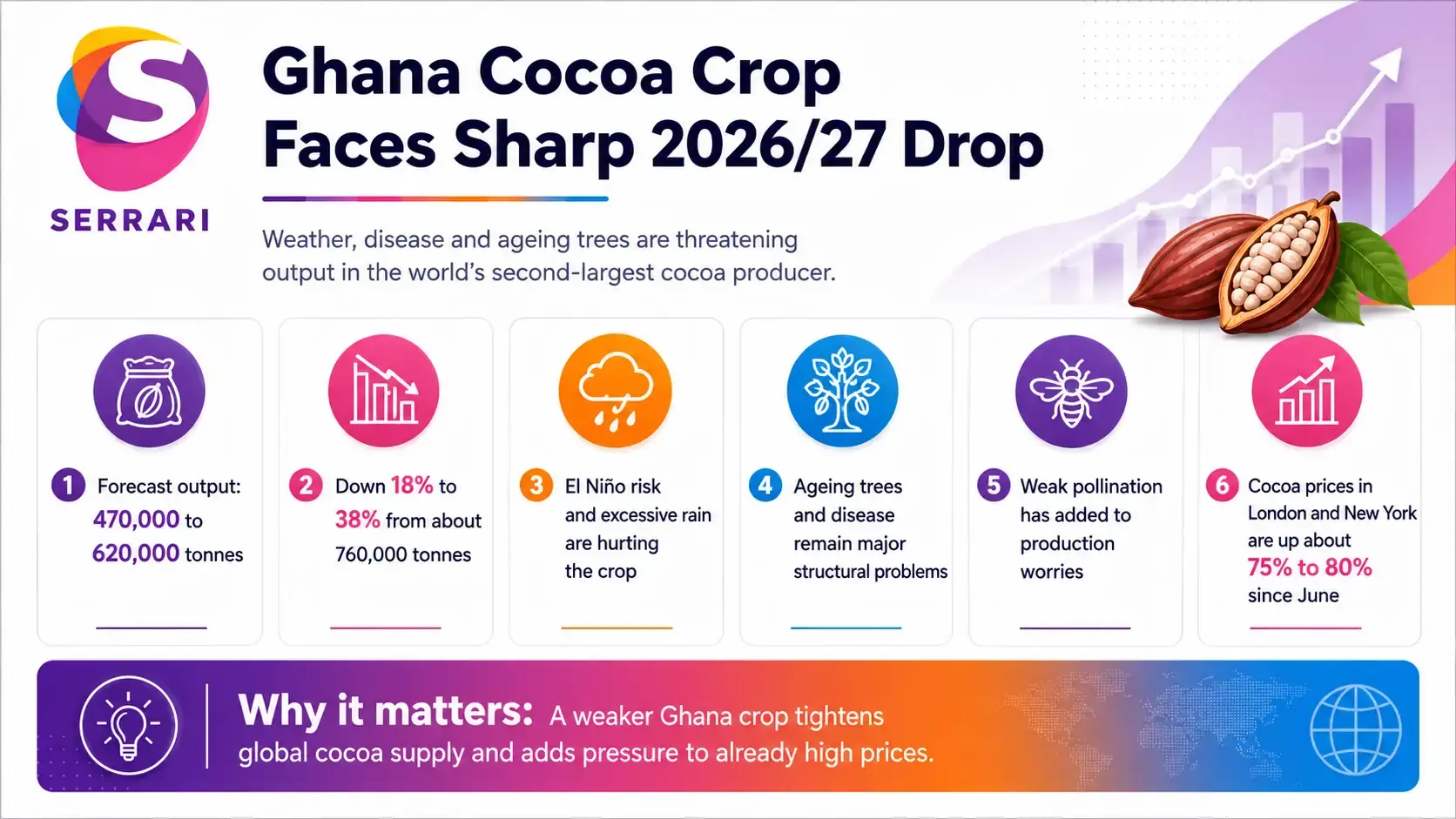
The latest production forecast from the state-run Cocoa Marketing Company puts output at 470,000 to 620,000 metric tonnes, compared with around 760,000 tonnes in the preceding season. That translates into a potential decline of roughly 18% to 38%, depending on where production falls within the forecast range.
The warning comes as cocoa prices in London and New York have risen sharply since June, reflecting growing concerns that tighter West African supplies could reduce the global market surplus.
Key Overview
- Ghana’s 2026/27 cocoa output is forecast at 470,000-620,000 tonnes.
- The estimate implies an 18%-38% decline from roughly 760,000 tonnes previously.
- Ageing trees, disease and unusually weak pollination are among the structural problems affecting production.
- COCOBOD separately warned in July that production could decline by at least 16%.
- Excessive rainfall in May and June and the risk of El Niño conditions are adding to crop uncertainty.
- Western and Western North, which together account for more than half of Ghana’s production, have recorded weak development of young cocoa pods.
- London and New York cocoa prices have risen about 75%-80% since June amid tightening supply expectations.
Ghana’s Production Outlook Deteriorates
The latest forecast is more severe than the outlook Ghana’s cocoa regulator provided earlier in the year. In July, COCOBOD projected a decline of at least 16% in the 2026/27 crop, citing weather conditions, disease and the cocoa tree’s natural production cycle.
The newer 470,000-to-620,000-tonne range indicates that risks to the harvest may be considerably greater at the lower end.
Cocoa Marketing Company Managing Director Wisdom Kofi Dogbey said ageing trees and persistent diseases remain structural problems. He also highlighted an unusual deterioration in pollination, saying the industry had not experienced similar conditions for around two decades.
Weak pollination directly threatens the number of flowers that develop successfully into cocoa pods, adding another challenge to farms already affected by diseases and weather disruptions.
Weather and Disease Hit Key Growing Regions
Weather conditions have added another layer of uncertainty. COCOBOD has pointed to excessive rainfall during May and June as well as the possibility of El Niño conditions affecting the crop.
The regulator also reported a low cherelle load, referring to the number of young cocoa pods that survive and continue developing toward maturity, in Ghana’s Western and Western North regions.
Those areas are particularly important because they produce more than half of Ghana’s cocoa. Lower pod survival there can therefore have a substantial effect on national output.
Farm productivity is simultaneously being damaged by cocoa swollen shoot virus disease, ageing farms and illegal gold mining, known locally as galamsey, which has resulted in the loss or degradation of some cocoa-growing land.
There is also a biological factor. Cocoa trees naturally tend to alternate between stronger and weaker bearing periods, meaning an adverse production cycle can amplify the effects of disease and difficult weather.
Context is everything. Stay ahead of shifting trends with today’s market updates, and uncover emerging opportunities using the Serrari Group Market Index and Marketplace. Then, take control of your own financial future by exploring our Money & Life Reset Transformation Blueprint ™ to build stronger habits, create better systems, and design a path toward lasting wealth.
Ghana Moves to Protect Future Cocoa Supply
Authorities are attempting to limit the decline through a combination of farm rehabilitation and agricultural support.
Measures include rehabilitating disease-affected farms in Western North, expanding insecticide and fungicide spraying and reintroducing free nationwide fertiliser distribution for the 2026/27 season.
Longer term, however, Ghana faces the more difficult challenge of replacing ageing trees and ensuring farmers have sufficient financial incentives to rehabilitate and replant their farms.
Dogbey has argued that farmer income should increasingly be treated as a supply-security issue. At the September cocoa conference in Singapore, he called for a fairer distribution of value across the cocoa supply chain, arguing that production cannot be rebuilt sustainably if farmers lack the income required to invest in their farms.
Global Cocoa Supply Risks Are Rising
Ghana’s weaker outlook matters well beyond its borders because West Africa remains the centre of global cocoa production.
Cocoa futures in London and New York have climbed roughly 75%-80% since June, with traders increasingly concerned about a shrinking global surplus and possible weather disruption across West Africa.
Supply risks are also not confined to Ghana. Neighbouring Côte d’Ivoire, the world’s largest cocoa producer, is expected to experience weaker production in the coming season, increasing the possibility that simultaneous declines in the region could tighten global availability.
For chocolate manufacturers and processors, another weak Ghanaian crop could therefore increase pressure on procurement costs and reinforce volatility in international cocoa markets.
For Ghana, the problem is more fundamental. Restoring output will require more than favourable weather in a single season. Rehabilitating diseased farms, replacing ageing trees, improving farmer incomes and protecting cocoa land will determine whether the country can rebuild production toward its historical potential.
Sources: Reuters / Ghana Cocoa Board / Ghana News Agency / Cocoa Marketing Company Ghana
Your financial future isn’t something you wait for—it’s something you build.
The real question is: when do you begin?
Move beyond simply staying informed.
Navigate the markets with clarity—track trends through the Serrari Group Market Index, uncover opportunities in the Serrari Marketplace, and build practical knowledge with our Curated Wealth Builder Platform.
Stay connected to what truly matters.
Get daily insights on macro trends and financial movements across Kenya, Africa, and global markets—delivered through the Serrari Newsletter.
Growth opens doors.
Advance your career through professional programs including ACCA, HESI A2, ATI TEAS 7 , HESI EXIT , NCLEX – RN and NCLEX – PN, Financial Literacy!🌟—designed to move you forward with confidence.
See where money is flowing—clearly and in real time.
Track Money Market Funds, Treasury Bills, Treasury Bonds, Green Bonds, and Fixed Deposits, alongside global and African indexes, key economic indicators, and the evolving Crypto and stablecoin landscape—all within Serrari’s Market Index.