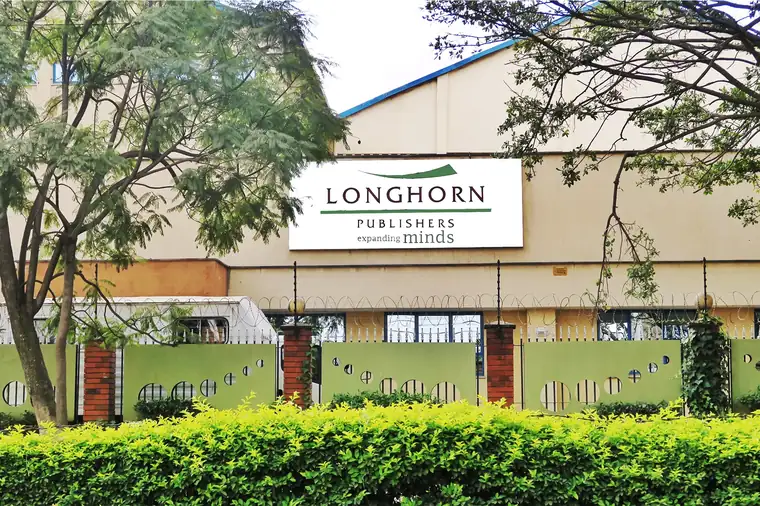
Kenya’s listed textbook publisher Longhorn Publishers has reported its largest annual loss since joining the Nairobi Securities Exchange (NSE) in 2012, pushing shareholders’ equity into negative territory after years of mounting losses and costly adjustments to the country’s education curriculum.
LIVENSE market summarySee NSE data →The company recorded a KSh949.67 million net loss for the financial year ended June 30, 2026, compared with KSh261.44 million a year earlier. The deterioration left shareholders’ equity at negative KSh1.03 billion, reflecting a balance sheet in which liabilities now substantially exceed assets.
The losses were driven largely by impairments on educational content developed for the outgoing 8-4-4 curriculum and the reversal of previously recognised deferred tax assets. However, Longhorn’s difficulties extend beyond accounting adjustments, with elevated borrowing, weakening cash generation and delayed institutional procurement exposing deeper financial pressures.
Despite these challenges, revenue increased 20.7% to KSh811 million, suggesting that demand for the company’s educational products is recovering even as its financial position deteriorates. The central question is whether improved sales and newly developed Competency-Based Curriculum (CBC) materials can generate sufficient cash and sustainable profits to restore the publisher’s financial stability.
Key Overview
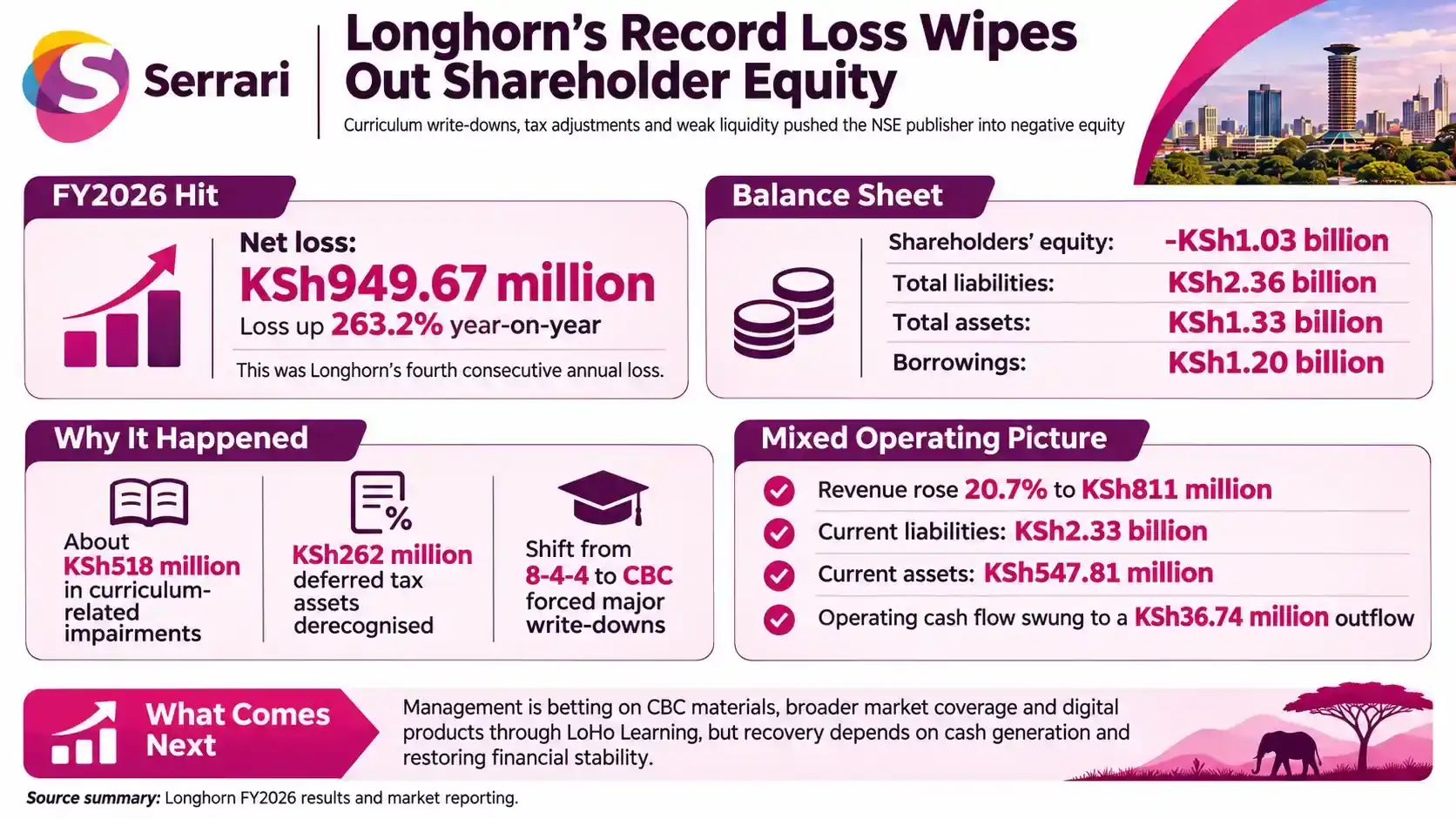
- Record annual loss: Longhorn’s net loss widened 263.2% to KSh949.67 million in FY2026, compared with KSh261.44 million in FY2025.
- Negative shareholders’ equity: Total equity deteriorated from positive KSh18.11 million to negative KSh1.03 billion, with liabilities of KSh2.36 billion exceeding assets of KSh1.33 billion.
- Fourth consecutive annual loss: Longhorn has accumulated approximately KSh2.02 billion in annual net losses since FY2023, reflecting sustained pressure on profitability.
- Curriculum-related impairments: The company reported approximately KSh518 million in impairment charges associated with curriculum changes, alongside the derecognition of KSh262 million in deferred tax assets.
- Revenue recovery: Turnover rose 20.7% to KSh811 million, supported by expanded market coverage and improved sales, although this was insufficient to prevent a record loss.
- Debt and liquidity concerns: Borrowings reached KSh1.20 billion, while current liabilities of KSh2.33 billion substantially exceeded current assets of KSh547.81 million.
- Cash flow deterioration: Operating cash flow reversed from a KSh337.27 million inflow to a KSh36.74 million outflow, with year-end cash equivalents declining to KSh4.18 million.
- Recovery strategy: Management is pursuing CBC-aligned publishing, digital learning through LoHo Learning, broader market coverage and improved operating efficiency to rebuild profitability.
Longhorn’s Fourth Consecutive Loss Wipes Out Shareholders’ Capital
Longhorn Publishers’ financial deterioration reached a significant milestone in the year ended June 2026, when accumulated losses pushed the company’s shareholders’ equity below zero for the first time since its 2012 stock market listing.
According to its audited FY2026 financial results, the publisher recorded a net loss of KSh949.67 million, representing a 263.2% increase from the KSh261.44 million loss reported in FY2025.
The latest results extend Longhorn’s run of annual losses to four consecutive financial years, with cumulative losses of approximately KSh2.02 billion since FY2023.
The company last reported an annual profit in FY2022, when earnings reached approximately KSh39.92 million, significantly below its historical peak of KSh185.13 million in FY2019.
The sustained deterioration has progressively eroded the capital accumulated during earlier profitable years. By June 2025, Longhorn’s shareholders’ equity had already fallen to KSh18.11 million, leaving little financial buffer against further losses.
The FY2026 deterioration eliminated that remaining buffer and pushed total equity to negative KSh1.03 billion.
This means Longhorn’s reported assets of KSh1.33 billion are now insufficient to cover its KSh2.36 billion in liabilities, creating a substantial deficit in the company’s accounting net worth.
Negative shareholders’ equity does not automatically mean that a company is insolvent or unable to continue operating. However, it indicates that accumulated losses and other equity movements have eroded the book value attributable to shareholders.
For Longhorn, the development is particularly significant because the company operates in an industry where investments in educational content, inventory and distribution must often be made before sales revenue is realised.
The deterioration also increases pressure on management to rebuild profitability, strengthen liquidity and maintain creditor and shareholder confidence.
Why Kenya’s Curriculum Transition Triggered Heavy Losses
The largest immediate driver of Longhorn’s FY2026 loss was the financial cost of transitioning from Kenya’s outgoing 8-4-4 education system to the Competency-Based Curriculum.
Educational publishing requires substantial upfront investment in content development, editing, illustration, curriculum approval, printing and distribution.
Publishers generally expect to recover those investments through textbook sales over several academic years.
However, changes in education policy can significantly shorten the commercial life of previously developed materials.
As Kenya completes its transition to the CBC system, textbooks designed for the outgoing curriculum face declining demand, forcing publishers to reassess their remaining commercial value.
Longhorn’s financial statement disclosures identify approximately KSh518 million in impairment losses related to curriculum changes.
Of this amount, KSh460.29 million was recognised within cost of sales, while the total impairment figure also reflects other curriculum-related charges.
These impairments represent reductions in the carrying value of assets whose expected future economic benefits have declined.
In practical terms, Longhorn previously invested capital in developing or holding educational materials that are now expected to generate less revenue than originally anticipated.
Group Managing Director Simon Ngigi explained that the approval of Grade 12 CBC textbooks had prompted provisions against remaining investments in books developed for the outgoing 8-4-4 system.
Some of these materials may still be sold during the remaining transition period, potentially allowing the company to recover part of their value.
However, the larger issue is that earlier curriculum investments have lost their commercial usefulness more rapidly than initially expected.
Longhorn has invested heavily in the transition. Between 2018 and 2025, the publisher reportedly committed more than KSh714 million to CBC content development, alongside earlier inventory, debtor and development-cost write-downs.
This creates a double financial burden: the company must absorb losses associated with outdated educational materials while continuing to fund the development and distribution of new curriculum-aligned products.
The transition therefore represents more than a temporary disruption to textbook sales.
It has fundamentally changed the economics of Longhorn’s publishing portfolio, with the company required to replace revenue-generating intellectual property while managing the financial consequences of earlier investments.
The broader implication is that curriculum reform carries significant financial consequences for private-sector suppliers, especially publishers whose assets derive much of their value from their alignment with government-approved learning materials.
Deferred Tax Adjustments Deepen the Financial Damage
Beyond the curriculum-related impairments, Longhorn derecognised approximately KSh262 million in previously recognised deferred tax assets.
Deferred tax assets can arise when a company expects to use eligible tax losses or temporary differences to reduce future taxable profits.
Their recognition depends on expectations that sufficient taxable profits will become available to utilise those benefits.
When those expectations weaken, accounting standards require companies to reassess whether the assets remain recoverable.
Longhorn’s decision to derecognise the tax assets therefore reflects reduced confidence in the future taxable profits available to support those balances.
Although the adjustment does not necessarily represent an immediate cash payment, it increases the reported tax expense and reduces the company’s accounting net assets.
The combination of approximately KSh518 million in curriculum-related impairments and KSh262 million in deferred tax adjustments had a substantial impact on FY2026 results.
Together, these charges total approximately KSh780 million, equivalent to about 82% of the reported net loss.
However, investors should not interpret this as evidence that the company would otherwise have been financially healthy.
The adjustments are significant accounting charges, but they exist alongside borrowing costs, operating expenses and weak liquidity that continue to influence Longhorn’s underlying financial position.
Their significance is also different. Curriculum impairments largely reflect the reduced value of past investments, while deferred tax derecognition reflects a reassessment of future taxable profitability.
Both developments point to the same underlying challenge: the expected financial returns on earlier investments have weakened.
Revenue Growth Fails to Offset the Record Loss
One of the more striking features of Longhorn’s FY2026 results is that revenue increased substantially even as the company recorded its largest annual loss.
Turnover rose 20.7% to KSh811 million from KSh672.09 million in FY2025, reflecting improved sales and expanded market coverage.
Management attributed the improvement to stronger customer reach and sales performance despite challenging operating conditions.
However, the reported revenue growth was insufficient to offset the impact of curriculum impairments and other expenses.
Cost of sales increased 75.4% to KSh913.84 million, exceeding total revenue and producing a gross loss of KSh102.84 million.
A closer examination reveals a more nuanced picture.
Excluding impairments recognised within cost of sales, Longhorn generated gross profit of KSh357.45 million, compared with KSh288.63 million a year earlier.
That represents growth of approximately 23.8%, suggesting some improvement in the underlying profitability of products sold.
Management also reported an adjusted operating profit of KSh16 million, reversing an adjusted operating loss of KSh20 million in FY2025.
These figures indicate that the company’s commercial operations may be recovering, even though the overall financial statements remain heavily affected by historical investment write-downs.
Nevertheless, the distinction between adjusted profitability and reported earnings is important.
Adjusted operating profit excludes specified charges and does not eliminate financing costs, working-capital requirements or the need to restore the company’s balance sheet.
Longhorn’s finance costs alone reached KSh182.23 million during FY2026, substantially exceeding its reported adjusted operating profit.
Consequently, stronger sales must eventually translate into meaningful operating cash flow and earnings after financing costs if the company is to achieve a sustainable recovery.
There is also a longer-term revenue challenge.
Despite the improvement in FY2026, the company’s turnover remains considerably below the approximately KSh1.74 billion in revenue and other income reported in FY2022.
This indicates that the latest sales recovery has not yet restored Longhorn to its previous scale.
Context is everything. Stay ahead of shifting trends with today’s market updates, and uncover emerging opportunities using the Serrari Group Market Index and Marketplace. Then, take control of your own financial future by exploring our Money & Life Reset Transformation Blueprint ™ to build stronger habits, create better systems, and design a path toward lasting wealth.
Why the Second Half of FY2026 Was Particularly Difficult
Longhorn’s annual results present a sharp contrast with the improved performance reported during the first six months of the financial year.
In its interim financial statements covering the period to December 31, 2025, revenue and other income increased 88% to KSh524.18 million.
The company also narrowed its interim net loss to KSh11 million from KSh148.61 million a year earlier.
Management had pointed to expanded market coverage, higher government orders and improved gross margins as evidence of an operating recovery.
However, full-year results subsequently revealed a much larger deterioration.
Comparing the interim and annual net losses indicates that approximately KSh938.68 million of the FY2026 net loss was recognised in the second half of the financial year.
The substantial difference reflects the impact of charges recorded during the remainder of the year, particularly those associated with curriculum-related impairments and deferred tax adjustments.
This distinction matters because investors assessing the publisher’s future performance must separate the effects of exceptional accounting adjustments from trends in its continuing operations.
The interim recovery demonstrated that Longhorn was capable of generating higher sales and improving its operating performance.
However, the full-year results exposed how vulnerable its financial statements remained to the reduced value of historical investments and the pressures associated with completing the curriculum transition.
LIVENSE market summarySee NSE data →The results also reinforce the importance of evaluating corporate performance across a full reporting cycle rather than relying exclusively on interim growth figures.
Borrowings and Weak Cash Flow Increase Financial Pressure
While curriculum-related charges explain much of the reported net loss, Longhorn’s financing position presents a separate and potentially more immediate challenge.
At June 30, 2026, total borrowings reached KSh1.20 billion, approximately 18.2% higher than the previous year’s combined borrowing balance.
The financial statements also show that all reported borrowings were classified as current liabilities, compared with the previous year when part of the borrowing balance was classified as non-current.
This concentration increases the importance of refinancing arrangements, repayment schedules and continued lender support.
Longhorn’s current liabilities stood at KSh2.33 billion, compared with current assets of KSh547.81 million.
That represents a working-capital deficit of approximately KSh1.78 billion.
The company’s current ratio was approximately 0.24, meaning it held about 24 cents in current assets for every shilling of current liabilities.
Such a position does not automatically establish that the company will default on its obligations, because repayment arrangements and access to financing also matter.
However, it indicates substantial dependence on creditor support, refinancing and future cash generation.
Cash-flow performance provides another warning signal.
Operating activities consumed KSh36.74 million during FY2026, reversing the KSh337.27 million inflow recorded in FY2025.
Meanwhile, cash and cash equivalents declined to KSh4.18 million at the end of June 2026.
The balance sheet separately reported KSh15.83 million in cash and bank balances, illustrating the importance of distinguishing the reported cash balance from cash equivalents presented in the cash-flow statement.
For a company carrying more than KSh1 billion in borrowings, these liquidity figures leave limited room for unexpected financing pressures.
Trade receivables also increased substantially, from KSh195.64 million to KSh348.89 million.
Although higher receivables may partly reflect improved sales, they also mean more capital is tied up in amounts owed by customers.
The combination of higher receivables, weak operating cash flow and substantial current liabilities makes timely customer collections especially important.
Longhorn has previously disclosed shareholder financial support arrangements, including a KSh200 million facility and a financial support commitment from Centum Investment Company.
However, the latest condensed results do not establish the current status or availability of those arrangements.
The immediate financial challenge is therefore not simply returning to accounting profitability but ensuring the business can meet its obligations while financing continued operations.
Can CBC Publishing and Digital Learning Restore Growth?
Longhorn’s management expects its investment in curriculum-aligned educational materials to support renewed sales growth as the transition to CBC progresses.
The completion of major curriculum revisions could reduce the need for further expenditure on replacing outdated materials and allow the publisher to focus more heavily on recovering development costs through new sales.
However, the ability to generate sustained returns will depend on several factors, including textbook approvals, institutional procurement, school funding and distribution efficiency.
Government-linked education spending remains particularly important.
The company has identified delays in institutional procurement and constrained funding among the challenges affecting its operating environment.
Such delays can weaken sales predictability and extend the period between investment in educational materials and receipt of payment.
Longhorn is also attempting to diversify beyond conventional printed textbooks.
Its digital learning initiative, LoHo Learning, forms part of a broader strategy to expand educational content delivery and develop additional revenue opportunities.
According to the company’s FY2026 outlook, management intends to expand curriculum-aligned intellectual property, improve gross margins, strengthen subsidiary performance and generate more cash from operations.
Digital learning offers an opportunity to reach customers through additional channels and potentially build more repeatable revenue streams.
However, developing digital products also requires investment in technology, distribution, content updates and customer acquisition.
The company must therefore demonstrate that diversification can produce attractive financial returns without placing further strain on its already weakened liquidity position.
The effectiveness of the recovery strategy will ultimately be measured by whether Longhorn can translate improved sales into consistent operating cash inflows, reduce financing pressure and rebuild positive shareholders’ equity.
What Negative Equity Means for Longhorn Shareholders
Longhorn’s transition into negative equity has significant implications for existing shareholders and prospective investors.
Shareholders’ equity represents the residual accounting interest in a company’s assets after deducting liabilities.
When this figure becomes negative, liabilities exceed recognised assets, meaning there is no positive residual book value attributable to shareholders.
However, negative equity does not automatically make a company’s shares worthless.
Market valuations may still reflect expectations of future earnings, brand value, intellectual property, restructuring opportunities and the potential recovery of the business.
The distinction is particularly relevant for companies experiencing major write-downs, where the reduction in recognised asset values may not directly correspond to the immediate cash position.
Nevertheless, the financial risk faced by shareholders increases when negative equity is accompanied by significant borrowings and weak operating cash flows.
Any future restructuring could involve asset sales, debt renegotiations, shareholder funding or the issuance of additional shares.
If new equity capital is raised, existing shareholders could face dilution depending on the structure and terms of the transaction.
Longhorn’s financial position also limits its flexibility to reward shareholders through dividends while it focuses on rebuilding profitability and liquidity.
The erosion of shareholders’ capital highlights how sustained losses can progressively undermine a company’s balance sheet even when it retains an established brand and operating business.
For investors, the most important indicators in subsequent reporting periods will include the sustainability of revenue growth, the recovery of gross margins, financing arrangements, operating cash flow and any further impairments.
A return to accounting profitability would be an important first step, but a full financial recovery would require more than a single profitable reporting period.
The Bigger Picture: Curriculum Reform Exposes Publishers’ Financial Risks
Longhorn’s financial difficulties highlight the risks facing education publishers operating in markets where curriculum policy determines the commercial life of a significant proportion of their products.
Unlike many consumer goods, textbooks are closely tied to official syllabus requirements, making demand sensitive to curriculum approvals and government procurement decisions.
When an education system undergoes a major structural transition, publishers may be required to develop entirely new products while simultaneously writing down existing inventories and intellectual property.
These pressures can be particularly difficult for companies with substantial debt or limited financial reserves.
Longhorn’s experience also demonstrates why higher revenue does not necessarily signal financial recovery.
Although FY2026 turnover increased, historical investment losses, financing costs and weak cash generation continued to undermine the company’s overall financial position.
The broader lesson extends beyond educational publishing to businesses whose revenues depend heavily on regulatory frameworks, public procurement or policy-driven product standards.
A major policy transition can create new commercial opportunities while simultaneously reducing the value of investments made under the previous system.
For Longhorn, the CBC transition is expected to generate future demand for revised learning materials, but the company must first overcome the financial damage associated with the transition.
The publisher’s challenge is therefore both operational and financial: rebuilding a competitive product portfolio while strengthening a balance sheet that has already absorbed four consecutive years of losses.
Conclusion
Longhorn Publishers’ record KSh949.67 million annual loss marks a turning point for the NSE-listed company, with shareholders’ equity falling to negative KSh1.03 billion after years of declining profitability.
The financial deterioration illustrates the substantial cost of adapting educational publishing operations to Kenya’s changing curriculum, but the company’s challenges cannot be attributed entirely to exceptional accounting charges.
Elevated debt, limited cash resources, weak operating cash flow and continued dependence on institutional procurement have left Longhorn with significant financial constraints.
The 20.7% increase in revenue offers evidence that sales performance is improving, while management’s adjusted operating results suggest that parts of the underlying business may be recovering.
However, higher sales alone will not be sufficient to restore financial stability.
The company’s recovery will depend on its ability to convert CBC investments into sustainable earnings, improve cash collection, manage borrowing obligations and strengthen liquidity.
For shareholders, the next phase will determine whether the latest impairments represent the final major financial cost of the curriculum transition or whether deeper structural weaknesses continue to undermine the publisher’s recovery.
Longhorn’s future will ultimately be shaped not by how quickly it grows revenue, but by whether that growth generates sufficient cash and profits to rebuild the shareholders’ capital erased by four consecutive years of losses.
Sources: Longhorn Publishers / Business Daily Africa / African Financials / ApexHub Insights
Your financial future isn’t something you wait for—it’s something you build.
The real question is: when do you begin?
Move beyond simply staying informed.
Navigate the markets with clarity—track trends through the Serrari Group Market Index, uncover opportunities in the Serrari Marketplace, and build practical knowledge with our Curated Wealth Builder Platform.
Stay connected to what truly matters.
Get daily insights on macro trends and financial movements across Kenya, Africa, and global markets—delivered through the Serrari Newsletter.
Growth opens doors.
Advance your career through professional programs including ACCA, HESI A2, ATI TEAS 7 , HESI EXIT , NCLEX – RN and NCLEX – PN, Financial Literacy!🌟—designed to move you forward with confidence.
See where money is flowing—clearly and in real time.
Track Money Market Funds, Treasury Bills, Treasury Bonds, Green Bonds, and Fixed Deposits, alongside global and African indexes, key economic indicators, and the evolving Crypto and stablecoin landscape—all within Serrari’s Market Index.