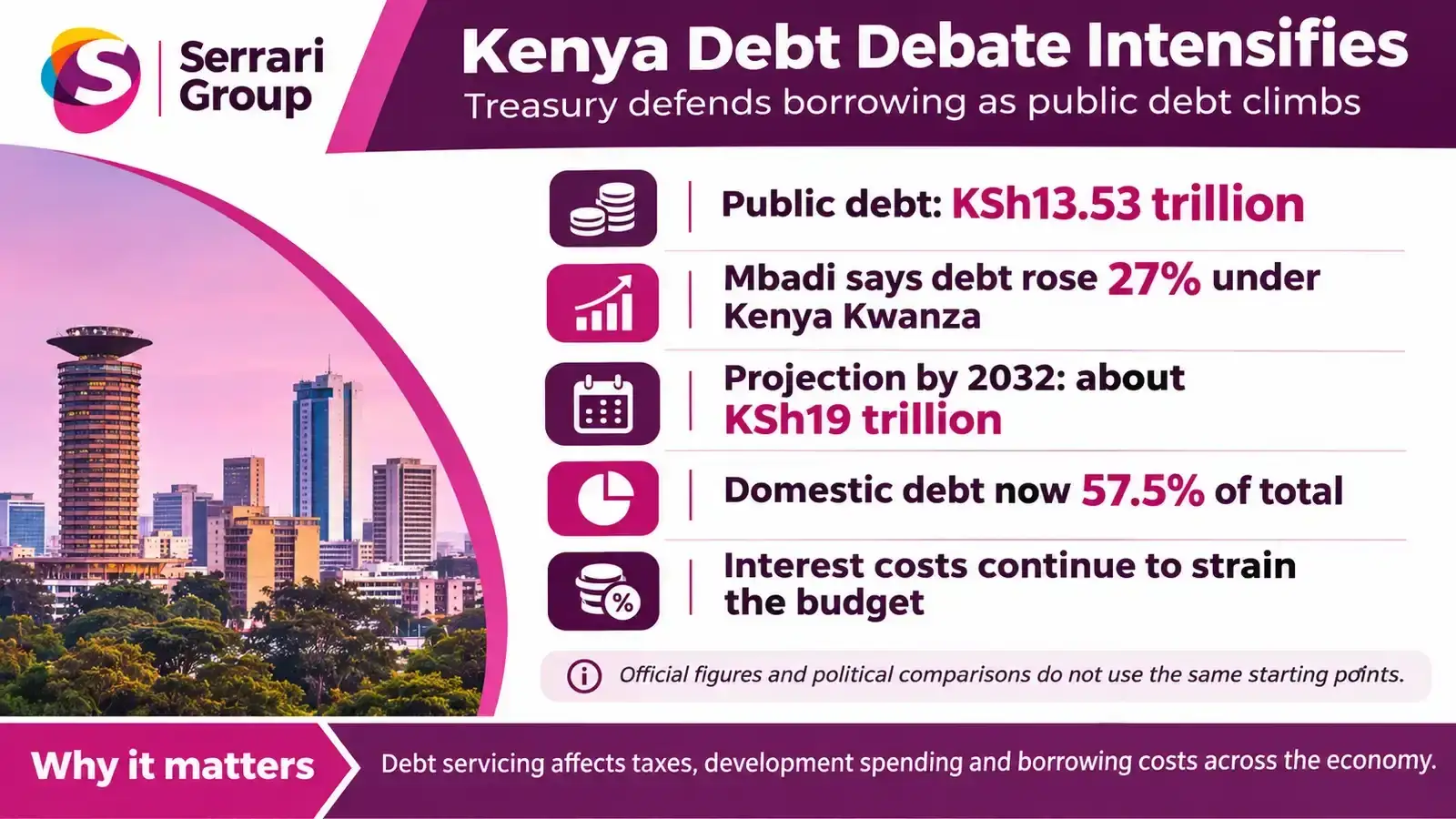
Treasury Cabinet Secretary John Mbadi has defended the Kenya Kwanza administration’s borrowing record, arguing that public debt is expanding more slowly than under previous governments. However, official September 2026 figures place Kenya’s public debt at KSh13.53 trillion, while historical records raise questions about the baseline used in the Treasury’s comparison. With interest payments consuming approximately one-third of government revenue and domestic borrowing becoming increasingly important, the debate extends beyond how much successive governments borrowed to whether Kenya can finance its obligations without undermining public services, private investment and economic growth.
LIVEKenya bond yields: Average yield 11.99% across 58 bonds · 24 NovSee yields →Key Overview
- Kenya’s public debt reached KSh13.53 trillion in September 2026, equivalent to 72.7% of GDP in nominal terms.
- Mbadi projected that public debt could reach KSh19 trillion by 2032, while defending the administration’s borrowing record.
- Official historical figures place public debt at approximately KSh8.70 trillion in September 2022.
- Domestic borrowing accounts for 57.5% of outstanding public debt, reflecting growing reliance on local capital markets.
- Official September data puts the US dollar share of external debt at 54.5%, differing from the 38% cited in Mbadi’s remarks.
- Interest payments absorb approximately one-third of government revenue, limiting resources available for development and essential services.
Treasury’s Borrowing Defence Raises Questions Over Historical Comparisons
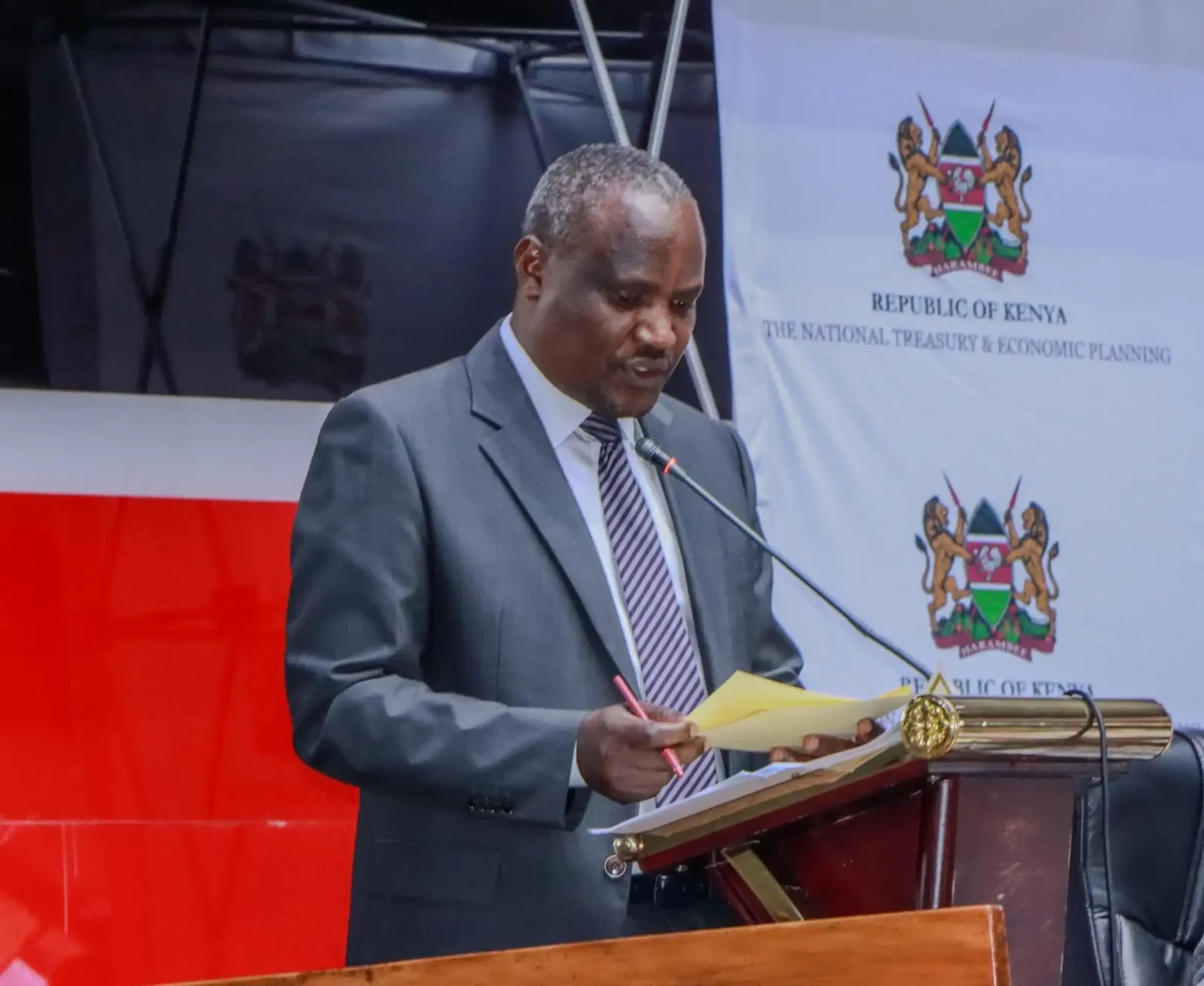
National Treasury Cabinet Secretary John Mbadi on November 24 defended the government’s borrowing performance, presenting the growth of public debt as comparatively moderate when measured against previous administrations.
Speaking during a stakeholder workshop, Mbadi projected public debt could reach KSh19 trillion by 2032, while maintaining that the current administration had increased borrowing by only 27%.
His argument comes at a time when the government faces the difficult task of financing its development commitments, meeting existing debt obligations and raising sufficient revenue without imposing excessive pressure on households and businesses.
However, the figures require careful interpretation. Mbadi used KSh10.3 trillion as his reference point, incorporating planned borrowing associated with the first budget under President William Ruto. An increase from that baseline to KSh13.4 trillion would mathematically represent approximately 30.1%, rather than 27%.
More importantly, planned borrowing should not be treated as equivalent to outstanding debt. The historical public debt series places the September 2022 stock at approximately KSh8.70 trillion, providing a more consistent starting point for assessing changes during the current administration.
Against that benchmark, the September 2026 debt stock of KSh13.53 trillion represents an increase of approximately KSh4.83 trillion, or 55.5%.
This does not mean that every shilling of the increase represents fresh borrowing initiated by the current government. Exchange-rate movements, inherited loan agreements, disbursements and repayments all influence outstanding debt balances.
Nevertheless, the distinction matters because using different definitions of debt at the beginning and end of a comparison can materially alter the apparent borrowing record.
Comparisons between administrations must also account for differences in their length of tenure, inflation, economic size and inherited financial obligations. A government starting with a larger debt stock can record a smaller percentage increase while adding substantially more debt in absolute terms.
Why Kenya Continues to Borrow Despite Fiscal Consolidation
The expansion of public debt reflects a persistent mismatch between government revenue and expenditure. Even when authorities introduce measures intended to reduce borrowing, outstanding debt can continue growing if annual budgets remain in deficit.
Kenya’s November 2025 economic assessment found that the fiscal deficit reached 5.9% of GDP in the 2024/25 financial year, exceeding an earlier revised target of 4.3% as revenue underperformance and rigid expenditure commitments complicated consolidation efforts.
These pressures explain why reducing borrowing is more difficult than announcing expenditure cuts or introducing new revenue measures.
Government salaries, pensions, interest payments and other contractual obligations cannot easily be reduced within a single financial year. Meanwhile, cutting investment in infrastructure or public services may weaken economic activity and compromise future revenue generation.
The government also needs to refinance maturing obligations. Refinancing does not necessarily increase outstanding debt if new borrowing replaces principal that is repaid, but it exposes the Treasury to changes in interest rates and investor appetite.
Consequently, Kenya faces two related challenges: reducing the amount of new financing needed to cover budget deficits and managing the cost of servicing debt accumulated over previous years.
Domestic Borrowing Reduces Currency Risk but Creates New Pressures
According to the September 2026 public debt bulletin, domestic liabilities amounted to KSh7.78 trillion, while external obligations stood at KSh5.75 trillion. Local borrowing therefore represented 57.5% of total public debt.
Greater reliance on shilling-denominated financing can reduce exposure to exchange-rate fluctuations. When the shilling weakens, the domestic currency value of foreign-denominated liabilities increases even without additional borrowing.
However, domestic borrowing replaces some currency risk with interest-rate and refinancing risks. If the government needs to raise substantial amounts from local investors, it may have to offer higher yields to attract sufficient demand.
Commercial banks, pension schemes, insurance companies and other institutional investors can benefit from government securities through predictable interest income. Nevertheless, excessive reliance on sovereign securities can concentrate financial institutions’ exposure to the government’s fiscal position.
It can also affect businesses seeking financing. When government securities offer attractive risk-adjusted returns, lenders may have less incentive to extend credit to businesses facing uncertain cash flows or requiring extensive credit assessment.
This crowding-out effect is not automatic: its magnitude depends on banking-sector liquidity, monetary policy, demand for private credit and the government’s borrowing requirements. Nonetheless, sustained domestic borrowing can complicate efforts to expand affordable business financing.
The Treasury must therefore balance the benefits of reduced foreign currency exposure against the need to preserve a competitive domestic credit market.
Context is everything. Stay ahead of shifting trends with today’s market updates, and uncover emerging opportunities using the Serrari Group Market Index and Marketplace. Then, take control of your own financial future by exploring our Money & Life Reset Transformation Blueprint ™ to build stronger habits, create better systems, and design a path toward lasting wealth.
The Dollar Exposure Remains Significant
Although Mbadi cited a 38% dollar share of external liabilities, the September debt bulletin identifies US dollar-denominated obligations as 54.5% of external debt. The basis of the lower figure remains unclear, making it inappropriate to treat it as directly comparable with the published debt composition.
LIVEKenya bond yields: Average yield 11.99% across 58 bonds · 24 NovSee yields →Using the official September balances, dollar-denominated external liabilities were equivalent to approximately KSh3.13 trillion. A hypothetical 10% depreciation of the shilling against the dollar would increase their shilling value by roughly KSh313 billion, holding all other factors constant.
That illustration is not a forecast of additional borrowing or annual repayments. It demonstrates how currency movements can change the reported debt stock and the domestic cost of meeting foreign currency obligations.
Maintaining adequate foreign exchange reserves, supporting exports and attracting stable foreign currency inflows remain important complements to the Treasury’s debt management strategy.
Why Loan Commitments and Disbursements Must Be Distinguished
Mbadi also disputed reports of KSh233 billion in borrowing between May and August, saying KSh95.7 billion had been disbursed.
The distinction is financially important. Signing a financing agreement establishes access to funds subject to contractual conditions, but the entire approved amount does not necessarily enter the outstanding loan balance immediately.
Development financing may be released in stages as projects progress or agreed policy conditions are met. Consequently, the value of newly signed agreements can exceed actual cash received during a reporting period.
Nevertheless, undisbursed commitments remain relevant to fiscal planning because they can generate future repayment obligations once funds are drawn. Some agreements may also involve commitment charges before full disbursement.
Transparent reporting should therefore distinguish approved financing, signed commitments, actual disbursements, principal repayments and outstanding balances. Without that distinction, public debate can confuse gross borrowing activity with changes in the government’s net financial position.
What KSh19 Trillion Would Mean for Taxpayers by 2032
Mbadi’s projection of KSh19 trillion implies approximately KSh5.47 trillion in additional outstanding debt relative to September 2026, equivalent to an increase of around 40.4%.
Over a six-year illustrative period, this would translate into annual compound debt growth of approximately 5.8%. Whether that trajectory is sustainable depends largely on the pace of nominal economic growth, revenue mobilisation and the effective interest rate on public liabilities.
Using the Treasury’s September 2026 GDP estimate of KSh18.63 trillion, Kenya would need nominal GDP of approximately KSh26.14 trillion for KSh19 trillion in debt to represent the same 72.7% debt-to-GDP ratio recorded in September.
Even maintaining that ratio would not necessarily improve affordability. According to the November 2026 economic update, interest costs already consume around one-third of government revenue, reducing the resources available for public investment and essential services.
For households, persistent fiscal pressure can translate into additional taxation, delayed improvements in public infrastructure or tighter expenditure allocations. For businesses, it can mean uncertainty over future tax policy, delayed settlement of government invoices and potentially more expensive credit.
These outcomes are risks rather than inevitable consequences. Stronger revenue collection through improved compliance, better expenditure management and productive investment could ease the adjustment without relying exclusively on higher tax rates.
Debt Sustainability Matters More Than Political Comparisons
Kenya’s fiscal challenge is ultimately not determined by which administration recorded the largest percentage increase in debt. It is determined by whether borrowed resources generate economic and social benefits sufficient to justify their financing costs.
The public finance reform proposals published in May 2025 illustrate how stronger fiscal management, governance reforms and structural changes could bring Kenya’s debt-to-GDP ratio down to around 44% by 2035 under a reform scenario.
Achieving a more sustainable trajectory would require consistent budget execution, credible revenue forecasts, disciplined project selection and improved accountability for public expenditure.
Borrowing can support economic development when it finances infrastructure, education and other investments that improve productivity. Its benefits diminish when financing costs absorb an increasing share of revenue without corresponding improvements in economic output or public services.
The decisive test of the government’s borrowing strategy will therefore be whether it can expand the economy, improve revenue capacity and reduce the burden of debt servicing while protecting the livelihoods of Kenyan households and the growth prospects of businesses.
Sources Used
Citizen Digital / National Treasury / Central Bank of Kenya / World Bank
Your financial future isn’t something you wait for—it’s something you build.
The real question is: when do you begin?
Move beyond simply staying informed.
Navigate the markets with clarity—track trends through the Serrari Group Market Index, uncover opportunities in the Serrari Marketplace, and build practical knowledge with our Curated Wealth Builder Platform.
Stay connected to what truly matters.
Get daily insights on macro trends and financial movements across Kenya, Africa, and global markets—delivered through the Serrari Newsletter.
Growth opens doors.
Advance your career through professional programs including ACCA, HESI A2, ATI TEAS 7 , HESI EXIT , NCLEX – RN and NCLEX – PN, Financial Literacy!🌟—designed to move you forward with confidence.
See where money is flowing—clearly and in real time.
Track Money Market Funds, Treasury Bills, Treasury Bonds, Green Bonds, and Fixed Deposits, alongside global and African indexes, key economic indicators, and the evolving Crypto and stablecoin landscape—all within Serrari’s Market Index.