Stanbic Bank Kenya reported KSh 10.32 billion in profit after tax for the nine months ended September 30, 2026, approximately 10% above the KSh 9.38 billion earned a year earlier. The earnings improvement came from expanding credit, stronger deposit mobilisation and lower loan-loss charges, rather than from wider lending margins. Net interest income rose even as the net interest margin contracted, while weaker foreign-exchange income weighed on non-interest revenue. The results illustrate how Kenyan banks are adapting to a lower interest-rate environment: they need more productive loans, reliable deposits and better credit quality to protect returns. For borrowers, depositors and shareholders, the central question is whether this growth can continue without pushing risk, funding costs or operating expenses higher.
Key Overview
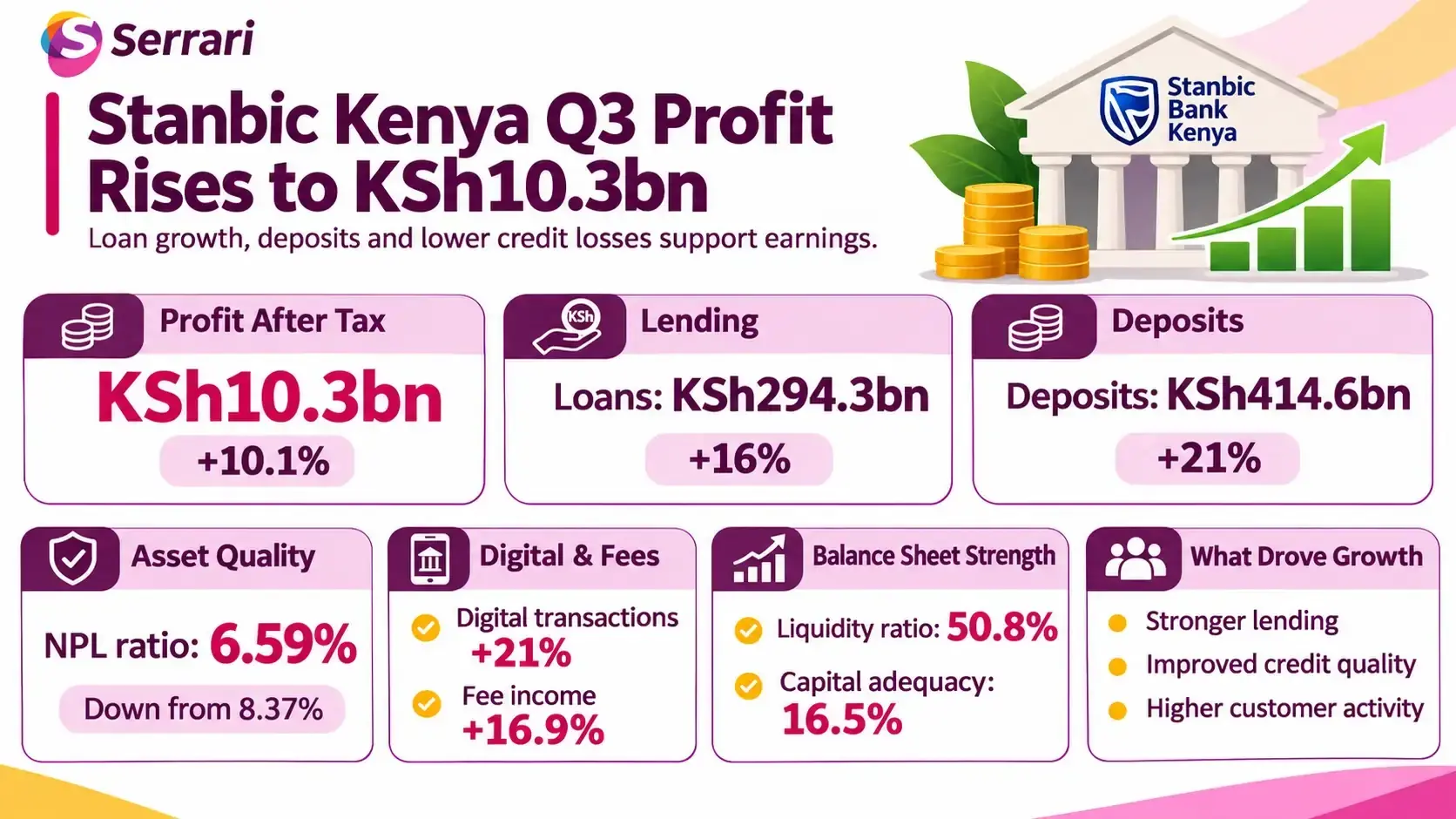
- Profit: Nine-month after-tax earnings reached KSh 10.32 billion, up approximately 10% from KSh 9.38 billion in September 2025.
- Revenue: Operating income increased 7.1% to KSh 30.32 billion, led by net interest income of KSh 22.99 billion.
- Loan growth: Net customer loans climbed 16.2% year on year to KSh 294.27 billion, while deposits rose 20.6% to KSh 414.62 billion.
- Asset quality: Loan-loss provisions fell 32.8% to KSh 1.68 billion, helping cushion earnings against pressure on margins.
- Competing pressures: Non-interest income declined 6.2%, including an 8.1% fall in foreign-exchange trading income.
- Resilience: The bank reported a 50.8% liquidity ratio and 16.5% total capital ratio, above statutory minimums of 20% and 14.5%, respectively.
Why Stanbic’s Profit Rose Despite Lower Lending Margins
Stanbic’s result is fundamentally a story about volumes offsetting thinner margins. Its unaudited September 2026 financial statements show net interest income rising from KSh 20.51 billion to KSh 22.99 billion. Yet the bank’s reported net interest margin narrowed from 5.79% to 4.79%. That means growth in the underlying lending and earning-asset base was central to generating more interest profit even as the return earned on each unit of interest-bearing assets came under pressure.
The figures explain the apparent contradiction. Net loans and advances grew from KSh 253.14 billion in September 2025 to KSh 294.27 billion a year later, an increase of about KSh 41.13 billion. Total assets expanded from KSh 476.21 billion to KSh 565.22 billion. A larger balance sheet can produce more absolute interest income without improving the lending spread, provided the additional assets are profitable and funded efficiently.
This matters because interest-rate reductions can help stimulate credit demand while compressing margins on loans that reprice downward. In October, policymakers held the Central Bank Rate at 8.75%, observing that lower commercial lending rates had supported a recovery in private-sector credit growth. For Stanbic, that backdrop created an opportunity to expand lending but also increased the need to manage funding costs carefully.
The bank’s KSh 35.52 billion in total interest income represented growth from KSh 32.13 billion a year earlier. Interest expense, however, also rose from KSh 11.63 billion to KSh 12.53 billion. The relevant performance measure is therefore not headline interest earned alone, but what remains after paying customers and other providers of funding.
Deposit Growth Creates Capacity, but Funding Is Not Free
Customer deposits increased by approximately KSh 70.77 billion over twelve months to KSh 414.62 billion, faster than the growth in the loan book. That is important because customer deposits provide a foundation for financing new credit without relying exclusively on wholesale borrowing or more volatile funding markets. The ratio of net customer loans to deposits stood at roughly 71% at September’s end, compared with about 74% one year earlier.
A lower loan-to-deposit ratio can signal additional room to lend, but it does not mean that all deposits can immediately be converted into new loans. Banks must meet liquidity requirements, maintain appropriate reserves and account for deposit withdrawals, currency composition and the maturity of funding. Stanbic’s reported liquidity ratio of 50.8% was well above the 20% regulatory requirement, although it had fallen from 57.0% in June. That quarterly movement is worth monitoring alongside continued business expansion.
Deposits also carry a cost. Customers expect competitive returns on savings and fixed-term accounts, and the bank faces pressure from rival institutions and alternative investment products. A deposit franchise becomes particularly valuable when it can attract stable, reasonably priced balances while providing useful payments and transaction services. This is one reason Stanbic’s increased digital engagement matters beyond technology branding: frequent transactions may deepen relationships and encourage customers to retain operational balances.
For depositors, strong liquidity and capital ratios offer useful information about a bank’s financial position, but they should not be confused with guarantees that every deposit has unlimited protection. For businesses seeking financing, sustained deposit growth can support credit availability, subject to the bank’s risk assessments and pricing.
Falling Credit Losses Were a Major Earnings Support
A less visible but crucial part of the profit increase was the decline in the cost of bad debts. Loan-loss provisions fell from KSh 2.50 billion to KSh 1.68 billion, a reduction of approximately KSh 821 million. That saving accounted for a meaningful part of the year-on-year improvement in pre-tax profit. Without the reduction, earnings growth would have faced more resistance from operating expenses and weaker non-interest revenue.
The bank’s gross non-performing loans declined from KSh 22.76 billion to KSh 20.56 billion, even as its loan book expanded. Its reported non-performing-loan ratio consequently improved to 6.59% from 8.37%. The ratio is below the Kenyan banking industry’s 13.9% recorded in September, as discussed in the October monetary-policy review. These comparisons suggest stronger relative asset quality, although the structure of loan portfolios differs between lenders.
Better loan performance can release resources that would otherwise be absorbed by provisions, allowing more revenue to reach the profit line. But impairment charges are not a permanent source of growth. Once problem loans have improved and provisions normalise, the bank must rely increasingly on interest income, fees and cost control. A rapid expansion in lending can also create future credit problems if underwriting weakens or borrowers encounter economic shocks. Consequently, the quality of new loans matters as much as their growth rate.
Context is everything. Stay ahead of shifting trends with today’s market updates, and uncover emerging opportunities using the Serrari Group Market Index and Marketplace. Then, take control of your own financial future by exploring our Money & Life Reset Transformation Blueprint ™ to build stronger habits, create better systems, and design a path toward lasting wealth.
Digital Fees Improve While Forex Revenue Weakens
Stanbic’s income mix was uneven. Fees and commissions increased as digital transactions reportedly grew 21%, with 75% of customers digitally active over a 90-day period. Other fees and commissions rose from KSh 3.45 billion to KSh 4.05 billion, while aggregate fee and commission income, including loan-related charges, reached approximately KSh 4.15 billion.
These gains matter because transaction and service fees can diversify earnings away from the interest margin. Digital services can also reduce the cost of routine transactions as customer numbers and usage increase, although investments in technology, cyber resilience, staffing and compliance have upfront and continuing expenses. Increased digital adoption does not automatically mean that each additional transaction has become more profitable.
At the same time, foreign-exchange trading income declined from KSh 3.13 billion to KSh 2.88 billion, or about 8.1%, despite reported foreign-exchange volume growth of 37%. This points to reduced earnings per unit traded, consistent with tighter pricing or a changing transaction mix. Other income also fell, contributing to a 6.2% drop in overall non-interest revenue to KSh 7.33 billion.
The consequence is that transaction growth alone cannot be the test of success. Investors need to see whether higher volumes translate into sustainable earnings after competitive spreads and operating costs. Customers may benefit from tighter foreign-exchange pricing, but the bank must replace the resulting margin pressure with scale, service revenues or greater efficiency.
Operating Costs and Capital Set the Next Test
The bank’s underlying operating costs excluding loan-loss provisions increased during the period, with staff expenses and other overheads contributing to the rise. On the reported management measure, operating costs reached around KSh 14.1 billion and the cost-to-income ratio stood at 46.59%, better than the 48.6% reported at the end of June. Nonetheless, expenses grew faster than total income year on year, signalling limited room for complacency.
Stanbic’s capital position remains an important buffer. Its total capital-to-risk-weighted-assets ratio stood at 16.5%, versus the statutory 14.5% minimum. That provides a two-percentage-point cushion, but the ratio was below the 17.9% recorded a year earlier. Risk-weighted assets increased as the bank grew, showing why expansion requires continued discipline in capital management. A bank can generate rising profits yet consume regulatory capital more quickly if its assets grow faster than its capital resources.
Stanbic has also highlighted financing for trade, fuel imports, affordable housing, solar energy and climate-smart agriculture. Those activities connect its balance-sheet growth with real-economy needs, although reported financing volumes should not be mistaken for additional revenue or profit. The eventual economic benefit depends on productive deployment of credit, loan repayment and whether financing reaches businesses and households on sustainable terms.
What the Results Mean for Kenya’s Banking Sector
Stanbic’s performance reflects a broader transition in Kenyan banking. During periods of high interest rates, strong lending spreads can support income even without rapid loan growth. As borrowing costs ease, banks increasingly need to earn returns through more lending activity, good deposit relationships, efficient payment services and disciplined credit assessment. The recovery in private-sector credit growth gives lenders an opportunity to expand, but also exposes them to new risks if economic conditions change.
For households and businesses, the encouraging signal is that a large lender expanded credit while recording fewer impaired loans. That suggests additional room for financing investment and consumption, though individual borrowers still face affordability and approval constraints. For shareholders, the critical issue is earnings quality: how much future growth comes from recurring income rather than further declines in provisions, and whether capital remains sufficient as lending expands.
The nine-month results therefore offer a qualified positive picture. Stanbic has shown that stronger volumes and improving credit quality can overcome pressure on lending spreads. The next challenge is to maintain that combination without allowing operating costs, credit losses or capital requirements to catch up. That is why the bank’s third-quarter performance matters now: it is an early test of whether Kenya’s banks can turn an easing-rate environment into durable, productive growth rather than merely larger loan books.
Sources: Stanbic Bank Kenya / Central Bank of Kenya / Bizna Kenya / Business Daily Africa / Reuters / Kenya News Agency
Your financial future isn’t something you wait for—it’s something you build.
The real question is: when do you begin?
Move beyond simply staying informed.
Navigate the markets with clarity—track trends through the Serrari Group Market Index, uncover opportunities in the Serrari Marketplace, and build practical knowledge with our Curated Wealth Builder Platform.
Stay connected to what truly matters.
Get daily insights on macro trends and financial movements across Kenya, Africa, and global markets—delivered through the Serrari Newsletter.
Growth opens doors.
Advance your career through professional programs including ACCA, HESI A2, ATI TEAS 7 , HESI EXIT , NCLEX – RN and NCLEX – PN, Financial Literacy!🌟—designed to move you forward with confidence.
See where money is flowing—clearly and in real time.
Track Money Market Funds, Treasury Bills, Treasury Bonds, Green Bonds, and Fixed Deposits, alongside global and African indexes, key economic indicators, and the evolving Crypto and stablecoin landscape—all within Serrari’s Market Index.