
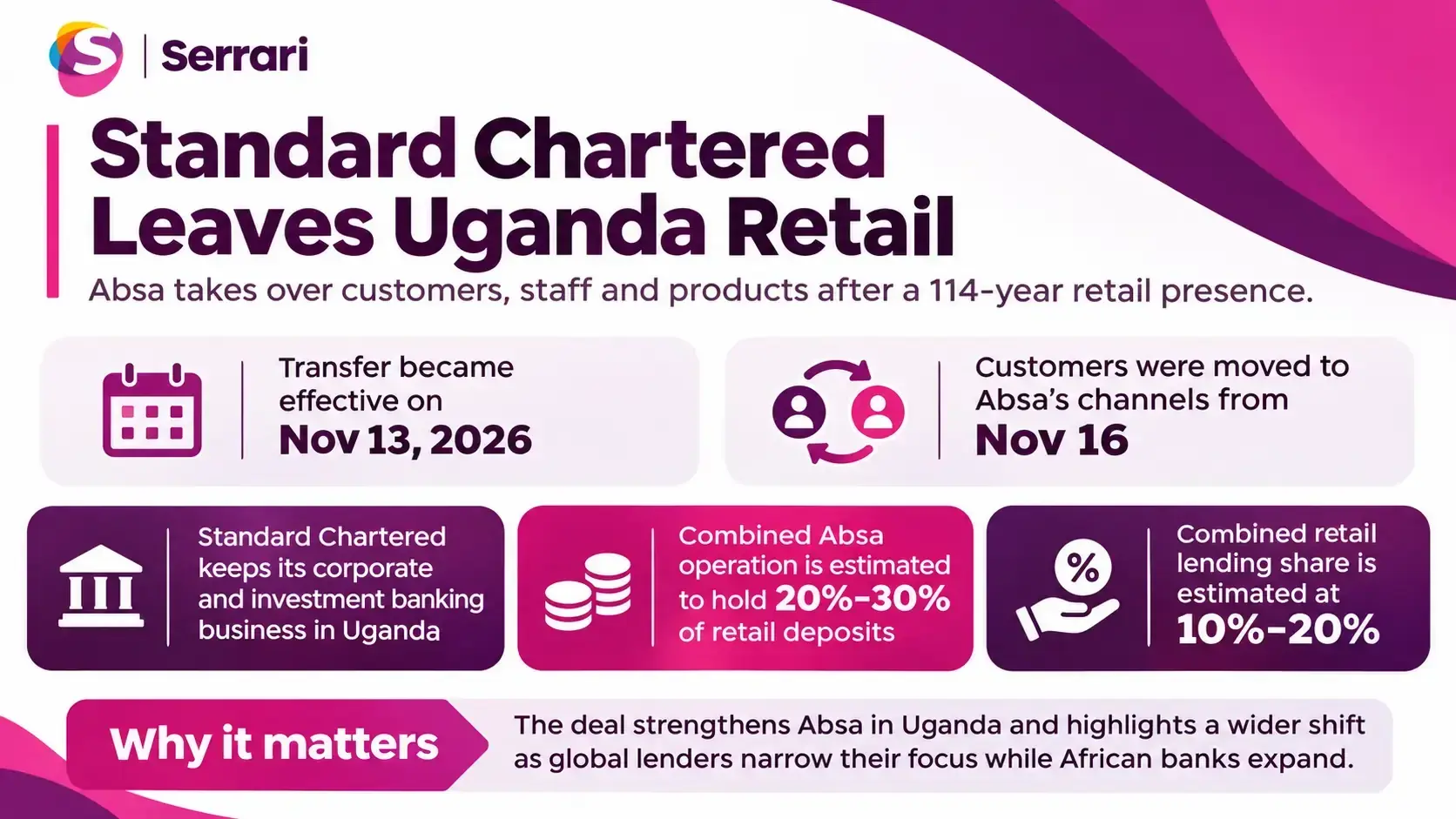
Standard Chartered has completed the transfer of its wealth and retail banking business in Uganda to Absa Bank Uganda, ending its direct provision of personal banking services after 114 years in the country. The sale became effective on November 13, 2026, and affected customers were scheduled to use Absa’s banking channels from November 16 after a weekend migration. The decision does not amount to a complete Ugandan exit: Standard Chartered retains its corporate and investment banking franchise. For Absa, the transaction offers an established customer base, deposits, lending relationships and wealth expertise. For customers and regulators, the question is whether a larger retail competitor can preserve service continuity while sustaining choice in a market where its combined deposit share is estimated at 20%–30%.
Key Overview
- Transfer completed: The sale took effect on November 13, 2026, with account migration scheduled for November 13–15 and access through Absa from November 16.
- 114-year transition: Standard Chartered began operating in Uganda in 1912 but will continue to serve corporate, institutional and cross-border clients.
- Customer and staff movement: The acquired operation includes personal and wealth banking customers, products and employees supporting those services.
- Competitive position: Regional competition authorities estimated the combined Absa operation would hold 20%–30% of retail deposits and 10%–20% of retail lending.
- Approval timeline: An agreement was signed in October 2025, followed by central bank approval in June 2026 and regional competition clearance.
- Undisclosed price: The banks have not publicly specified the purchase consideration or the final value of transferred deposits and loans.
Why Standard Chartered Is Leaving Uganda’s Retail Market
Standard Chartered’s decision is primarily a strategic allocation of capital, not a declaration that Uganda no longer matters to the group. In its November 2024 strategic review, the London-headquartered bank identified wealth and retail operations in Uganda, Botswana and Zambia as potential disposals. It said the objective was to direct more resources toward businesses where its international network offered a stronger competitive advantage and opportunities for improved returns.
Operating a domestic retail bank requires investment in branches, digital systems, cards, compliance, consumer credit, servicing and customer acquisition. Those costs must be supported by sufficient scale and sustainable income. An international banking group can conclude that a smaller country’s retail portfolio is less attractive than using the same resources to serve multinational companies, trade flows or wealthy clients through larger regional hubs. That is a strategic judgment about relative returns rather than evidence that the sold business was failing.
The bank has not abandoned its Ugandan relationships altogether. Its retained corporate and investment banking operation will continue serving businesses, financial institutions and cross-border clients. The completed-transfer announcement makes that distinction explicit. For Ugandan companies needing trade finance, international payments, capital-market expertise or institutional lending, the bank’s global network remains relevant.
The change is therefore best described as a narrowing of its business model. After establishing a presence in Uganda in 1912, Standard Chartered has ended one prominent chapter of that history while preserving another that fits its global strategy.
Why Absa Wanted an Established Retail and Wealth Franchise
For Absa, the appeal is almost the reverse. It already operates consumer banking infrastructure in Uganda and wants a larger share of the country’s personal and wealth-management market. Purchasing an existing portfolio can bring customer relationships, deposits, loans, mortgages, cards and experienced employees much faster than attracting each relationship individually.
When the banks signed the acquisition agreement on October 24, 2025, Absa framed it as part of its pan-African expansion and a way to strengthen its retail and wealth offerings. Acquiring customers who already use savings, borrowing and investment products may create opportunities to provide additional services through Absa’s existing network.
But the commercial benefit is not automatic. Deposits carry funding costs, loans carry credit risk, and migrating customers entails integration expenses. Wealth relationships are especially dependent on trust and continuity. If customers encounter problems accessing accounts or believe product terms have worsened, some may move to competitors. Retaining the transferred business, rather than merely booking it on completion day, will determine how much lasting value Absa captures.
The consideration paid remains undisclosed. Without the price, the acquired portfolio’s financial size and future earnings disclosures, it is premature to quantify the investment’s return or describe the deal as cheap or expensive for Absa.
What Changes for Customers and Employees
The legal transfer took effect on November 13, while the customer migration timetable covered November 13–15. Former Standard Chartered retail and wealth customers were expected to access their accounts, products and services through Absa’s platforms and channels beginning November 16. Staff who supported the transferred business also joined Absa to help preserve client knowledge and continuity.
For customers, ownership is less important than functionality. Salaries and incoming transfers must reach the right accounts; standing instructions, loan repayments, cards and online access must work; and customers need clear information about any account identifiers or channels that have changed. Borrowers should verify their repayment instructions and retain records of existing loan terms, while depositors and investors should check product notices and applicable conditions rather than assume every feature is identical.
Both lenders committed to supporting clients through the transition. Absa’s regulatory-approval update emphasized continuity and communication, and the banks described coordinated arrangements for accounts, cards and digital access. Those assurances matter most during the first weeks after migration, when operational faults could affect households and small businesses even if the wider acquisition is financially sound.
For employees, transferring with the business offers continuity of expertise and client relationships. It does not, by itself, establish that every role, responsibility or employment condition will remain unchanged indefinitely; such outcomes depend on subsequent integration decisions and applicable protections.
Context is everything. Stay ahead of shifting trends with today’s market updates, and uncover emerging opportunities using the Serrari Group Market Index and Marketplace. Then, take control of your own financial future by exploring our Money & Life Reset Transformation Blueprint ™ to build stronger habits, create better systems, and design a path toward lasting wealth.
Why Competition Regulators Allowed a Larger Absa
The merger creates a more significant player in Ugandan personal banking. The regional competition authority’s published merger decision estimated that Absa and the acquired business together would account for 20%–30% of retail deposits and 10%–20% of retail lending. These are ranges for the combined business, not the market share contributed by Standard Chartered alone.
The same assessment concluded that rivals would continue holding substantial shares and that the transaction was unlikely to make the relevant markets uncompetitive. The official case register records approval without conditions. Uganda’s central bank had separately approved the acquisition in June, ahead of completion in November.
Approval does not mean there is no competition risk. Larger banks may benefit from greater operating scale, a broader product range and stronger distribution. Customers could benefit if those efficiencies translate into better service, technology or pricing. Yet a larger institution also has more bargaining power, and concentration can matter in particular customer segments even when the national market remains competitive.
The practical test will be whether Absa’s growth stimulates rivals such as Stanbic and Centenary to compete harder for deposits, credit and affluent customers, and whether customers retain meaningful alternatives. Monitoring pricing, customer complaints, lending access and service quality will matter more than simply observing the market-share percentages.
A Regional Shift From Global Banks to African Operators
The Ugandan transaction illustrates a wider reshaping of banking ownership rather than an across-the-board retreat of international finance. Standard Chartered’s restructuring plan was designed to concentrate resources in selected affluent and cross-border businesses. Absa, by contrast, views domestic banking relationships in African markets as central to its expansion.
This creates an opportunity for regional groups to buy franchises that global banks no longer consider essential. They can combine acquired relationships with established local networks and, potentially, spread technology and compliance costs across a larger customer base. The sellers can release management attention and capital for segments they believe will produce higher returns.
For Uganda’s banking sector, the implications extend beyond ownership. A locally established regional operator may be more motivated to develop mass-market and affluent banking services, while a specialist international bank continues supporting trade and large institutional transactions. Those roles can coexist and serve different financing needs.
Nevertheless, banking consolidation is not a substitute for financial inclusion. Expanding an existing customer book may improve scale without necessarily reaching households or businesses outside the formal banking system. Meaningful progress would require more affordable products, reliable digital access, wider credit availability and stronger consumer protection.
What Matters After the November Handover
The sale is complete, but its economic outcome remains to be proven. For Standard Chartered, success means retaining a competitive corporate and investment banking business in Uganda while deploying resources more productively across its international network. For Absa, success means converting the acquired customer relationships and products into durable deposits, responsible lending and profitable wealth management without damaging service quality.
For customers, the immediate priorities are uninterrupted access, accurate account migration and clarity on contractual terms. For regulators, the longer-term issues are competition, conduct and operational resilience. The deal’s undisclosed price also leaves investors unable to calculate the financial return until more information emerges.
After 114 years, Standard Chartered’s exit from personal banking is historically notable, but the bigger story is a division of roles in African finance: international lenders are becoming more selective about where they compete for retail customers, while regional banks are using acquisitions to deepen their presence. Whether this shift benefits Ugandans will be judged less by the handover ceremony than by the cost, reliability and accessibility of the banking services that follow.
Sources: Standard Chartered / Absa Group / Absa Bank Uganda / COMESA Competition and Consumer Commission / Uganda Broadcasting Corporation / ChimpReports / Maudhui House
Your financial future isn’t something you wait for—it’s something you build.
The real question is: when do you begin?
Move beyond simply staying informed.
Navigate the markets with clarity—track trends through the Serrari Group Market Index, uncover opportunities in the Serrari Marketplace, and build practical knowledge with our Curated Wealth Builder Platform.
Stay connected to what truly matters.
Get daily insights on macro trends and financial movements across Kenya, Africa, and global markets—delivered through the Serrari Newsletter.
Growth opens doors.
Advance your career through professional programs including ACCA, HESI A2, ATI TEAS 7 , HESI EXIT , NCLEX – RN and NCLEX – PN, Financial Literacy!🌟—designed to move you forward with confidence.
See where money is flowing—clearly and in real time.
Track Money Market Funds, Treasury Bills, Treasury Bonds, Green Bonds, and Fixed Deposits, alongside global and African indexes, key economic indicators, and the evolving Crypto and stablecoin landscape—all within Serrari’s Market Index.