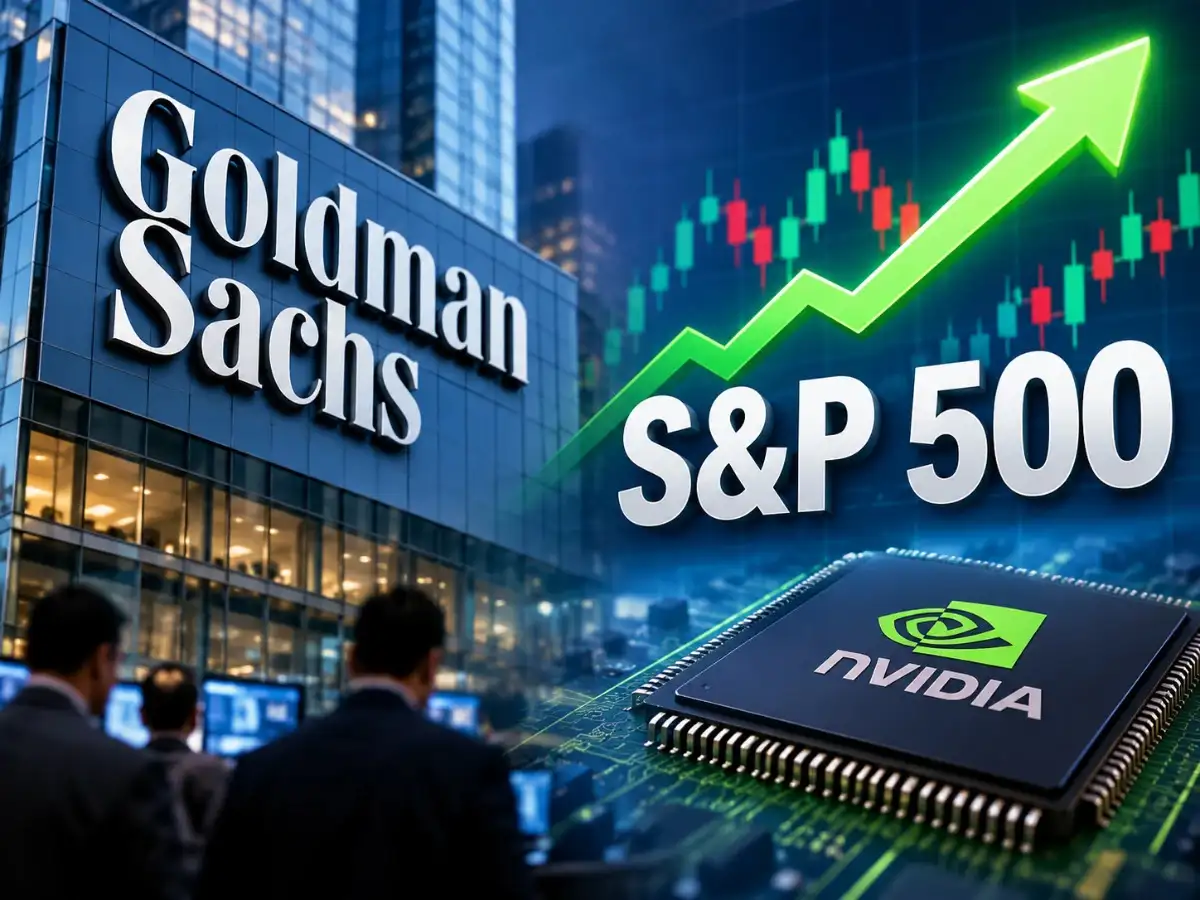
Goldman Sachs expects the S&P 500 to reach 8,700 over the next 12 months, implying roughly 14% price upside from the level cited in its November outlook, even as the extraordinary earnings boost from artificial intelligence investment begins to fade. The bank’s argument is not that technology spending will suddenly stop, but that a sharp market selloff has lowered valuations enough for profits to support further gains at more modest growth rates. Its optimism contrasts with continued caution from other strategists as investors weigh expensive borrowing, energy prices and the risk that returns from AI infrastructure arrive later than expected.
Key Overview
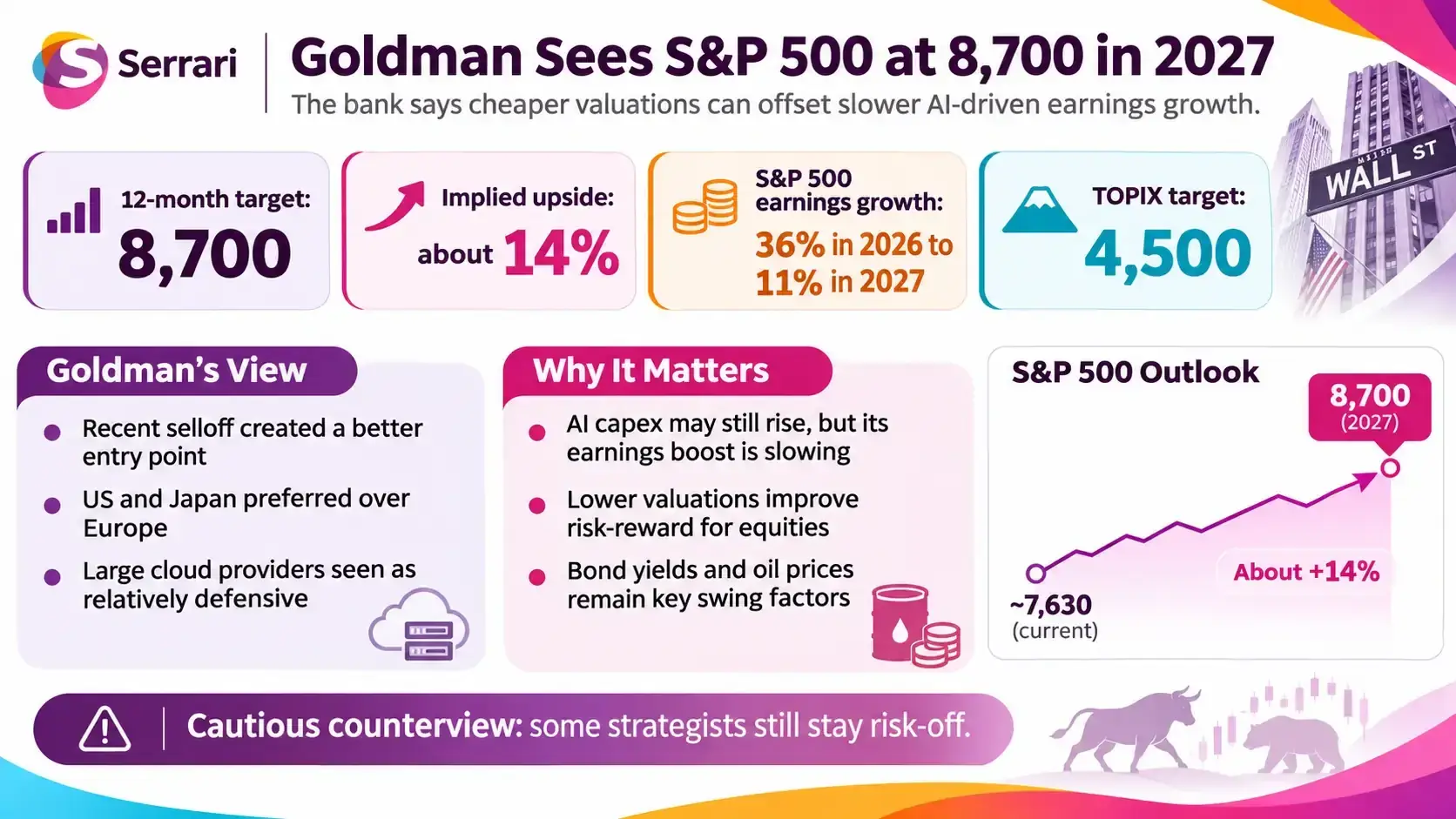
- US target: Goldman Sachs projects the S&P 500 at 8,700 over 12 months, about 14% above a recent November close, excluding dividends.
- Earnings slowdown: Its global equity outlook sees US earnings growth cooling to around 11% in 2027 from an estimated 36% in 2026.
- Valuation reset: The benchmark’s forward earnings multiple was reported near 18.5 times in a November market snapshot, down from above 23 times previously.
- AI turning point: Hyperscaler spending can keep increasing in dollars while contributing less to the growth of corporate profits, especially as depreciation rises.
- Regional choices: Goldman is overweight US and Japanese equities, neutral on Asia and emerging markets, and underweight Europe.
- Competing view: Bank of America’s Michael Hartnett wants lower oil prices, Treasury yields below 4.5% and a weaker dollar before becoming more positive on risk assets.
Why Goldman Sachs Sees Opportunity After the Selloff
Goldman Sachs’ 8,700 forecast arrives after a violent repricing of US technology shares rather than a period of uninterrupted market strength. On November 5, the S&P 500 dropped 4.4%, while the Nasdaq Composite lost 5.5%. The selloff followed Democratic victories in the US midterm elections and revived concerns about potential restrictions on data center expansion, the cost of artificial intelligence infrastructure and the sustainability of technology companies’ growth assumptions.
For Goldman’s strategists, led by Peter Oppenheimer, a falling market can create an opportunity when stock prices decline faster than expected future earnings. Their November equity outlook projects the index reaching 8,700 over 12 months. Against the 7,592.40 closing level referenced in that reporting, the target translates to approximately 14.6% price appreciation, before dividends. It is a forecast, not a guaranteed year-end level.
The valuation adjustment matters. One contemporary November assessment placed the index near 18.5 times the next 12 months’ expected earnings, down from a recent level above 23 times. The original market account also cited 17.7 times in another snapshot; these are time-sensitive estimates that can differ with the index level, earnings forecasts and measurement date. Both illustrate the same broad argument: investors are paying less for a dollar of projected profit than they did near the market’s peak.
Yet lower multiples alone do not make equities cheap. If earnings projections fall sharply, a stock can become more expensive relative to its revised profits without its price recovering at all. Goldman’s thesis therefore needs two things to happen together: the US economy must avoid a severe earnings contraction, and investors must remain willing to pay reasonable valuations for companies whose growth is slowing.
Why AI Spending Can Peak Without the Boom Ending
The biggest tension inside the bullish call concerns AI. Capital spending on chips, servers, data centers and power systems has recently boosted revenues across the technology supply chain. That has made the buildout a direct driver of earnings rather than merely a promise of distant productivity benefits.
In a September research assessment, Goldman estimated that AI-related investment was responsible for nearly half of S&P 500 earnings-per-share growth in 2026. It projected spending by major US hyperscalers of around $800 billion in 2026, with investment potentially reaching $1.2 trillion in 2027 and $1.4 trillion in 2028.
These figures explain an important distinction in the November narrative. A peak in spending growth is not necessarily a decline in the amount spent. If annual investment rises from $800 billion to $1.2 trillion, spending remains enormous, even if the percentage increase slows. What changes is the incremental boost enjoyed by suppliers, particularly if the previous year’s growth was exceptionally strong.
Goldman’s November outlook expects overall S&P 500 earnings growth to slow from an estimated 36% in 2026 to approximately 11% in 2027. Similar decelerations are expected elsewhere, suggesting that the exceptionally favorable comparison base of 2026 is unlikely to persist. The risk for equity investors is that companies valued on explosive AI-driven expansion may disappoint even while reporting higher absolute revenue and profit.
There is also a cost side to the story. As newly built facilities enter service, depreciation expenses begin to accumulate. Cloud providers may have to pay interest on financing, fund power requirements and replace fast-aging computing equipment before all anticipated customer revenue materializes. If those costs rise faster than monetization, profits and free cash flow can come under pressure even without an outright fall in demand.
That is why the market’s next debate is about returns on capital, not just spending announcements. Investors increasingly need evidence that new computing capacity is being used profitably and that AI adoption is lifting productivity beyond the firms selling infrastructure.
Context is everything. Stay ahead of shifting trends with today’s market updates, and uncover emerging opportunities using the Serrari Group Market Index and Marketplace. Then, take control of your own financial future by exploring our Money & Life Reset Transformation Blueprint ™ to build stronger habits, create better systems, and design a path toward lasting wealth.
Why Hyperscalers Could Become Defensive Investments
The most counterintuitive part of Goldman’s argument is that some of the companies funding the AI boom may now offer relative protection. Reporting on its 2027 global strategy identifies US hyperscalers among its preferred growth exposures after the technology selloff.
The reasoning is comparative. Large cloud providers often have established customers, diverse revenue streams and stronger balance sheets than smaller infrastructure developers. Some can finance investment with operating cash flows rather than relying entirely on refinancing or new equity. A reported forward earnings multiple of about 19.7 times for major US cloud providers also suggests their market valuations have fallen relative to earlier expectations.
However, calling them relatively defensive does not make them immune to risk. If capital spending grows faster than cloud revenue, free cash flow can weaken. High customer concentration, regulatory restrictions and slower deployment of AI services could also undermine earnings projections. Investors should distinguish companies that can absorb disappointment from those whose survival depends on perfect execution.
For the broader market, that distinction is especially consequential because large technology firms carry substantial weight in major equity indexes. A recovery in a handful of highly weighted stocks can lift the S&P 500 even if performance across smaller companies remains weak. Conversely, an earnings shock concentrated in those names can drag down index returns despite healthy results elsewhere.
Why Goldman Favors the US and Japan Over Europe
Goldman’s regional positioning shows that its optimism is selective. The bank maintains an overweight stance on US and Japanese equities, a neutral assessment of Asia and emerging markets, and an underweight position in Europe. It has also outlined a TOPIX target of 4,500, together with a STOXX 600 target of 700 and an MSCI Emerging Markets target of 1,850.
The US preference rests on a combination of profitable technology franchises, the possibility of lower yields and still-positive economic growth. For Japan, corporate profitability and domestic policy support offer a different potential route to equity returns. In both markets, the case depends on earnings holding up even as the powerful growth impulses of 2026 moderate.
Europe presents a less compelling balance in Goldman’s framework. Slower earnings momentum, exposure to the energy cycle and fiscal constraints could limit returns relative to other regions. That does not mean every European company will underperform; it means the bank expects the regional index to offer less attractive aggregate upside for the risks involved.
Asia and emerging markets involve a different complication: concentration. Major semiconductor manufacturers have become increasingly important to regional benchmarks, making headline market performance sensitive to global AI hardware demand. Strong potential returns may therefore come with significant volatility if memory prices, chip orders or international trade expectations reverse.
For global investors, the issue is not simply choosing the market with the highest forecast return. Currency movements, sector concentration, valuation and risk tolerance can materially alter what investors ultimately earn in their own home currency.
Why Bond Yields and Oil Prices Could Decide the Outcome
Goldman’s forecast assumes that lower inflation and bond yields will help offset slower profit growth. That is economically important because stocks compete with bonds for investment capital. Falling Treasury yields can make future corporate cash flows more valuable in today’s terms, especially for long-duration growth businesses whose expected profits lie further into the future.
But the macroeconomic outcome is uncertain. Oil prices and inflation can keep yields elevated, raising financing costs and weakening the case for higher stock valuations. A decline in crude prices could ease pressure on businesses and consumers, while higher energy prices could undermine the expected disinflationary trend. Technology companies also face direct exposure through the electricity and construction costs of expanding data centers.
Not all strategists accept Goldman’s favorable balance of risks. Bank of America’s Michael Hartnett has maintained a risk-off stance, arguing that a more constructive view requires oil below $70 a barrel, the US 10-year Treasury yield below 4.5% and a weaker dollar. His caution reflects concern that restrictive financial conditions could last longer than stock investors anticipate.
This disagreement identifies what could invalidate the 8,700 target. If yields remain elevated while AI-related earnings decelerate, the market could face pressure from both lower profit expectations and reduced valuation multiples. Conversely, falling yields and resilient earnings would provide support for Goldman’s view even if the AI spending boom becomes less spectacular.
What Investors Should Watch Through 2027
The clearest test will be whether earnings estimates stabilize following the market’s November reset. Investors should monitor actual S&P 500 profit growth, the gap between hyperscaler capital expenditure and cash generation, cloud revenue trends, semiconductor margins and the path of Treasury yields. These indicators will show whether the market’s lower valuations reflect genuine opportunity or merely the beginning of a deeper adjustment.
The broader significance is a possible shift in the equity cycle. For several years, investors could reward announcements of ever-larger AI spending. As that spending becomes embedded in corporate budgets, valuation discipline and evidence of economic returns become more important. A company can remain central to a transformative technology while still disappointing shareholders who paid too much for its anticipated growth.
Goldman’s 8,700 forecast captures that transition. It suggests the US equity rally can continue without another extraordinary surge in technology spending, provided earnings keep expanding and financing conditions improve. The risk is that markets have priced in those favorable developments before they materialize. In 2027, the decisive question may no longer be how much companies spend on AI, but how much lasting profit the investment creates.
Sources: Goldman Sachs / Reuters / Associated Press / Investing.com / Bank of America
Your financial future isn’t something you wait for—it’s something you build.
The real question is: when do you begin?
Move beyond simply staying informed.
Navigate the markets with clarity—track trends through the Serrari Group Market Index, uncover opportunities in the Serrari Marketplace, and build practical knowledge with our Curated Wealth Builder Platform.
Stay connected to what truly matters.
Get daily insights on macro trends and financial movements across Kenya, Africa, and global markets—delivered through the Serrari Newsletter.
Growth opens doors.
Advance your career through professional programs including ACCA, HESI A2, ATI TEAS 7 , HESI EXIT , NCLEX – RN and NCLEX – PN, Financial Literacy!🌟—designed to move you forward with confidence.
See where money is flowing—clearly and in real time.
Track Money Market Funds, Treasury Bills, Treasury Bonds, Green Bonds, and Fixed Deposits, alongside global and African indexes, key economic indicators, and the evolving Crypto and stablecoin landscape—all within Serrari’s Market Index.