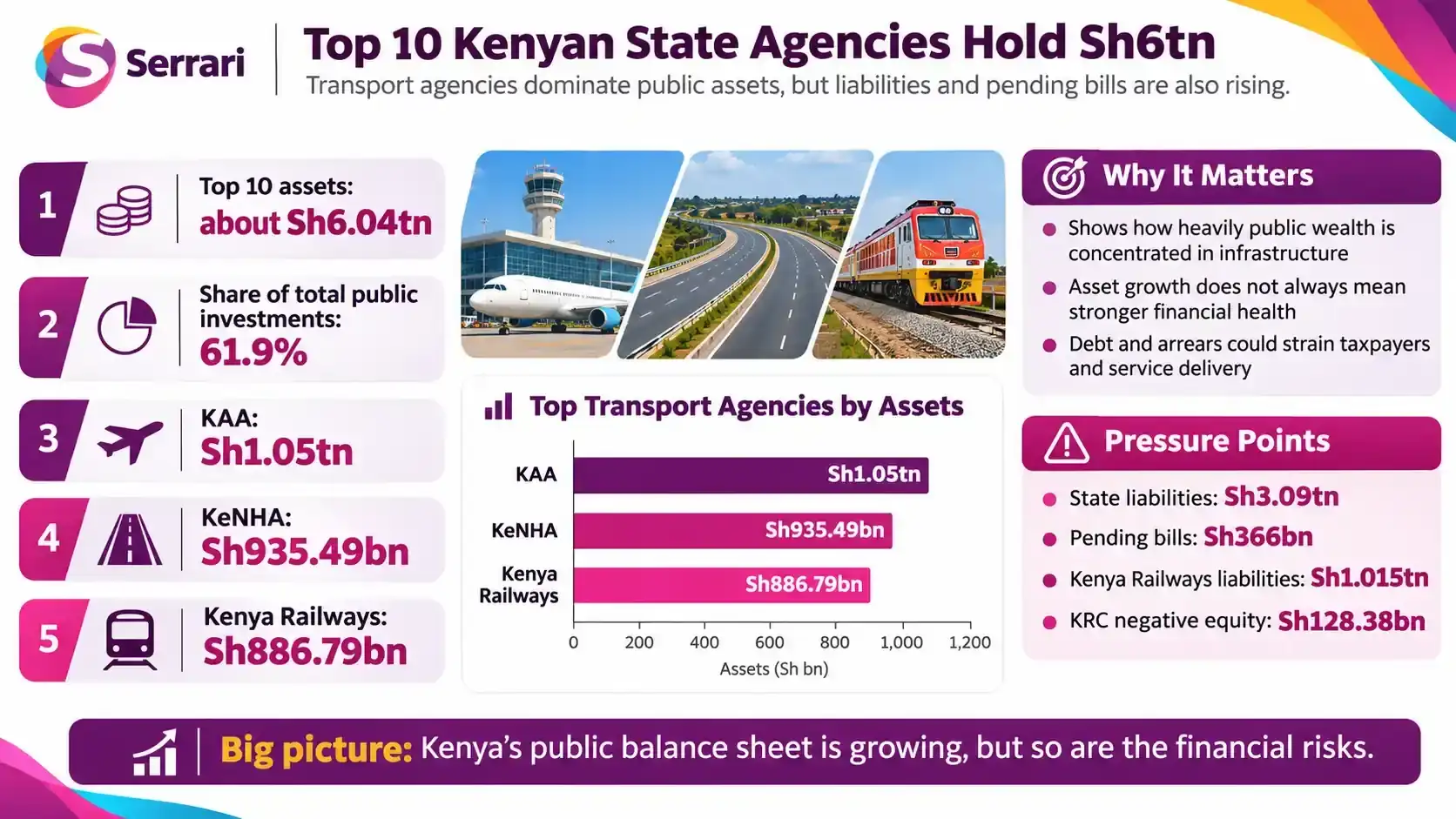
Kenya’s ten largest state institutions held approximately Sh6.04 trillion in assets at June 30, 2026, equivalent to 61.9% of the Sh9.76 trillion recorded in the National Treasury’s 2025/26 government investment report. Kenya Airports Authority (KAA), Kenya National Highways Authority (KeNHA) and Kenya Railways Corporation (KRC) occupy the top three positions, reflecting the scale of public investment in transport infrastructure. Yet the larger asset base masks a growing financial burden: liabilities among state corporations increased to Sh3.09 trillion, while Kenya Railways alone reported liabilities exceeding Sh1 trillion. The figures raise a central public-finance question: are Kenya’s expanding state assets creating sufficient economic value and financial returns to justify their costs?
Key Overview
- Concentrated holdings: Ten state institutions hold approximately Sh6.04 trillion, or 61.9%, of the Sh9.76 trillion investment-report asset total.
- Transport dominates: KAA holds Sh1.05 trillion, KeNHA Sh935.49 billion and Kenya Railways Sh886.79 billion.
- Growing asset base: Reported holdings rose from Sh8.93 trillion in June 2025 to Sh9.76 trillion in June 2026, an increase of about 9.3%.
- Higher liabilities: State-corporation liabilities climbed from Sh2.92 trillion to Sh3.09 trillion, with Kenya Railways carrying Sh1.015 trillion.
- Payment pressures: Outstanding government-loan arrears reached Sh568.91 billion, while pending bills stood at Sh366 billion.
- Fiscal significance: Asset sales, dividends, operational efficiency and debt restructuring are becoming increasingly important as Kenya finances new infrastructure.
Why Transport Agencies Control So Much Public Wealth
The dominance of transport institutions is a reflection of the type of assets they manage. Airports, national highways and rail corridors require exceptionally large upfront capital commitments, but their economic contribution cannot be assessed simply by looking at the accounting value of runways, roads or tracks. According to the November 16 account of Treasury’s investment findings, KAA leads with Sh1.05 trillion in assets, followed by KeNHA at Sh935.49 billion and Kenya Railways at Sh886.79 billion.
Together, these three hold approximately Sh2.87 trillion, or nearly 29.4% of the reported Sh9.76 trillion total. The wider transport portfolio also includes Kenya Rural Roads Authority with Sh439.2 billion and Kenya Ports Authority with Sh389 billion. This concentration helps explain why road, rail and airport investment is central to Kenya’s public-sector balance sheet.
The increase in overall assets from Sh8.93 trillion to Sh9.76 trillion—roughly Sh830 billion—was attributed chiefly to capital work in progress on transport and energy infrastructure and growth in fixed-interest investments held by funds. This is an important distinction: an unfinished railway or airport project can increase reported assets before producing significant operating income or economic benefits.
Nor should the Sh9.76 trillion figure be described as cash available to the Treasury. It combines assets reported across government-owned and government-linked institutions, including infrastructure, investments and pension-fund holdings. Pension assets, in particular, support obligations to members rather than constituting unrestricted budget resources. A separate government asset-register disclosure previously placed the documented public asset portfolio at about Sh4.9 trillion as of June 2025, underscoring why figures prepared for different reporting purposes should not be treated as interchangeable.
Why Kenya Railways Is the Biggest Balance-Sheet Warning
Kenya Railways illustrates the gap between the scale of a public asset and its capacity to finance itself. Although the corporation reported Sh886.79 billion in assets, its liabilities reached approximately Sh1.015 trillion, largely linked to loans advanced for construction of the Standard Gauge Railway. Its reported negative equity of Sh128.38 billion means liabilities exceeded assets on the accounting basis used in the report.
That does not mean the railway lacks economic usefulness. Freight and passenger networks can reduce transport costs, improve trade connectivity and generate benefits beyond the corporation’s own revenue. The difficulty is that those benefits do not automatically provide the cash needed to service the entity’s debts. Where operating receipts are insufficient, debt payments may ultimately depend on government support, restructuring or other fiscal measures.
The imbalance is particularly concerning because Kenya Railways accounted for approximately Sh473.17 billion of Sh568.91 billion in reported outstanding government-loan arrears, roughly 83%. It also posted the largest reported net loss among state enterprises at Sh51.02 billion. These figures make the corporation a crucial test of whether major infrastructure projects are being accompanied by sustainable operating and financing arrangements.
For taxpayers, the distinction matters because a government-backed project can impose costs even when it is held outside the core ministry budget. Debt servicing, maintenance requirements and financial assistance to agencies compete indirectly with other priorities, including health, education and county transfers. Kenya Railways’ negative equity should therefore prompt questions about transport volumes, pricing, operational efficiency and the treatment of historical construction debt—not just the assessed value of the railway itself.
How Pension Contributions Are Reshaping the Asset Rankings
The fourth-largest institution is the National Social Security Fund, with Sh760.7 billion in assets. Its expansion reflects a different mechanism from infrastructure construction: higher mandatory retirement contributions have increased funds available for long-term investment. The shift toward higher NSSF contributions began in 2023 and has expanded the scheme’s role in Kenya’s savings system.
The Public Service Superannuation Fund also appears in the top ten with Sh348 billion. Its growth follows the transition of public service pensions toward a contributory arrangement, under which covered employees contribute 7.5% of pensionable pay, alongside employer contributions. Unlike ordinary government shareholdings, these pension assets are linked to future benefit obligations and should be evaluated through investment performance, contribution adequacy and actuarial sustainability.
The economic opportunity is significant. Large, professionally managed retirement pools can support long-term investments in bonds, listed shares and appropriate infrastructure financing. But concentration in public securities or politically favored projects can introduce risks if investment decisions are not grounded in returns, liquidity needs and fiduciary obligations. Bigger fund balances are encouraging for national savings only when they improve members’ retirement security.
Context is everything. Stay ahead of shifting trends with today’s market updates, and uncover emerging opportunities using the Serrari Group Market Index and Marketplace. Then, take control of your own financial future by exploring our Money & Life Reset Transformation Blueprint ™ to build stronger habits, create better systems, and design a path toward lasting wealth.
Why Rising Liabilities and Pending Bills Matter More Than Asset Growth
Across state corporations, total liabilities increased from Sh2.92 trillion in June 2025 to Sh3.09 trillion a year later, an increase of approximately Sh170 billion. Besides Kenya Railways, substantial obligations were reported at Kenya Power, with Sh288.39 billion; Kenya Electricity Transmission Company, with Sh245.9 billion; and KenGen, with Sh207.5 billion. These exposures reveal that the country’s infrastructure expansion is accompanied by large financing commitments.
Pending bills of Sh366 billion add a second pressure point, comprising Sh171 billion in recurrent obligations and Sh195 billion in development-related payments. For contractors and suppliers, unpaid bills are not merely an accounting issue: they can restrict working capital, delay wages, lead to more expensive borrowing and weaken businesses that depend on government contracts.
A rise in assets alongside higher liabilities is not automatically undesirable. Borrowing can be justified when it finances productive assets that generate lasting economic returns. The real question is whether projects are completed on time, operated efficiently and maintained sufficiently to protect their value. Where delays, underutilisation or payment arrears persist, the fiscal costs can accumulate before the expected benefits materialise.
The report also indicated that grants and subsidies to state corporations increased to Sh546.43 billion from Sh365.14 billion. Some transfers finance legitimate public-service mandates that are not intended to earn commercial profits. Nevertheless, the jump strengthens the case for distinguishing social-service subsidies from support required to sustain inefficient commercial operations.
Why Privatization and Dividends Are Becoming More Important
Kenya’s large public balance sheet is increasingly part of its financing strategy. The government has sought to mobilise capital through partial asset sales while retaining an interest in selected enterprises. The March 2026 Kenya Pipeline Company IPO results reported Sh112.37 billion in share applications for a 65% stake offered at Sh9 per share. That subscription value should not be mistaken for sale proceeds: approximately Sh106.3 billion was raised on the shares offered, leaving the state with a 35% holding.
The distinction is important because oversubscription measures investor demand, while the value of shares actually sold determines the government’s transaction proceeds. The Treasury’s 2026/27 budget statement identifies the pipeline sale alongside the proposed partial Safaricom divestiture as sources of seed capital for an infrastructure financing model. This approach aims to turn holdings in existing enterprises into capital for new projects, reducing reliance on conventional taxation and borrowing.
But selling profitable assets also changes future income. State corporations contributed Sh52.95 billion through dividends, loan repayments, interest and directors’ fees in 2025/26, down from Sh55.35 billion the previous year. Safaricom accounted for Sh21.03 billion in dividends, while KCB, KenGen and KPA were also major contributors. These recurring receipts must be weighed against one-off privatisation proceeds when assessing whether asset sales improve the state’s long-term finances.
What the Sh6 Trillion Concentration Means for Kenyans
For ordinary Kenyans, the value of a public asset lies in what it delivers. Better airports can facilitate tourism and trade, efficient roads can reduce journey times and freight costs, and reliable power infrastructure can help businesses expand. Equally, pension assets should translate into secure retirement income, while commercial enterprises should generate appropriate returns or fulfil clearly funded public mandates.
The top-ten concentration creates a governance challenge because financial weaknesses in a few large entities can dominate the wider portfolio. It also creates an opportunity: improvements in procurement, maintenance, financial disclosure and operating performance at these agencies could have an outsized impact on public finances and service delivery.
The next tests are therefore not rankings alone, but independently assessed project performance, debt-repayment plans, arrears reduction, investment returns and the extent to which state corporations can fund operations without repeated fiscal intervention. The Treasury’s new figures show that Kenya has accumulated substantial public wealth. Whether that wealth strengthens the economy will depend on how efficiently it is managed—and whether its financial obligations remain affordable.
Sources: National Treasury / Daily Nation / Kenya News Agency / Privatization Authority / Kenya Pipeline Company
Your financial future isn’t something you wait for—it’s something you build.
The real question is: when do you begin?
Move beyond simply staying informed.
Navigate the markets with clarity—track trends through the Serrari Group Market Index, uncover opportunities in the Serrari Marketplace, and build practical knowledge with our Curated Wealth Builder Platform.
Stay connected to what truly matters.
Get daily insights on macro trends and financial movements across Kenya, Africa, and global markets—delivered through the Serrari Newsletter.
Growth opens doors.
Advance your career through professional programs including ACCA, HESI A2, ATI TEAS 7 , HESI EXIT , NCLEX – RN and NCLEX – PN, Financial Literacy!🌟—designed to move you forward with confidence.
See where money is flowing—clearly and in real time.
Track Money Market Funds, Treasury Bills, Treasury Bonds, Green Bonds, and Fixed Deposits, alongside global and African indexes, key economic indicators, and the evolving Crypto and stablecoin landscape—all within Serrari’s Market Index.