Taiwan Semiconductor Manufacturing Company (TSMC) has approved investments of up to $500 million each in Anthropic and OpenAI, extending its artificial intelligence strategy beyond manufacturing the chips that power advanced models. The November 10, 2026 decision comes as Anthropic prepares a potentially record-breaking stock market debut and technology companies commit enormous sums to computing infrastructure. For TSMC, the investments offer possible exposure to software-sector gains while reinforcing relationships across its most important growth market. They also raise a question for investors: can the companies financing and supplying the AI boom earn sufficient returns when so much of the industry’s money circulates among the same interconnected businesses?
Key Overview
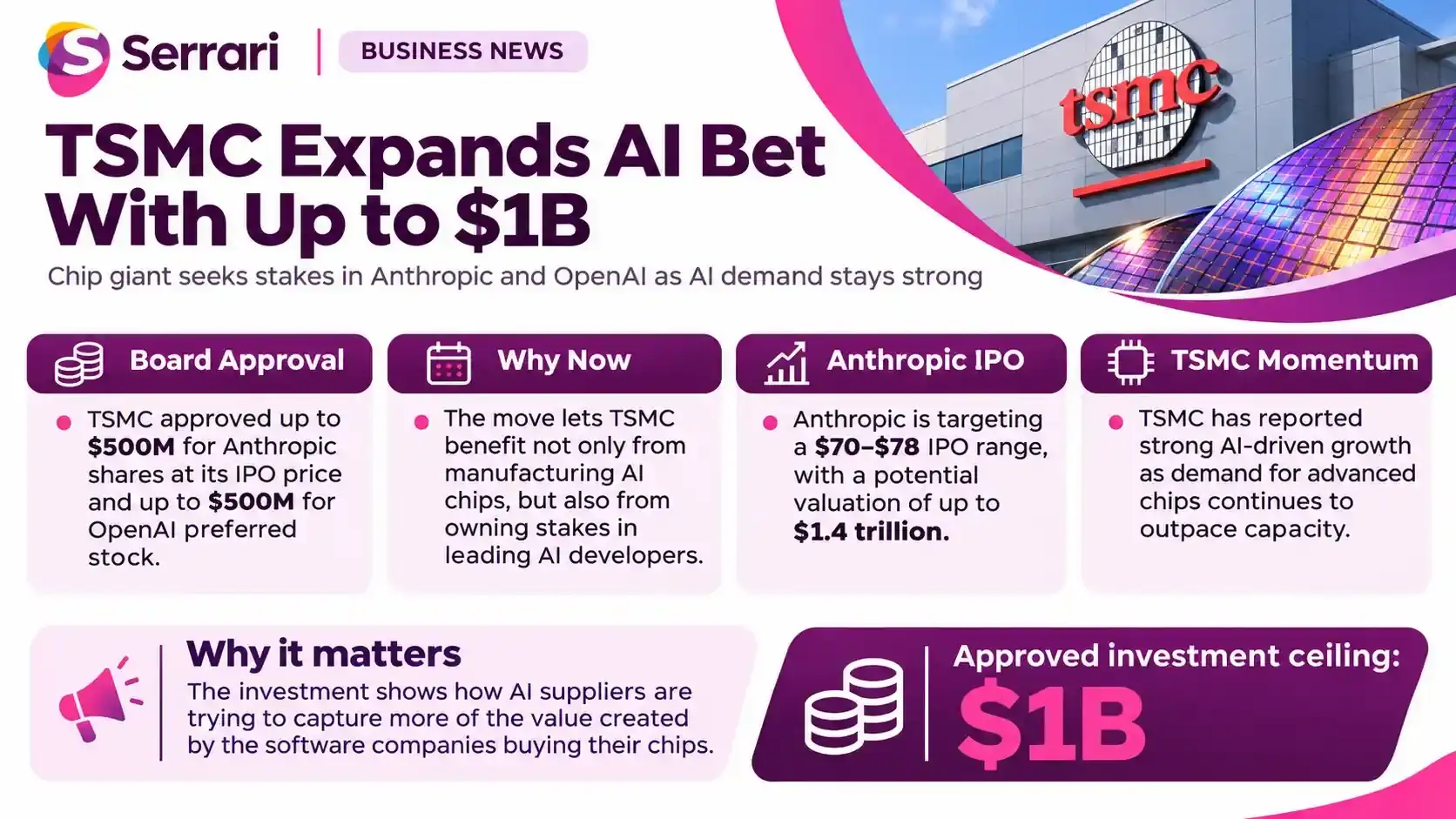
- Investment approval: TSMC’s board authorised up to $500 million for Anthropic shares at its initial public offering price and up to $500 million for OpenAI preferred shares; approval does not establish that the purchases have been completed.
- Anthropic IPO: The Claude developer has indicated a 78 share price range, with a maximum fully diluted valuation of about $1.4 trillion.
- Additional funding: Anthropic’s IPO is accompanied by a planned $26 billion private placement involving major semiconductor and technology partners.
- Manufacturing momentum: TSMC reported third-quarter revenue of approximately NT763.06 billion.
- Strategic significance: The chipmaker could benefit from AI demand both as a manufacturing supplier and as an equity investor in model developers.
- Key risk: Investments between chip suppliers and AI customers create overlapping exposures, even when both companies grow rapidly.
Why TSMC Is Investing in Its Industry’s Biggest AI Customers
TSMC already occupies one of the most powerful positions in artificial intelligence. As a leading manufacturer of advanced semiconductors, it produces chips designed by businesses such as Nvidia, whose processors underpin many of the computing systems used to train and operate AI models. Yet manufacturing success gives TSMC only one route to the value being created by AI adoption.
The company’s November 10 board resolutions establish a second route. Directors authorised up to $500 million to acquire Anthropic common shares at the company’s IPO price and the same amount to purchase OpenAI preferred shares. These are ceilings on approved investments, not confirmation that the full $1 billion has already been spent. The board separately approved up to $500 million for an investment company focused on strategic semiconductor and ecosystem opportunities; that is a distinct authorisation, not part of the two-company $1 billion headline.
Why does this matter? TSMC normally earns its return by manufacturing chips for customers, not by directly owning the applications that use them. AI developers can eventually capture profits from subscriptions, enterprise contracts, automated workflows and other software services. Equity ownership could allow TSMC to participate in those potential gains rather than rely exclusively on wafer orders and manufacturing margins.
There is also a strategic relationship angle. Model developers require reliable access to immense computing capacity, while chip manufacturers need confidence that customers will keep purchasing advanced products. A financial stake may deepen commercial alignment, although the investment does not itself prove that either AI company has promised TSMC additional manufacturing orders. Nor does it guarantee preferential access to chips, which are generally ordered through TSMC’s direct semiconductor customers.
Anthropic’s IPO Offers a High-Stakes Entry Point
The timing is closely linked to Anthropic’s planned public listing. In its amended IPO registration statement, Anthropic describes an offering of 825 million Class A shares at an estimated $70 to $78 each. Roughly 801.35 million shares are to be issued by the company, while about 23.65 million are being sold by existing shareholders. At the top of the range, the base offering would total approximately $64.35 billion before considering the underwriters’ option.
Reports put its maximum fully diluted valuation at approximately $1.4 trillion. That figure includes potential shares beyond the immediately outstanding stock, and should not be confused with the value implied by outstanding shares alone. The distinction is important when assessing how expensive the investment may be relative to revenue and prospective profits.
Alongside the public offering, Anthropic has arranged a separate $26 billion private placement of non-voting Class N shares with partners including Google, Nvidia, Microsoft, AMD, Broadcom, Micron and a TSMC-related entity. The proposed placement is conditional on the IPO and shares its pricing basis. Investors must therefore distinguish the public share sale from the privately negotiated partner financing rather than combine them into a single IPO size.
For TSMC, the IPO provides a defined pricing event rather than a conventional private-company negotiation. But an IPO price is not evidence that shares will sustain that valuation after trading begins. Public markets can rapidly reassess growth assumptions, expected cash requirements and profitability, especially when businesses are priced for years of exceptional expansion.
The Financial Logic: Capture More of AI’s Economic Value
TSMC’s core business is benefiting substantially from rising demand for powerful processors and advanced packaging. The company reported third-quarter results showing revenue of NT763.06 billion, illustrating the scale of the business supporting its investment plans. Its October earnings commentary also pointed to strong AI-related demand, while acknowledging uncertainty about how future spending may evolve.
But a semiconductor foundry and a developer of AI services have different financial models. TSMC invests in fabrication plants, machinery and engineering processes, then earns revenue as customers buy manufacturing capacity. A model developer spends heavily on research, software development, cloud computing and deployment, then seeks revenue from users and enterprises.
Owning both kinds of exposure could give TSMC an investment return if AI applications become exceptionally profitable even after hardware growth moderates. The opposite is also possible: AI usage may surge while competition, discounts and computing bills consume much of the economic value, leaving equity investors disappointed.
The size of the approved investments also needs perspective. The board simultaneously authorised about $40.93 billion of capital appropriations for technology development, manufacturing capacity, packaging and other projects. A potential $1 billion investment in the two developers is therefore much smaller than TSMC’s manufacturing commitments. It marks a meaningful strategic expansion without signalling that TSMC is abandoning its core foundry business.
Context is everything. Stay ahead of shifting trends with today’s market updates, and uncover emerging opportunities using the Serrari Group Market Index and Marketplace. Then, take control of your own financial future by exploring our Money & Life Reset Transformation Blueprint ™ to build stronger habits, create better systems, and design a path toward lasting wealth.
Why the Industry’s Circular Financing Raises Questions
The Anthropic transaction highlights a broader feature of AI finance: suppliers and technology partners are increasingly becoming investors in the companies that buy their services or depend on their products. A chip company can earn revenue from AI infrastructure demand while also holding equity in businesses whose future success requires that infrastructure to keep expanding.
Such arrangements are not inherently problematic. Strategic investments can help businesses finance capacity, coordinate product development and share some of the gains from innovation. However, they complicate the assessment of independently sustainable demand. If an investor provides capital to an AI company that later spends significant sums on infrastructure involving the investor’s wider ecosystem, it becomes important to determine how much demand is supported by end-customer payments rather than successive rounds of financing.
Anthropic’s own risk disclosures illustrate the issue. The company reported approximately $900.9 billion in aggregate compute-related purchase commitments and lease arrangements entered into as of and after September 30, 2026, with obligations stretching across many years. These commitments are not equivalent to a single year’s cash expense, but they reveal the long-term infrastructure burden associated with developing and operating frontier AI systems.
The question is whether customer revenue and future financing can support those obligations while generating attractive returns for shareholders. An impressive valuation does not itself settle that question. Nor does rapid revenue growth establish that additional revenue will produce equivalent increases in profit, particularly when computing costs, depreciation and competitive pricing pressure remain significant.
OpenAI Adds a Different Kind of Investment Exposure
TSMC’s planned investment in OpenAI would involve preferred stock rather than the ordinary shares specified for Anthropic. Preferred securities can have rights that differ from common stock, potentially including priority economic claims or other negotiated protections. Without the complete investment terms, however, it would be misleading to assume a guaranteed return, a specific liquidation preference or control over strategic decisions.
Holding stakes in two competing model developers could reduce reliance on the success of a single company’s products. At the same time, both investments remain exposed to the same broad forces: model-training costs, inference demand, regulation, competition, pricing and the sustainability of AI infrastructure expenditure. Diversification across corporate names is less protective when their economic drivers overlap.
There is another reason this strategy warrants scrutiny. TSMC manufactures chips for a wide range of customers. Taking equity stakes in selected downstream developers could raise questions from other industry participants about commercial neutrality. The board’s decision does not establish preferential treatment or a conflict of interest, but maintaining confidence across competing clients will remain important for a foundry whose strength depends partly on serving the wider semiconductor ecosystem.
What Investors Should Watch Next
The first test is execution: how much of the authorised funding TSMC actually deploys, at what valuation, and on what final legal terms. The second is Anthropic’s IPO reception. A strong opening could establish a market valuation for a major AI developer; volatility or weak demand could force investors to reconsider assumptions that have supported substantial private financing.
The more consequential test will play out over several years. TSMC needs chip demand and manufacturing utilisation to support its enormous capital programme, while Anthropic and OpenAI need AI revenue to grow fast enough to cover the infrastructure and research required to serve customers. Market observers should track customer spending, computing commitments, operating cash flow and profitability rather than treating fundraising totals as evidence of commercial success.
For shareholders, the immediate financial exposure from the proposed equity investments is modest relative to TSMC’s manufacturing scale, but the strategic message is much larger. One of the world’s most important chipmakers is seeking a direct claim on the companies building AI services, reflecting confidence that value will accumulate across more than one link of the supply chain.
The decision also reflects the defining uncertainty of the current AI investment cycle. Suppliers are reporting strong orders and developers are attracting extraordinary capital, yet the industry must still prove that its ultimate customers will pay enough to justify its expanding infrastructure. TSMC’s move is therefore both an endorsement of AI’s commercial future and a calculated bet on who will capture the profits once the spending boom matures.
Sources: TSMC / U.S. Securities and Exchange Commission / Reuters / TechCrunch
Your financial future isn’t something you wait for—it’s something you build.
The real question is: when do you begin?
Move beyond simply staying informed.
Navigate the markets with clarity—track trends through the Serrari Group Market Index, uncover opportunities in the Serrari Marketplace, and build practical knowledge with our Curated Wealth Builder Platform.
Stay connected to what truly matters.
Get daily insights on macro trends and financial movements across Kenya, Africa, and global markets—delivered through the Serrari Newsletter.
Growth opens doors.
Advance your career through professional programs including ACCA, HESI A2, ATI TEAS 7 , HESI EXIT , NCLEX – RN and NCLEX – PN, Financial Literacy!🌟—designed to move you forward with confidence.
See where money is flowing—clearly and in real time.
Track Money Market Funds, Treasury Bills, Treasury Bonds, Green Bonds, and Fixed Deposits, alongside global and African indexes, key economic indicators, and the evolving Crypto and stablecoin landscape—all within Serrari’s Market Index.