Malaysia has launched the Forest Carbon Offset (FCO) programme to mobilise financing for forest conservation, restoration and sustainable management. Developed by the Malaysia Forest Fund (MFF), the programme establishes a national carbon crediting system for the forestry sector, designed around Malaysia’s forest ecosystems and federal and state legal requirements. It allows eligible projects to generate Forest Carbon Units after independent verification, which can then be sold to buyers seeking to offset emissions. With initial project participation costs below RM8,500, the programme aims to lower barriers for developers, retain more financing within the country and strengthen local expertise. Malaysia also intends to develop the system before pursuing wider international carbon credit trading.
Key Takeaways
- Malaysia has launched the Forest Carbon Offset programme as its national carbon crediting system for the forestry sector.
- Eligible projects can generate Forest Carbon Units through verified emissions reductions or carbon removals.
- Initial participation costs for project developers are below RM8,500.
- The programme covers afforestation, reforestation, forest restoration, improved forest management, avoided deforestation and wetland ecosystems.
- Malaysia is developing the framework for potential international carbon credit trading under Article 6.2 of the Paris Agreement and CORSIA.
- Partnerships with Tenaga Nasional, Yinson, Japan’s OECC and FRIM Inc will support project development, conservation financing and technical capacity building.
Malaysia Establishes a National Carbon Crediting System for Forests
Malaysia has launched the Forest Carbon Offset (FCO) programme to mobilise financing for forest conservation, restoration and sustainable management.
Developed by the Malaysia Forest Fund (MFF), an agency under the Ministry of Natural Resources and Environmental Sustainability (NRES), FCO is designed specifically around Malaysia’s forest ecosystems and federal and state legal requirements.
The programme aims to lower participation costs, build local expertise and ensure more funding remains available for conservation and communities.
It also gives local forest projects a domestic carbon crediting option alongside international programmes such as Verra’s Verified Carbon Standard (VCS).
The launch marks a step towards establishing a national system for measuring, verifying and recording carbon credits generated from forest-related activities.
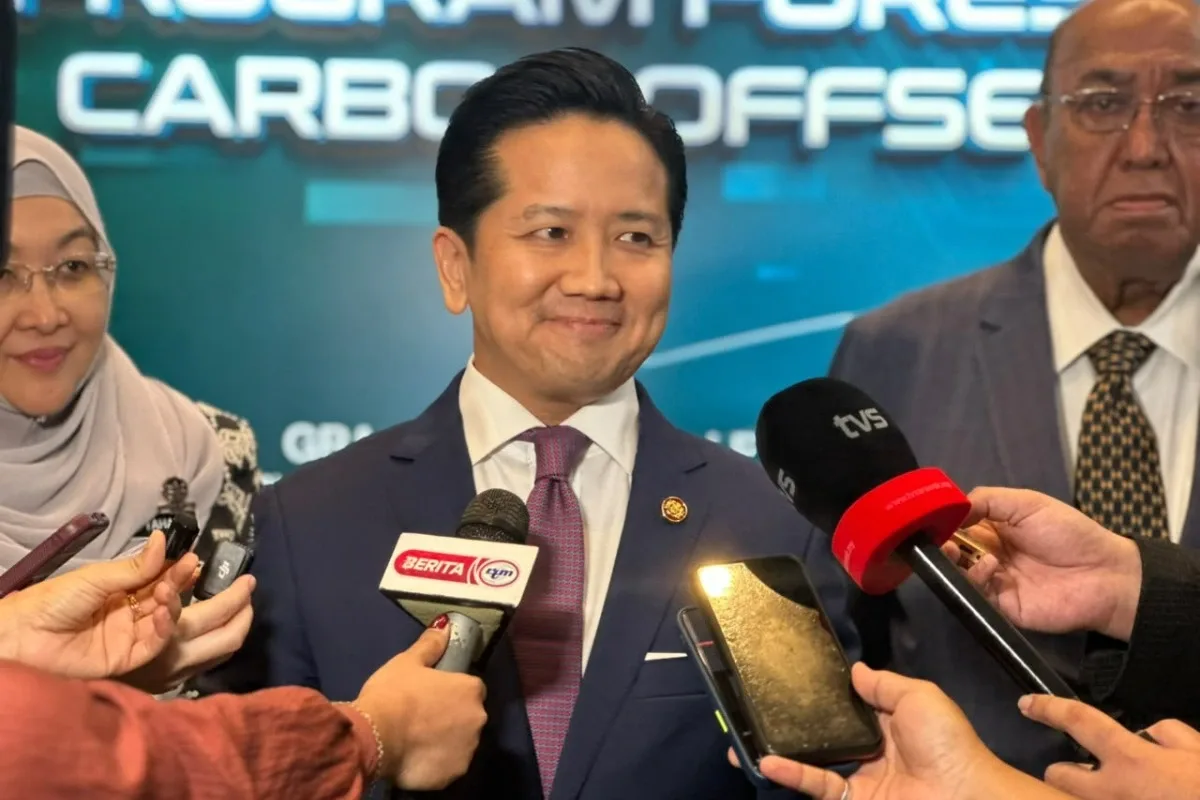
Natural Resources and Environmental Sustainability Minister Datuk Seri Arthur Joseph Kurup said the country needed its own verification, measurement and reporting system to establish a database of domestic carbon credits and support future participation in international markets.
He said:
“We want to be involved in international trading and the international market, but we need to get our system correct first, and have our own established system… As we move forward, then we’ll see how we start trading internationally, because we’re still waiting for the Climate Change [Bill] to be passed, so then we’ll have a clearer picture. But the policy is there.”
The programme was launched at Aloft Kuala Lumpur Sentral.
How the Forest Carbon Offset Programme Works
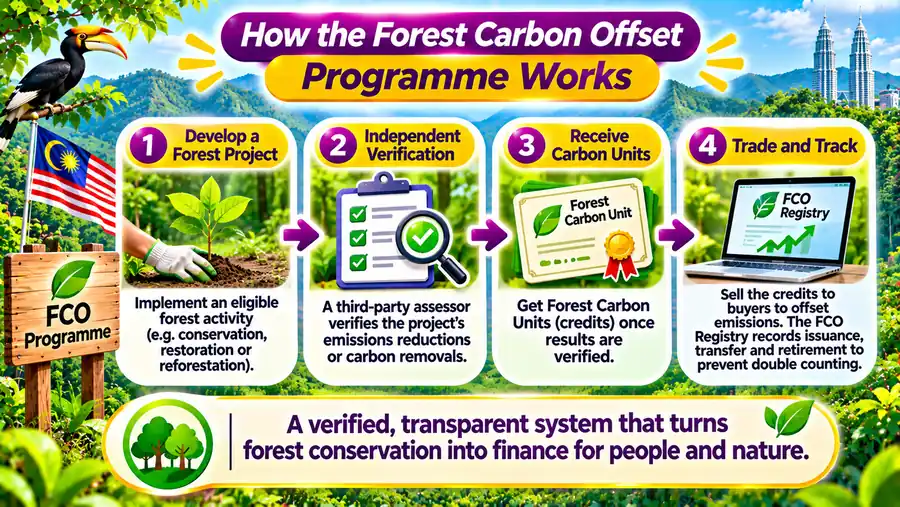
Under FCO, eligible forest projects can generate carbon credits, known as Forest Carbon Units, by reducing or preventing greenhouse gas emissions or removing these gases from the atmosphere.
The credits are issued once the reported results have been independently verified. They can then be sold to buyers seeking to offset their emissions, subject to the programme’s requirements.
The system requires independent assessors to verify that projects meet its requirements and that the emissions reductions or carbon removals they report are supported by evidence.
A central FCO Registry will record each project and track the issuance, transfer and retirement of carbon credits.
Retired credits are permanently taken out of circulation so they cannot be sold or used again. These records make credits easier to trace and help guard against double counting, whereby the same climate benefit is claimed more than once.
This verification and registry structure is important because buyers need confidence that the credits represent genuine and independently supported climate benefits.
Context is everything. Stay ahead of shifting trends with today’s market updates, and uncover emerging opportunities using the Serrari Group Market Index and Marketplace. Then, take control of your own financial future by exploring our Money & Life Reset Transformation Blueprint ™ to build stronger habits, create better systems, and design a path toward lasting wealth.
Four Forest Carbon Methodologies Already Developed
MFF has developed methodologies covering four areas of forest-related activity:
- Afforestation, reforestation and restoration: Activities that establish new forests, restore forest areas or rehabilitate degraded ecosystems.
- Improved forest management: Practices intended to improve the management and sustainability of existing forests.
- Reducing emissions from deforestation and forest degradation: Projects that reduce greenhouse gas emissions associated with forest loss and degradation.
- Wetland ecosystems: Activities focused on protecting and managing wetland ecosystems and their carbon benefits.
The methodologies and supporting tools have been piloted in Kelantan, Johor, Sabah and Negeri Sembilan to assess their suitability under different forest conditions.
Two additional methodologies covering urban forestry and agroforestry are being developed. They will undergo pilot implementation and validation before being included in the framework.
The development of these methodologies is intended to provide a wider range of eligible forest and land-use projects with an opportunity to participate in the programme.
Lower Participation Costs Aim to Keep More Funding in Malaysia
One of the programme’s key features is its lower entry cost for project developers.
Kurup said project developers can participate in FCO at an initial cost of less than RM8,500. Ongoing fees for recording and managing carbon credits are also lower than those under other international standards.
The lower costs are intended to make carbon credit development more accessible while reducing the amount of project financing spent on external crediting fees.
Kurup said:
“This also ensures that capital remains within the country rather than flowing out to foreign entities solely to cover crediting fees. Through FCO, we are building stronger incentives to protect our forests, restore degraded areas and manage our forest resources sustainably for present and future generations.”
For Malaysia, retaining more financing domestically is part of the programme’s wider objective of supporting state governments, forest stakeholders and local communities.
MFF and NRES also aim to create employment opportunities and develop local expertise, including auditors and assessors who can support the verification and monitoring of forest carbon projects.
Malaysia Seeks Access to International Carbon Markets
Although FCO is being established as a domestic crediting system, Malaysia also intends to develop opportunities for international participation.
Kurup said the credits have the potential for international use through cooperative approaches under Article 6.2 of the Paris Agreement and the Carbon Offsetting and Reduction Scheme for International Aviation (CORSIA).
Article 6.2 provides a framework for countries to cooperate in achieving climate targets through internationally transferred mitigation outcomes. CORSIA is the international aviation sector’s carbon offsetting scheme.
The minister also referred to the Carbon Border Adjustment Mechanism (CBAM), highlighting the importance of developing a domestic system for measuring and recording carbon credits.
However, international trading is not yet an automatic outcome of the programme’s launch.
Kurup said Malaysia first needs to establish its own system and is awaiting the passage of the Climate Change Bill to provide a clearer picture of the policy framework.
He said the launch of FCO was a major step in implementing the National Carbon Market Policy (DPKK), introduced in April, which recognises FCO as the national crediting system for the forestry sector.
The policy is intended to support Malaysia’s ambition to develop high-integrity carbon credits.
Local Communities and Indigenous Peoples to Participate in Forest Protection
The programme is also designed to create financing opportunities for state governments and forest stakeholders.
MFF and NRES intend to develop additional sources of financing, create employment opportunities and strengthen local technical expertise.
Local communities and Indigenous Peoples are expected to be key partners in forest protection and management.
MFF chairman Tan Sri Dr Abdul Majid Khan said the programme had been shaped through 37 consultations involving state governments, project implementers and technical experts.
The consultations were intended to ensure that the system was scientifically robust and practical to implement.
He said:
“Building a system is only the beginning. Building confidence is the real challenge. The success of FCO will not be measured solely by the number of documents published or carbon credits recorded. Its success will be measured by the level of trust it builds among state governments, project developers, investors and communities.”
Abdul Majid said MFF would prioritise strengthening the system’s integrity, developing local expertise and expanding the number of high-quality projects while keeping pace with scientific, policy and market developments.
He also called for continued development of new methodologies and improvements to existing ones to address weaknesses and gaps identified during field implementation.
MFF is looking to collaborate with domestic and international entities to develop the first forest carbon project capable of generating carbon credits by 2030.
MFF Builds Partnerships to Support Forest Conservation and Carbon Projects
Alongside the FCO launch, MFF formalised collaborations with Tenaga Nasional Bhd, Yinson Holdings Bhd, Japan’s Overseas Environmental Cooperation Center (OECC) and FRIM Inc Sdn Bhd.
The partnerships cover potential forest carbon projects, biodiversity conservation, ecosystem restoration, knowledge-sharing and capacity building.
Tenaga Nasional
Under its collaboration with Tenaga Nasional, MFF will explore the utility company’s potential participation in both the Forest Conservation Certificate (FCC) and FCO.
The work includes identifying and developing biodiversity conservation projects that could qualify for certification under the two instruments.
The collaboration will also cover technical knowledge-sharing, capacity building and the exploration of methodologies and guidelines for monitoring, reporting and verifying conservation projects.
Yinson Holdings
MFF’s partnership with Yinson focuses on developing nature-based solutions under FCO to halt and reverse forest loss and degradation, conserve biodiversity and manage carbon stocks.
Both parties will explore natural capital assessments and work with landowners to identify suitable areas and projects.
They will also develop a roadmap for potential projects, subject to agreement from the relevant stakeholders and landowners.
MFF and Yinson will explore ways for the company to help fund forest conservation through voluntary contributions under FCC, including efforts to help forests adapt to the effects of climate change.
According to MFF, FCC provides a transparent and measurable mechanism to support sustainability reporting by Yinson and other corporations, including disclosures relating to nature and biodiversity.
Japan’s Overseas Environmental Cooperation Center
The collaboration with OECC will support knowledge-sharing between Malaysia and Japan on carbon financing and crediting mechanisms.
It will also help strengthen FCC under Article 6.8 of the Paris Agreement, which supports international climate cooperation through non-market approaches.
OECC will provide technical advice to support FCO’s development and operation, drawing on Japan’s experience with the J-Credit Scheme and Joint Crediting Mechanism.
The exchange will cover methodologies, governance, eligibility criteria and safeguards.
FRIM Inc
The partnership with FRIM Inc will combine MFF’s role in managing forest financing programmes with FRIM Inc’s expertise in forest research, technology and field data collection.
The work will include assessing forest conditions, measuring and verifying the carbon benefits of projects, using digital tools to map and monitor forests, and conducting research and training.
Forest Carbon Offset and Forest Conservation Certificate
FCO is not the only financing mechanism introduced by MFF.
In 2024, the organisation introduced the Forest Conservation Certificate (FCC), a non-market-based financing mechanism that mobilises voluntary contributions from the private sector to support forest conservation efforts.
The two instruments are designed to complement each other.
Suhaini Haron, an officer acting on behalf of MFF’s CEO, said:
“FCO and FCC are complementary mechanisms that adopt a finance-stacking approach to mobilise consistent and structured financing over the long term in support of forest conservation, restoration and sustainable management. This approach also ensures that environmental integrity is maintained and double counting is avoided.”
While FCO provides a route for eligible projects to generate and sell verified carbon credits, FCC provides a channel for voluntary private-sector contributions towards conservation.
Together, the mechanisms are intended to create more structured financing for forest protection and restoration.
The Bigger Picture: Building a Domestic Forest Carbon Market
Malaysia’s FCO programme represents an effort to establish a domestic framework for financing forest conservation through carbon credits.
The lower participation costs, local verification capacity and central registry are intended to make the system accessible while strengthening confidence in the credits it generates.
The programme also links forest conservation with wider economic opportunities, including employment, technical expertise and partnerships with companies and international organisations.
However, the credibility of the system will depend on the quality of its methodologies, independent verification, registry records and safeguards against double counting.
The 37 stakeholder consultations and pilot testing across four states provide an initial foundation, while the planned urban forestry and agroforestry methodologies could widen the range of eligible projects.
Why Does This Matter Now?
Forest conservation requires long-term financing, particularly when governments and forest stakeholders must protect existing ecosystems, restore degraded areas and manage forests sustainably.
FCO introduces another financing route by allowing eligible forest projects to generate credits that can be sold to buyers seeking to offset emissions.
For project developers, the initial participation cost of less than RM8,500 could reduce the financial barriers associated with entering the carbon credit market.
For state governments and local communities, the programme aims to create additional financing opportunities, employment and technical capacity.
For companies, the partnerships provide potential ways to participate in biodiversity conservation, restoration and nature-based solutions.
The international dimension is also important. Malaysia wants its domestic system to support future participation in international carbon markets, but the government has made clear that the verification and policy framework must be established first.
Outlook: Malaysia Targets Its First Forest Carbon Project by 2030
The next stage for FCO will involve strengthening its methodologies, expanding project participation and building confidence among governments, developers, investors and communities.
MFF will continue improving the methodologies already established while developing additional approaches for urban forestry and agroforestry.
The partnerships with Tenaga Nasional, Yinson, OECC and FRIM Inc are expected to support project development, technical knowledge-sharing and conservation financing.
MFF has also expressed its intention to collaborate with domestic and international organisations to develop the first forest carbon project capable of generating credits by 2030.
International trading remains a longer-term ambition, dependent on the development of Malaysia’s domestic system and greater clarity following the passage of the Climate Change Bill.
For now, the programme establishes a national route for generating forest carbon credits, with its success likely to depend on implementation, environmental integrity and the confidence it builds among the people and organisations involved.
Frequently Asked Questions
1. What is Malaysia’s Forest Carbon Offset programme?
The Forest Carbon Offset programme is Malaysia’s national carbon crediting system for the forestry sector. It allows eligible forest projects to generate Forest Carbon Units through independently verified emissions reductions or carbon removals.
2. How much does it cost to participate in the FCO programme?
Project developers can participate at an initial cost of less than RM8,500. Ongoing fees for recording and managing carbon credits are also lower than those under other international standards.
3. Which forest activities qualify under the FCO programme?
The methodologies cover afforestation, reforestation and restoration; improved forest management; reducing emissions from deforestation and forest degradation; and wetland ecosystems. Urban forestry and agroforestry methodologies are also being developed.
4. Can Malaysia’s forest carbon credits be traded internationally?
The credits have potential for international use through cooperative approaches under Article 6.2 of the Paris Agreement and CORSIA. However, Malaysia first intends to establish its domestic verification, measurement and reporting system and obtain greater policy clarity.
Your financial future isn’t something you wait for—it’s something you build.
The real question is: when do you begin?
Move beyond simply staying informed.
Navigate the markets with clarity—track trends through the Serrari Group Market Index, uncover opportunities in the Serrari Marketplace, and build practical knowledge with our Curated Wealth Builder Platform.
Stay connected to what truly matters.
Get daily insights on macro trends and financial movements across Kenya, Africa, and global markets—delivered through the Serrari Newsletter.
Growth opens doors.
Advance your career through professional programs including ACCA, HESI A2, ATI TEAS 7 , HESI EXIT , NCLEX – RN and NCLEX – PN, Financial Literacy!🌟—designed to move you forward with confidence.
See where money is flowing—clearly and in real time.
Track Money Market Funds, Treasury Bills, Treasury Bonds, Green Bonds, and Fixed Deposits, alongside global and African indexes, key economic indicators, and the evolving Crypto and stablecoin landscape—all within Serrari’s Market Index.