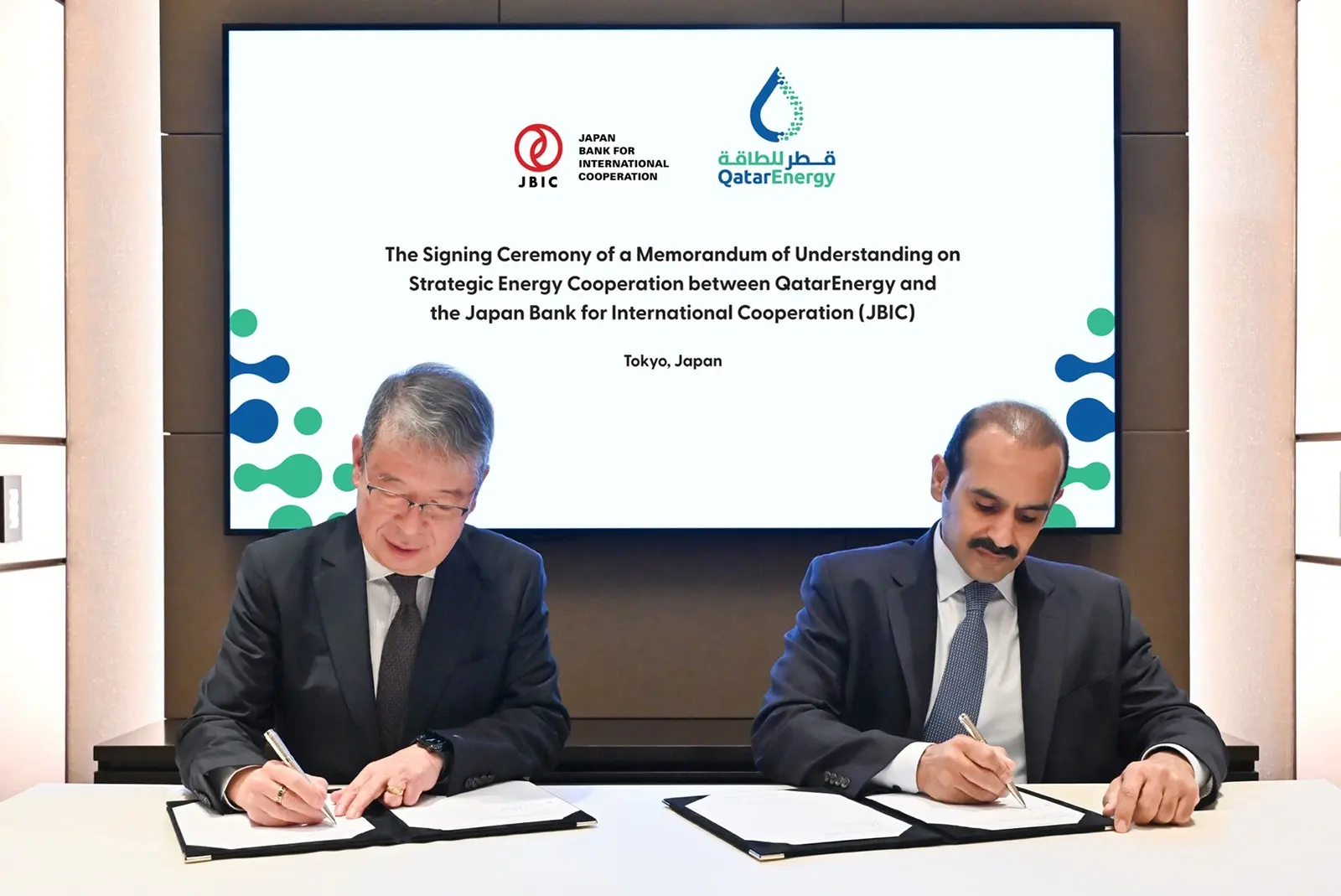
QatarEnergy and the Japan Bank for International Cooperation (JBIC) have signed a memorandum of understanding (MoU) to expand energy cooperation between Qatar and Japan, with a focus on energy security, resilient supply chains and investment. Signed in Tokyo by QatarEnergy President and CEO Saad bin Sherida Al-Kaabi and JBIC Governor Kazuhiko Amakawa, the agreement establishes a framework to explore opportunities across liquefied natural gas (LNG), natural gas, upstream and downstream development, energy infrastructure, carbon capture and storage, power generation, renewable energy and water desalination. It also provides for potential cooperation on energy projects involving Japanese companies in third countries. The agreement aligns with Japan’s Partnership on Wide Energy and Resources Resilience (POWERR Asia), an initiative aimed at strengthening regional energy security. It builds on existing Qatar-Japan LNG trade, including a 27-year agreement for QatarEnergy to supply Japanese utility JERA with 3 million tonnes of LNG annually from 2028.
Key Takeaways
- QatarEnergy and JBIC have signed an MoU to strengthen energy cooperation between Qatar and Japan.
- The agreement covers LNG, natural gas, upstream and downstream development, energy infrastructure, carbon capture and storage, power generation and renewable energy.
- The partnership aims to strengthen energy security and improve the resilience of energy supply chains across the Middle East and Asia.
- Japan relies heavily on imported energy, with the Middle East accounting for more than 90% of its crude oil imports.
- Qatar supplied 5.3% of Japan’s LNG imports in 2025.
- The agreement builds on existing LNG ties, including a 27-year supply agreement with JERA for 3 million tonnes of LNG annually from 2028.
- JBIC could support future opportunities through its financing instruments and capacity to take on investment risk.
QatarEnergy and JBIC Expand Strategic Energy Cooperation
QatarEnergy and the Japan Bank for International Cooperation (JBIC) have signed a memorandum of understanding to strengthen their energy partnership, with the aim of supporting energy security, resilient supply chains and investment across the energy sector.
The agreement was signed in Tokyo by Saad bin Sherida Al-Kaabi, Qatar’s Minister of State for Energy Affairs and President and CEO of QatarEnergy, and Kazuhiko Amakawa, Governor of JBIC.
Under the MoU, the two organisations will explore opportunities across several areas of the energy value chain, including liquefied natural gas (LNG), natural gas, upstream and downstream development, energy infrastructure, carbon capture and storage, power generation, renewable energy and water desalination.
The framework also provides for potential cooperation on energy projects involving Japanese companies in third countries.
The agreement is aligned with the principles of the Partnership on Wide Energy and Resources Resilience (POWERR Asia), an initiative aimed at strengthening energy security and supply chain resilience across Asia.
QatarEnergy said the partnership reflects the shared objective of supporting stable and sustainable energy supplies across the Middle East and Asia.
For both parties, the agreement creates a broader framework to explore investment and business opportunities across energy production, infrastructure and supply.
The Cause: Why Qatar and Japan Are Strengthening Energy Ties
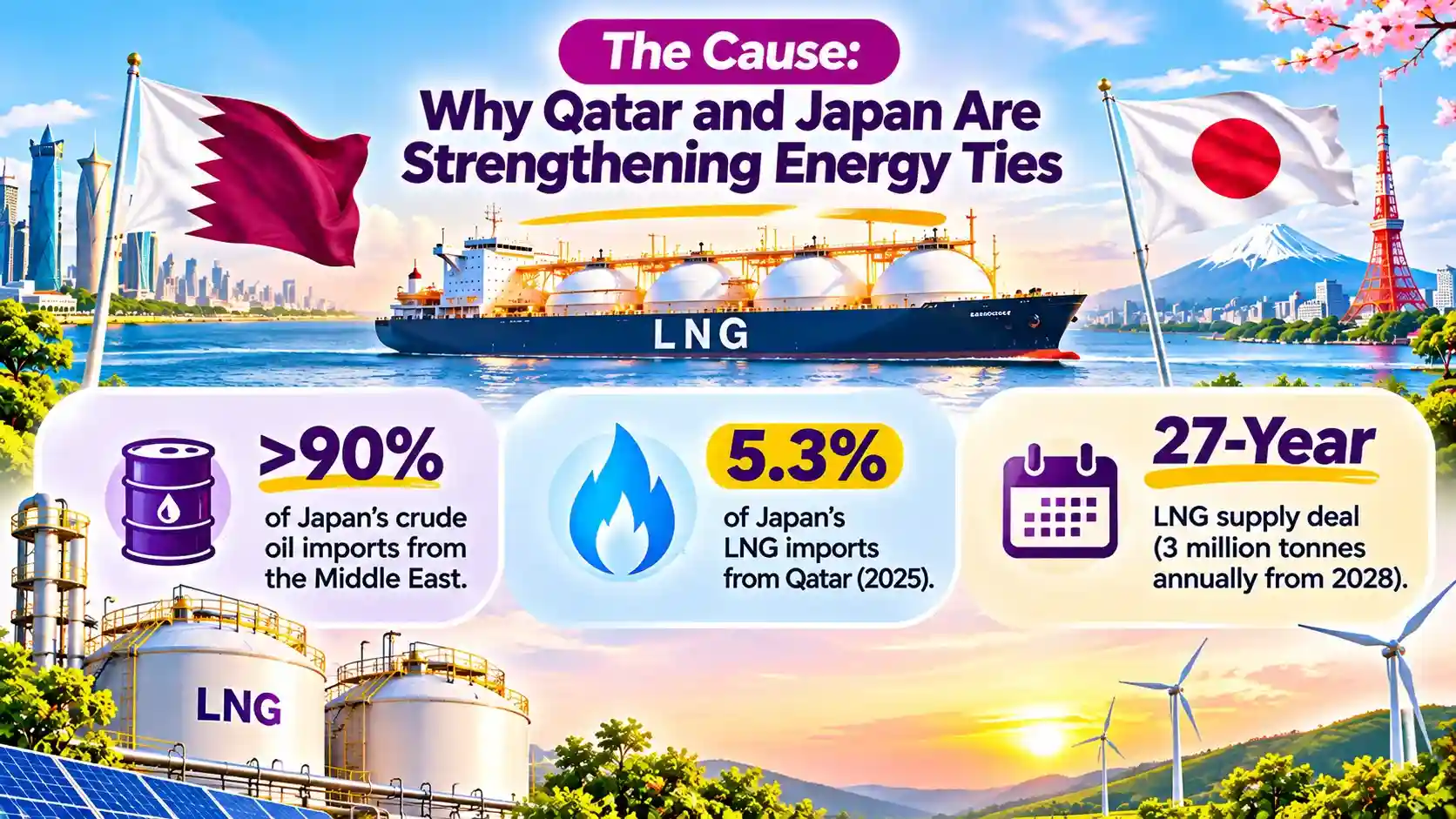
Japan’s dependence on imported energy is an important factor behind the partnership.
The country relies heavily on overseas suppliers to meet its energy requirements, making secure and diversified supply arrangements important to its energy security.
The Middle East accounts for more than 90% of Japan’s crude oil imports. Although Japan’s LNG supplies are more diversified, Qatar remains an important supplier.
According to Japan’s Ministry of Education, Culture, Sports, Science and Technology (MEXT), Qatar accounted for 5.3% of Japan’s LNG imports in 2025.
This relationship gives Qatar a significant role in Japan’s energy supply network, while Japan remains an established market for Qatari LNG.
The two countries have also strengthened their commercial relationship through long-term supply agreements.
In February 2026, QatarEnergy signed a 27-year agreement to supply Japanese utility JERA with 3 million tonnes of LNG annually, beginning in 2028.
The latest MoU builds on these existing energy ties by creating a wider framework for cooperation beyond LNG supply. It allows the parties to explore opportunities in energy infrastructure, power generation, renewable energy and other parts of the energy value chain.
The agreement also reflects Japan’s wider efforts to strengthen regional energy security through POWERR Asia.
The initiative provides a framework for cooperation with energy-producing countries and partners to improve the resilience of energy and critical resource supply chains.
Context is everything. Stay ahead of shifting trends with today’s market updates, and uncover emerging opportunities using the Serrari Group Market Index and Marketplace. Then, take control of your own financial future by exploring our Money & Life Reset Transformation Blueprint ™ to build stronger habits, create better systems, and design a path toward lasting wealth.
What the Agreement Covers Across the Energy Sector
The MoU identifies several areas in which QatarEnergy and JBIC will explore potential cooperation.
1. Liquefied Natural Gas and Natural Gas
LNG and natural gas form a central part of the Qatar-Japan energy relationship.
Qatar is a major global LNG supplier, while Japan is an important market for imported natural gas.
The agreement creates an opportunity to explore further cooperation in LNG and natural gas activities, building on existing supply arrangements between the two countries.
For Japan, maintaining reliable access to LNG is important for energy security. For QatarEnergy, deeper cooperation with Japanese institutions and businesses could support its long-term commercial relationships and investment opportunities.
However, the MoU does not announce a new LNG supply contract or specify additional volumes.
2. Upstream and Downstream Development
The two parties will also explore cooperation in upstream and downstream energy development.
Upstream activities involve the exploration and production of oil and natural gas, while downstream activities include processing, refining, distribution and the supply of energy products.
Cooperation across these areas could create opportunities for Japanese companies to participate in projects connected to QatarEnergy’s wider energy operations.
The agreement does not identify specific projects or confirm new investments in either area.
3. Energy Infrastructure
Energy infrastructure is another priority under the MoU.
This may include facilities and systems required to produce, process, transport and distribute energy.
For Japan, cooperation in infrastructure can support the development of more resilient supply arrangements. For Qatar, it creates opportunities to explore partnerships with Japanese companies and financial institutions in energy-related projects.
The framework also allows the two parties to consider potential energy infrastructure projects in third countries.
4. Carbon Capture and Storage
Carbon capture and storage (CCS) is included among the areas of potential cooperation.
CCS involves capturing carbon dioxide emissions from industrial or energy-related processes and storing them rather than releasing them directly into the atmosphere.
Its inclusion means the partnership is not limited to conventional energy supply. It also provides room to explore technologies and infrastructure associated with managing emissions from energy activities.
However, the MoU does not announce a specific carbon capture project, investment amount or implementation schedule.
5. Power Generation and Renewable Energy
The agreement also covers power generation and renewable energy.
This creates an opportunity for QatarEnergy and JBIC to explore cooperation in electricity-related projects and the development of renewable energy capacity.
For Japan, these areas are relevant to efforts to maintain reliable energy supplies while broadening its energy sources.
For Qatar, cooperation could support investment opportunities across different parts of the energy sector.
No specific renewable energy technologies, generation capacities, project locations or investment commitments have been announced.
6. Water Desalination
Water desalination is also included in the framework.
Desalination involves removing salts and other impurities from seawater to produce freshwater. The process requires energy, making its development relevant to energy infrastructure and resource security.
The inclusion of desalination creates another area for potential cooperation between the two parties, although no specific facility or project has been confirmed.
JBIC’s Role in Financing Energy Cooperation
The agreement brings together QatarEnergy’s position in the energy sector and JBIC’s role as Japan’s government-backed financial institution for overseas investment and economic cooperation.
JBIC said the agreement aims to strengthen energy security across the Middle East and Asia, secure stable and sustainable supplies to Japan and expand cooperation between Japanese companies and QatarEnergy.
An important part of JBIC’s potential contribution is its ability to support overseas business opportunities through financing instruments and its capacity to take on investment risk.
The institution is expanding support through its Japan Strategic Investment Facility, which can help Japanese companies pursue overseas opportunities.
This is relevant because energy projects often require substantial upfront capital, long development periods and coordination between multiple partners.
JBIC’s participation could help create financing opportunities for projects involving Japanese companies, particularly where investment risks or funding requirements make international cooperation important.
However, the MoU itself does not confirm that JBIC has approved or committed financing to any specific project.
The Impact: What the Partnership Could Mean for Energy Security
The agreement matters because it creates a broader framework for cooperation between an established LNG supplier and a country that depends heavily on imported energy.
For Japan, stronger cooperation with Qatar could support efforts to maintain reliable access to natural gas and explore additional energy investment opportunities.
The agreement’s coverage of LNG, infrastructure, power generation and renewable energy also gives Japan opportunities to engage with Qatar across more than one part of the energy value chain.
For QatarEnergy, the partnership could strengthen its relationship with Japanese energy stakeholders and create opportunities for cooperation with Japanese companies in Qatar and other markets.
For the wider energy sector, the agreement could support the development of projects involving energy infrastructure, power generation and supply chain resilience.
However, the immediate impact should be understood in context. The MoU establishes areas for exploration; it does not confirm new energy production capacity, additional LNG volumes, financing approvals or completed projects.
Its practical significance will depend on whether the two parties move from the cooperation framework to specific commercial and investment arrangements.
The Bigger Picture: Energy Security and Supply Chain Resilience in Asia
The Qatar-Japan agreement reflects a wider focus on energy security and the resilience of international energy supply chains.
Countries that depend on imported oil and gas are exposed to risks associated with supply disruptions, changes in global energy markets and dependence on particular suppliers or transport routes.
As a result, governments and energy companies are exploring ways to strengthen long-term supply relationships, diversify energy sources and support investment in energy infrastructure.
Japan’s POWERR Asia initiative forms part of this approach, with a focus on strengthening energy and critical resource supply chains across the region.
The agreement with QatarEnergy provides another platform for that cooperation, bringing together energy supply, infrastructure development and potential investment opportunities.
It also highlights the continuing role of natural gas and LNG in international energy relationships, even as countries explore renewable energy and lower-emission technologies.
The inclusion of carbon capture and storage and renewable energy alongside LNG and natural gas shows that the parties are considering cooperation across a broad range of energy activities.
This does not mean that the agreement signals an immediate shift away from conventional fuels. Rather, it creates a framework for exploring opportunities across different parts of the energy sector.
Why Does This Matter Now?
Japan’s reliance on imported energy makes the security and resilience of its supply arrangements an ongoing strategic concern.
With the Middle East accounting for more than 90% of its crude oil imports and Qatar supplying 5.3% of its LNG imports in 2025, maintaining strong relationships with energy-producing countries remains important.
The timing also matters because Qatar and Japan already have long-term LNG supply arrangements, including the 27-year agreement between QatarEnergy and JERA that begins in 2028.
The new MoU creates an opportunity to build on that relationship by exploring cooperation in infrastructure, power generation, renewable energy and other areas beyond LNG trade.
For investors and energy businesses, the areas to watch include whether JBIC’s financing capabilities translate into support for specific projects and whether Japanese companies secure opportunities in Qatar or third-country energy developments.
For the energy market, the agreement reinforces the importance of long-term partnerships and infrastructure investment in maintaining reliable energy supplies.
The key point is that energy security is not only about securing fuel. It also depends on the infrastructure, financing and international partnerships needed to deliver energy reliably.
Outlook
QatarEnergy and JBIC will explore potential cooperation across LNG and natural gas, upstream and downstream development, energy infrastructure, carbon capture and storage, power generation, renewable energy and water desalination.
The next developments to watch will be whether the framework leads to specific project agreements, financing arrangements or participation by Japanese companies in energy developments.
The role of JBIC’s Japan Strategic Investment Facility will also be important in determining how potential overseas investment opportunities are supported.
For now, the agreement strengthens the institutional relationship between QatarEnergy and JBIC and provides a broader platform for Qatar-Japan energy cooperation.
Its longer-term significance will depend on whether the two parties translate the MoU into concrete projects that strengthen energy supply chains, support investment and improve energy security across the Middle East and Asia.
Frequently Asked Questions
1. What is the QatarEnergy and JBIC agreement about?
QatarEnergy and JBIC have signed an MoU to explore cooperation in energy security, LNG, natural gas, energy infrastructure, upstream and downstream development, carbon capture and storage, power generation and renewable energy.
2. Why is Qatar important to Japan’s energy security?
Japan relies heavily on imported energy. The Middle East accounts for more than 90% of its crude oil imports, while Qatar accounted for 5.3% of its LNG imports in 2025.
3. What role will JBIC play in the partnership?
JBIC will provide a framework for exploring financing and investment cooperation, including potential support for Japanese companies pursuing overseas energy projects through its financing instruments and investment facilities.
4. Does the MoU confirm a new LNG supply agreement?
No. The agreement establishes a framework for exploring cooperation across the energy sector. It does not announce new LNG supply volumes or a new supply contract. QatarEnergy’s separate 27-year agreement with JERA provides for 3 million tonnes of LNG annually from 2028.
Your financial future isn’t something you wait for—it’s something you build.
The real question is: when do you begin?
Move beyond simply staying informed.
Navigate the markets with clarity—track trends through the Serrari Group Market Index, uncover opportunities in the Serrari Marketplace, and build practical knowledge with our Curated Wealth Builder Platform.
Stay connected to what truly matters.
Get daily insights on macro trends and financial movements across Kenya, Africa, and global markets—delivered through the Serrari Newsletter.
Growth opens doors.
Advance your career through professional programs including ACCA, HESI A2, ATI TEAS 7 , HESI EXIT , NCLEX – RN and NCLEX – PN, Financial Literacy!🌟—designed to move you forward with confidence.
See where money is flowing—clearly and in real time.
Track Money Market Funds, Treasury Bills, Treasury Bonds, Green Bonds, and Fixed Deposits, alongside global and African indexes, key economic indicators, and the evolving Crypto and stablecoin landscape—all within Serrari’s Market Index.