



Non-oil trade between the United Arab Emirates and West Africa reached $61.3 billion in the first nine months of 2026, an increase of 40.3% from the same period a year earlier and almost the $62.1 billion recorded during all of 2025. The figures, presented at a regional investment summit in Sierra Leone, demonstrate the Gulf state’s growing commercial ties with a region seeking capital for energy, transport, food production and industry. Yet the headline trade value is only one measure of progress. The deeper question is whether rapidly expanding commercial flows will finance local manufacturing, improve regional connections and create jobs—or primarily increase the movement of existing goods through international trading hubs.
Key Overview
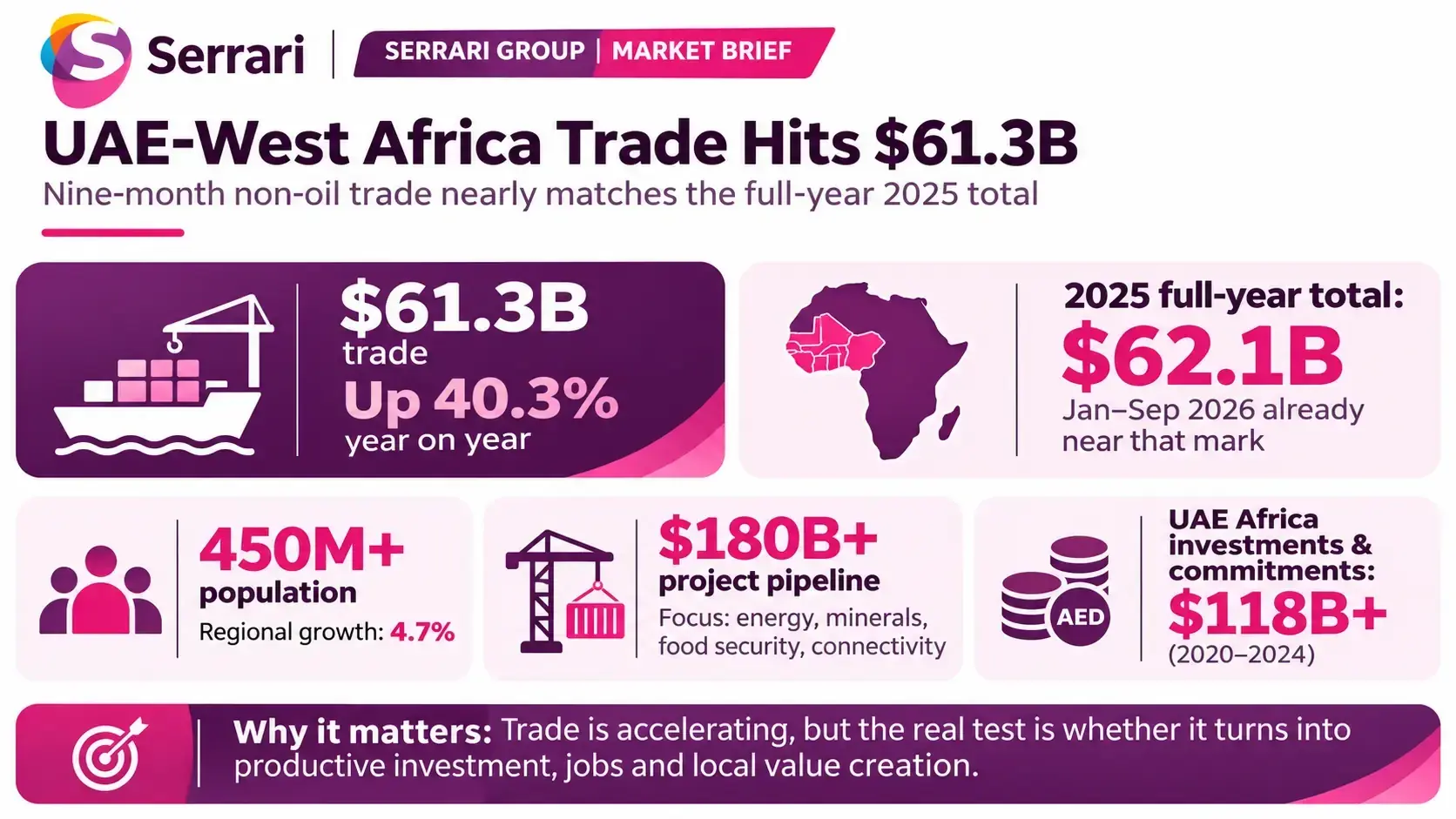
- Trade accelerates: UAE-West Africa non-oil trade reached $61.3 billion during January–September 2026, up 40.3% year on year.
- Nearly a full-year total: Nine-month turnover was about 98.7% of the $62.1 billion registered throughout 2025, when trade grew 56.3%.
- Major investment pipeline: West African officials and partners highlighted more than $180 billion in potential projects across energy, minerals, agriculture and connectivity.
- Africa-wide commitments: UAE investments and investment commitments exceeded $118 billion in 2020–2024, a figure that does not represent completed spending solely in West Africa.
- Sierra Leone partnership: A bilateral economic partnership agreement was signed in February 2026, although signing alone does not establish that every provision has entered into force.
- Central challenge: Greater trade must translate into productive investment, local value addition and stronger regional supply chains to deliver lasting benefits.
Why UAE Trade With West Africa Is Growing So Quickly
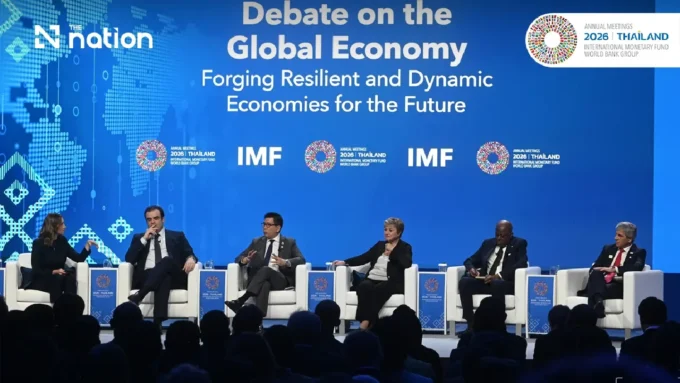
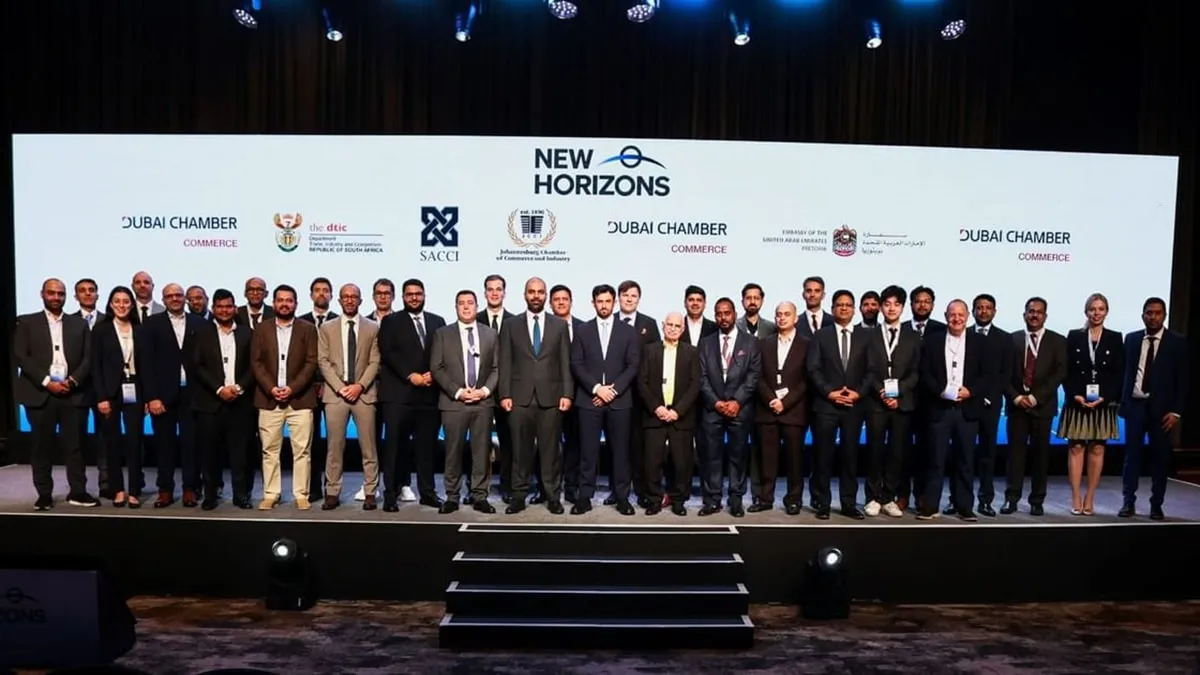
The UAE’s growing relationship with West Africa is part of a strategy to expand trade beyond oil and deepen commercial links with fast-growing markets. At the November 17–18 West Africa Integration and Investment Summit in Lungi, UAE Minister of Foreign Trade Thani bin Ahmed Al Zeyoudi reported that regional non-oil trade rose 40.3% from a year earlier. The previous full-year total had already jumped 56.3% in 2025, suggesting that the latest increase is not an isolated monthly surge.
The comparison, however, requires care. The $61.3 billion covers nine months, while $62.1 billion covers twelve. The 40.3% growth rate compares January–September 2026 with the corresponding period in 2025, not with the entire previous year. It would also be misleading to treat the nine-month figure as the UAE’s exports to West Africa alone: bilateral trade covers goods moving in both directions under the reporting definition, and the published headline does not establish their precise balance.
Why is the region attractive? More than 450 million people live in a group of markets with substantial demand for energy, food, consumer goods, transport infrastructure and industrial equipment. The UAE brings access to international trading networks, financing and logistics expertise, while West African economies offer customers, productive resources and potential investment destinations. The minister cited regional growth of 4.7%, though growth prospects are not uniform across countries.
The UAE’s role as a trading and redistribution centre is another factor. A rise in goods passing between its commercial networks and African markets can expand headline trade even when the underlying products are manufactured somewhere else. That makes it essential to distinguish stronger commercial connectivity from greater local industrial production.
Why the UAE Wants More Than Export Markets
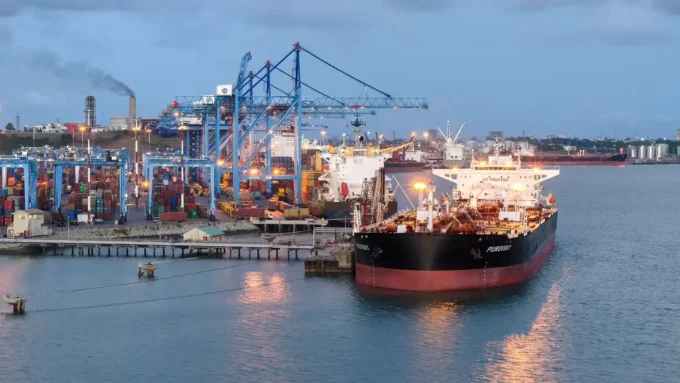
The UAE has an economic incentive to turn trade relationships into long-term participation in ports, power systems, manufacturing and supply chains. Logistics investments can create business for ports and distribution companies; reliable energy projects can support both industrial customers and investors seeking operating revenue; and food-system investments may strengthen access to agricultural commodities and processed goods.
A September assessment of African partnerships described Emirati activity in Senegal’s port infrastructure and Togo’s solar power sector. These examples show that the relationship already extends beyond buying and selling finished goods. They do not, by themselves, prove that every project under discussion has reached financial close or produced its expected economic benefits.
The reported $118 billion of investment and investment commitments across Africa between 2020 and 2024 is considerable, but commitments and realised spending must be separated. Some announced projects may proceed over many years, change scale or depend on regulatory and financing milestones. It is therefore inappropriate to divide that figure among West African countries or present it as money already transferred to their economies.
For West African governments, the attraction of diversified overseas capital is straightforward. Infrastructure needs are large, public budgets are constrained and dependence on any single foreign financing source creates vulnerability. Commercial partnerships can supplement domestic savings and development finance, provided agreements offer transparent terms and credible economic returns.
Context is everything. Stay ahead of shifting trends with today’s market updates, and uncover emerging opportunities using the Serrari Group Market Index and Marketplace. Then, take control of your own financial future by exploring our Money & Life Reset Transformation Blueprint ™ to build stronger habits, create better systems, and design a path toward lasting wealth.
The $180 Billion Opportunity—and the Financing Gap
At the summit, Al Zeyoudi cited a regional project pipeline exceeding $180 billion, concentrated in energy, industry and minerals, food security and connectivity. That is a measure of identified opportunities, not the value of signed contracts or guaranteed funding.
The distinction helps explain why regional leaders used an investment summit rather than a conventional trade fair. Projects can look attractive in principle but remain unfinanceable without secure land rights, dependable electricity, clear offtake agreements, environmental assessments, consistent regulation and arrangements to manage exchange-rate risk. An investor interested in a processing plant must know not just where raw materials will come from but whether transport links, power supply and paying customers will remain reliable.
Energy investments could lower the operating costs of factories and cold-storage facilities. Better roads, ports and border systems could reduce delays for agricultural exports. Local mineral processing could keep more revenue and technical skills in producing economies rather than leaving countries dependent on shipping raw materials abroad.
But governments also need to decide who captures the gains. A large concession may generate construction activity without delivering substantial domestic procurement or long-term employment. The policy objective should therefore be projects with measurable output, local supplier participation, skills transfer and public benefits, not simply higher announced investment totals.
Why Sierra Leone’s Trade Agreement Matters
Sierra Leone offers a concrete illustration of how the UAE is trying to convert regional interest into bilateral arrangements. The two governments signed a Comprehensive Economic Partnership Agreement on February 2, 2026, with the stated goal of expanding trade, private investment and cooperation in sectors including agriculture, infrastructure and energy.
The agreement is strategically important because a relatively small economy can gain access to partners with financing capacity, logistics networks and experience developing major projects. However, an agreement’s signature should not be confused with evidence that its provisions have all become legally operative. The international treaty record records the treaty as signed; the implementation status and practical effects warrant continued monitoring.
Bilateral non-oil trade with Sierra Leone reached $152.3 million in 2025 and $113.4 million from January through October 2026, according to summit-side discussions. Those figures should not be read as proof of a decline: ten months are being compared with a full year, and the corresponding ten-month 2025 figure was not provided.
For Sierra Leone, the critical outcomes will be whether new partnerships help move minerals into processing, improve agricultural productivity, expand dependable energy supply and reduce the cost of getting goods to market. The benefits are more likely to be durable if domestic firms can participate rather than merely observe the arrival of large foreign contractors.
What Rising Trade Means for Businesses and Households
Importers and exporters may benefit first from stronger shipping, warehousing and commercial networks. More reliable access to buyers can help agricultural producers and manufacturers plan output, while more predictable logistics can reduce spoilage, inventory requirements and delivery costs. Businesses might also gain access to additional equipment suppliers and sources of financing.
The gains are not automatic for consumers. Higher bilateral trade does not guarantee cheaper food or fuel, because final prices depend on exchange rates, taxes, market competition, distribution costs and domestic production. If trade growth consists mainly of imported finished goods, local retailers may gain while domestic factories face stronger competition.
This is why value addition matters. West African economies that can process agricultural commodities, manufacture components or supply logistics and business services capture a broader share of the commercial relationship. The resulting benefits may include formal employment, tax revenue and improved skills, but each outcome must be demonstrated through actual projects rather than inferred from trade turnover.
Regional integration is equally important. A company establishing production in one West African country may need customers and suppliers across several neighbouring markets to achieve efficient scale. Delays at borders, incompatible standards and uncertain payments can prevent that expansion even when a foreign investor is willing to finance a factory.
The Bigger Picture: From Trade Headlines to Economic Transformation
The summit takes place against a larger shift in the UAE’s Africa strategy. The country has been pursuing economic partnership agreements and investment links across the continent as it diversifies commercial relationships. West Africa, meanwhile, is trying to develop productive capacity and connect its markets rather than depend exclusively on commodity exports and imported manufactured goods.
Those objectives can reinforce one another, but they can also diverge. Investors generally seek predictable returns, while governments must consider employment, public revenue, environmental protection and local industrial development. Good outcomes require transparent contracts, competitive procurement, reliable institutions and clear reporting of what has actually been delivered.
The next test is therefore not whether the trade total exceeds $62.1 billion by year-end. It is whether the region’s governments and private-sector partners convert proposed investments into operating power plants, modern logistics links, competitive industries and functioning agricultural supply chains. Tracking completed capital expenditure, local sourcing, job creation and export diversification would give a far more useful picture of progress than announcements alone.
The $61.3 billion milestone shows that commercial engagement is accelerating; it does not yet prove that West Africa is receiving an equivalent increase in productive investment. Turning this momentum into broad-based economic growth will depend on the quality of the deals, the strength of regional integration and the share of value that stays within West African economies.
Sources: Emirates News Agency / Punch Newspapers / UAE Ministry of Foreign Affairs / UN Trade and Development / Zawya
Your financial future isn’t something you wait for—it’s something you build.
The real question is: when do you begin?
Move beyond simply staying informed.
Navigate the markets with clarity—track trends through the Serrari Group Market Index, uncover opportunities in the Serrari Marketplace, and build practical knowledge with our Curated Wealth Builder Platform.
Stay connected to what truly matters.
Get daily insights on macro trends and financial movements across Kenya, Africa, and global markets—delivered through the Serrari Newsletter.
Growth opens doors.
Advance your career through professional programs including ACCA, HESI A2, ATI TEAS 7 , HESI EXIT , NCLEX – RN and NCLEX – PN, Financial Literacy!🌟—designed to move you forward with confidence.
See where money is flowing—clearly and in real time.
Track Money Market Funds, Treasury Bills, Treasury Bonds, Green Bonds, and Fixed Deposits, alongside global and African indexes, key economic indicators, and the evolving Crypto and stablecoin landscape—all within Serrari’s Market Index.