



Malaysia’s return to the international sovereign sukuk market in July 2026 attracted a peak order book exceeding US1.5 billion issuance, allowing the government to secure its tightest global sukuk spreads on record. The outcome, highlighted again in a November 3 parliamentary reply, matters beyond a successful fundraising exercise: it shows how fiscal consolidation, stable sovereign ratings and a well-established Islamic finance market can lower the premium investors demand for lending to a government. Yet the transaction also raises a crucial distinction between strong demand for a particular security and the long-term sustainability of public finances, especially when debt is denominated in foreign currency.
Key Overview
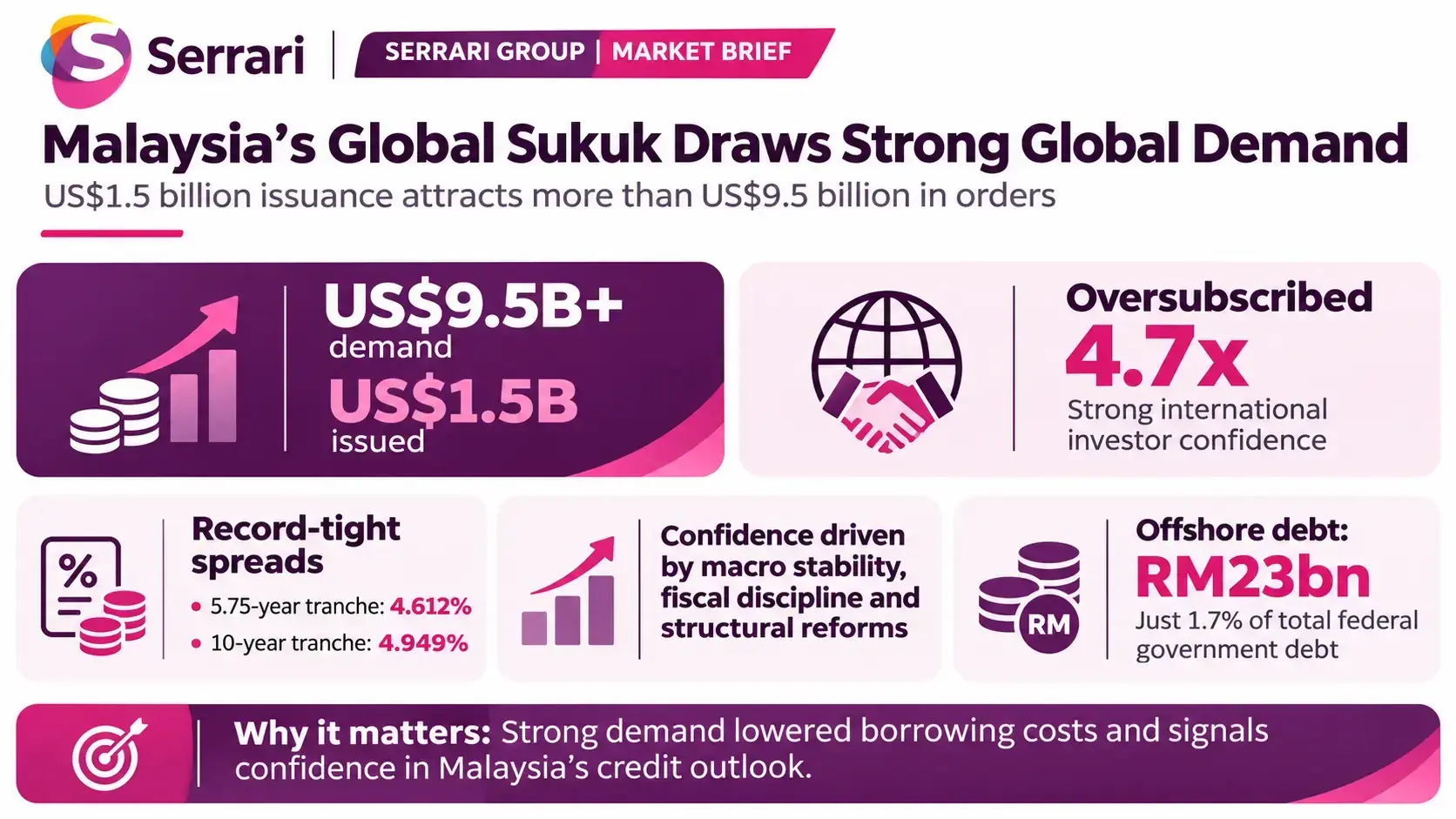
- US$1.5 billion raised: Malaysia issued US650 million of 10-year sukuk in July 2026.
- Demand exceeded US$9.5 billion: The figure represents the peak order book; the government separately reported 4.7 times oversubscription.
- Record-tight pricing: Both tranches tightened by 30 basis points from initial guidance, closing at spreads of 15 and 25 basis points over comparable US Treasuries.
- Final profit rates: The 5.75-year tranche priced at 4.612% annually and the 10-year tranche at 4.949%.
- Limited offshore exposure: Following the issue, federal offshore debt was RM23 billion, about 1.7% of total federal debt and below the RM35 billion legal ceiling.
- Wider significance: The sovereign transaction establishes reference prices that could help Malaysian companies and financial institutions access overseas Islamic finance markets.
Why Global Investors Rushed Into Malaysia’s Sukuk
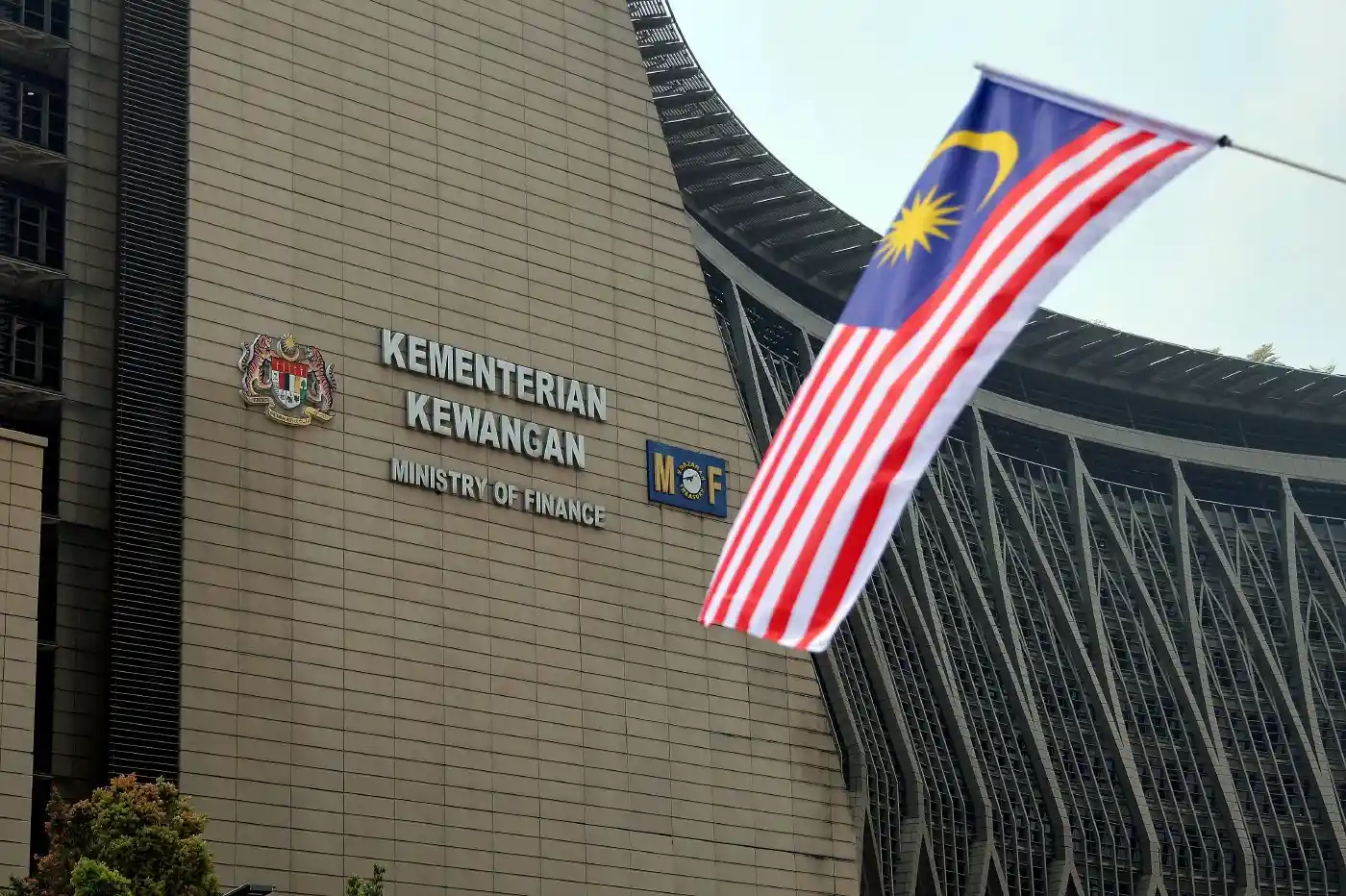
Malaysia’s July transaction was not simply another government borrowing exercise. It marked the country’s return to the international sovereign sukuk market after five years and offered investors two new dollar-denominated benchmarks. In its July 24 issuance announcement, the finance ministry disclosed that the US850 million in 5.75-year trust certificates and US$650 million in 10-year certificates.
The peak order book exceeded US$9.5 billion, while the official reported oversubscription rate was 4.7 times. These should not be confused with a straightforward calculation of peak orders divided by the final issue size. The peak book captures demand at a particular point in marketing, whereas the reported oversubscription measure reflects the transaction’s own bookbuilding convention. Both figures indicate substantial investor interest, but they are not interchangeable.
The deeper explanation lies in the combination of sovereign creditworthiness and market structure. International buyers were offered exposure to a country with an established Islamic capital market, investment-grade ratings, a diversified investor base and a relatively small stock of foreign-currency government debt. Sukuk also provide a Shariah-compliant alternative to conventional bonds, broadening the pool of potential investors beyond institutions focused exclusively on conventional fixed income.
Malaysia’s government linked demand to its fiscal and economic reform programme. The official fiscal performance figures show that the fiscal deficit narrowed from 6.4% of GDP in 2021 to 3.7% in 2025. Economic growth reached 5.2% in both 2024 and 2025, while the ministry reported 5.4% growth in the first quarter of 2026. Such indicators help explain why investors were willing to accept a narrower risk premium, although they do not remove fiscal or currency risks.
The issue was also supported by extensive investor outreach. The ministry said the roadshow engaged more than 140 international investors, including asset managers, sovereign wealth funds, banks, pension funds and other institutions. This breadth matters because demand from different types of investors can reduce dependence on any single buyer category or geographic market.
Context is everything. Stay ahead of shifting trends with today’s market updates, and uncover emerging opportunities using the Serrari Group Market Index and Marketplace. Then, take control of your own financial future by exploring our Money & Life Reset Transformation Blueprint ™ to build stronger habits, create better systems, and design a path toward lasting wealth.
How Strong Demand Reduced Malaysia’s Borrowing Costs
When investors compete for a limited supply of high-quality securities, issuers can often reduce the return offered without losing sufficient demand. Malaysia used that advantage to tighten pricing by 30 basis points on both tranches from initial guidance. One basis point equals 0.01 percentage point, so 30 basis points represents 0.30 percentage point.
The 5.75-year sukuk was priced 15 basis points above the corresponding five-year US Treasury benchmark, with a final annual profit rate of 4.612%. The 10-year sukuk was priced 25 basis points above the relevant 10-year Treasury benchmark, with a final profit rate of 4.949%. These are the transaction’s profit rates, not the Treasury yields themselves, as confirmed by the government’s transaction terms.
The difference is financially meaningful. A narrower spread means the issuer pays less compensation above a comparable benchmark for perceived credit and other risks. Holding the benchmark and other pricing factors constant, 30 basis points on US$1.5 billion corresponds to roughly US$4.5 million a year in simple illustrative financing-cost terms. This is not an official estimate of realised savings: the actual economic comparison depends on the pricing benchmarks, cash flows, original guidance and duration of each tranche.
The spreads were particularly notable because both tranches carried Moody’s A3 and S&P Global Ratings A− ratings. In its November parliamentary account, the finance ministry said pricing was close to levels associated with higher-rated sovereign issuers. That comparison is a statement about this deal’s spreads, not evidence that Malaysia’s formal credit ratings had improved.
A competitive transaction can also produce benefits beyond the government’s own interest expense. Sovereign securities provide reference points for domestic businesses planning foreign-currency financing. Once a credible government yield curve exists at several maturities, corporate and government-linked issuers can price their securities against it, making future fundraising negotiations more transparent.
Why Fiscal Discipline Was Central to the Investor Response
Investors purchasing sovereign debt ultimately assess a government’s ability and willingness to honour future payment commitments. For Malaysia, the argument supporting the sukuk was not that public debt had disappeared, but that the authorities had created a more credible path for managing borrowing needs.
The narrowing deficit is central to that argument. A smaller fiscal shortfall generally reduces the need for new borrowing relative to national output, while more predictable fiscal management can limit uncertainty around future issuance. Malaysia’s Public Finance and Fiscal Responsibility Act 2023 also embeds a framework for longer-term fiscal objectives, including a medium-term deficit target of 3% of GDP.
The country’s 2027 fiscal outlook describes the July issuance as a return to global sukuk markets after five years and identifies its two maturities as an effort to build benchmark reference points while spreading repayments across time. Rather than relying solely on investor enthusiasm, Malaysia is attempting to link foreign-market borrowing to a wider debt-management strategy.
There are nevertheless limitations. A narrower issuance spread is not the same as a lower overall debt stock. Nor does demand for one heavily subscribed instrument guarantee the government can always refinance at similar terms. US Treasury yields, global liquidity, geopolitical risks and changes in Malaysia’s fiscal performance could all push future borrowing costs higher.
For this reason, the July deal is best read as a market endorsement of Malaysia’s credit position at the time of issuance, rather than a permanent verdict on its finances. Continued deficit reduction and credible execution of structural reforms will determine whether that confidence endures.
Offshore Debt Exposure Remains a Key Safeguard
The foreign-currency dimension is especially important. Dollar-denominated borrowing diversifies funding sources and can deepen relationships with international investors, but it also creates exchange-rate exposure. If the ringgit weakens against the dollar, servicing a fixed dollar obligation can become more expensive when measured in local currency.
Following the 2026 sukuk issuance, Malaysia’s outstanding federal offshore debt stood at RM23 billion, equivalent to approximately 1.7% of total federal government debt. That was comfortably below the RM35 billion statutory ceiling established under the External Loans Act 1963, according to the government’s debt-management disclosure.
The RM12 billion difference between the reported offshore debt stock and the statutory ceiling represents legal headroom, not a recommendation or commitment to borrow the remaining amount. Keeping foreign obligations to a small share of federal debt makes the overall portfolio less sensitive to currency movements than a debt structure heavily dependent on offshore financing.
Maturity management offers another protection. The July deal added obligations maturing around 2032 and 2036 rather than concentrating repayments in a single year. Spreading principal repayments can reduce refinancing pressure, particularly during periods when international capital markets become volatile or expensive.
This matters to taxpayers and businesses because debt-service costs compete with spending priorities. If borrowing costs rise sharply or refinancing becomes difficult, governments may have less budgetary flexibility for infrastructure, social programmes and other public commitments. Prudent issuance today can therefore protect policy choices tomorrow, although lower financing spreads alone cannot guarantee lower taxes or increased public spending.
What the Deal Means for Islamic Finance and Regional Borrowers
Malaysia’s sukuk success also reflects a structural advantage built over decades: an extensive Islamic finance ecosystem with established legal, Shariah governance and market infrastructure. Sukuk are not merely conventional bonds with different names. Their legal structures connect investors’ claims to defined assets, services or contractual rights while providing agreed distribution mechanisms.
In this case, the certificates were supported by rights to services within Malaysia’s urban rail transport network under the Manafae concept, rather than by transferring ownership of the physical rail infrastructure. The ministry’s transaction structure disclosure explains that the proceeds were intended for general Shariah-compliant government purposes, including development expenditure or refinancing existing obligations.
The market’s depth is significant. In a September 2026 Islamic finance address, a Malaysian central bank deputy governor said Malaysia accounted for approximately 37% of global sukuk outstanding and that Islamic financing made up almost half of domestic banking-system financing. These figures help explain why a Malaysian sovereign issuance can attract investors already familiar with the market’s structures and oversight.
The longer-term opportunity lies in international capital mobilisation. A successful sovereign benchmark can give Malaysian corporations a pricing reference and support wider investor engagement, while demonstrating to other emerging economies how a well-developed Islamic finance framework may broaden funding options. However, replicating Malaysia’s pricing requires more than adopting sukuk documentation: investors also consider sovereign ratings, market depth, legal certainty, economic stability and fiscal credibility.
For Malaysia, the immediate result is clear: the government obtained US$1.5 billion at record-tight spreads while keeping offshore debt a small fraction of total obligations. The larger test is whether it can translate that investor confidence into sustained fiscal resilience and lower financing friction for the rest of the economy. That is why this transaction matters now—not simply because the order book was large, but because it offers a measurable signal of what disciplined debt management and mature capital markets can achieve together.
Sources: Ministry of Finance Malaysia / Bernama / Government of Malaysia Fiscal Outlook 2027 / Bank for International Settlements
Your financial future isn’t something you wait for—it’s something you build.
The real question is: when do you begin?
Move beyond simply staying informed.
Navigate the markets with clarity—track trends through the Serrari Group Market Index, uncover opportunities in the Serrari Marketplace, and build practical knowledge with our Curated Wealth Builder Platform.
Stay connected to what truly matters.
Get daily insights on macro trends and financial movements across Kenya, Africa, and global markets—delivered through the Serrari Newsletter.
Growth opens doors.
Advance your career through professional programs including ACCA, HESI A2, ATI TEAS 7 , HESI EXIT , NCLEX – RN and NCLEX – PN, Financial Literacy!🌟—designed to move you forward with confidence.
See where money is flowing—clearly and in real time.
Track Money Market Funds, Treasury Bills, Treasury Bonds, Green Bonds, and Fixed Deposits, alongside global and African indexes, key economic indicators, and the evolving Crypto and stablecoin landscape—all within Serrari’s Market Index.