
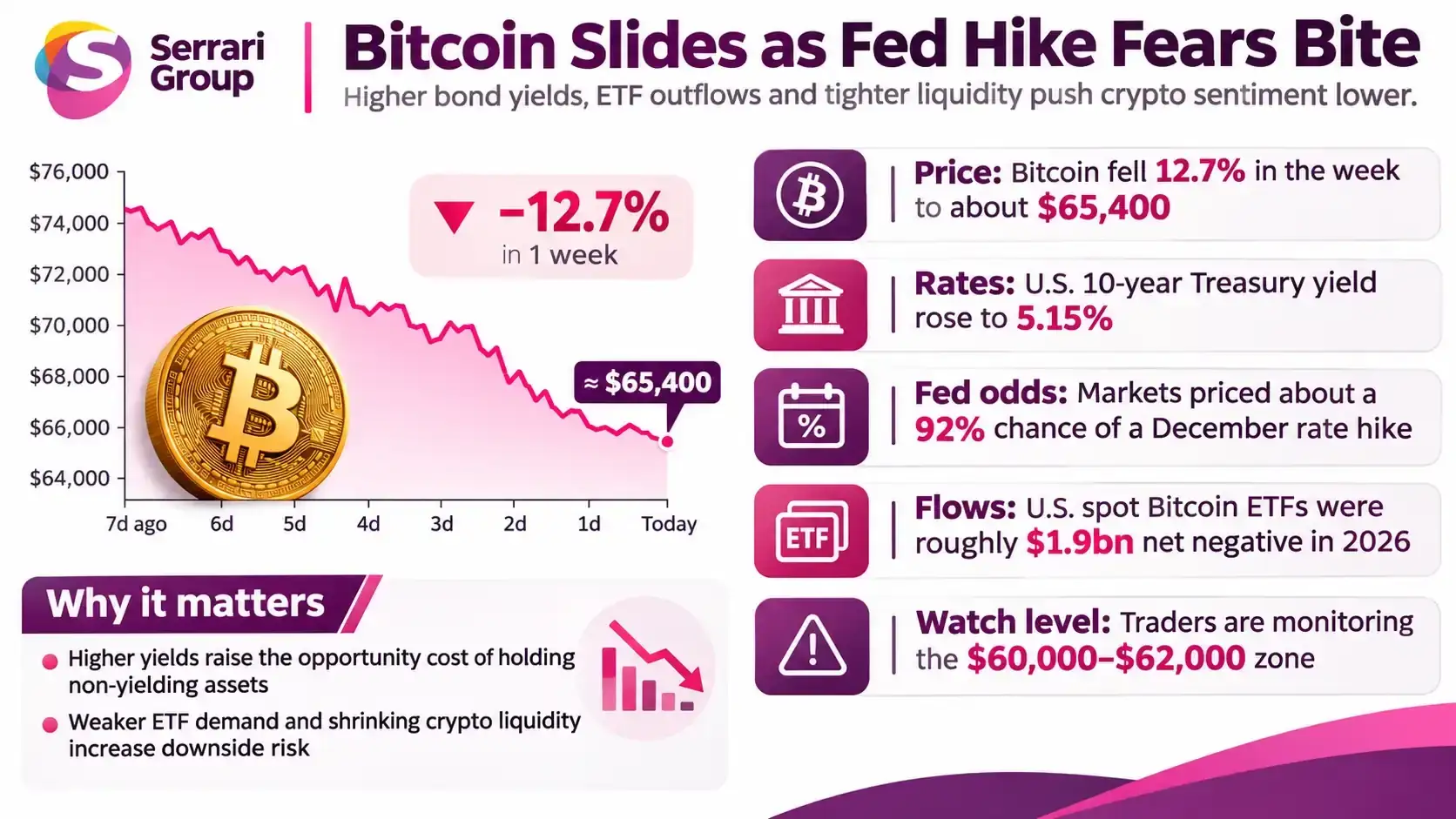
Bitcoin’s 12.7% weekly fall to $65,400 has exposed more than a technical setback. Rising U.S. bond yields and expectations of tighter Federal Reserve policy have increased the cost of holding non-yielding assets, while redemptions from exchange-traded funds and contracting stablecoin supply have reduced the fresh capital available to support prices. Bitcoin’s break below its 200-week moving average has intensified fears of a deeper correction, although the next direction will depend on whether institutional demand returns and interest-rate expectations ease.
Key Overview
- Price breakdown: Bitcoin lost 12.7% over the week assessed on November 16, closing near $65,400 and below its 200-week moving average around $68,000.
- Interest-rate pressure: The 10-year U.S. Treasury yield reached about 5.15%, while Wintermute cited approximately 92% market-implied odds of a December Fed rate increase.
- Institutional withdrawals: U.S. spot Bitcoin ETFs were approximately $1.9 billion net negative for 2026, reversing the substantial inflows seen in 2024 and 2025.
- Liquidity contraction: Stablecoin supply reportedly fell by 16 billion in 30 days, while $1.7 billion in leveraged positions was liquidated over one weekend period.
- Key thresholds: Analysts are monitoring $68,000 as a recovery marker and the 62,000 region as a potential downside test.
Why Higher Bond Yields Are Putting Bitcoin Under Pressure
Bitcoin’s retreat is increasingly a story about global financing conditions rather than cryptocurrency sentiment alone. In its November 16 market assessment, trading firm Wintermute reported a 12.7% weekly decline to $65,400, compared with a 2.5% gain in the S&P 500. That divergence matters because it shows investors were not abandoning every risky asset indiscriminately. Instead, they were becoming more selective about which exposures justified their cost.
The immediate catalyst was a reassessment of U.S. interest rates. Core consumer inflation increased by 0.3% for a third consecutive month, reinforcing concerns that price pressures were proving persistent. The benchmark 10-year Treasury yield reached approximately 5.15%, up around 30 basis points during the week. Wintermute estimated that markets were assigning roughly a 92% probability to another Federal Reserve rate increase in December. That figure is a market-implied estimate at a particular point in time, not a Federal Reserve commitment or a guarantee of the decision.
Higher yields change the investment calculation. Government bonds offer contractual interest payments, while Bitcoin generates no interest or dividend by simply being held. As the return available on relatively low-risk instruments rises, investors require stronger expectations of price appreciation to justify holding volatile alternatives. This can particularly affect leveraged traders, whose financing costs and potential losses become more difficult to absorb.
The October Federal Reserve meeting minutes, released on November 18, reinforce the policy backdrop. Officials kept the policy range at 3.75%–4.00% at that meeting, but almost all participants judged that additional tightening would probably be appropriate under their baseline outlooks. Some considered a larger increase possible if inflation disappointed. The minutes strengthen the explanation for why markets have become defensive, although they do not establish precisely what the central bank will do in December.
This matters beyond Bitcoin. More expensive capital can reduce demand for speculative technology shares, leveraged investments and other assets whose valuations rely heavily on future growth. The present selloff therefore reflects a broader repricing of financial conditions, with Bitcoin unusually exposed because it lacks an underlying cash yield.
ETF Withdrawals Remove a Major Source of Buying
During Bitcoin’s 2024–2025 advance, exchange-traded funds provided a relatively accessible route for investors to gain exposure without directly managing digital wallets. Sustained subscriptions created an additional source of demand. That supportive flow has weakened substantially.
Wintermute reported approximately $35 billion in net spot Bitcoin ETF inflows in 2024 and $21 billion in 2025, against roughly $1.9 billion in net outflows for 2026 as of its latest assessment. Separately, fund-flow reporting for November 5–13 showed about $1.91 billion leaving U.S. spot Bitcoin funds across seven consecutive trading sessions. These are different measures: the first is a year-to-date balance and the second is a recent withdrawal streak.
The distinction is important because a concentrated redemption wave can affect market prices even when the longer-term annual balance appears less severe. When investors withdraw money from spot-backed products, funds or their counterparties may need to adjust holdings, weakening a demand channel that previously helped absorb Bitcoin supply. If new purchases do not replace those sales, the market must find a lower price to clear.
The flow picture is not uniformly negative every day. Trading data reported on November 17 indicated a modest $7.9 million net ETF inflow for the preceding Monday, ending the seven-session withdrawal streak. That is a positive change in direction, but a single small inflow is not enough to offset billions in previous withdrawals or establish a durable recovery.
For investors, the relevant question is whether several sessions of meaningful inflows return, rather than whether one day’s total turns positive. Persistent demand would suggest institutions are again willing to accumulate Bitcoin at current prices; renewed redemptions would strengthen the case for further weakness.
Stablecoin Contraction and Liquidations Deepen the Decline
Exchange-traded funds are only one component of cryptocurrency liquidity. Stablecoins, digital tokens intended to maintain a stable value against currencies such as the dollar, also provide trading balances that can be rapidly deployed into crypto assets. A sustained decline in their total circulating supply can indicate that capital is being redeemed or moved out of the ecosystem.
Wintermute estimated a 16 billion contraction in stablecoin supply over 30 days. This does not mean that every dollar removed would otherwise have purchased Bitcoin; stablecoins also support payments, transfers and other trading strategies. Nevertheless, declining supply alongside ETF withdrawals reduces confidence that fresh buying power is arriving to counter sellers.
Leverage then magnified the price movement. Wintermute estimated that about $1.7 billion in positions were liquidated over the 24 hours into Sunday, with roughly 80% representing bullish long positions. When prices drop below the collateral thresholds on leveraged trades, exchanges close positions automatically. These forced sales can push prices down further, triggering additional liquidations in a feedback loop.
That mechanism explains why a violent decline does not necessarily mark the final bottom. A rebound immediately after forced liquidations may reflect traders closing bearish bets or reduced selling pressure, rather than investors committing new long-term capital. Wintermute also warned that altcoin open interest remained almost twice Bitcoin’s, suggesting potential vulnerability elsewhere in the digital-asset market.
Options traders have been paying attention to downside protection. The original market reporting identified heavy demand for puts around $60,000 and $62,000. A put option generally increases in value when the underlying asset falls below its strike, making it a common hedge against lower prices. Such positioning reveals concern and hedging demand, but it is not proof that Bitcoin will reach those levels.
Context is everything. Stay ahead of shifting trends with today’s market updates, and uncover emerging opportunities using the Serrari Group Market Index and Marketplace. Then, take control of your own financial future by exploring our Money & Life Reset Transformation Blueprint ™ to build stronger habits, create better systems, and design a path toward lasting wealth.
Strategy’s Index Removal Raises Another Institutional Risk
Pressure is also spreading to public companies that hold large Bitcoin reserves. Strategy, one of the most prominent corporate Bitcoin holders, faces exclusion from major equity benchmarks following a change in index eligibility rules. The November index decision is scheduled to take effect at the close of November 30.
The significance is indirect but potentially substantial. Passive funds tracking the affected indexes may need to sell Strategy shares to align their portfolios with the revised benchmark composition. That selling does not automatically oblige Strategy to dispose of its Bitcoin holdings. However, pressure on the company’s share price could weaken its ability to raise capital on attractive terms and, consequently, its capacity to expand its Bitcoin treasury.
Wintermute estimated that the spot Bitcoin price was approximately 14% below Strategy’s reported average acquisition cost of $75,500 at the time of its analysis. An unrealized loss is not itself a forced liquidation, particularly when a company has a longer investment horizon. The broader concern is whether the corporate treasury model can continue generating incremental demand during a period of weaker market valuations and less favorable financing conditions.
AI Earnings and an IPO Add to the Competition for Capital
Bitcoin’s next challenge is linked to the concentration of investor attention in artificial intelligence. Nvidia’s earnings and the anticipated initial public offering of Anthropic present potential tests of risk appetite. Disappointing earnings or uncertainty about future AI investment returns could encourage portfolio managers to reduce speculative exposure elsewhere, including cryptocurrencies.
Anthropic has progressed beyond informal listing speculation. Its November 17 amended registration filing describes a proposed offering of 825 million Class A shares. However, the preliminary document is explicitly subject to completion; the existence of an offering filing does not confirm that trading has begun or guarantee a particular debut date.
A large offering could compete for investment allocations if institutions finance subscriptions by trimming existing positions. Yet a direct causal link between anticipated Anthropic demand and Bitcoin’s weekly decline has not been established. The more defensible argument is that both markets are competing for risk capital at a time when financing costs have increased and investors are scrutinizing valuations more closely.
The Fed’s latest financial-stability discussion also highlighted exposure to AI-related borrowing and the possibility that disappointing investment returns could amplify market losses. This creates a connection between crypto weakness and broader capital-market vulnerabilities, even though the assets have very different fundamentals.
What Could Determine Bitcoin’s Next Move?
Technically, the break below the 200-week moving average near $68,000 has weakened confidence in a long-term support level that many market participants follow. Wintermute identified a daily recovery above that level, accompanied by renewed net ETF inflows, as a condition that could justify a less defensive stance. Without stronger demand, the 62,000 area remains an important zone to monitor, while movement into the $50,000 range is a downside scenario rather than an assured outcome.
The policy calendar is just as significant as technical trading levels. Investors will be watching inflation data and the December 8–9 Federal Reserve meeting for evidence that expected tightening is either strengthening or losing momentum. Lower yields and softer rate-hike expectations could reduce the opportunity cost of owning Bitcoin. Conversely, persistent inflation could keep pressure on speculative assets even if short-lived rebounds occur.
The central lesson is that Bitcoin’s institutional adoption has not insulated it from conventional financial-market forces. ETFs, corporate treasuries and leveraged trading have connected its price more closely to portfolio allocation decisions and the cost of money. Those channels can accelerate rallies when capital is abundant, but they can also intensify declines when liquidity reverses.
For now, a convincing recovery requires more than a bounce in the quoted price. It requires evidence that money is flowing back into the market, forced selling is subsiding and the interest-rate outlook is becoming less hostile. That combination, rather than one isolated technical level, will determine whether the latest slide becomes a temporary correction or a deeper phase of the bear market.
Sources: Wintermute / Federal Reserve / The Block / CoinDesk / U.S. Securities and Exchange Commission
Your financial future isn’t something you wait for—it’s something you build.
The real question is: when do you begin?
Move beyond simply staying informed.
Navigate the markets with clarity—track trends through the Serrari Group Market Index, uncover opportunities in the Serrari Marketplace, and build practical knowledge with our Curated Wealth Builder Platform.
Stay connected to what truly matters.
Get daily insights on macro trends and financial movements across Kenya, Africa, and global markets—delivered through the Serrari Newsletter.
Growth opens doors.
Advance your career through professional programs including ACCA, HESI A2, ATI TEAS 7 , HESI EXIT , NCLEX – RN and NCLEX – PN, Financial Literacy!🌟—designed to move you forward with confidence.
See where money is flowing—clearly and in real time.
Track Money Market Funds, Treasury Bills, Treasury Bonds, Green Bonds, and Fixed Deposits, alongside global and African indexes, key economic indicators, and the evolving Crypto and stablecoin landscape—all within Serrari’s Market Index.