
Russia expects domestically issued rouble stablecoins to gain market share in foreign trade transactions next year following the introduction of a new cryptocurrency law. The legislation, which took effect on September 1, 2026, allows rouble stablecoins to be issued as digital financial assets on public blockchains. Although none have been launched under the new framework, Sberbank expects strong demand for locally regulated payment solutions as businesses seek alternatives to traditional international settlement channels affected by Western sanctions.
Key Takeaways
- Russia expects locally issued rouble stablecoins to gain traction in cross-border trade transactions in 2027.
- A new cryptocurrency law that took effect on September 1 allows rouble stablecoins to be issued as digital financial assets on public blockchains.
- Russian companies have increasingly turned to cryptocurrencies as Western sanctions have restricted access to traditional international payment channels.
- Businesses currently rely heavily on A7A5, a rouble-pegged stablecoin issued in Kyrgyzstan, which recorded $140 billion in turnover this year.
- Sberbank is working with Russia’s central bank and has received digital depository and cryptocurrency exchange status.
- Security remains a major concern as Russia seeks to develop domestic cryptocurrency infrastructure that meets banking-sector standards.
Why Is Russia Expecting Rouble Stablecoins to Gain Market Share?
Russia expects locally issued rouble stablecoins to become more widely used in foreign trade transactions next year, following the introduction of legislation allowing their issuance within the country.
Alexander Vedyakhin, First Deputy CEO of Sberbank, said Russian-issued stablecoins could gain traction as businesses seek faster, cheaper and more secure ways to settle international transactions.
Russian companies have increasingly turned to cryptocurrencies as Western sanctions have hampered their ability to use traditional currencies to settle international transactions. Restrictions on conventional payment channels have encouraged businesses to explore alternative settlement methods, including digital assets.
However, until the new law creating a legal framework for cryptocurrency use came into force on September 1, 2026, issuing digital currencies in Russia was not permitted.
The legislation now provides a legal route for issuing rouble stablecoins as digital financial assets on public blockchains. Despite this development, no rouble stablecoins have yet been issued in Russia under the new framework.
Vedyakhin expects that to change soon, pointing to demand for payment instruments that can operate under Russian law.
“The market needs a cheap, secure, and fast tool for cross-border transactions, issued under Russian law,” he said.
He added that the legislation establishes the possibility of issuing rouble stablecoins in the form of digital financial assets on public blockchains.
The anticipated rollout could give Russian businesses another option for international settlements while reducing their dependence on stablecoins issued outside the country.
What Is Driving Demand for Rouble Stablecoins?
The growing interest in rouble stablecoins is closely linked to the difficulties Russian companies face when conducting international trade.
Western sanctions have made it harder for businesses to use traditional currencies and established financial channels for cross-border transactions. As a result, some companies have increasingly turned to cryptocurrencies to facilitate international payments.
Stablecoins offer a potential alternative because their value is pegged to another asset, such as a fiat currency or gold. This arrangement is intended to reduce the price fluctuations commonly associated with cryptocurrencies such as Bitcoin and Ethereum.
With their value pegged to other assets like a fiat currency or gold, stablecoins are gaining popularity globally even as they face scrutiny over their financial stability and use in money laundering.
For Russian businesses, a rouble-pegged stablecoin could make it easier to conduct transactions while maintaining a link to the domestic currency.
However, the proposed domestic instruments will enter a market where businesses are already using an alternative.
How Does A7A5 Fit Into Russia’s Stablecoin Market?
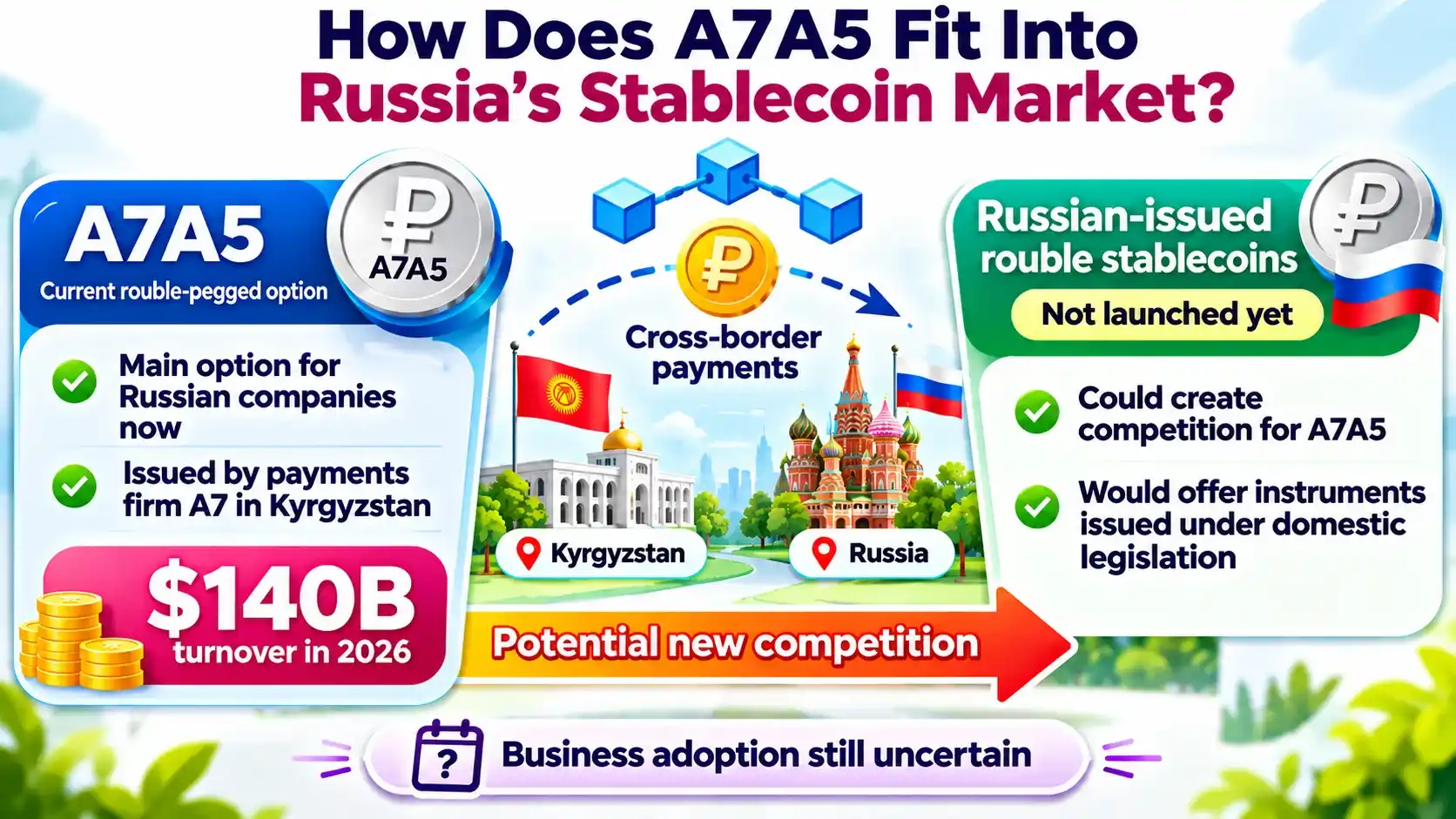
In the absence of domestically issued rouble stablecoins, Russian companies have primarily relied on A7A5, a rouble-pegged stablecoin issued by payments firm A7 in Kyrgyzstan last year.
A7A5 turnover reached $140 billion this year, according to Russian bank PSB, which co-founded A7.
The reported turnover highlights the scale of activity surrounding the existing rouble-pegged payment instrument and the demand for alternatives to traditional international settlement channels.
The introduction of Russian-issued stablecoins could create competition for A7A5 by providing businesses with instruments issued under domestic legislation.
However, Vedyakhin did not explain how the new Russian-issued stablecoins would perform against A7A5 or whether businesses would shift away from the existing instrument.
Instead, he expressed confidence in the potential demand for homegrown payment solutions.
This leaves an important question for the coming year: whether domestic issuance will attract enough businesses to establish a significant market presence alongside existing alternatives.
Context is everything. Stay ahead of shifting trends with today’s market updates, and uncover emerging opportunities using the Serrari Group Market Index and Marketplace. Then, take control of your own financial future by exploring our Money & Life Reset Transformation Blueprint ™ to build stronger habits, create better systems, and design a path toward lasting wealth.
What Role Will Sberbank Play in Russia’s Crypto Infrastructure?
Sberbank is positioning itself to participate in the development of Russia’s cryptocurrency infrastructure under the new legislation.
Vedyakhin said the bank is actively working with the country’s central bank as the regulatory framework takes shape.
In October 2026, Sberbank received digital depository and cryptocurrency exchange status under the new law. It is also planning to launch a depository to manage digital securities in December.
These developments indicate that the bank is preparing to support a broader range of digital financial activities as Russia establishes its domestic cryptocurrency market.
A digital depository can provide infrastructure for recording and managing digital financial assets, while cryptocurrency exchange services can support the trading of permitted digital assets.
Sberbank’s involvement could therefore extend beyond the issuance of stablecoins to the infrastructure required to manage and facilitate digital financial transactions.
However, the expected launch of domestic stablecoins and the development of supporting infrastructure will depend on how the new framework is implemented.
Why Is Cryptocurrency Security a Major Concern?
While Russia is seeking to expand the use of cryptocurrencies in international payments, security remains a significant challenge.
Vedyakhin warned that Russian cryptocurrency infrastructure needs security mechanisms that meet banking-sector standards. These should include safeguards against human error and social engineering, where attackers manipulate individuals into revealing sensitive information or authorising fraudulent transactions.
His comments came after a reported $6.3 billion hack involving Binance, the world’s largest cryptocurrency exchange, last month.
The incident highlights the operational risks facing cryptocurrency platforms, including large market participants with substantial resources.
“We are doing everything possible for this. Even the largest participants in the cryptocurrency market remain vulnerable to complex cyberattacks based on social engineering,” he said.
For Russia, building a domestic stablecoin market will therefore require more than legal permission to issue digital assets. Financial institutions will also need reliable systems for protecting transactions, managing digital assets and preventing cyberattacks.
This is particularly important if locally issued stablecoins are expected to support international trade, where businesses will need confidence that payments can be completed securely and reliably.
The Bigger Picture: Stablecoins Are Becoming Part of Cross-Border Payments
Russia’s planned expansion of rouble stablecoins reflects the growing role of digital currencies in international payment systems.
Stablecoins are increasingly being explored as instruments for transferring value across borders, particularly where businesses face difficulties accessing traditional banking channels or need alternative settlement arrangements.
Unlike highly volatile cryptocurrencies, stablecoins are designed to maintain a relatively stable value through their links to underlying assets. This makes them potentially useful for payments and settlements, although their reliability depends on the quality of their reserves, governance and supporting infrastructure.
Russia’s approach is particularly shaped by its sanctions environment. By allowing domestic issuance under national legislation, the country is seeking to develop payment instruments that can support foreign trade while operating within its own regulatory framework.
Nevertheless, wider adoption is not guaranteed. Businesses will need to assess the reliability, security, accessibility and practical usefulness of the new instruments before making them part of their payment operations.
Why Does This Matter Now?
The September 2026 legislation marks a shift in Russia’s approach to domestic cryptocurrency issuance. Previously, issuing digital currencies within the country was not permitted. The new framework creates a legal route for issuing rouble stablecoins on public blockchains.
For businesses, the development could expand the available options for international settlements at a time when sanctions continue to complicate access to traditional financial channels.
For financial institutions, it creates opportunities to develop digital asset services, including cryptocurrency exchanges and depositories.
For the wider stablecoin market, the potential entry of Russian-issued instruments could introduce another competitor to existing rouble-pegged alternatives such as A7A5.
However, the market will also face questions about regulation, financial stability, cybersecurity and the potential misuse of digital assets.
Outlook: Will Russian-Issued Stablecoins Gain Ground in 2027?
Russia’s new cryptocurrency framework has opened the door for domestically issued rouble stablecoins, with Sberbank expecting them to gain market share in foreign trade transactions next year.
The immediate development to watch is whether Russian financial institutions begin issuing stablecoins under the new legislation and how quickly businesses adopt them.
Sberbank’s regulatory status and planned digital securities depository launch suggest that the bank is preparing to play a role in the country’s developing digital financial infrastructure.
However, the scale of adoption remains uncertain. No Russian-issued rouble stablecoins have yet been launched under the new rules, and it is not clear how they will compete with A7A5, which has already recorded substantial turnover.
Ultimately, the success of Russia’s domestic stablecoin market will depend on whether the new instruments can provide businesses with secure, affordable and reliable cross-border payment solutions while meeting the country’s regulatory and banking-sector security requirements.
Frequently Asked Questions (FAQs)
1. What is a rouble stablecoin?
A rouble stablecoin is a digital currency designed to maintain a value linked to the Russian rouble. It can be used as a digital payment or settlement instrument, depending on the framework under which it is issued.
2. What does Russia’s new cryptocurrency law allow?
The legislation, which took effect on September 1, 2026, establishes a legal framework allowing rouble stablecoins to be issued as digital financial assets on public blockchains.
3. What is A7A5?
A7A5 is a rouble-pegged stablecoin issued by payments firm A7 in Kyrgyzstan last year. Russian companies have primarily used it in the absence of domestically issued rouble stablecoins. Its reported turnover reached $140 billion in 2026.
4. Why does Russia want to introduce its own rouble stablecoins?
Russia wants to expand the availability of payment instruments for international trade as Western sanctions have made it harder for businesses to use traditional currencies and payment channels. Locally issued stablecoins could provide another option under Russian law.
Your financial future isn’t something you wait for—it’s something you build.
The real question is: when do you begin?
Move beyond simply staying informed.
Navigate the markets with clarity—track trends through the Serrari Group Market Index, uncover opportunities in the Serrari Marketplace, and build practical knowledge with our Curated Wealth Builder Platform.
Stay connected to what truly matters.
Get daily insights on macro trends and financial movements across Kenya, Africa, and global markets—delivered through the Serrari Newsletter.
Growth opens doors.
Advance your career through professional programs including ACCA, HESI A2, ATI TEAS 7 , HESI EXIT , NCLEX – RN and NCLEX – PN, Financial Literacy!🌟—designed to move you forward with confidence.
See where money is flowing—clearly and in real time.
Track Money Market Funds, Treasury Bills, Treasury Bonds, Green Bonds, and Fixed Deposits, alongside global and African indexes, key economic indicators, and the evolving Crypto and stablecoin landscape—all within Serrari’s Market Index.