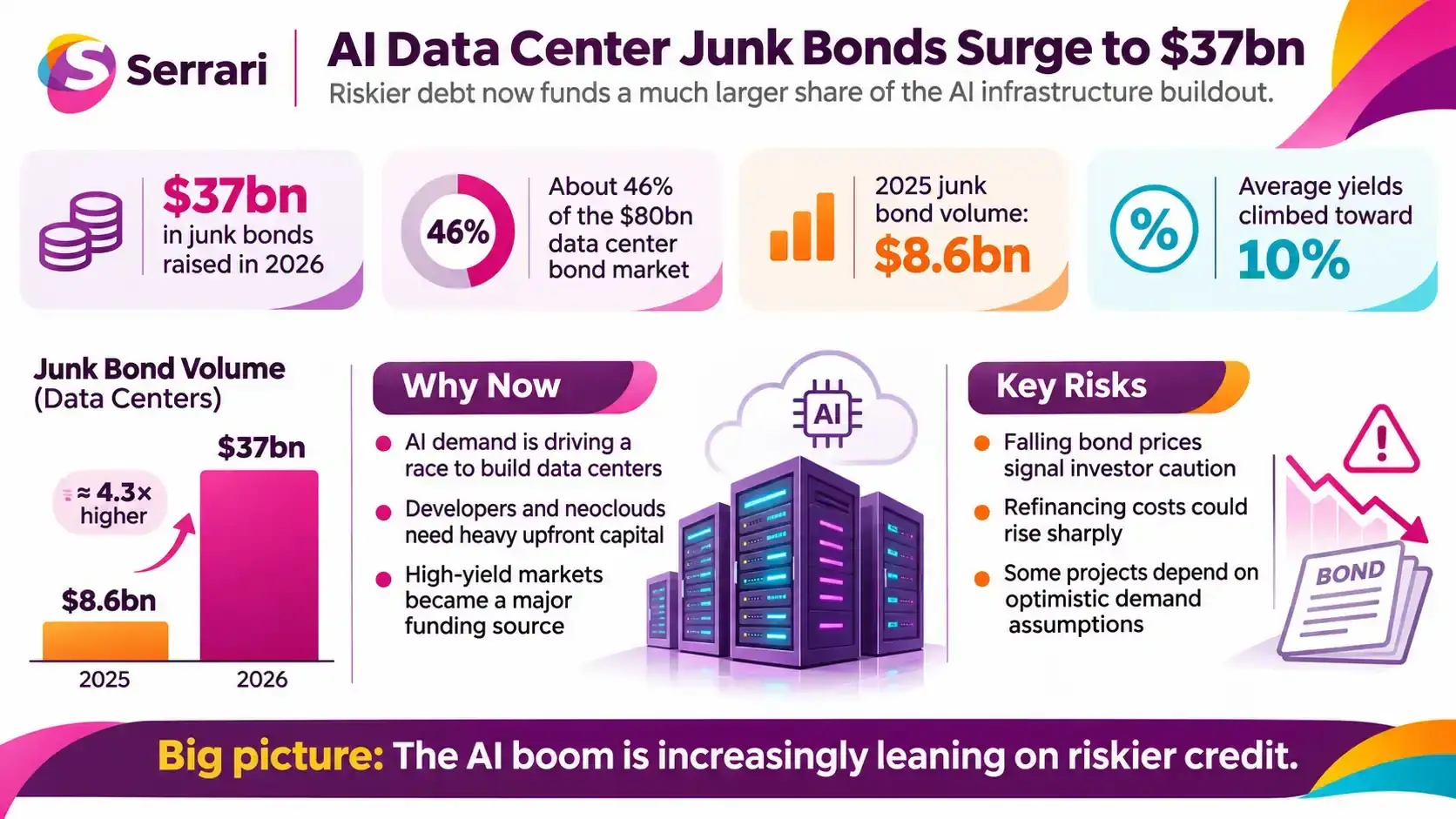
US data center developers and specialist AI cloud providers raised $37 billion through below-investment-grade bonds by mid-October 2026, accounting for about 46% of the $80 billion in data center bond issuance tracked at that point. The shift reflects the enormous upfront cost of building computing capacity and the growing dependence of smaller infrastructure providers on borrowed money. But falling bond prices and rising yields reveal a new question for lenders: will AI customers generate enough dependable revenue, soon enough, to repay the debt financing their infrastructure? By November, banks and bond investors were demanding stronger contractual protections, suggesting the AI investment boom is entering a more selective phase rather than ending outright.
Key Overview
- Riskier financing: Approximately $37 billion, or 46%, of $80 billion in US data center bonds issued by mid-October was below investment grade, compared with $8.6 billion of $36 billion in 2025.
- Higher borrowing costs: Yields on a tracked group of data center bonds climbed toward 10% in October, while some CoreWeave debt traded below 80 cents on the dollar.
- Projects under pressure: Power connections, construction schedules and uncertain AI demand have weakened confidence in some borrowers’ ability to service debt.
- IPO difficulties: Firmus, SB Energy and AirTrunk were reported to have postponed or canceled planned stock-market listings.
- Wider risk: The market is distinguishing cash-rich technology companies from leveraged developers and neoclouds that depend on external financing.
Why AI Infrastructure Is Turning to Riskier Debt
The boom in generative artificial intelligence has created an unusual financing problem. Demand for computing power is expected to expand rapidly, but the infrastructure supporting that demand must be paid for well before its full commercial potential is known. Data centers require land, grid connections, cooling systems, buildings and expensive graphics processing units. Developers frequently commit capital years before facilities are fully operational and generating stable rental income.
That timing mismatch explains the rush into debt markets. In an October 16 analysis of bond issuance, FactSet figures showed $37 billion of junk-rated securities within $80 billion of data center bonds raised in 2026. The below-investment-grade share was approximately 46%, against about 24% in 2025. The dollar amount was more than four times the previous year’s $8.6 billion.
Those percentages refer to the tracked bond issuance, not all financing for data centers, which also includes bank loans, private credit, equity, leasing and other structures. Nor does a junk rating mean a borrower has defaulted. It indicates greater assessed credit risk and ordinarily requires investors to demand higher returns.
The analysis identified 16 projects linked to major technology companies and fast-growing specialist operators, including facilities leased to or backed by Amazon, Meta, Nvidia, Oracle and Jane Street, alongside businesses such as CoreWeave and Fluidstack. A prominent customer can improve the expected revenue base of a project, but the creditworthiness of the tenant and the security of its obligations are not necessarily identical to the credit risk of the developer borrowing the money.
Why Bond Investors Are Suddenly Demanding More
The crucial change is not simply that companies borrowed aggressively. It is that lenders have begun repricing the probability that construction or future earnings disappoint. In October, yields on the group of data center bonds examined in the issuance analysis approached 10% as prices fell. Separate reports of distressed trading showed some CoreWeave bonds below 80 cents on the dollar, with yields approaching 15%.
A bond trading at 80 cents does not necessarily mean the investor will lose 20% if the issuer repays in full at maturity. It does show that buyers currently require a substantial discount to take the risk. Because bond yields generally rise when prices fall, the selloff also sends a warning to borrowers seeking fresh funds: refinancing could become much more expensive than their earlier projections assumed.
The pressure has not been confined to smaller corporate issuers. Debt tied to large data center projects serving major technology tenants also traded below face value in October. That matters because lenders initially appeared willing to treat the involvement of established technology companies as a strong safeguard. Increasingly, they are separating the quality of a tenant from the risks of completing, powering and operating the asset itself.
Power availability is particularly consequential. A server campus can have strong customer interest but still fail to generate expected revenue if grid connections are delayed. Construction setbacks increase interest expense and postpone cash receipts. A borrower may then need additional financing precisely when nervous lenders are charging more. The resulting combination of delay, higher leverage and weaker market access can compound rapidly.
Context is everything. Stay ahead of shifting trends with today’s market updates, and uncover emerging opportunities using the Serrari Group Market Index and Marketplace. Then, take control of your own financial future by exploring our Money & Life Reset Transformation Blueprint ™ to build stronger habits, create better systems, and design a path toward lasting wealth.
Why Neoclouds Face a Tougher Test Than Tech Giants
Neoclouds specialize in supplying computing capacity for AI workloads, often relying on extensive GPU purchases and long-term customer agreements. Unlike diversified technology giants, many lack multiple profitable businesses capable of subsidizing a lengthy construction period or absorbing a sudden drop in equipment utilization.
Their model depends on several conditions aligning: machines must arrive on time, customers must use or pay for the capacity, energy must be available, and service revenue must cover financing and operating costs. Meanwhile, rapidly improving chips can make expensive hardware economically obsolete before its physical life ends. If resale values weaken, the collateral available to protect lenders may be worth less than originally expected.
This helps explain why investors have compared some AI infrastructure financing to the earlier growth-at-all-costs model associated with WeWork. Both involve long-term obligations supported by expectations of strong future demand. But the analogy has limits: data centers, cloud-computing contracts and office leases are economically different, and individual borrowers possess very different cash flows, guarantees and asset values. A comparison is a warning about financing discipline, not evidence that all AI infrastructure companies will fail.
The equity market has reinforced the uncertainty. In October, developers Firmus, SB Energy and AirTrunk were reported to have delayed or withdrawn IPO plans. An IPO can give a leveraged company fresh equity without adding contractual interest payments. When that exit route narrows, existing lenders may become more concerned about how borrowers intend to fund expansion or reduce leverage.
Why the Stress Matters Beyond Data Centers
The consequences extend to customers and financial markets. Companies buying AI computing capacity could face higher rental rates if operators must pass on financing costs. Alternatively, competition may prevent operators from raising prices, squeezing their margins and leaving lenders exposed. Some planned facilities could be delayed, resized or abandoned if the cost of capital exceeds expected investment returns.
The change also creates a potential feedback loop. A borrower that cannot refinance may cut equipment orders or construction spending, affecting chip suppliers, utilities, engineering firms and local contractors. For communities, a delayed campus can mean fewer anticipated jobs or tax receipts, even where grid investment and permitting work have already begun.
Financial stability concerns are broader than any single company. In its October assessment of AI financing risks, the International Monetary Fund described an ecosystem becoming more capital intensive and increasingly reliant on external funding. Its financial stability warning highlighted the possibility that disappointing AI earnings, rising leverage and concentrated exposures could amplify a market correction.
These concerns should not be confused with proof of a systemic crisis. Large, profitable technology companies still possess substantial financial resources, and some data centers have durable customer contracts. The vulnerability is more concentrated among highly leveraged projects whose economic assumptions require rapid delivery and sustained demand. The distinction matters for pension funds, insurers, private-credit lenders and other investors exposed to different parts of the financing chain.
What Changed by November and What Comes Next
The October selloff was followed by tighter scrutiny rather than an immediate disappearance of infrastructure funding. By November 9, lenders were examining cash flows and customer guarantees more closely, alongside construction milestones and the terms that could allow customers to reduce or terminate their commitments. Nebius had abandoned a planned high-yield bond offering, underscoring how fast the financing window could narrow for riskier companies.
At the same time, analysts continued to expect substantial borrowing by large cloud companies. That contrast suggests a shift toward selective credit allocation rather than a verdict against AI investment itself. Projects with credible completion schedules, reliable power supply, strong counterparties and manageable debt are better placed to secure financing than those relying mainly on forecasts of future demand.
For investors, the next indicators are concrete: whether bond prices stabilize, whether borrowers can refinance without punitive yields, whether data centers begin operating on schedule and whether contracted revenues turn into cash. For companies, transparent disclosure of lease obligations, construction costs, customer concentration and debt maturity schedules will become increasingly important.
The $37 billion junk-bond figure matters because it identifies where part of the AI boom’s risk has migrated. The technology may transform industries, but a successful technological revolution does not guarantee that every heavily indebted project financing it will generate an attractive return. The defining test is now whether anticipated AI revenues arrive quickly and reliably enough to support the financial commitments already made.
Sources: Forbes / FactSet / Columbia Business School / Financial Times / Reuters / International Monetary Fund
Your financial future isn’t something you wait for—it’s something you build.
The real question is: when do you begin?
Move beyond simply staying informed.
Navigate the markets with clarity—track trends through the Serrari Group Market Index, uncover opportunities in the Serrari Marketplace, and build practical knowledge with our Curated Wealth Builder Platform.
Stay connected to what truly matters.
Get daily insights on macro trends and financial movements across Kenya, Africa, and global markets—delivered through the Serrari Newsletter.
Growth opens doors.
Advance your career through professional programs including ACCA, HESI A2, ATI TEAS 7 , HESI EXIT , NCLEX – RN and NCLEX – PN, Financial Literacy!🌟—designed to move you forward with confidence.
See where money is flowing—clearly and in real time.
Track Money Market Funds, Treasury Bills, Treasury Bonds, Green Bonds, and Fixed Deposits, alongside global and African indexes, key economic indicators, and the evolving Crypto and stablecoin landscape—all within Serrari’s Market Index.