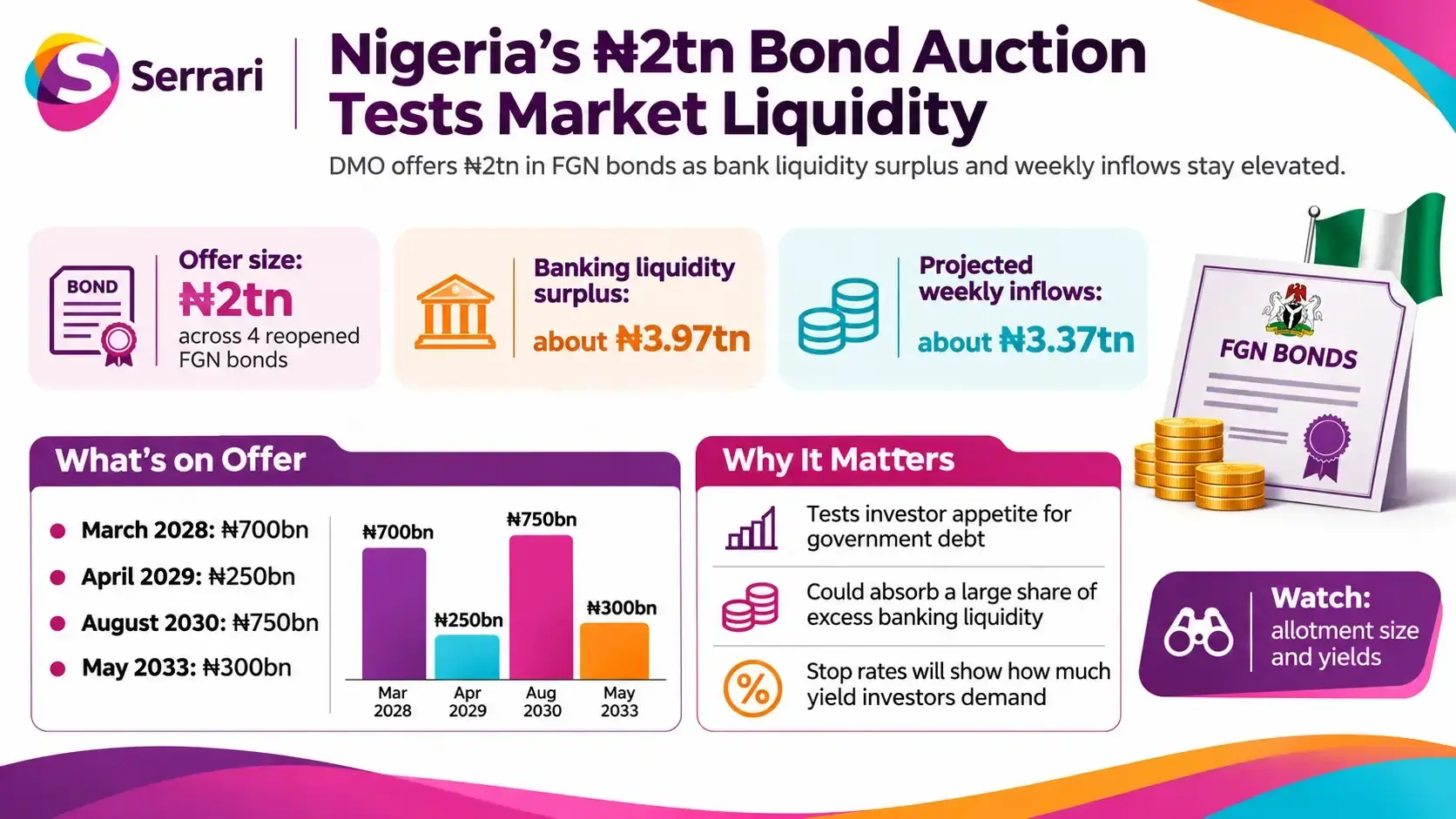
Nigeria’s Debt Management Office (DMO) is offering ₦2 trillion in Federal Government bonds on November 16, 2026, against a banking-system liquidity surplus of about ₦3.97 trillion and anticipated weekly cash inflows of ₦3.37 trillion. The sale presents an opportunity for the government to finance its obligations and redirect part of the banking system’s surplus into longer-term securities. Yet plentiful cash does not guarantee cheap borrowing: investors will judge the returns against inflation, alternative money-market instruments and the risks of holding government debt. The amount eventually allotted, rather than the headline offer, will show whether the DMO can attract funding without conceding significantly higher yields.
Key Overview
- Auction size: ₦2 trillion across four reopened Federal Government of Nigeria bonds, with settlement on November 18.
- Available liquidity: Banking-system surplus stood near ₦3.97 trillion on November 13, while projected inflows for the new week total about ₦3.37 trillion.
- Largest issues: The August 2030 bond accounts for ₦750 billion and the March 2028 bond for ₦700 billion, together representing 72.5% of the offer.
- Market tension: Recent auctions demonstrate that strong cash balances do not necessarily translate into acceptance of lower government borrowing yields.
- What matters next: Investor bids, accepted yields, actual allotments and subsequent central-bank liquidity operations will determine the auction’s wider effect.
Why Nigeria Is Seeking ₦2 Trillion as Cash Builds Up
The timing of Nigeria’s latest bond sale reflects two pressures moving in opposite directions: the federal government’s need for domestic financing and the banking system’s accumulation of cash awaiting profitable deployment. Under the DMO’s November bond offer circular, four existing securities are being reopened for auction on Monday, November 16, with settlement scheduled for Wednesday, November 18.
The government is offering ₦700 billion of the 21.00% March 2028 bond, ₦250 billion of the 19.30% April 2029 bond, ₦750 billion of the 17.945% August 2030 bond and ₦300 billion of the 19.89% May 2033 bond. The 2030 instrument carries 37.5% of the total, followed by the 2028 instrument at 35%. Concentrating nearly three-quarters of the offer in these two maturities gives buyers alternatives to the longest-dated instrument while allowing the government to spread its repayment obligations.
This is more than a single large auction. The DMO’s revised issuance calendar schedules another ₦2 trillion offer on December 14, taking the combined advertised volume for the final two months of 2026 to ₦4 trillion. Those are planned offers, not confirmed borrowing proceeds. The difference matters because the government retains discretion over how much it actually sells.
The calendar also signals why the authorities are approaching the market now. Cash in banks can create a window for government borrowing, especially when existing securities mature and investors need replacement assets. But borrowing repeatedly at elevated yields can increase future interest obligations. A successful funding strategy therefore depends on both securing cash today and controlling the cost of servicing it tomorrow.
Where the ₦3.97 Trillion Liquidity Surplus Comes From
The approximately ₦3.97 trillion liquidity figure is a point-in-time measure, not money the DMO can automatically collect. In its November 13 weekly financial markets review, Cowry Research reported that banking liquidity had fallen from ₦8.51 trillion the previous week after sizeable liquidity-absorbing operations. It identified roughly ₦2.3 trillion in open market operations and ₦713 billion in Treasury bill sales among the drains on cash.
The same report projected ₦3.37 trillion of fresh inflows during the week of November 16. That includes around ₦1.95 trillion from maturing open market operations securities, ₦1.11 trillion from Treasury bill maturities and ₦312 billion in government bond coupon payments. These payments return funds to holders of existing securities, potentially giving banks and institutional investors cash to reinvest.
A full ₦2 trillion allotment would be equivalent to approximately 59.3% of those projected weekly inflows. That comparison illustrates the scale of the offer, but it should not be confused with a forecast of the net change in banking liquidity. Cash movements occur on different dates, buyers may draw on pre-existing balances, and the Central Bank of Nigeria (CBN) may conduct additional operations that alter market conditions.
The central bank also has a different objective from the DMO. While the debt office seeks financing on acceptable terms, the CBN uses liquidity management to influence short-term interest rates and broader monetary conditions. Excess liquidity can put downward pressure on money-market rates and, depending on transmission into the economy, complicate efforts to contain inflation. Government bond issuance can absorb investable funds, but it is not a substitute for the central bank’s monetary-policy decisions.
Why Investors May Still Demand Higher Bond Yields
Abundant liquidity does not eliminate the price of risk or the opportunity cost of investing. Banks can compare government bonds with Treasury bills, central-bank instruments, lending opportunities and the option to retain short-term liquidity. Pension funds and other long-horizon investors must additionally assess purchasing-power erosion and the length of time their capital will be committed.
October’s bond auction provides a useful warning. Following the October 19 auction results, competitive bids amounted to about ₦1.75 trillion, while competitive allotments were approximately ₦1.21 trillion. The September 2036 and June 2038 securities cleared at 17.29% and 17.19%, respectively, up 50 and 34 basis points from their previous rates. Those increases indicated that buyers were seeking greater compensation for holding longer-term naira debt.
There is an important reporting distinction in the October totals. Separate coverage of non-competitive sales identified roughly ₦800 billion allocated outside the competitive process, bringing reported combined allocations to around ₦2.02 trillion. The often-cited ₦1.21 trillion figure therefore refers principally to competitive allotments, not necessarily the entire volume of securities issued that month.
The DMO has also shown that it may decline expensive bids rather than allot every security offered. At the October 28 Treasury bills auction, reported allotments were just ₦71.16 billion after the rejection of approximately ₦1.84 trillion of bids. The implication for November is straightforward: the government could choose to raise less than ₦2 trillion if investors insist on yields it considers too costly.
This restraint protects against accepting unfavorable prices immediately, but it creates a trade-off. Reduced allotments mean less cash raised through that particular auction. If financing needs persist, the government must secure the balance through subsequent issuance, other funding channels or cash management. Neither a fully subscribed auction nor a smaller allotment, considered in isolation, establishes that the funding strategy has succeeded.
Context is everything. Stay ahead of shifting trends with today’s market updates, and uncover emerging opportunities using the Serrari Group Market Index and Marketplace. Then, take control of your own financial future by exploring our Money & Life Reset Transformation Blueprint ™ to build stronger habits, create better systems, and design a path toward lasting wealth.
What Bond Coupons Mean for Returns and Borrowing Costs
The coupon rates printed beside the four securities should not be mistaken for the yields new buyers will earn. Because each bond is a reopening, its contractual coupon and maturity date remain unchanged, but the purchase price is established by the yield accepted at the auction. The official subscription terms also require successful bidders to pay applicable accrued interest.
When an investor buys an existing fixed-coupon bond below its face value, the yield to maturity can exceed its coupon rate; when purchased above face value, the yield can be lower. That distinction makes auction prices and clearing yields more informative than a simple comparison of the four coupon percentages.
The securities pay interest semi-annually and repay principal at maturity. The minimum auction subscription is ₦50.001 million, with additional subscriptions in ₦1,000 increments, a threshold that places direct primary-market participation largely within the reach of institutional and substantial private investors. Their listing on the Nigerian Exchange and FMDQ provides secondary-market trading venues, although listing alone does not guarantee buyers or stable prices when an investor wishes to sell.
For banks, qualifying government bonds count as liquid assets in liquidity-ratio calculations. That regulatory treatment can support demand, but maturity differences remain economically important: a bond due in 2033 exposes its holder to more years of potential interest-rate changes than one maturing in 2028. Investors selling before maturity may incur capital losses if yields rise.
The Wider Impact on Credit, Inflation and Public Finances
The auction’s significance extends beyond government securities dealers. If banks allocate more funds to sovereign debt, they may earn comparatively predictable coupon income while reducing the amount of capital they might otherwise deploy elsewhere. Whether that crowds out private-sector lending depends on lending demand, bank risk assessments, funding conditions and the returns available on alternative assets. It is a potential transmission channel, not an automatic consequence of this auction.
For companies, sustained high sovereign yields can establish a demanding benchmark for corporate borrowing. Businesses typically must offer investors compensation above government yields to account for additional credit risk. When those benchmark yields remain elevated, financing expansion, infrastructure and working capital can become more expensive, even in a system with substantial aggregate liquidity.
For households, higher government yields may improve returns available through some fixed-income investments, but the benefit must be judged against inflation and access costs. A high nominal yield is not the same as a high real return. Similarly, when financial institutions prefer securities over riskier lending, the abundance of cash at the banking-system level may not translate into cheaper credit for small businesses or consumers.
The fiscal consequences are equally important. Selling bonds helps meet financing requirements, yet the accepted yields affect future debt-service costs. More expensive borrowing can compete with other budget priorities over time. The critical distinction is between raising a large sum and raising it sustainably: attractive immediate auction proceeds do not remove the obligation to service the resulting debt.
Why the November Results Will Matter Beyond One Auction
Three indicators will clarify the outcome. First is the amount investors bid relative to the advertised ₦2 trillion. Second is the range of accepted yields across the four maturities. Third is the final amount allotted and how much liquidity remains after settlement and subsequent CBN operations. Looking at these measures together will reveal whether the government secured financing because cash was plentiful or because it offered returns investors considered sufficiently attractive.
The December 14 offer provides another reason to watch the November outcome closely. If investors absorb the current securities at yields acceptable to the DMO, the result could support confidence ahead of the next scheduled auction. If bids cluster at costly yields or allotments are restricted, the government could face a more difficult balancing exercise as the year draws to a close.
Ultimately, the ₦2 trillion sale is a test of the relationship between sovereign financing, banking liquidity and monetary restraint. Nigeria has substantial cash circulating through its financial system, but cash availability alone cannot settle the question of borrowing cost. The decisive signal will come from the prices investors demand, the amounts the government accepts and whether those choices support fiscal financing without adding unnecessary pressure to the wider economy.
Sources: Debt Management Office / Cowry Asset Management / Central Bank of Nigeria / Nairametrics / Punch
Your financial future isn’t something you wait for—it’s something you build.
The real question is: when do you begin?
Move beyond simply staying informed.
Navigate the markets with clarity—track trends through the Serrari Group Market Index, uncover opportunities in the Serrari Marketplace, and build practical knowledge with our Curated Wealth Builder Platform.
Stay connected to what truly matters.
Get daily insights on macro trends and financial movements across Kenya, Africa, and global markets—delivered through the Serrari Newsletter.
Growth opens doors.
Advance your career through professional programs including ACCA, HESI A2, ATI TEAS 7 , HESI EXIT , NCLEX – RN and NCLEX – PN, Financial Literacy!🌟—designed to move you forward with confidence.
See where money is flowing—clearly and in real time.
Track Money Market Funds, Treasury Bills, Treasury Bonds, Green Bonds, and Fixed Deposits, alongside global and African indexes, key economic indicators, and the evolving Crypto and stablecoin landscape—all within Serrari’s Market Index.