Equinix has raised €2.5 billion through its largest green senior notes offering to date, issuing the debt across four tranches through its financing subsidiary, Equinix Europe 2 Financing Corporation LLC. The notes carry a blended effective all-in interest rate of 4.82% annually after estimated interest-rate hedging costs. The proceeds are expected to finance or refinance eligible projects under the company’s updated Green Finance Framework, covering green buildings, renewable and clean energy, energy efficiency, and sustainable water management.
Key Takeaways
- Equinix issued €2.5 billion in green senior notes across four tranches, with the offering closing on November 9, 2026.
- The issuance is the company’s largest green senior notes offering to date.
- The notes carry a blended effective all-in interest rate of 4.82% annually after estimated hedging costs.
- Eligible projects include green buildings, renewable energy, energy efficiency and sustainable water management.
- Equinix has issued more than US$12 billion in green bonds globally.
Why Has Equinix Raised €2.5 Billion Through Green Bonds?
Equinix announced on November 10, 2026, that its financing subsidiary, Equinix Europe 2 Financing Corporation LLC, had issued €2.5 billion in aggregate principal amount of green senior notes across four tranches. The offering closed on November 9, 2026, and the notes are guaranteed by Equinix Inc.
Equinix described the transaction as its largest green senior notes offering to date. Including the new notes, the company has issued more than US$12 billion of green bonds globally.
The issuance is part of the company’s approach to integrating sustainability into its business and capital allocation strategy. The proceeds are expected to finance or refinance eligible green projects under its recently updated Green Finance Framework.
Equinix Chief Financial Officer Olivier Leonetti said: “The strong demand for this offering reflects investor confidence in our long-term growth strategy.”
The company said the transaction supports investments intended to deliver environmental impact across its global operations.
What Are the Interest Rates and Maturities of the Green Notes?
The €2.5 billion issuance is divided into four euro-denominated senior note series. The notes carry annual interest rates ranging from 4.150% to 5.450%, with maturities between 2028 and 2038.
The notes carry an effective all-in interest rate of 4.82% per year on a blended basis after the estimated impact of interest rate hedges.
The notes are fully and unconditionally guaranteed on an unsecured basis by Equinix Inc. The blended rate reflects the estimated impact of hedging arrangements rather than simply the stated coupon rates on the individual tranches.
This distinction matters because the four series have different interest rates and maturity dates. The 4.82% figure represents the blended effective cost after estimated hedging, not the coupon applicable to every tranche.
Context is everything. Stay ahead of shifting trends with today’s market updates, and uncover emerging opportunities using the Serrari Group Market Index and Marketplace. Then, take control of your own financial future by exploring our Money & Life Reset Transformation Blueprint ™ to build stronger habits, create better systems, and design a path toward lasting wealth.
Which Projects Will Receive the Green Bond Proceeds?
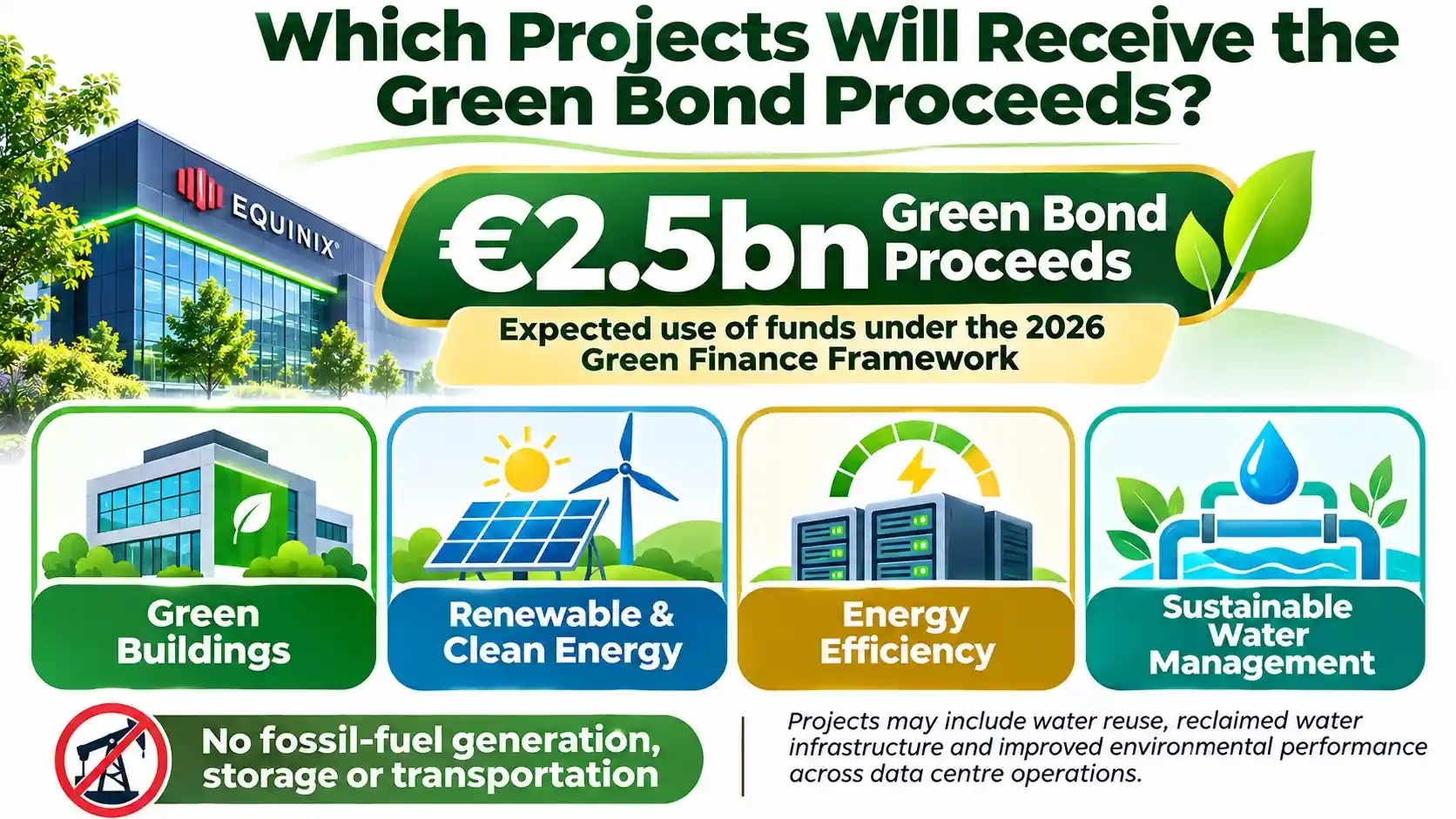
Equinix expects to allocate an amount equal to the offering’s net proceeds to finance or refinance eligible green projects under its 2026 Green Finance Framework.
The updated framework focuses on four main categories:
- Green buildings: Investments that meet the company’s eligibility requirements for sustainable buildings.
- Renewable and clean energy: Projects supporting the use and development of cleaner energy.
- Energy efficiency: Investments aimed at improving energy performance across operations.
- Sustainable water management and watershed resilience: Projects involving water reuse, reclaimed or non-potable water infrastructure, dry cooling in water-stressed regions and watershed resilience.
The framework also includes requirements for new data centres. It sets design average power usage effectiveness (PUE) thresholds of no more than 1.35 in Asia-Pacific, Latin America, the Middle East and Africa, and no more than 1.30 in Europe and North America, subject to stricter local requirements.
Equinix does not intend to allocate green-financing proceeds to fossil-fuel generation, storage or transportation.
These requirements are important because data centres require substantial electricity and cooling infrastructure. The framework therefore connects the financing to specific areas where the company intends to improve environmental performance.
How Will Equinix Monitor the Use of the Funds?
Equinix has established internal controls to assess projects before they qualify for green financing.
Business units first review proposed investments for legal, policy and environmental and social risk compliance. The Green Finance Committee then assesses eligibility and monitors continuing compliance. The committee draws on expertise from the Sustainability Program Office, Treasury, Investor Relations and other relevant specialists, and meets at least annually.
The company intends, on a best-efforts basis, to allocate the full proceeds of each financing within 24 months of issuance, and no later than 36 months.
While awaiting allocation, the proceeds may be held in cash, cash equivalents and US government securities or used to repay existing borrowings under the company’s general Treasury policy.
What Environmental Results Has Equinix Reported From Earlier Green Bonds?
The latest issuance follows the publication of Equinix’s 2026 Green Bond Allocation and Impact Report, which provides information on how proceeds from previous green bond offerings have been used.
The report confirms that, as of June 2026, 100% of proceeds from Equinix’s outstanding green bond issuances had been allocated, with no remaining unallocated net proceeds.
The report covers 206 projects across 28 countries for the reporting year running from July 2025 through June 2026.
Equinix reported that projects receiving allocations were expected to deliver more than 616,000 metric tonnes of carbon dioxide equivalent in annual emissions reductions and 960 gigawatt-hours in energy savings. The company also reported 2,210 gigawatt-hours of renewable energy generated through power-purchase agreements.
These are reported or expected environmental outcomes associated with previous allocations, rather than confirmed results from the newly issued €2.5 billion notes.
The Bigger Picture: Why Are Green Bonds Important for Data Centres?
The issuance highlights the role of green financing in supporting companies that need to fund infrastructure while addressing environmental concerns.
For Equinix, the framework directs financing towards areas such as renewable energy procurement, efficient data centre buildings and sustainable water management. These areas are particularly relevant to data centre operations, where electricity consumption, cooling and water use are important operational considerations.
The transaction also demonstrates continued investor demand for sustainability-linked uses of capital. However, the green designation relates to how the proceeds are intended to be used. It does not mean that repayment depends on whether the financed projects achieve their environmental targets.
Principal and interest on the new notes come from Equinix’s general account and are not linked to project performance.
Investors therefore need to distinguish between the company’s commitment to allocate proceeds to eligible green projects and the financial obligations attached to the notes.
Why Does This Matter Now?
Equinix’s €2.5 billion issuance comes as the company expands its sustainable financing activities and updates the criteria governing which projects can receive green funding.
The deal brings its cumulative global green bond issuance above US$12 billion and gives the company additional capital to finance or refinance eligible projects across its operations.
The next important development will be how the new proceeds are allocated and what environmental outcomes Equinix reports from the financed projects. Its allocation and impact reporting will help investors assess whether the company’s green financing commitments translate into measurable environmental progress.
Frequently Asked Questions
1. How much has Equinix raised through its latest green bond offering?
Equinix issued €2.5 billion in green senior notes across four tranches, making it the company’s largest green senior notes offering to date.
2. What is the blended interest rate on the notes?
The notes carry a blended effective all-in interest rate of 4.82% annually after the estimated impact of interest-rate hedges.
3. What will Equinix use the green bond proceeds for?
The proceeds are expected to finance or refinance eligible projects involving green buildings, renewable and clean energy, energy efficiency, and sustainable water management and watershed resilience.
4. Does repayment of the green bonds depend on the environmental performance of the projects?
No. Principal and interest are payable from Equinix’s general account and are not linked to the environmental performance of the projects financed.
Your financial future isn’t something you wait for—it’s something you build.
The real question is: when do you begin?
Move beyond simply staying informed.
Navigate the markets with clarity—track trends through the Serrari Group Market Index, uncover opportunities in the Serrari Marketplace, and build practical knowledge with our Curated Wealth Builder Platform.
Stay connected to what truly matters.
Get daily insights on macro trends and financial movements across Kenya, Africa, and global markets—delivered through the Serrari Newsletter.
Growth opens doors.
Advance your career through professional programs including ACCA, HESI A2, ATI TEAS 7 , HESI EXIT , NCLEX – RN and NCLEX – PN, Financial Literacy!🌟—designed to move you forward with confidence.
See where money is flowing—clearly and in real time.
Track Money Market Funds, Treasury Bills, Treasury Bonds, Green Bonds, and Fixed Deposits, alongside global and African indexes, key economic indicators, and the evolving Crypto and stablecoin landscape—all within Serrari’s Market Index.