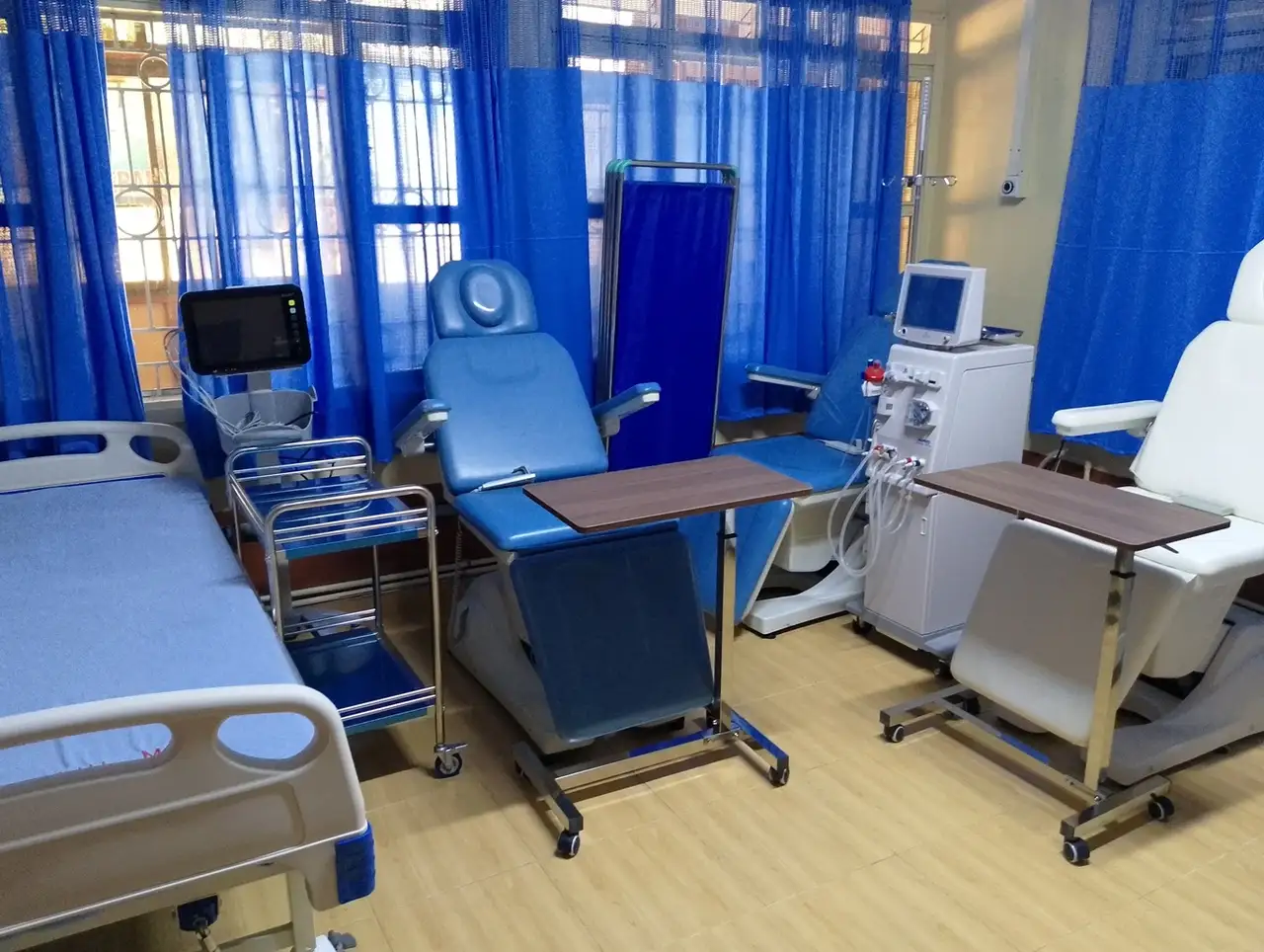
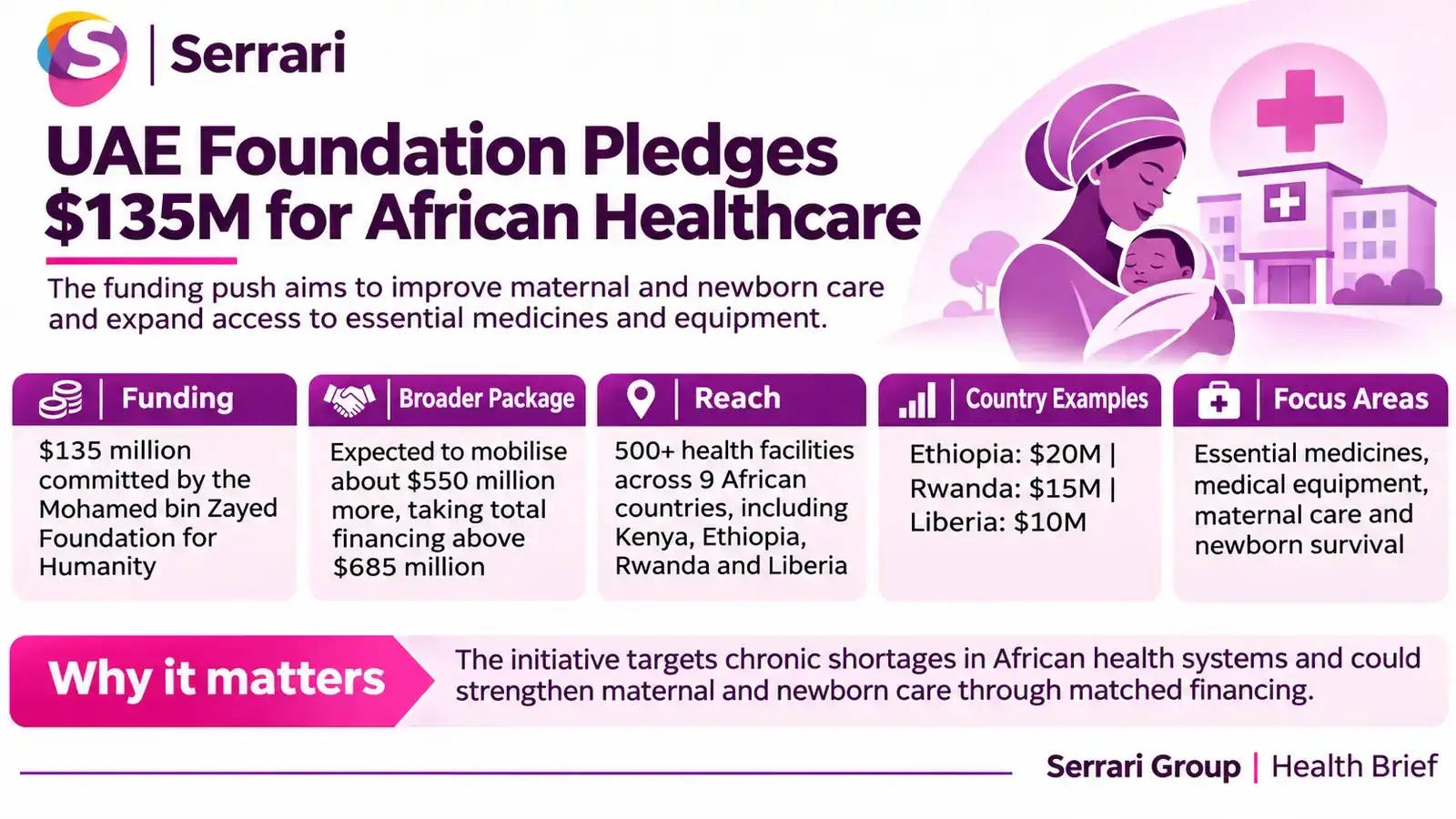
The Mohamed bin Zayed Foundation for Humanity has committed $135 million to improve maternal and newborn healthcare across nine African countries, targeting more than 500 medical facilities. Announced at the International Conference on Public Health in Africa in Addis Ababa, the initiative is expected to mobilise another $550 million from governments and development partners. The programme addresses shortages of medicines, diagnostic equipment and clinical technologies at a time when declining external assistance and constrained public budgets threaten healthcare delivery. Its co-financing structure also signals a shift towards partnerships that require African governments to commit domestic resources alongside philanthropic funding.
Key Overview
- The foundation has pledged $135 million, with combined financing expected to reach at least $685 million.
- Ethiopia, Kenya, Liberia, Malawi, Nigeria, Rwanda, Ghana, Sierra Leone and Mozambique are beneficiaries.
- Ethiopia’s programme has an announced financing package of $342.4 million.
- Rwanda will receive $15 million from the foundation, targeting 170 health facilities.
- Liberia’s $10 million commitment includes equipment, clinical mentorship and biomedical engineering training.
- The initiative seeks to improve maternal and newborn survival while strengthening domestic health financing.
Why Africa Needs Investment Beyond Hospital Construction
The nine-country healthcare initiative addresses a fundamental weakness in African healthcare delivery: a facility can exist, employ medical professionals and receive patients without having the resources necessary to provide effective treatment.
A maternity ward without reliable access to medicines, oxygen or diagnostic equipment cannot consistently manage complicated deliveries. Similarly, a rural clinic that identifies a medical emergency but lacks stabilisation equipment may be unable to prevent a patient’s condition from deteriorating before referral.
These gaps are particularly consequential for pregnant women and newborns because many complications require immediate intervention. Delays in identifying and treating severe bleeding, infections and respiratory difficulties can turn manageable conditions into fatal emergencies.
According to global maternal mortality estimates, approximately 260,000 women died from pregnancy-related causes in 2023, with sub-Saharan Africa accounting for around 70% of those deaths. The concentration illustrates the unequal distribution of healthcare resources and access to timely treatment.
The new programme therefore focuses on whether facilities can actually deliver care, rather than simply increasing the number of buildings available to patients. Reliable procurement, functioning equipment and trained personnel are complementary investments; weakness in any one of them can undermine the value of the others.
How $135 Million Could Mobilise $685 Million
The initiative’s financial architecture is as significant as its clinical objectives. The foundation intends to use its initial commitment to attract approximately $550 million in additional financing, with participating governments expected to contribute at least as much as the foundation’s investment.
The announced co-financing arrangement would bring combined resources to approximately $685 million or more if the expected contributions materialise. On that basis, every dollar committed by the foundation would correspond to roughly $4.07 in additional financing, or $5.07 in total programme resources.
This is a funding mobilisation ratio, not a financial return or a guarantee that all contributions have already been disbursed. The distinction matters because government appropriations, donor agreements and procurement schedules can determine how quickly announced resources translate into services.
Matching arrangements can strengthen national ownership by requiring governments to incorporate programme priorities into their own spending decisions. They can also reduce the risk of creating parallel healthcare systems that become difficult to sustain once external grants expire.
However, matching requirements can present difficulties for governments with limited fiscal space. Countries facing high debt-servicing costs or weak revenue collection may struggle to provide their contributions without reallocating resources from other essential services. Programme design must therefore account for each country’s financial capacity rather than assuming identical implementation conditions.
Context is everything. Stay ahead of shifting trends with today’s market updates, and uncover emerging opportunities using the Serrari Group Market Index and Marketplace. Then, take control of your own financial future by exploring our Money & Life Reset Transformation Blueprint ™ to build stronger habits, create better systems, and design a path toward lasting wealth.
Ethiopia, Rwanda and Liberia Illustrate Different Priorities
The foundation’s country-level investment plans show how a common financing framework can address different clinical and institutional needs.
Ethiopia’s reproductive, maternal, newborn and child health programme will receive $20 million from the foundation, alongside $151.2 million from development partners and $171.2 million in government matching resources, as implied by the reported package total of $342.4 million. Approximately 120 facilities are expected to benefit over three years.
The planned introduction of AI-enabled ultrasound technology could help healthcare workers identify pregnancy complications where specialist expertise is limited. Its effectiveness, however, will depend on appropriate training, clinical oversight, reliable electricity and functioning referral networks. Antibiotics and other essential supplies will remain equally important because diagnostic improvements must be accompanied by the capacity to treat identified conditions.
In Rwanda, the $15 million national commitment targets 170 facilities and is expected to attract a further $40 million. Equipment for managing severe bleeding after childbirth and supporting premature newborns can strengthen the ability of hospitals to respond to emergencies without unnecessary transfers.
Liberia’s referral hospital investment includes a $10 million foundation commitment and complementary donor support. Its emphasis on clinical mentorship and biomedical engineering is particularly important because medical equipment creates little lasting value if hospitals cannot operate, service or repair it locally.
Kenya and the other five participating countries are also included in the regional programme, although the announcement does not establish individual funding allocations for each of them. The overall commitment should therefore not be interpreted as an equal division of resources among nine governments.
Why the Commitment Matters as External Health Aid Declines
The timing of the announcement reflects a changing international development financing environment. African governments are increasingly expected to sustain essential services while external assistance becomes less predictable.
According to an assessment of Africa’s health financing transition, development assistance for health fell from $25.8 billion in 2021 to approximately $13 billion in 2025. Although the earlier figure reflected exceptional pandemic-related spending, the decline illustrates the pressure on programmes accustomed to external support.
When aid falls, healthcare systems face more than the loss of new projects. Existing programmes may struggle to purchase medicines, retain personnel and maintain equipment. Governments cannot necessarily replace lost funding immediately, particularly when rising debt obligations compete with social expenditure.
The foundation’s pledge offers additional resources in this environment, but its scale remains modest relative to the continent’s overall financing needs. Its broader significance lies in whether it can demonstrate a sustainable approach to mobilising domestic funds around specific service-delivery priorities.
For Kenya, participation could help address gaps in maternal and newborn services while complementing existing healthcare reforms. The practical benefit will depend on where facilities are selected, how national and county responsibilities are coordinated and whether procurement and staffing arrangements support continuous service delivery.
What Better Healthcare Could Mean for Households and Economies
Maternal and newborn complications create economic costs that extend beyond hospital expenditure. Families can lose income when caregivers must travel long distances, pay for emergency transport or purchase medicines privately because public facilities have exhausted their stocks.
Improved availability of essential supplies could reduce some of these costs by allowing patients to receive timely treatment closer to home. Better emergency care could also reduce avoidable disability and the long-term financial burden associated with severe complications.
The economic benefits are not automatic, however. Equipment purchases alone cannot eliminate user fees, geographical barriers or shortages of qualified healthcare professionals. Governments must integrate the programme with broader efforts to improve affordability, referrals and workforce distribution.
What Will Determine Whether the Programme Succeeds?
The central test will be whether financing commitments become reliable improvements in patient care. Governments and development partners will need to monitor actual disbursements, procurement lead times, medicine stockouts, equipment functionality and clinical outcomes rather than relying solely on the number of facilities receiving supplies.
Maintenance budgets deserve particular attention. A donated incubator or diagnostic device can create recurring obligations for spare parts, consumables, calibration and staff training. Without provision for these costs, the initial investment risks producing only temporary improvements.
Ultimately, the $135 million pledge matters because it connects philanthropic capital with domestic public financing at a time of growing uncertainty over traditional development assistance. If the expected matching resources are delivered and facilities can sustain the resulting improvements, the programme could provide a useful model for strengthening African health systems. Its lasting value will be measured not by the size of the announcement, but by whether mothers and newborns receive effective care when they need it most.
Sources: The National / World Health Organization / BusinessDay / Africa Science News / The New Times / ARN News Centre / Africa CDC
Your financial future isn’t something you wait for—it’s something you build.
The real question is: when do you begin?
Move beyond simply staying informed.
Navigate the markets with clarity—track trends through the Serrari Group Market Index, uncover opportunities in the Serrari Marketplace, and build practical knowledge with our Curated Wealth Builder Platform.
Stay connected to what truly matters.
Get daily insights on macro trends and financial movements across Kenya, Africa, and global markets—delivered through the Serrari Newsletter.
Growth opens doors.
Advance your career through professional programs including ACCA, HESI A2, ATI TEAS 7 , HESI EXIT , NCLEX – RN and NCLEX – PN, Financial Literacy!🌟—designed to move you forward with confidence.
See where money is flowing—clearly and in real time.
Track Money Market Funds, Treasury Bills, Treasury Bonds, Green Bonds, and Fixed Deposits, alongside global and African indexes, key economic indicators, and the evolving Crypto and stablecoin landscape—all within Serrari’s Market Index.