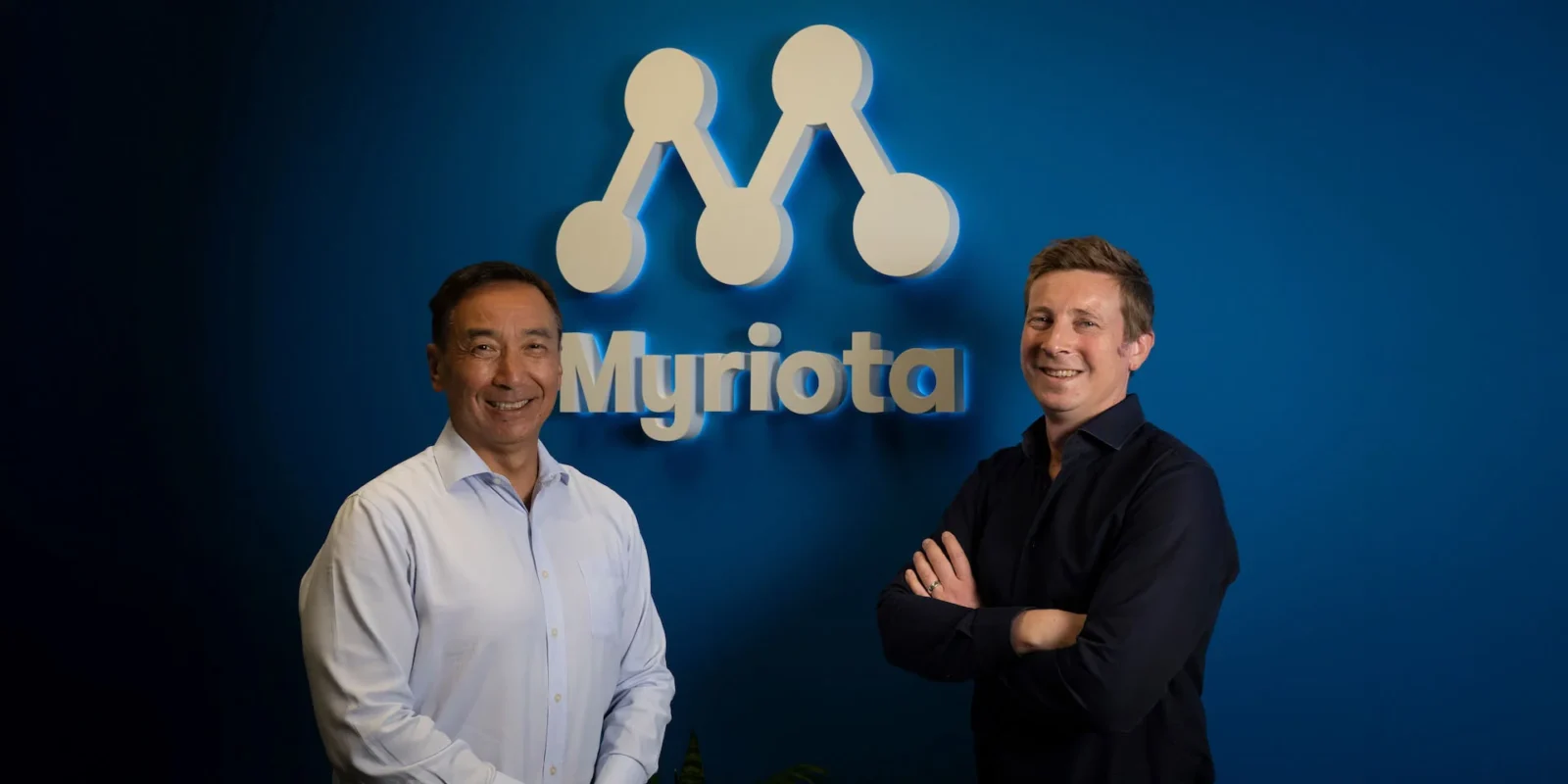
Australian satellite connectivity company Myriota has secured AU40 million) in the first close of its Series C funding round, strengthening its capacity to serve businesses operating beyond conventional telecommunications networks. The financing will support next-generation satellites, international expansion and employment growth in Adelaide. With institutional investors and government-backed capital supporting the expansion, the deal illustrates how commercial space infrastructure is increasingly being developed to address practical industrial challenges. The company’s next test will be converting its expanding network into recurring revenues and sustainable returns on capital.
Key Overview
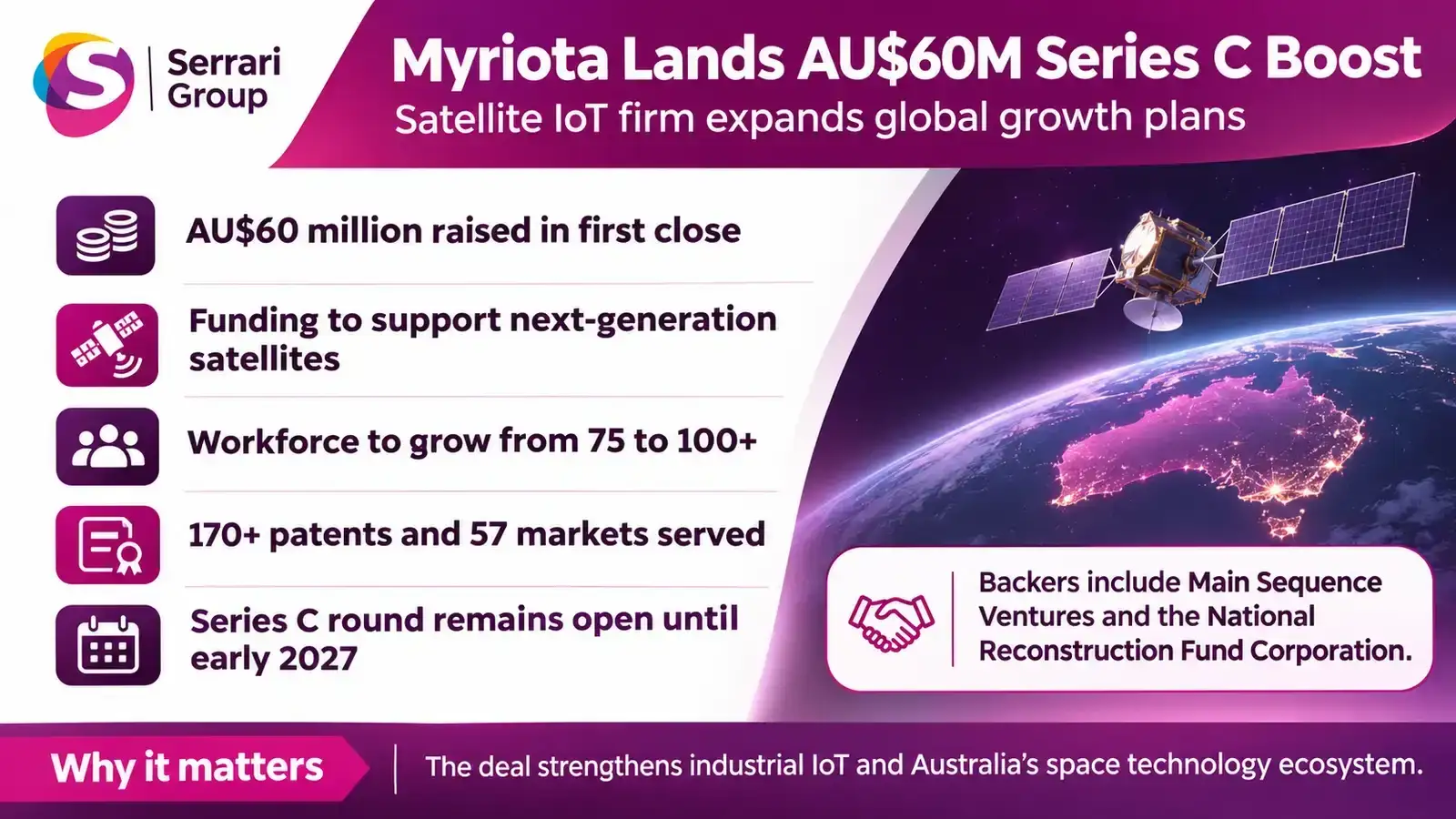
- Myriota announced AU160 million.
- Main Sequence Ventures and the National Reconstruction Fund Corporation led the first close, with Hostplus participating and Funds SA joining as a new investor.
- The National Reconstruction Fund Corporation invested AU45 million.
- Myriota plans to increase its workforce from 75 to more than 100 employees while retaining its Adelaide headquarters.
- The company serves customers across 57 markets and has secured more than 170 patents since 2015.
- Sixteen satellites were launched during 2026, with further launches scheduled for 2027 and 2028.
- The Series C funding round remains open until early 2027.
Why Industrial Connectivity Is Driving Satellite Investment
Myriota’s latest fundraising reflects an economic opportunity that extends considerably beyond the traditional space industry: connecting industrial assets in locations where terrestrial telecommunications are unavailable or prohibitively expensive.
The Adelaide company’s Series C funding announcement establishes that the first tranche was completed ahead of schedule. The timing matters because financing satellite infrastructure requires companies to commit substantial capital before earning the full commercial benefits of an expanded network.
Businesses operating mines, farms, water infrastructure and transport fleets frequently need information from assets spread across enormous geographical areas. Conventional mobile networks are economical where sufficient customers share infrastructure costs, but constructing towers to serve isolated industrial equipment may not generate adequate returns.
Myriota addresses this problem through satellite-enabled Internet of Things (IoT) connectivity. Rather than supplying high-speed broadband for activities such as video streaming, its technology allows industrial devices to communicate operational measurements, alerts and tracking information.
This distinction is commercially significant. A remote water tank does not necessarily require a continuous broadband connection to report its water level. A small periodic transmission may be sufficient to support an operational decision.
By matching connectivity to the amount of information needed, businesses can potentially reduce communications costs and energy consumption. This makes monitoring assets that were previously uneconomical to connect a more realistic proposition.
The funding will help Myriota expand the infrastructure supporting this approach, but its commercial success ultimately depends on whether customers save more money through improved information than they spend acquiring and operating connected devices.
How Satellite Sensors Can Improve Industrial Profitability
The economic value of satellite IoT becomes clearer when examining the costs associated with physical inspections, equipment failures and incomplete operational information.
Australia’s agricultural technology case studies demonstrate how satellite-enabled monitoring can help agricultural operators manage water infrastructure without relying on cellular coverage. Remote information allows workers to prioritise inspections according to actual conditions rather than fixed schedules.
A hypothetical farm conducting five inspection trips weekly at AU15,600 annually over 52 weeks. If remote monitoring reduced these trips to two per week, the annual gross savings would amount to AU$9,360 before device purchases, connectivity fees and maintenance costs.
The calculation is illustrative rather than a reported Myriota customer result. Nevertheless, it demonstrates how relatively modest amounts of data can generate substantial operational value when assets are expensive to inspect physically.
Similar principles apply to logistics and mining. An asset-tracking device can help operators identify misplaced equipment, while a sensor monitoring machinery may provide information that supports more effective maintenance scheduling.
A documented municipal water monitoring deployment in Queensland demonstrates that satellite and cellular technologies can complement one another. This matters because industrial customers rarely need to replace all their existing communications infrastructure to benefit from satellite services.
However, connectivity does not solve every operational problem. Sensors must be reliable, alerts must arrive within useful timeframes and organisations must have processes for acting on the information received.
The return on investment therefore depends on the complete monitoring system, not simply the availability of a satellite connection.
Network Expansion Creates Scale but Increases Financial Risk
Myriota’s expansion is occurring at a time when the company needs to accommodate larger deployments of connected industrial devices. Its 2026 satellite launch programme included 16 satellites, with additional missions planned over the following two years.
Increasing network capacity can improve the number of devices a provider supports and create additional opportunities for those devices to communicate with orbiting infrastructure. Greater redundancy can also reduce reliance on individual spacecraft.
Myriota combines owned spacecraft with access to capacity supplied by other satellite operators, as described in its government-backed investment profile. This approach provides alternatives to financing every component of a network independently.
Such flexibility matters because satellite infrastructure entails manufacturing expenses, launch costs, operational expenditure and eventual replacement requirements. Unexpected delays or technical problems can postpone revenue while costs continue accumulating.
A larger paying customer base could improve operating economics by spreading fixed infrastructure expenditure across more connections. Conversely, if customer growth falls short of expectations, expanding capacity too quickly could weaken financial performance.
Investors will therefore need to assess not only the number of satellites deployed but also network utilisation, customer retention, subscription revenues and the cost of delivering each additional connection.
The financing announcement does not provide enough financial information to calculate these measures independently. Funding growth should not be confused with profitability.
Context is everything. Stay ahead of shifting trends with today’s market updates, and uncover emerging opportunities using the Serrari Group Market Index and Marketplace. Then, take control of your own financial future by exploring our Money & Life Reset Transformation Blueprint ™ to build stronger habits, create better systems, and design a path toward lasting wealth.
Why Public Capital and Institutional Investors Are Participating
The latest round brings together investors with different commercial mandates and investment horizons. The National Reconstruction Fund Corporation’s additional AU$20 million commitment represents one-third of the first tranche and follows an earlier AU$25 million investment.
The government’s involvement is significant because advanced technology companies can face financing gaps between demonstrating a scientific breakthrough and building infrastructure capable of serving international customers.
Traditional lenders may find it difficult to finance businesses with uncertain future cash flows and highly specialised assets. Equity capital can accommodate some of this uncertainty because it does not require the same scheduled principal and interest repayments as conventional borrowing.
However, equity investors assume the possibility of losses if commercial performance disappoints. Public-sector participation does not remove that risk; it means public capital is exposed to the company’s future valuation.
The participation of Funds SA, described in an investment transaction announcement, adds another institutional investor to the company’s shareholder base. Main Sequence Ventures and Hostplus also participated in the first close.
The wider question is whether patient institutional capital can help Australian technology companies remain domestically anchored while expanding internationally, rather than relocating their principal operations to access larger financing markets.
For taxpayers and institutional beneficiaries, the investment must ultimately be assessed against its financial performance as well as any industrial development benefits.
Adelaide’s Opportunity to Retain High-Value Technology Jobs
The planned workforce expansion from 75 to more than 100 employees represents growth exceeding one-third. Myriota intends to retain its headquarters and most employees within Adelaide’s Lot Fourteen innovation district.
The significance extends beyond the direct jobs created. An expanding technology company can generate demand for electronics engineering, software development, specialist manufacturing, testing and professional services.
Myriota’s origins in university research illustrate how scientific discoveries can become commercially useful intellectual property. Its more than 170 patents also highlight the importance of protecting innovations that underpin international competitiveness.
Australia’s wider investment in space technologies illustrates an industrial policy designed to strengthen domestic technical capabilities and commercial opportunities.
Nevertheless, sovereign capability does not necessarily mean producing every component domestically. Satellite operators often depend on international launch providers, component suppliers and communications infrastructure. A commercially viable strategy can involve maintaining control over critical intellectual property and operational capabilities while participating in global supply chains.
The long-term economic benefit for South Australia will depend on whether expansion creates durable, productive jobs and supports local suppliers rather than merely increasing short-term spending.
What the Expansion Could Mean for African Markets
The economics underpinning Myriota’s expansion are relevant to other regions where industrial operations extend beyond reliable terrestrial telecommunications coverage.
In Kenya, remote water infrastructure, agricultural enterprises, conservation operations and renewable energy installations could potentially benefit from low-power monitoring devices. Satellite connectivity could be particularly useful where regular manual inspections are expensive or difficult.
These are potential applications, not confirmed deployments associated with the Series C announcement.
Affordability remains a critical constraint. Imported hardware, foreign currency exposure, local licensing requirements and recurring connectivity fees can affect the viability of industrial deployments. Customers must also be able to maintain equipment and integrate the information into existing operating systems.
Satellite IoT may consequently be most attractive where the financial consequences of incomplete information are substantial relative to the cost of connectivity.
The broader opportunity for African businesses is not simply buying imported satellite services. Local companies could develop sensor hardware, software, installation services and industry-specific applications that capture a share of the economic value generated by connected infrastructure.
The Next Milestone Is Sustainable Commercial Returns
Myriota’s AU$60 million funding tranche signals confidence in the potential of industrial satellite connectivity, but the next stage of development will require effective capital allocation.
Management must balance new infrastructure expenditure against realistic demand forecasts, while maintaining service reliability and affordable pricing. The company must also demonstrate that its expanding international footprint can produce recurring revenue sufficient to support operating costs and future infrastructure replacement.
The Series C round remaining open until early 2027 gives Myriota an opportunity to attract additional financing, although its final size remains unknown.
The wider significance of the transaction is the changing commercial role of satellite technology. Instead of treating space infrastructure as an end in itself, businesses increasingly evaluate it according to the productivity improvements it can deliver on Earth.
For Myriota, the decisive measure of success will be whether its investment in orbit produces sustainable financial returns by solving expensive problems for customers on the ground.
Sources Used
Myriota / Lot Fourteen / Australian Space Agency / Optus / InDaily / National Reconstruction Fund Corporation / Business News Australia / Eastend Ventures
Your financial future isn’t something you wait for—it’s something you build.
The real question is: when do you begin?
Move beyond simply staying informed.
Navigate the markets with clarity—track trends through the Serrari Group Market Index, uncover opportunities in the Serrari Marketplace, and build practical knowledge with our Curated Wealth Builder Platform.
Stay connected to what truly matters.
Get daily insights on macro trends and financial movements across Kenya, Africa, and global markets—delivered through the Serrari Newsletter.
Growth opens doors.
Advance your career through professional programs including ACCA, HESI A2, ATI TEAS 7 , HESI EXIT , NCLEX – RN and NCLEX – PN, Financial Literacy!🌟—designed to move you forward with confidence.
See where money is flowing—clearly and in real time.
Track Money Market Funds, Treasury Bills, Treasury Bonds, Green Bonds, and Fixed Deposits, alongside global and African indexes, key economic indicators, and the evolving Crypto and stablecoin landscape—all within Serrari’s Market Index.