Sierra Leone has announced a $45 million initiative to secure a second international submarine internet cable, joining telecom operators and regional partners in a bid to reduce dependence on its existing Africa Coast to Europe (ACE) connection. Unveiled at the West Africa Integration and Investment Summit in November 2026, the proposed A4 project brings together the government, operators and infrastructure partners through a National Cable Consortium. The government has identified $15 million in World Bank-supported financing, while the balance will require other investment. Beyond promising faster connections, the project addresses a fundamental economic vulnerability: when a country has limited independent routes to the global internet, a single serious cable problem can affect financial services, commerce and public administration. The investment could improve resilience and competition, but lower consumer prices will depend on how the new capacity is financed, shared and regulated.
Key Overview
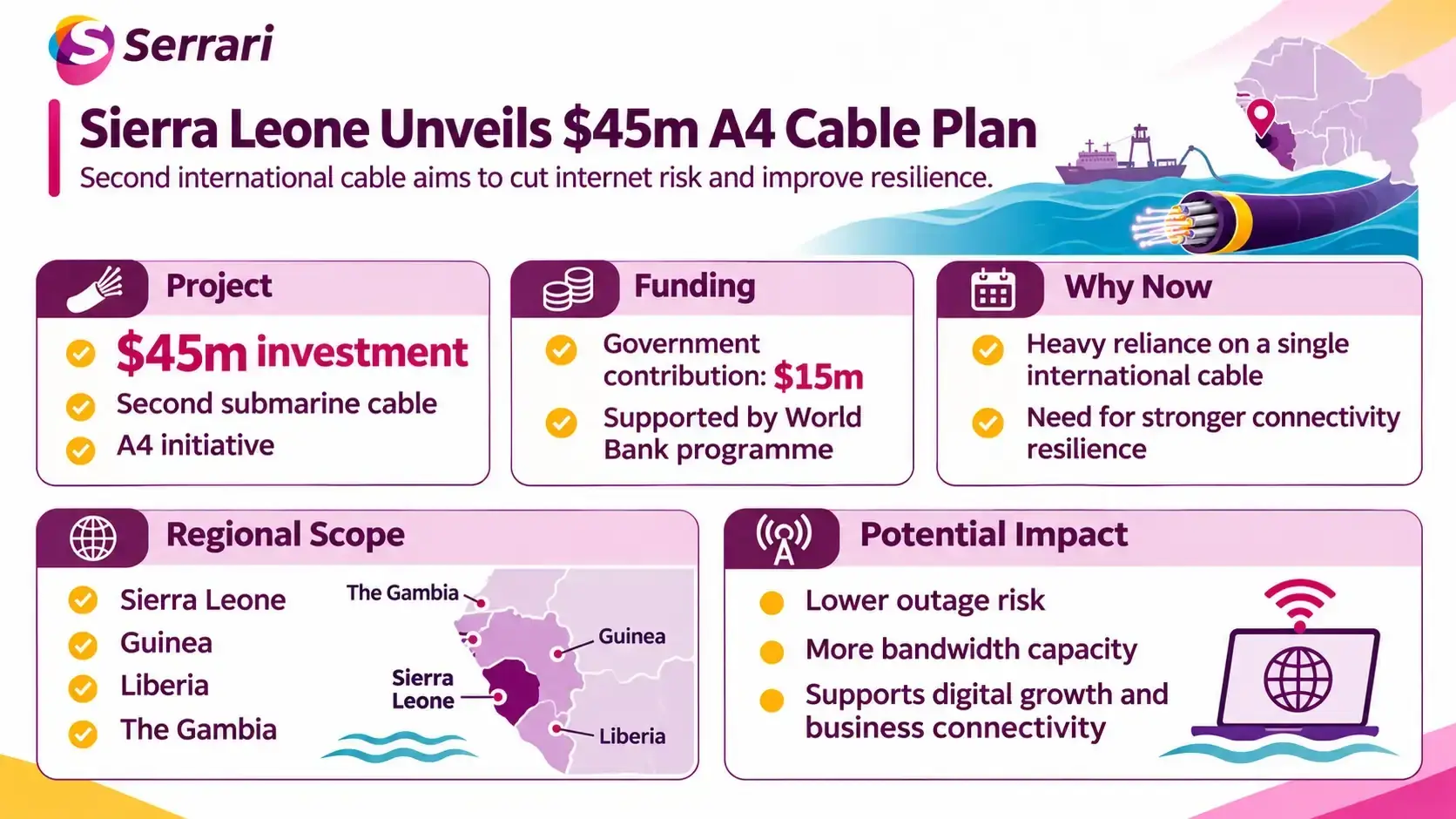
- Project: A proposed second international submarine cable for Sierra Leone, described as the A4 initiative, with an announced investment estimate of $45 million.
- Financing: The government has identified a $15 million contribution supported by a regional World Bank programme; the full financing structure and remaining commitments have not been publicly detailed.
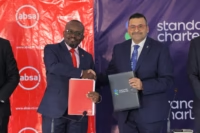
- Partners: The National Cable Consortium involves the government and telecommunications operators including Africell, Orange and QCell, with digital infrastructure provider Zoodlabs also identified in reporting.
- Regional scope: Sierra Leone, Guinea, Liberia and The Gambia are cited in the A4 announcement; a broader regional cable procurement process also involves Guinea-Bissau.
- Why now: Heavy reliance on the ACE route creates exposure to cable damage, while regional authorities are moving to procure additional international capacity.
- What is at stake: A second connection could make services more reliable, improve wholesale competition and support digital trade, but a launch announcement is not the same as a completed landing or operational service.
Why Sierra Leone Needs a Second Route to the Internet
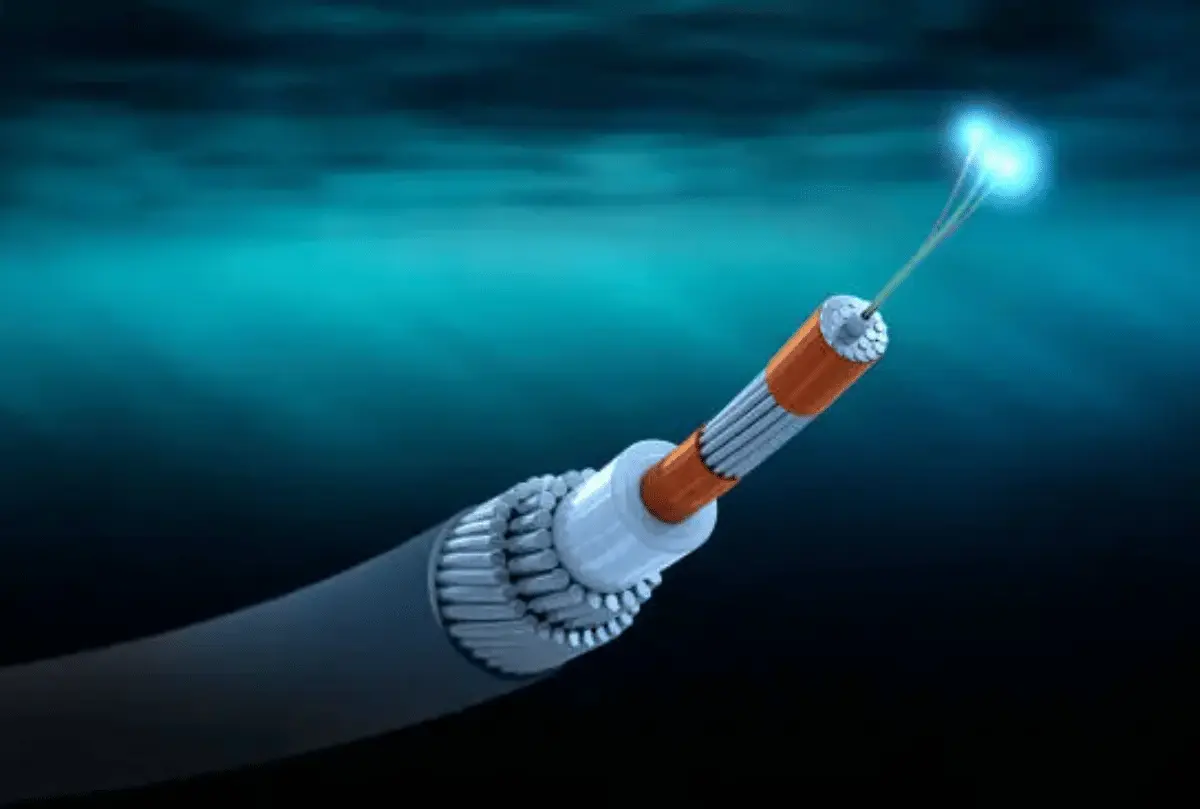
A submarine fibre-optic cable is not simply a faster internet connection. It is a piece of critical infrastructure that carries international data traffic between countries, cloud services, banks and other networks. Sierra Leone’s established international submarine connection is the Africa Coast to Europe cable, leaving the country unusually exposed when its international traffic has few independently available routes.
That vulnerability has been visible across the region. The March 2024 West African cable disruption affected connectivity in 13 countries, demonstrating how damage to submarine infrastructure can spill across borders and networks. The incident did not affect every country or operator equally, but it showed that regional internet reliability depends on route diversity, repair capabilities and backup arrangements rather than headline bandwidth alone.
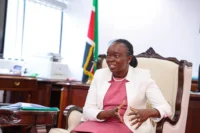
In Sierra Leone, the new National Cable Consortium announcement is an effort to address that structural exposure. Minister of Communication, Technology and Innovation Salima Monorma Bah connected the project to a shared problem faced by Sierra Leone, Guinea, Liberia and The Gambia: excessive dependence on a single submarine route. By aggregating demand, the countries aim to make the economics of an additional connection more attractive to investors and suppliers.
The immediate cause, therefore, is not a sudden surge in social-media use or a single new telecommunications product. It is the risk of concentrating an essential national service in too little international infrastructure. As payments, education, government records and enterprise systems become more dependent on cloud connectivity, that exposure grows more costly.
How the $45 Million Partnership Is Intended to Work
The government announced the project at the summit in Lungi, where President Julius Maada Bio attended the launch discussions. The reported structure brings public authorities together with network operators that would ultimately need reliable international bandwidth to serve their customers. The government contribution is reported as $15 million, supported through the World Bank’s West Africa Regional Digital Integration Programme.
The remaining amount cannot yet be treated as fully secured private financing. Media accounts of the summit also cited a $40 million estimate, with $25 million sought from private investors, while other coverage put the initiative at $45 million. These are differences in reported project estimates, not evidence that the completed infrastructure has already cost either amount. A definitive cost, financing agreement and construction schedule will matter more as procurement proceeds.
The wider regional development programme approved in March totals $137 million across Benin, Liberia and Sierra Leone. That figure is the value of a broader operation covering broadband infrastructure, regulation and digital entrepreneurship; it should not be presented as the budget for Sierra Leone’s A4 landing alone.
There is also a reason for the consortium model. A single operator may hesitate to underwrite costly international infrastructure if it cannot predict enough demand. Pooling expected capacity purchases from multiple operators can improve the investment case. Public participation can support national resilience objectives that may not generate an immediate private-sector return. In exchange, the governance arrangements must prevent one participant from controlling access at the expense of competitors.
Why Regional Cooperation Could Change the Economics
Submarine cables are capital-intensive, and smaller national markets may struggle to justify new routes independently. Regional procurement allows countries to combine demand, coordinate technical requirements and potentially negotiate better terms. The regional evaluation exercise held in Abuja between June 29 and July 10, 2026 brought representatives from The Gambia, Guinea, Guinea-Bissau, Liberia and Sierra Leone together to assess proposals for added cable capacity.
This wider process explains why the A4 announcement is part of a longer policy effort, not an entirely new idea conceived at the November summit. It also requires precision: the four countries identified by the minister in describing A4 are not identical to the five countries involved in the wider procurement exercise. Project specifications and participating-country arrangements may be refined as contracts are negotiated.
Successful coordination could do more than add a new coastal landing. It may encourage links between national terrestrial networks, support cross-border traffic and reduce the need for data to travel through unnecessarily distant routes. However, a second submarine connection only provides meaningful redundancy if inland links, landing facilities and international paths are sufficiently independent. Two cables feeding through the same vulnerable inland corridor can still fail together.
Context is everything. Stay ahead of shifting trends with today’s market updates, and uncover emerging opportunities using the Serrari Group Market Index and Marketplace. Then, take control of your own financial future by exploring our Money & Life Reset Transformation Blueprint ™ to build stronger habits, create better systems, and design a path toward lasting wealth.
What Businesses and Consumers Could Gain
For a mobile subscriber, the potential benefit is more consistent connectivity when a major international route fails. For businesses, the stakes are broader. Banks and mobile-money companies depend on continuous communication with payment processors and other systems. Exporters, remote-service firms, online retailers and software companies need predictable connectivity to serve customers, process orders and use cloud platforms.
An additional cable could also increase wholesale internet capacity and strengthen the bargaining position of service providers. If operators can obtain bandwidth more competitively, some savings may eventually reach households and firms through lower data prices or improved packages. But this outcome is conditional. Retail tariffs also reflect domestic fibre networks, mobile towers, electricity, taxes, spectrum and the intensity of local competition. The existence of a second cable does not automatically guarantee cheaper mobile data.
The wider regional programme seeks to extend or improve broadband access for approximately 5.2 million people across the three countries covered by its second phase, alongside support for digital services and entrepreneurs. Those are programme-level goals, not forecasts of how many Sierra Leoneans will receive new connections solely because of A4.
This distinction matters for accountability. Authorities should ultimately be judged by actual operational uptime, delivered capacity, wholesale access conditions and affordability, rather than the announced construction value alone.
Sierratel’s Regional Ambitions Add a Second Dimension
The summit also highlighted a separate telecommunications initiative: a proposed Sierratel International partnership with Africell to pursue mobile virtual network operator licences in selected African markets. An MVNO offers mobile services using another operator’s physical radio network rather than building an entirely independent tower network.
This proposed expansion builds on the May 2026 relaunch of Sierratel as an MVNO through a partnership with Africell in Sierra Leone. It suggests the government wants the national telecommunications brand to pursue a commercial role beyond the country’s borders, although foreign licences and market entry remain prospective rather than achieved.
The two announcements are related strategically but should not be confused. The cable is an international connectivity infrastructure project; Sierratel International is a proposed expansion of mobile services. Both fit a regional integration agenda, yet each requires different funding, regulatory permissions and commercial execution.
The Test Is Delivery, Access and Resilience
Sierra Leone’s proposed cable is significant because digital connectivity has become basic economic infrastructure. An unreliable international connection can affect transactions and services far beyond the telecom industry. The project responds to a genuine weakness shared by several West African economies, and the consortium could help overcome the limited scale of any one national market.
But the November announcement is a starting point. Contracts, financing closure, route design, marine installation, landing arrangements and commercial access rules must follow before users receive the benefits. Independent physical routing and transparent wholesale terms will determine whether the cable genuinely reduces risk and encourages competition.
For Sierra Leone, the larger question is whether a $45 million proposal becomes a durable improvement in the reliability and cost of being connected to the world. For West Africa, the answer will show whether regional cooperation can turn shared infrastructure vulnerability into a stronger foundation for digital trade, investment and public services.
Sources: CAJ News Africa / World Bank / Economic Community of West African States / Internet Society / Office of the President of Sierra Leone / Awoko / SierraLoaded
Your financial future isn’t something you wait for—it’s something you build.
The real question is: when do you begin?
Move beyond simply staying informed.
Navigate the markets with clarity—track trends through the Serrari Group Market Index, uncover opportunities in the Serrari Marketplace, and build practical knowledge with our Curated Wealth Builder Platform.
Stay connected to what truly matters.
Get daily insights on macro trends and financial movements across Kenya, Africa, and global markets—delivered through the Serrari Newsletter.
Growth opens doors.
Advance your career through professional programs including ACCA, HESI A2, ATI TEAS 7 , HESI EXIT , NCLEX – RN and NCLEX – PN, Financial Literacy!🌟—designed to move you forward with confidence.
See where money is flowing—clearly and in real time.
Track Money Market Funds, Treasury Bills, Treasury Bonds, Green Bonds, and Fixed Deposits, alongside global and African indexes, key economic indicators, and the evolving Crypto and stablecoin landscape—all within Serrari’s Market Index.