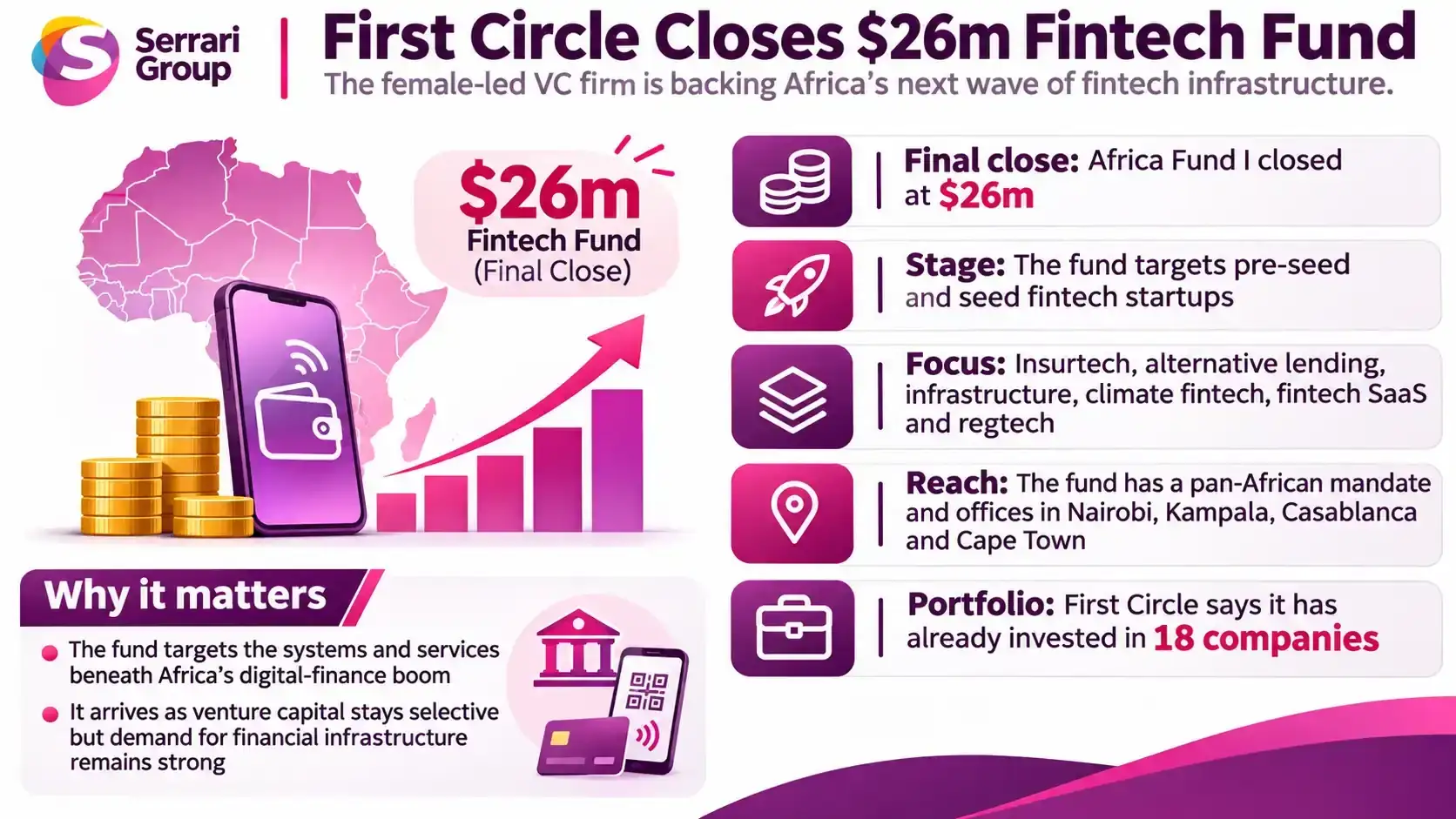
First Circle Capital has completed the $26 million final close of its first Africa-focused venture fund, giving the female-led investment firm a larger pool of committed capital to back financial technology startups at the pre-seed and seed stages. Announced on November 18, 2026, the close comes as African venture investors remain selective about new deals even while fundraising by venture funds has recovered. The firm is prioritising the systems beneath digital finance—credit, insurance, payment interoperability, compliance and business software—rather than assuming another consumer payments app will solve the continent’s remaining financial-access problems. Its strategy also places greater emphasis on artificial intelligence, although the success of its investments will depend on startups converting promising technology into sustainable businesses.
Key Overview
- Fund secured: First Circle Africa Fund I reached a $26 million final close, above the $25 million target described in earlier institutional disclosures.
- Investment stage: The fund backs pre-seed and seed-stage African fintech companies, where funding can help teams validate products and win early customers.
- Six priorities: Insurtech, alternative lending, interoperability and infrastructure, climate fintech, fintech software-as-a-service and regulatory technology.
- Institutional supporters: Investors named at the close include IFC, Bpifrance, MSMEDA, Axian, the Dutch Good Growth Fund, Stellar Foundation and FSD Africa.
- Existing portfolio: First Circle says it has already invested in 18 companies, including TurnStay, WafR, Scale, Orca Fraud, Opareta, Balad and Power.
- Bigger trend: The fund is being completed in a market where fundraising has improved but early-stage companies still face demanding requirements for growth and follow-on financing.
Why a $26 Million Close Matters in a Selective Funding Market
First Circle’s final close is not simply another announced funding round for a technology company. A venture fund raises commitments from investors and deploys the capital over time into several businesses. This provides a financing channel for founders who may be too early for bank borrowing or large institutional growth rounds. The firm’s November 18 fund announcement confirms that its mandate is to invest across African markets in companies developing financial products and the infrastructure that delivers them.
The $26 million close also modestly exceeds the $25 million fundraising target disclosed earlier in the institutional investment proposal, which carried a $30 million hard cap. Final close means fundraising for this vehicle has concluded at the announced amount; it does not mean that all $26 million has already been paid to startups or is available for new investments after fees, reserves and previous commitments.
Timing matters. The third-quarter 2026 venture-capital review counted 271 African venture deals through September, describing activity as 25% below the recent historical average. Yet fundraising by venture funds reached $671 million in the comparable year-to-date period, compared with $239 million a year earlier. These measures describe different parts of the market: investor commitments to funds can recover even while fund managers finance fewer startups.
That divergence helps explain the importance of specialist managers. Investors are committing capital, but they increasingly want a disciplined strategy and credible knowledge of the businesses receiving it. First Circle’s focus on fintech infrastructure is a way to compete through sector expertise rather than through the largest possible number of investments.
Why African Fintech Is Moving Beyond Basic Payments
Africa’s first major fintech wave made sending and receiving money easier for millions of users. But a digital wallet or payment channel does not automatically provide affordable business credit, usable insurance, lower-cost remittances or dependable financial records. Problems also remain when financial systems cannot communicate across banks, mobile-money providers or national borders.
First Circle calls its approach FinTech 2.0. The thesis is that the next commercially valuable companies may build the technology allowing banks, merchants, insurers and other financial providers to serve customers more efficiently. Its six investment areas cover insurance technology, alternative credit models, interoperability, climate-related financial tools, financial software and regulatory compliance.
The cause is structural. A small business may accept digital payments but still lack transaction histories that a lender can assess. A migrant worker may be able to initiate a transfer but encounter expensive intermediaries. An insurer may struggle to distribute small policies profitably. Software that improves verification, data exchange and administration could address these constraints, but only where products also satisfy local regulations and customers’ ability to pay.
That distinction is especially important for readers assessing fintech investment claims. More financial applications do not necessarily mean deeper financial inclusion. A useful measure is whether a service reduces costs, improves access, manages risk or helps a financial institution reach previously excluded customers sustainably. First Circle’s investments will ultimately need to demonstrate such outcomes rather than relying on the size of Africa’s population or its long-term digital growth potential.
Why Development Investors Are Backing the Strategy
The fund’s backers combine development-oriented investors with institutional and strategic capital providers. Their participation signals an interest in financial infrastructure and in expanding the pool of professional managers able to fund African startups. It does not guarantee that each investment will succeed.
The public investment disclosure records an approved IFC equity investment of up to $4 million and a proposed additional commitment of up to $2 million through the Women Entrepreneurs Finance Initiative. Those amounts are disclosed institutional arrangements, not a basis for assigning exact final contributions to every investor listed in the November closing announcement.
The development rationale extends beyond individual company returns. Early-stage capital may help businesses build services for consumers and smaller enterprises that traditional investors consider too risky or costly to reach. Institutional support can also provide governance, technical expertise and access to later investors. In 2025, a dedicated $1 million investment announcement highlighted the potential for local specialist fund managers to attract additional commitments while advancing financial inclusion.
For founders, that support matters because capital is only one obstacle. Regulated fintech companies often need bank partnerships, licences, trusted systems and several rounds of financing before achieving meaningful scale. A fund that helps secure commercial relationships and prepares companies for Series A financing could therefore deliver value beyond the initial cheque.
Context is everything. Stay ahead of shifting trends with today’s market updates, and uncover emerging opportunities using the Serrari Group Market Index and Marketplace. Then, take control of your own financial future by exploring our Money & Life Reset Transformation Blueprint ™ to build stronger habits, create better systems, and design a path toward lasting wealth.
Existing Portfolio Shows Where the Next Opportunities Lie
First Circle reports 18 investments already made across African markets. That makes its final close a milestone in an operating investment programme rather than the starting point of a portfolio assembled from zero. The firm names South Africa’s TurnStay, which addresses cross-border travel payments, and Morocco’s WafR, which digitises transactions through neighbourhood retailers. Scale provides card-issuing infrastructure, while Orca Fraud applies AI to detecting suspicious financial activity.
Its investments also include Opareta, which develops software for mobile-money agent networks; Balad, which works on regulated remittance infrastructure in Egypt; and Power, an earned-wage-access provider. The published portfolio descriptions illustrate a common thread: many companies sell tools or infrastructure to other businesses rather than competing solely for retail app downloads.
That business-to-business orientation can be attractive because a successful provider may become embedded in customers’ everyday operations. Yet it carries risks. Financial institutions can have lengthy procurement processes, cross-border expansion may require separate regulatory approvals, and revenue concentration in a handful of large clients can make early companies vulnerable. Investors will need evidence of recurring revenue, reliable technology and manageable customer-acquisition costs.
AI-Native Fintech Offers Efficiency but Creates New Risks
The fund is also paying closer attention to AI-native fintech companies—businesses built around automation, data and machine learning from inception. Potential applications include fraud detection, document processing, customer service, transaction monitoring and credit assessment. Used effectively, these tools could lower the cost of handling small transactions or serving customers who have historically been expensive to reach.
However, automation is not inherently cheaper or safer. Models can make errors, reflect biases in training data or perform poorly when local information is incomplete. Financial businesses also handle sensitive customer information and must explain decisions that affect access to money or insurance. AI therefore creates opportunities for productivity alongside requirements for data protection, oversight and regulatory compliance.
First Circle’s emphasis on AI is best understood as an additional filter across its existing sectors, not a promise that every portfolio business is AI-driven. The test will be whether founders can establish measurable improvements in unit economics and customer outcomes while maintaining trust.
What the Fund Means for Kenya and the Wider Continent
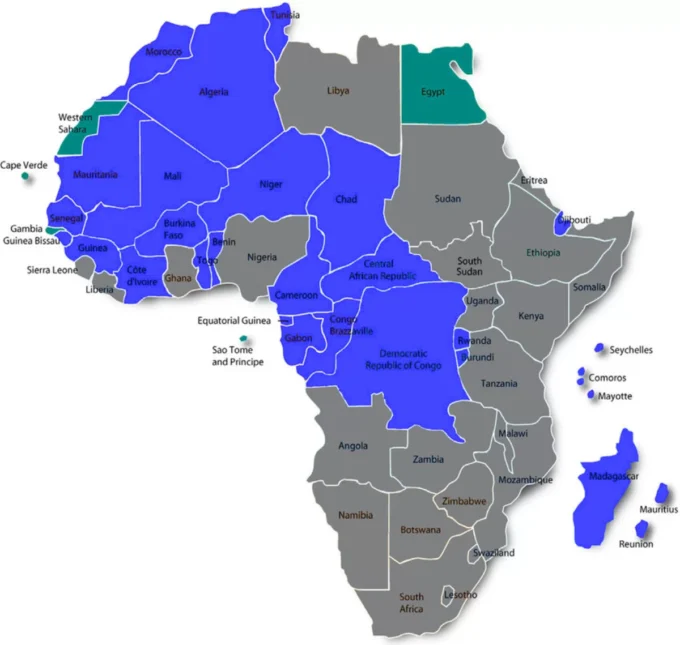
With offices in Nairobi, Kampala, Casablanca and Cape Town, First Circle has a pan-African mandate that includes Kenya, Nigeria, South Africa, Egypt, Morocco, Uganda, Ghana and Francophone markets. Kenyan founders could benefit from a locally accessible investor with regional relationships, particularly where products need to work across mobile money, banks and other service providers. But the $26 million is a continental fund; it has not been earmarked for Kenya alone.
The bigger implication is that investors still see opportunity in African fintech, but their priorities are becoming more precise. The 2026 fund close does not reverse every challenge facing startup finance, and a portfolio of 18 companies does not establish profitable exits. It does, however, put committed capital behind businesses attempting to solve problems that first-generation payment services left unresolved.
The next measure of success will be how many funded companies secure repeat customers, navigate regulation, attract follow-on capital and improve the delivery of financial services. If those outcomes materialise, First Circle’s $26 million could matter far beyond its headline size: it would show that Africa’s next fintech growth phase can be built on dependable infrastructure, not merely the rapid adoption of new apps.
Sources: Disruption Banking / International Finance Corporation / African Private Capital Association / FSD Africa / Tech in Africa
Your financial future isn’t something you wait for—it’s something you build.
The real question is: when do you begin?
Move beyond simply staying informed.
Navigate the markets with clarity—track trends through the Serrari Group Market Index, uncover opportunities in the Serrari Marketplace, and build practical knowledge with our Curated Wealth Builder Platform.
Stay connected to what truly matters.
Get daily insights on macro trends and financial movements across Kenya, Africa, and global markets—delivered through the Serrari Newsletter.
Growth opens doors.
Advance your career through professional programs including ACCA, HESI A2, ATI TEAS 7 , HESI EXIT , NCLEX – RN and NCLEX – PN, Financial Literacy!🌟—designed to move you forward with confidence.
See where money is flowing—clearly and in real time.
Track Money Market Funds, Treasury Bills, Treasury Bonds, Green Bonds, and Fixed Deposits, alongside global and African indexes, key economic indicators, and the evolving Crypto and stablecoin landscape—all within Serrari’s Market Index.