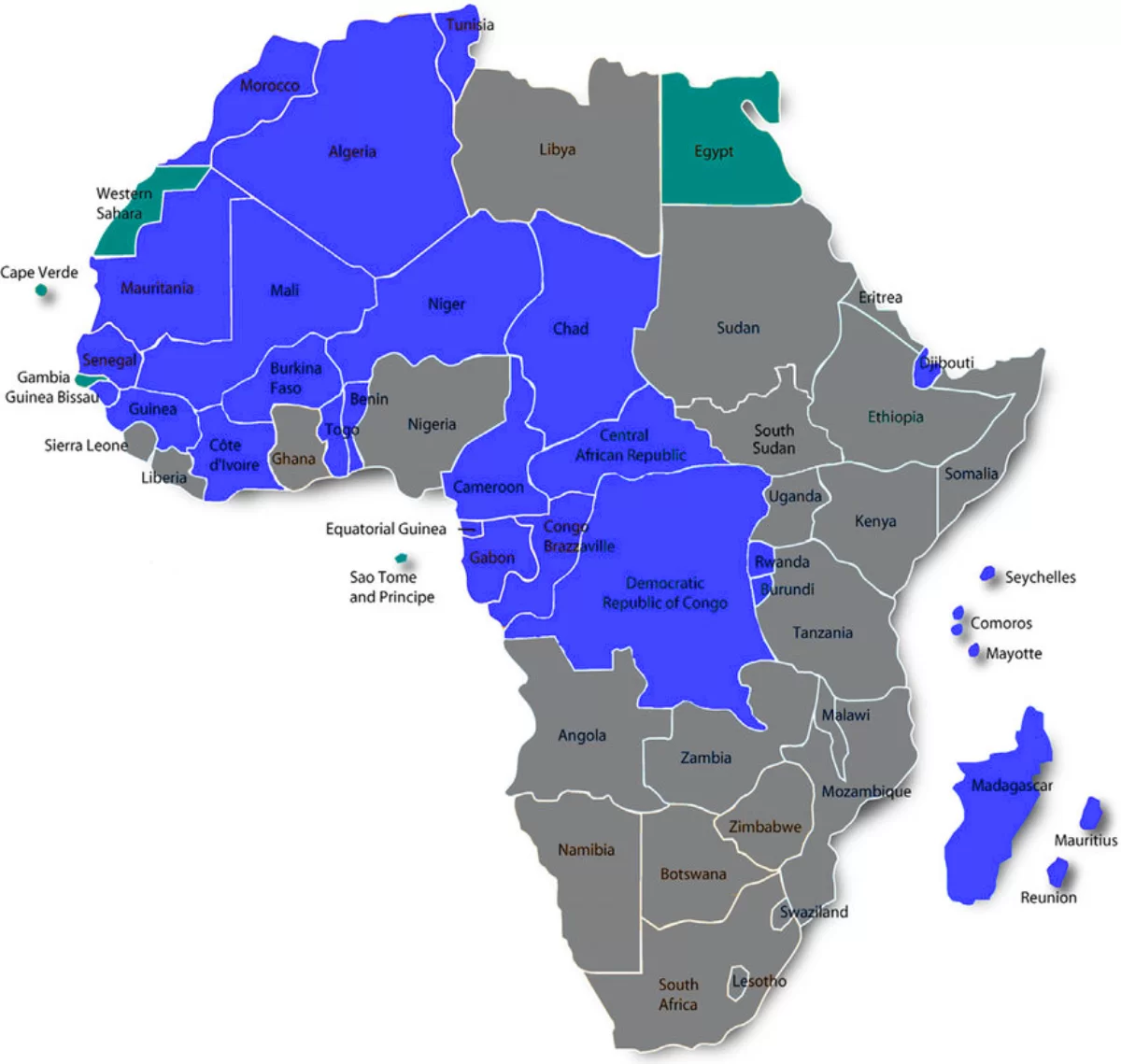
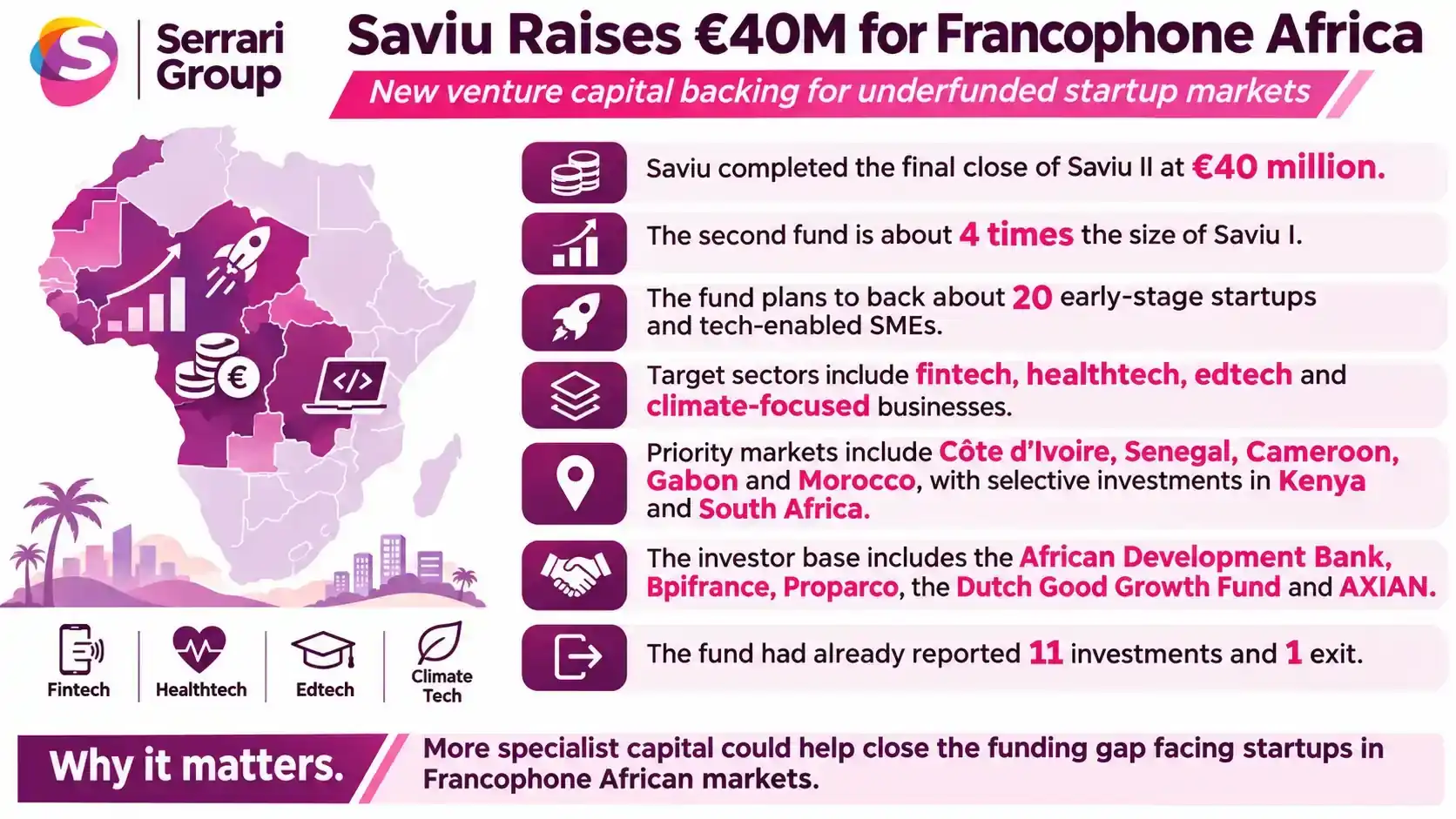
Venture capital firm Saviu has completed the final close of its second fund, Saviu II, at €40 million, approximately four times the size of its predecessor. The financing brings new institutional backing from the African Development Bank and Bpifrance to a vehicle targeting roughly 20 early-stage startups and technology-enabled businesses, primarily in French-speaking Africa. More than a fundraising milestone, the closing tests whether development finance and hands-on investment management can help close a persistent capital gap outside Africa’s most prominent startup hubs. With 11 investments and one exit already reported, attention now shifts to the quality of the businesses financed, their ability to raise follow-on capital and whether investors can ultimately realize returns.
Key Overview
- Fund size: Saviu II reached a final close of €40 million, compared with approximately €10 million raised by Saviu I.
- Institutional support: New backers include the African Development Bank and Bpifrance, joining investors including Proparco, the Dutch Good Growth Fund and AXIAN.
- Risk-sharing structure: The development bank approved €6.5 million, comprising €4.5 million in equity and €2 million in first-loss support funded through European Commission resources.
- Investment strategy: About 20 businesses are targeted, with initial investment tickets generally between €500,000 and €3 million.
- Geographic focus: Côte d’Ivoire, Senegal, Cameroon, Gabon and Morocco lead the mandate, alongside selected investments in Kenya and South Africa.
- Existing activity: The fund has reported 11 investments and one exit, making deployment and commercial outcomes the next measures of success.
Why Saviu’s €40 Million Closing Matters Beyond Fundraising
Saviu’s final closing at €40 million is important because the fund is aimed at a financing gap rather than at the continent’s most heavily courted venture markets. Nigeria, Kenya, Egypt and South Africa have long dominated discussions of African technology investing. Startups in French-speaking West and Central Africa have often faced a thinner pool of specialist investors, fewer large financing rounds and more limited evidence of successful exits.
That imbalance can reinforce itself. When investors see few examples of companies selling at attractive valuations or reaching substantial scale, they hesitate to commit capital. Without funding, promising founders struggle to expand, recruit experienced staff or demonstrate the growth needed to attract the next investor. A specialized fund can help interrupt that cycle, although one vehicle cannot resolve an entire region’s financing constraints.
Saviu II’s size also demonstrates progress in its own fundraising journey. The fund reached an initial close of €12 million in 2023, followed by a €25 million second close in 2025. Its €40 million final close is therefore the culmination of several fundraising stages, not €40 million newly collected in November 2026. The predecessor fund, Saviu I, was approximately €10 million and invested in 12 startups.
For founders, the practical difference is the prospect of a more established investor able to write meaningful early-stage cheques and remain involved after the deal closes. For other investors, the new fund offers a managed route into markets that may be difficult to access and evaluate independently.
Why Development Banks Are Taking on More Startup Risk
The most consequential element of Saviu II’s financing is not simply who invested but how part of the commitment is structured. The African Development Bank approved €6.5 million in financing, made up of €4.5 million in equity and €2 million from European Commission resources under the Boost Africa programme.
The latter component is described as first-loss support. In broad terms, first-loss structures allocate an agreed portion of potential losses to a more risk-tolerant investor, aiming to make participation more acceptable to others. The precise protection available to any investor depends on the fund’s contractual terms, which should not be inferred from the headline amount alone.
The rationale is straightforward. Early-stage businesses can have uncertain revenues, limited collateral and long periods before an investor can sell a stake. Those conditions discourage commercial investors seeking predictable returns or relatively quick liquidity. Development institutions may accept particular risks where they believe financing can also create jobs, improve access to services and deepen local capital markets.
Bpifrance joined through its Averroès Africa investment programme. Existing supporters include Proparco, the Dutch Good Growth Fund and AXIAN, alongside a broad base of private investors. This combination of public-backed, corporate and individual capital matters because it spreads participation across institutions with different investment mandates and potential resources for portfolio companies.
But public support should not be confused with proof of profitability. If startups cannot sustain operations, obtain additional investment or generate attractive exits, risk-sharing may support fundraising without establishing a durable commercial market. The larger ambition is to make future funds less dependent on special protections.
How the Fund Plans to Support 20 Businesses
Saviu II intends to back approximately 20 startups and technology-enabled small and medium-sized enterprises, with initial cheques of €500,000 to €3 million. Its interests include fintech, healthcare technology, education technology and climate-related businesses, although its investment approach is not restricted to those categories.
Its geographic priorities include Côte d’Ivoire, Senegal, Cameroon, Gabon and Morocco, while allowing selective investments in Kenya and South Africa. That wider mandate can provide access to businesses with regional expansion potential, particularly if they can bring products or capabilities into French-speaking markets.
The firm describes its model as hands-on investing. Beyond providing capital, its team helps founders with recruitment, business development, market entry and subsequent fundraising. This approach can be especially relevant where startups lack access to experienced executives, specialist legal advice or well-developed networks of follow-on investors.
There is a trade-off. Intensive support consumes time and management capacity. As the portfolio moves toward 20 companies, Saviu will need to preserve the quality of its assistance without overstretching its investment team. The fund’s performance will depend on both selecting viable businesses and helping them execute plans in diverse regulatory and commercial environments.
Context is everything. Stay ahead of shifting trends with today’s market updates, and uncover emerging opportunities using the Serrari Group Market Index and Marketplace. Then, take control of your own financial future by exploring our Money & Life Reset Transformation Blueprint ™ to build stronger habits, create better systems, and design a path toward lasting wealth.
What the First Investments Reveal About Demand
Saviu II says it has already made 11 investments and recorded one exit. Its disclosed holdings include Cameroon’s Waspito, which provides telemedicine services; Senegal’s Soram, involved in printer reconditioning and deployment; Gabon’s Pozi, focused on fleet management; Morocco’s AgenZ, a property technology business; and South Africa’s Resolute, which develops robotics and coding education offerings.
The portfolio examples disclosed at the closing show the diversity of potential demand. Healthcare platforms can address gaps in access to consultations, while logistics technology may help businesses manage vehicles and operating costs. Education technology and equipment-reuse businesses address different customer needs but similarly depend on finding paying users and sustainable margins.
These companies should not be treated as equally mature, equally successful or guaranteed beneficiaries of the fund’s entire capital pool. Publicly available announcements do not establish their individual investment sizes, current valuations or realized returns. The reported exit is encouraging, but without disclosed proceeds it cannot establish how profitable the fund has been.
Saviu’s earlier fund reported exits involving ICT4Dev, Lapaire Glasses and Rubyx. Those transactions suggest that some investors can find buyers for Francophone African technology businesses. However, repeatable exits at valuations sufficient to compensate for failed investments will be a more meaningful measure of the region’s investment maturity than isolated transactions.
Why This Matters for African Founders and Investors Now
For founders, the fund potentially expands access to institutional equity when bank borrowing may be unsuitable for early-stage companies with few tangible assets. A larger early-stage cheque can finance product development, hiring and market expansion without immediately imposing debt-service obligations. Equity financing, however, involves dilution and expectations of substantial future growth.
For workers and consumers, successful portfolio companies could expand access to useful products and create employment. Yet these outcomes remain possibilities rather than demonstrated results of the new closing. Job creation, affordability and service quality will depend on what the funded firms actually deliver.
For investment managers, Saviu II offers a test of whether specialist local knowledge and operational support can overcome some disadvantages of investing across fragmented markets. Differences in language, regulations, customer purchasing power, taxation and currency conditions can complicate expansion even where business models appear similar.
The timing is also significant. After the African venture market’s earlier funding boom gave way to tighter capital conditions, investors have placed greater emphasis on business fundamentals, profitability pathways and exit opportunities. A completed institutional fundraise signals that capital remains available for focused strategies, not that the wider market has returned to unlimited funding.
The Bigger Picture: A Fund Closing Is Only the First Test
Saviu II has secured €40 million, widened its institutional investor base and begun assembling a cross-border portfolio. Those achievements matter in markets where a shortage of early-stage risk capital can hold back otherwise promising businesses.
The harder questions come next. Can its portfolio companies build durable revenue? Will commercial investors finance later rounds? Can Saviu obtain exits that generate strong enough returns to justify another fund? And can development-backed financing eventually support a venture ecosystem that attracts more private capital on its own?
The broader significance of the closing is therefore not the dollar equivalent attached to the announcement. It is the opportunity to test whether targeted capital, risk sharing and sustained operational support can transform underfunded startup markets into viable destinations for long-term investment. That is why Saviu II matters now—and why its ultimate results will be measured in business performance rather than fundraising headlines.
Sources: Saviu Ventures / African Development Bank / Proparco / Dealroom / Launch Base Africa / Tech in Africa
Your financial future isn’t something you wait for—it’s something you build.
The real question is: when do you begin?
Move beyond simply staying informed.
Navigate the markets with clarity—track trends through the Serrari Group Market Index, uncover opportunities in the Serrari Marketplace, and build practical knowledge with our Curated Wealth Builder Platform.
Stay connected to what truly matters.
Get daily insights on macro trends and financial movements across Kenya, Africa, and global markets—delivered through the Serrari Newsletter.
Growth opens doors.
Advance your career through professional programs including ACCA, HESI A2, ATI TEAS 7 , HESI EXIT , NCLEX – RN and NCLEX – PN, Financial Literacy!🌟—designed to move you forward with confidence.
See where money is flowing—clearly and in real time.
Track Money Market Funds, Treasury Bills, Treasury Bonds, Green Bonds, and Fixed Deposits, alongside global and African indexes, key economic indicators, and the evolving Crypto and stablecoin landscape—all within Serrari’s Market Index.