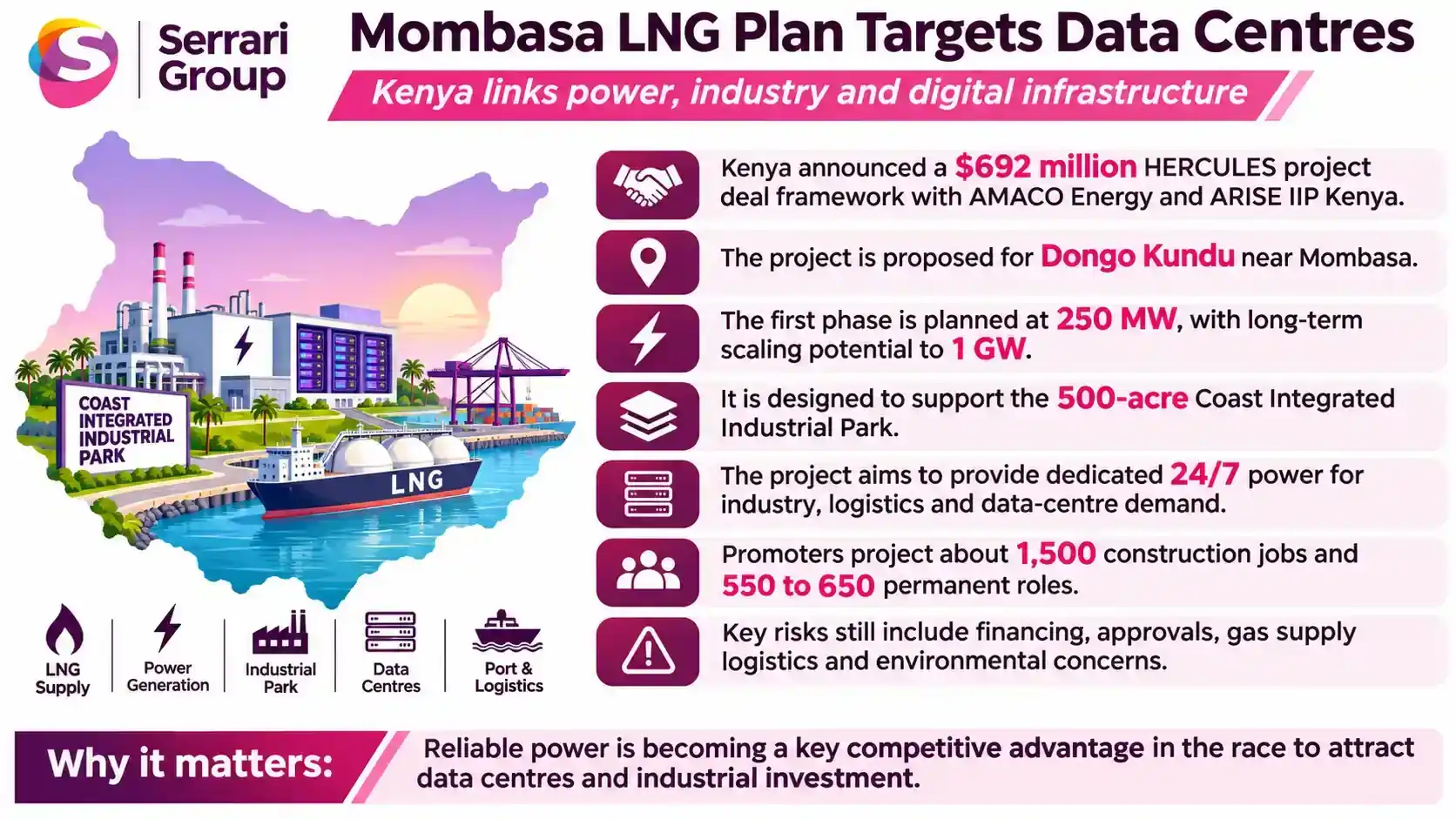
A proposed KSh90 billion ($692 million) liquefied natural gas (LNG) and digital-infrastructure development at Dongo Kundu could reshape Mombasa’s ambitions as an industrial and data-centre destination. Greek energy company AMACO Energy and ARISE Integrated Industrial Platforms (ARISE IIP) Kenya signed a memorandum of understanding on November 6, 2026, to advance the HERCULES project, initially envisaging 250 megawatts (MW) of dedicated electricity generation with scope to expand to 1 gigawatt (GW). The business case is built around a persistent investment barrier: factories and computing facilities need reliable, competitively priced power as much as they need land, port access and fibre connectivity. However, the agreement launches development work rather than confirming construction, financial close or future electricity prices, leaving important commercial and environmental questions unanswered.
Key Overview
- Project value: The proposed integrated power and digital-infrastructure development is valued at about KSh90 billion, commonly reported as $692 million to $700 million.
- Agreement status: AMACO Energy and ARISE IIP Kenya signed a memorandum of understanding, not a completed financing or construction contract.
- Planned generation: An initial 250 MW LNG-powered system could expand to 1,000 MW if demand and investment support additional phases.
- Industrial location: The project would support the 500-acre Coast Integrated Industrial Park at Dongo Kundu, close to Mombasa’s port and international cable landings.
- Employment potential: Promoters project approximately 1,500–1,850 construction jobs and 550–650 direct and indirect operational jobs.
- Outstanding risks: Engineering, permits, fuel logistics, commercial contracts, financing and environmental safeguards still require resolution.
Why Mombasa Is Pursuing Dedicated LNG Power
Kenya’s proposed HERCULES project responds to a basic industrial-development problem: attracting investors to a designated economic zone is easier than ensuring those investors can operate continuously once they arrive. Large manufacturers, cold-chain operators, port logistics businesses and data centres cannot rely on land availability and tax incentives alone. They need dependable electricity, predictable operating costs and supporting utilities before committing substantial capital.
The November 6 development agreement brings AMACO Energy together with ARISE IIP Kenya to assess an integrated power, cooling and digital-infrastructure project at the Coast Integrated Industrial Park. Reports from the industrial zone indicate that some investors have delayed full-scale commitments because electricity connections, roads, water and sewerage infrastructure are not yet sufficiently developed. That helps explain why the developers propose to build electricity generation alongside the facilities expected to consume it.
Rather than treating power as a utility to be connected after tenants arrive, the model seeks to make generation part of the site’s initial investment proposition. In principle, a dedicated supply could reduce exposure to interruptions elsewhere on the network and offer industrial users clearer contractual arrangements. But an independently operated power facility is not automatically cheaper or more reliable: performance would still depend on its turbines, maintenance, fuel availability, backup arrangements and the terms under which customers buy electricity.
The project is being described as a KSh90 billion initiative, or around $692 million at the conversion used in initial reporting. This is a proposed development value, not proof that KSh90 billion has been disbursed. The memorandum sets out a framework for technical, commercial, environmental, regulatory and financing work before a final investment decision can be made.
What the 250 MW First Phase Would Actually Deliver
HERCULES is designed to begin with approximately 250 MW of electricity generation, potentially expanding in stages to 1,000 MW as industrial and computing demand increases. The project’s reported technical concept includes a floating LNG-fuelled power barge, associated cooling infrastructure and systems intended to support data centres and other large electricity users.
A 250 MW generating plant has a maximum instantaneous output of 250 MW; it does not generate 250 MW every hour without interruption. Actual electricity produced would depend on availability, dispatch, fuel deliveries and maintenance. Nor should the potential 1 GW endpoint be treated as an approved or fully funded expansion. Growth would need paying customers, additional capital and sufficient supporting infrastructure.
An important distinction also concerns the site. The Coast Integrated Industrial Park is described as a 500-acre industrial development. Reporting on HERCULES identifies a smaller dedicated onshore power-and-digital-infrastructure footprint of roughly 50 acres, with an offshore component proposed for the floating system. The 500-acre figure therefore describes the wider park, not necessarily the footprint of the power plant itself.
The planned employment benefits are substantial but conditional. Project documentation projects 1,500–1,850 opportunities during construction, followed by roughly 350–400 direct specialised jobs and 200–250 indirect jobs in operation. These figures are estimates, not positions already created. The eventual local benefit will depend partly on procurement choices, technical training and how many suppliers and service businesses establish a presence around the complex.
Context is everything. Stay ahead of shifting trends with today’s market updates, and uncover emerging opportunities using the Serrari Group Market Index and Marketplace. Then, take control of your own financial future by exploring our Money & Life Reset Transformation Blueprint ™ to build stronger habits, create better systems, and design a path toward lasting wealth.
Why Data Centres Put Electricity at the Centre of the Deal
Mombasa has an asset that many inland industrial locations cannot replicate: direct proximity to the Port of Mombasa and international submarine fibre-optic cable connections. The reported seven submarine cable connections strengthen the city’s case as a gateway for regional data traffic, while its port helps industrial tenants bring in machinery, inputs and export finished goods.
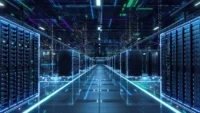
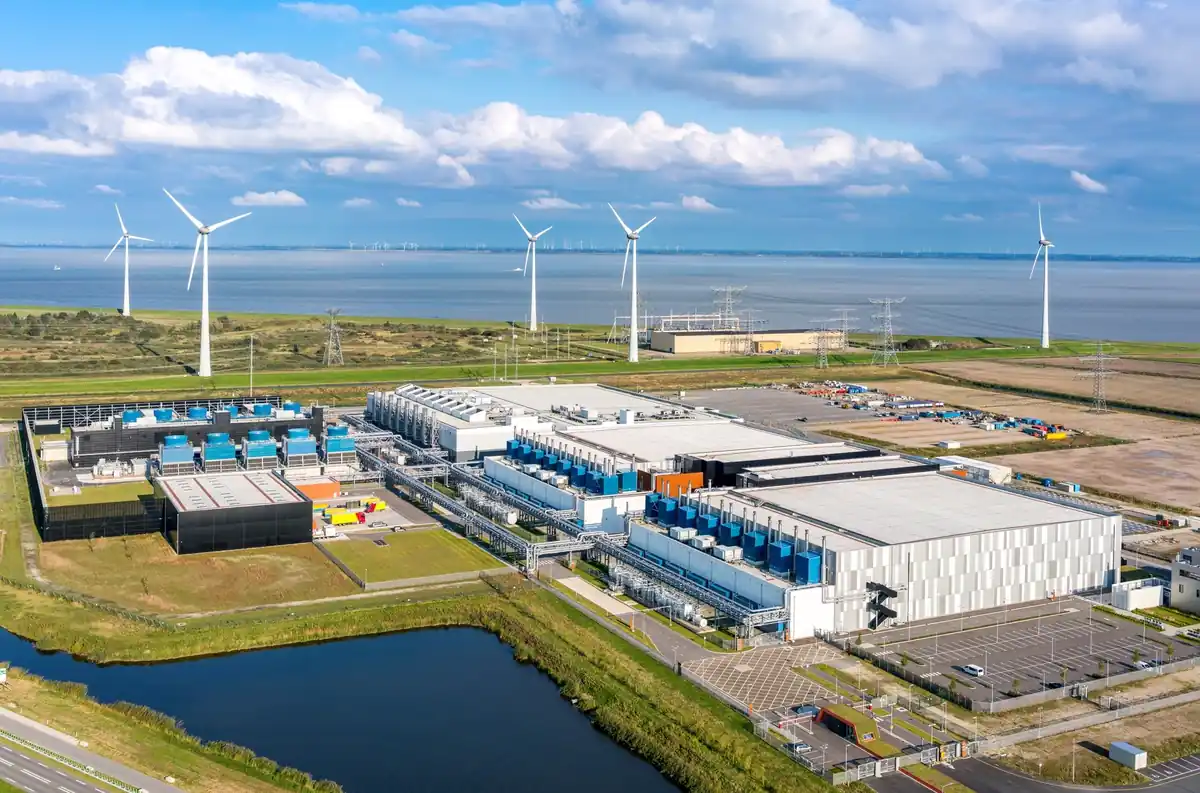
Yet cable connectivity alone cannot attract hyperscale computing operators. Data centres must power servers continuously and remove the heat they generate. Interruptions can affect customers well beyond the host country, making electricity availability, cooling capacity, telecommunications redundancy and service-level guarantees central considerations in site selection. Artificial-intelligence computing can intensify those requirements because densely packed equipment demands significant power and cooling.
That is why HERCULES combines generation and cooling rather than proposing only an ordinary gas power station. Its developers envisage placing energy infrastructure near potential computing tenants, potentially shortening some supply links and improving coordination between power and cooling design. Still, no publicly confirmed hyperscale tenant or binding electricity-purchase commitment was established by the announcement reviewed here. The projected demand therefore remains a commercial opportunity to be converted into contracts, not a guaranteed revenue stream.
The Mombasa strategy also has a broader regional dimension. Businesses serving East and Central Africa could potentially locate digital infrastructure closer to regional users rather than relying exclusively on more distant computing hubs. Whether that advantage translates into investment will depend on power pricing, latency, data regulation, connectivity redundancy, security and skilled labour availability, not just the number of cable landings.
The Gas-Supply and Climate Trade-Off Kenya Must Resolve
The proposed LNG model offers a clear technical attraction: gas-fired generation can be dispatched to meet demand when variable renewable sources are unavailable. For a large computing or industrial facility, that flexibility can be commercially valuable. But LNG is not a domestic zero-carbon power source. It must be procured, transported, handled and burned, creating exposure to international gas prices, foreign-exchange movements and greenhouse-gas emissions.
A dedicated plant would also need credible arrangements for LNG imports, marine operations, storage or regasification, safety and fuel transport. These details matter because electricity security merely shifts from grid availability to fuel-chain reliability if gas supplies cannot be maintained. Tariffs would have to cover construction, operating costs and fuel while remaining attractive enough for tenants to commit.
Project promoters have described a system designed to accommodate a future transition toward hydrogen and renewable energy. That is an aspiration, not evidence that the initial LNG phase will be emissions-free or that conversion is commercially assured. Environmental assessments would need to address air emissions, marine impacts, safety, water demands and the interaction of offshore and onshore works with nearby communities.
There is also a strategic question for a country whose electricity sector already draws heavily on geothermal and other renewable sources: whether long-term dependence on imported gas offers the best combination of affordability, reliability and emissions performance for new industrial loads. The answer requires project-specific comparison with grid reinforcement, renewable generation, storage and hybrid supply options rather than assuming that either gas or renewables always wins.
What Must Happen Before the Investment Becomes Real
The agreement’s immediate economic value is that it gives partners a structure for preparing an investable project. It does not settle the most consequential questions. The developers must complete detailed engineering and environmental work, establish the marine and land-use arrangements, obtain permits, confirm fuel supply, negotiate customer contracts and secure construction financing. Reported timelines for operation remain targets rather than guaranteed commissioning dates.
Financiers will want to see whether the 250 MW first phase can earn enough revenue without relying on a speculative build-out to 1 GW. Potential tenants will seek clarity on tariffs, uptime guarantees and the responsibilities of the project operator. Local authorities and communities will need credible information about jobs, safety, land use and environmental effects.
Mombasa’s opportunity is significant because the proposed project links three investment priorities that usually develop separately: industrial land, reliable power and digital infrastructure. If they advance together, the Coast Integrated Industrial Park could offer tenants a more complete operating environment and strengthen Kenya’s competitiveness for regional manufacturing and data services. If financing, fuel logistics or supporting utilities lag, the headline investment value will mean far less.
The central question is therefore not whether Kenya has signed a $692 million agreement—it has announced a framework for pursuing one—but whether the partners can turn a compelling infrastructure concept into affordable, bankable and responsibly operated capacity. That is what will determine whether Dongo Kundu becomes a working industrial and computing hub or remains an ambitious plan.
Sources: Kenya News Agency / Kenya Engineer / The Standard / Rigzone / People Daily
Your financial future isn’t something you wait for—it’s something you build.
The real question is: when do you begin?
Move beyond simply staying informed.
Navigate the markets with clarity—track trends through the Serrari Group Market Index, uncover opportunities in the Serrari Marketplace, and build practical knowledge with our Curated Wealth Builder Platform.
Stay connected to what truly matters.
Get daily insights on macro trends and financial movements across Kenya, Africa, and global markets—delivered through the Serrari Newsletter.
Growth opens doors.
Advance your career through professional programs including ACCA, HESI A2, ATI TEAS 7 , HESI EXIT , NCLEX – RN and NCLEX – PN, Financial Literacy!🌟—designed to move you forward with confidence.
See where money is flowing—clearly and in real time.
Track Money Market Funds, Treasury Bills, Treasury Bonds, Green Bonds, and Fixed Deposits, alongside global and African indexes, key economic indicators, and the evolving Crypto and stablecoin landscape—all within Serrari’s Market Index.