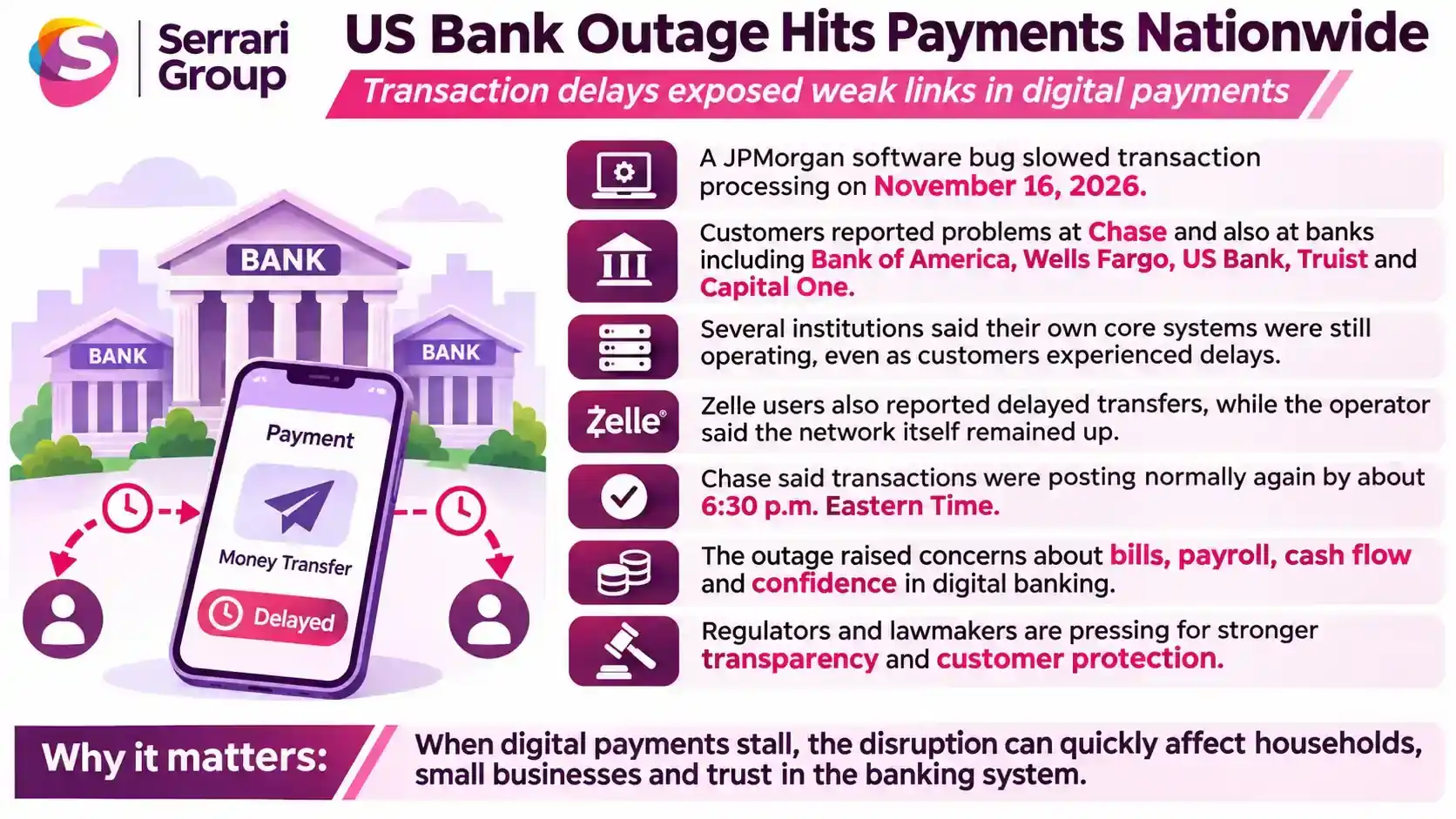
A software bug at JPMorgan Chase disrupted transaction processing on November 16, 2026, prompting thousands of complaints involving several major US banks and the Zelle payment service. Chase said the issue affected its own on-premises systems and could slow transactions involving other institutions, while several banks and Zelle’s operator maintained that their underlying platforms remained operational. By Monday evening, Chase said transactions were posting normally. The disruption nevertheless exposed an important weakness in modern banking: a customer’s ability to move money depends not only on their own bank’s app but also on the interconnected institutions and processing systems behind it. The immediate incident was temporary, but its implications for payment resilience, consumer protection and operational oversight could last considerably longer.
Key Overview
- Confirmed cause: JPMorgan attributed the delays to a software bug affecting on-premises hardware systems, with no evidence of a cyberattack.
- Customer reports: Users reported account-access and transfer problems involving Chase, Wells Fargo, Bank of America and several other institutions; reports did not establish that every bank suffered an internal outage.
- Payment knock-on effects: Some Zelle transfers involving other banks were delayed even as the network’s operator said its system was working.
- Restoration: Chase reported normal transaction posting at approximately 6:30 p.m. Eastern Time on November 16.
- Financial implications: Delayed transfers can affect household bills, business cash flow and confidence in digital financial services.
- Wider concern: Recent unrelated technology failures have intensified scrutiny of operational resilience across essential services.
Why a Software Bug at One Bank Disrupted Payments Elsewhere
The disruption began with a problem inside JPMorgan Chase, the largest US bank by assets. The institution said that a software bug in its on-premises hardware systems was slowing transaction processing. Its explanation of the technical fault ruled out evidence of a cyber-related incident and distinguished the problem from a failure of the entire banking system.
That distinction is central to understanding what happened. A customer making a transfer experiences a single action on a phone, but the transaction can involve an originating bank, a receiving institution, a payment network, internal controls and settlement or posting systems. When one participant processes instructions more slowly, customers elsewhere can encounter delays even if their own institution’s technology is operating as designed.
Reports of problems at Bank of America, Wells Fargo, US Bank, Truist and Capital One therefore need careful interpretation. User-submitted outage reports show that people experienced difficulties; they do not independently establish the technical condition of each bank. Bank of America said its systems were functioning normally, while Capital One and Truist also denied broad internal disruptions. US Bank said its systems were not directly affected but warned of delays in payments involving other financial institutions.
The banking incident and institutional responses illustrate a vulnerability that can be easy to overlook: operational dependence extends beyond corporate boundaries. A bank can have a functioning mobile application and still be unable to complete a particular payment promptly because another participant is experiencing trouble.
Why Zelle Complaints Did Not Mean the Network Failed
Zelle became part of the public concern because customers use it for payments that often feel instantaneous. Some reported transfers that did not arrive when expected, raising questions about whether the network itself had gone down.
But Early Warning Services, Zelle’s operator, said the network remained operational. Participating banks provide the customer-facing access to Zelle, so a problem at a bank involved in a payment can affect the customer’s experience without an outage at the central network. The reported distinction between bank delays and Zelle availability is critical when evaluating the scale of the incident.
This is not a technicality for customers. If a transfer is delayed rather than rejected, sending it again could create uncertainty or a duplicate payment. A person waiting for rent, emergency funds or a business settlement needs to know whether the payment is queued, completed or requires a new instruction. During a disruption, banks should provide specific transaction-status information rather than a generic statement that services are experiencing difficulties.
The episode also demonstrated why an outage tracker is a useful warning signal but not a final diagnosis. Peaks in user reports can reveal a widespread customer experience while leaving the original fault, affected services and the number of failed payments uncertain. Claims that millions of transactions failed would require transaction-level evidence not established by the public reports.
The Real Cost for Households and Small Businesses
For consumers, interrupted access to money can be more consequential than the short duration of the underlying software problem suggests. A delayed transfer can affect a bill due that day, a purchase at a pharmacy or a payment to a family member. Even where funds remain safe, uncertainty over their availability changes the practical value of a banking service.
For small businesses, the costs can be amplified. Companies depend on predictable incoming payments to purchase stock, compensate workers and pay suppliers. A payment delay close to a payroll deadline may force a business to use a credit facility or its cash buffer. Large firms have treasury teams and multiple payment channels, but smaller enterprises may have few immediate alternatives.
The incident did not establish a measurable nationwide economic loss, and reports of affected customers should not be converted into unsupported estimates of lost commerce. Nevertheless, it demonstrates how payment reliability has become part of ordinary economic infrastructure. The cost of a system’s failure is partly measured in the opportunities and obligations that customers cannot easily postpone.
Customers also face a secondary risk when an outage becomes headline news: criminals can exploit confusion with fake support messages and payment-verification requests. Banks need consistent communications in applications, branches and call centres so that customers know which instructions to trust. Users should keep records of delayed transactions and confirm their status before retrying a payment.
Context is everything. Stay ahead of shifting trends with today’s market updates, and uncover emerging opportunities using the Serrari Group Market Index and Marketplace. Then, take control of your own financial future by exploring our Money & Life Reset Transformation Blueprint ™ to build stronger habits, create better systems, and design a path toward lasting wealth.
Why Chase’s Recovery Did Not End Every Question
By about 6:30 p.m. Eastern Time on November 16, Chase said transactions were posting normally again. Its evening restoration update marked an important operational milestone after hours of complaints.
However, restoring ordinary processing does not automatically prove that every delayed transfer was completed, that no customer incurred a fee or that all downstream reconciliation was finished. Those questions require individual transaction records and follow-up from the institutions involved. It is therefore more accurate to say the bank reported restored processing than to declare that every customer consequence had been resolved.
The quality of recovery matters as much as the speed. A useful post-incident review would explain how the software fault escaped controls, whether backup systems could have contained its effects and what measures would reduce recurrence. For customers, a meaningful resolution also includes clear instructions about failed transfers, duplicate payments and any applicable fee adjustments.
The episode highlights a distinction between cybersecurity and operational resilience. A bank can protect systems from hostile intrusion yet remain exposed to internal defects, changes in software configurations or failures in critical infrastructure. Calling an event non-cyber-related does not make it unimportant; it changes which controls need scrutiny.
Why Regulators Are Demanding More Transparency
The political response reflects the growing importance of uninterrupted digital access. Representative Maxine Waters, the senior Democrat on the House Financial Services Committee, called for banks to explain which services were disrupted, when problems would be addressed and how consumers would be protected. Her statement seeking accountability for affected customers also called on regulators to ensure that people harmed by the disruption were made whole.
That demand is consequential because operational failures can impose costs even without a data breach or loss of deposits. Supervisors must assess whether institutions understand their technical dependencies, test contingency plans and maintain communications that work when normal channels fail. They also need to distinguish a contained operational incident from a genuinely systemic event that threatens financial stability.
Stronger resilience will probably require investment in software testing, monitoring, redundant processing capacity and coordinated recovery exercises involving partners. These expenditures create costs for banks, but reducing the probability of repeated disruption can protect trust and avoid more expensive failures later.
The Bigger Picture: A Warning, Not Evidence of a Coordinated Attack
The November 16 banking disruption came shortly after separate problems at Microsoft and the Federal Aviation Administration. The proximity of these events has understandably increased public concern about the reliability of technology underpinning essential services. Yet timing alone does not establish a shared cause.
Microsoft’s disruption affected important cloud and productivity services, while the aviation incident involved separate communications infrastructure. JPMorgan reported an internal software bug. None of those explanations should be discarded merely because the incidents occurred in the same week, and there is no verified evidence from the available reporting of a coordinated cyberattack linking them.
The more defensible conclusion is also important: modern economies are becoming more dependent on complex digital infrastructure, and problems in one organization can be transmitted through commercial relationships. Shared networks create efficiency, but they can also turn a local malfunction into a broad customer experience.
Why does this matter now? Payments increasingly move through digital channels that customers assume will always be available, while banks continue connecting services and automating operations. The November outage is a reminder that speed and convenience must be matched by resilience. For consumers, that means clearer transaction information and practical alternatives. For financial institutions, it means engineering systems that can fail safely and communicating quickly when they do not. The decisive test is not whether another software bug will occur, but how effectively the financial system prevents it from interrupting people’s access to money.
Sources: Reuters / Associated Press / Banking Dive / CBS News / NBC News / U.S. House Committee on Financial Services Democrats
Your financial future isn’t something you wait for—it’s something you build.
The real question is: when do you begin?
Move beyond simply staying informed.
Navigate the markets with clarity—track trends through the Serrari Group Market Index, uncover opportunities in the Serrari Marketplace, and build practical knowledge with our Curated Wealth Builder Platform.
Stay connected to what truly matters.
Get daily insights on macro trends and financial movements across Kenya, Africa, and global markets—delivered through the Serrari Newsletter.
Growth opens doors.
Advance your career through professional programs including ACCA, HESI A2, ATI TEAS 7 , HESI EXIT , NCLEX – RN and NCLEX – PN, Financial Literacy!🌟—designed to move you forward with confidence.
See where money is flowing—clearly and in real time.
Track Money Market Funds, Treasury Bills, Treasury Bonds, Green Bonds, and Fixed Deposits, alongside global and African indexes, key economic indicators, and the evolving Crypto and stablecoin landscape—all within Serrari’s Market Index.