Kia has become the first automaker to surpass 300,000 domestic electrified vehicle sales in South Korea in a single year, reaching 300,048 units as of November 9, 2026. Sales increased 41.9% year on year, with fully electric vehicles accounting for 120,360 units and hybrids contributing 179,688. Electrified models represented 59.7% of Kia’s total domestic sales of 502,286 vehicles during the period. The EV3 was the company’s best-selling electric model, while the Sorento Hybrid led hybrid sales. The milestone reflects growing demand for electric and hybrid vehicles and the expansion of Kia’s electrified vehicle lineup.
Key Takeaways
- Kia recorded 300,048 electrified vehicle sales in South Korea as of November 9, up 41.9% year on year.
- It became the first automaker to surpass 300,000 domestic electrified vehicle sales in a single year.
- Fully electric vehicles accounted for 120,360 units, more than doubling from the previous year.
- Hybrid sales increased 16.9% to 179,688 units.
- Electrified vehicles represented 59.7% of Kia’s total domestic sales of 502,286 vehicles.
- The EV3 was Kia’s best-selling electric model, while the Sorento Hybrid led hybrid sales.
- Kia aims to sell one million EVs annually worldwide by 2030.
How Did Kia Surpass 300,000 Electrified Vehicle Sales in South Korea?
Kia Corp. has become the first automaker in South Korea to surpass 300,000 domestic sales of electrified vehicles in a single year, achieving the milestone as of November 9, the company announced Sunday.
The automaker, an affiliate of Hyundai Motor Group, said it sold a total of 300,048 electrified vehicles, including fully electric vehicles (EVs) and hybrid models, marking a 41.9 percent increase from the same period last year.
The achievement represents a significant increase in Kia’s domestic electrified vehicle sales, which have grown steadily over the past several years.
Kia’s annual electrified vehicle sales first exceeded 100,000 units in 2021, reaching 109,741. The figure subsequently surpassed 200,000 in 2024, when sales totaled 222,085.
The latest milestone shows how quickly the company’s vehicle sales mix is shifting towards electric and hybrid models.
According to the reported figures, Kia’s total domestic sales reached 502,286 vehicles during the period, with electrified models accounting for 59.7% of the total.
This means that almost six out of every ten vehicles Kia sold in South Korea during the period were either fully electric or hybrid models.
The achievement also places Kia among the leading contributors to South Korea’s expanding electrified vehicle market, with both passenger and commercial models supporting its sales growth.
How Much Did Kia Sell in Electric Vehicles and Hybrids?
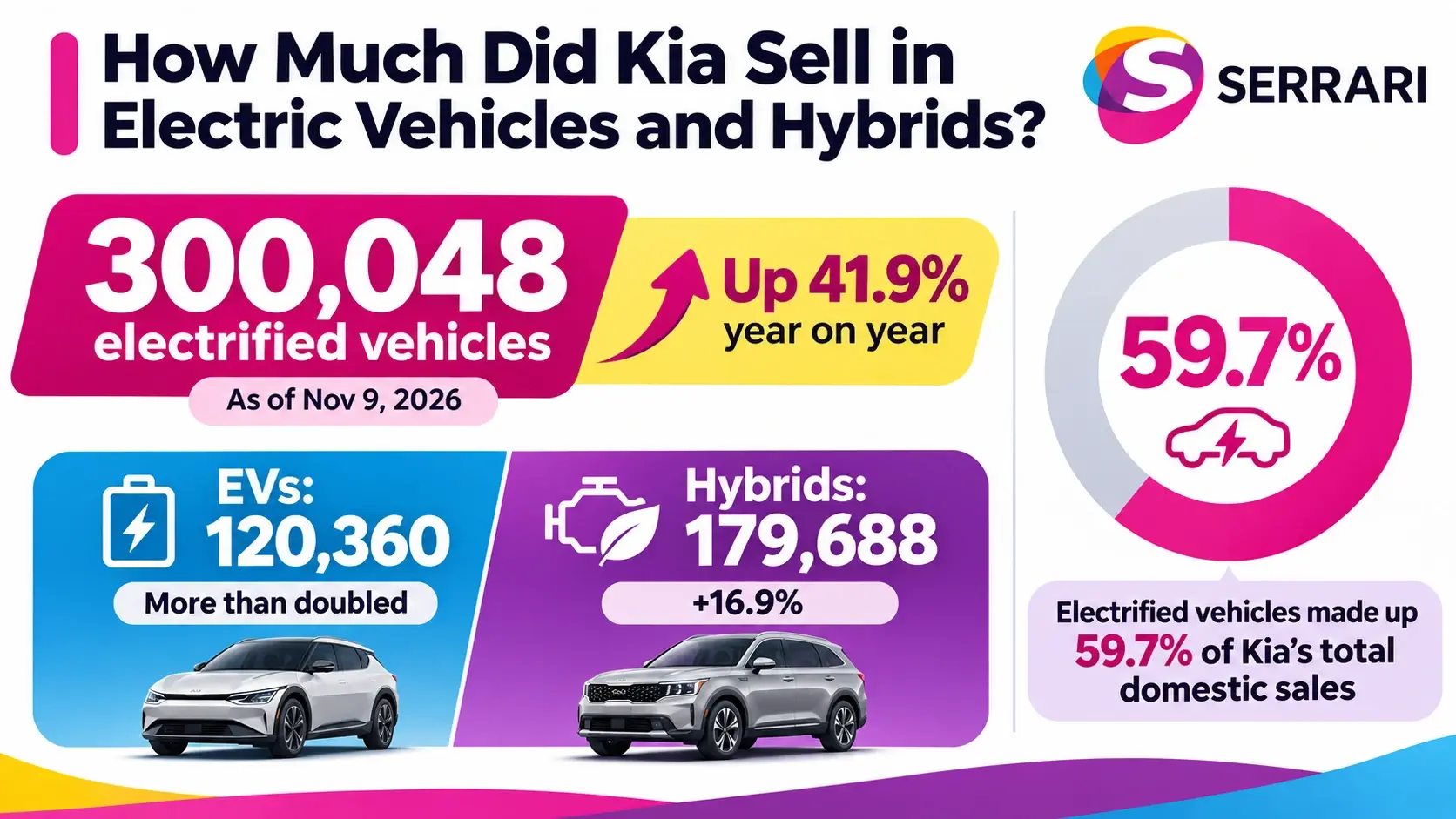
Fully electric vehicles and hybrid models both contributed to Kia’s 300,048 electrified vehicle sales.
Fully electric vehicles accounted for 120,360 units of Kia’s sales this year, more than double the figure recorded a year earlier. This also marked the first time any automaker had sold more than 100,000 EVs in South Korea within a single year.
The growth in fully electric vehicle sales demonstrates the increasing contribution of battery-powered models to Kia’s domestic performance.
Meanwhile, sales of hybrid vehicles increased 16.9 percent year-on-year to 179,688 units.
Hybrids accounted for the larger share of Kia’s electrified vehicle sales, while fully electric models delivered the stronger growth rate.
The two categories together contributed to the company’s overall electrified vehicle milestone.
Vehicle category
Sales as of November 9
Year-on-year growth
Fully electric vehicles
120,360
More than doubled
Hybrid vehicles
179,688
16.9%
Total electrified vehicles
300,048
41.9%
The figures highlight how Kia’s electrification strategy is supported by two different vehicle categories: fully electric models and hybrids.
Which Kia Electric Vehicles Recorded the Highest Sales?
Kia’s EV3 was the best-selling electric vehicle in its domestic market during the reported period.
Among its electric vehicle lineup, the EV3 was the best-selling model, with 30,455 units sold. It was followed by the EV5, with 28,971 units, and the PV5, with 24,266 units.
The three models were the leading contributors to Kia’s electric vehicle sales.
Other models also supported the company’s performance. These included the Ray EV, which recorded 11,056 sales, the EV4 with 11,038 units and the Bongo EV with 3,491 units.
Together, the six models recorded 109,277 sales, according to the model breakdown provided in the supplied material.
The EV lineup includes passenger vehicles as well as commercial models, giving Kia a presence across different vehicle categories.
The PV5, in particular, is part of the company’s purpose-built vehicle (PBV) range. The model has also achieved an official Guinness World Record for the longest distance travelled by a light-duty electric van, according to one of the supplied reports.
The growing contribution of these models reflects the importance of expanding vehicle choices as automakers compete for customers in the electric vehicle market.
Which Kia Hybrid Models Are Driving Sales?
Kia’s hybrid vehicle sales were led by three popular models: the Sorento Hybrid, Carnival Hybrid and Sportage Hybrid.
In the hybrid segment, the Sorento Hybrid led sales with 70,176 units, followed by the Carnival Hybrid at 46,056 units and the Sportage Hybrid at 19,264 units.
Together, the three models recorded 135,496 sales, accounting for approximately 75% of Kia’s total hybrid vehicle sales.
The figures show that demand for hybrid vehicles is concentrated in these three models.
Hybrid vehicles combine an internal combustion engine with an electric motor, allowing them to operate using both power sources. Unlike fully electric vehicles, they do not rely exclusively on battery power.
Their contribution to Kia’s sales demonstrates that the company’s electrification growth is not limited to fully electric vehicles.
The 16.9% year-on-year increase in hybrid sales also shows that customers continue to contribute to demand for vehicles that combine conventional and electric powertrains.
Context is everything. Stay ahead of shifting trends with today’s market updates, and uncover emerging opportunities using the Serrari Group Market Index and Marketplace. Then, take control of your own financial future by exploring our Money & Life Reset Transformation Blueprint ™ to build stronger habits, create better systems, and design a path toward lasting wealth.
What Is Driving Kia’s Electrified Vehicle Sales Growth?
Kia’s performance reflects the expansion of its electrified vehicle lineup, alongside financial support and incentives aimed at encouraging vehicle purchases.
Kia attributes the increase in sales to the expansion of its electric vehicle lineup, including the EV3, EV4, and EV5, as well as financial support and enhanced benefits for the repurchase of used electric vehicles.
The broader model range allows the company to serve customers across different vehicle categories, including passenger cars and commercial vehicles.
The expansion of the lineup has also helped Kia increase the number of electric models contributing to its domestic sales.
In addition, financial support and incentives for used electric vehicle repurchases can help reduce ownership costs and encourage customers to consider electric vehicles.
The company’s performance also comes amid wider growth in South Korea’s electric vehicle market.
South Korea’s new EV registrations rose 74.8% year-over-year in the first nine months and accounted for 24.0% of all new vehicle registrations.
Domestic EV sales also increased 81.4% in October, according to the supplied report.
These figures point to growing demand for electric vehicles in the country, providing a supportive market environment for automakers expanding their electrified lineups.
How Does Kia’s Performance Compare With Other Automakers in South Korea?
Kia’s domestic electrified vehicle sales milestone is significant because it surpassed the 300,000-unit threshold within a single year.
Its fully electric vehicle sales also exceeded 100,000 units for the first time.
Kia recorded sales of 120,360 battery-electric vehicles in South Korea through November 9, more than twice the figure reported during the same period a year earlier.
The figure also surpassed Tesla’s 98,313 vehicle registrations between January and October, making Kia’s battery-electric vehicle sales higher than those of South Korea’s leading imported car brand, according to the supplied report.
Kia had already crossed 100,000 EV sales by September, reaching 100,118 units before increasing the total to 120,360 by November 9.
The comparison highlights Kia’s growing position in the domestic EV market.
However, the reported Tesla figure covers January to October, while Kia’s figure runs through November 9. The periods are therefore not identical, and the comparison should be understood in that context.
What Are Kia’s Electric Vehicle Targets for 2030?
Kia’s domestic sales milestone forms part of its wider global electrification ambitions.
Kia aims to sell 1 million EVs annually worldwide by 2030 across 14 electric models and expects purpose-built vehicle sales to reach 230,000 units a year by the end of the decade.
The target reflects the company’s plans to expand its electric vehicle portfolio and increase its presence in both passenger and commercial vehicle markets.
Its purpose-built vehicle strategy is particularly relevant as commercial transport operators explore electric alternatives for delivery, logistics and other business activities.
The PV5 is one of the models supporting this direction.
Achieving the 2030 targets will depend on factors including consumer demand, model availability, competition, production capacity and the development of charging infrastructure across markets.
Kia’s latest domestic performance provides evidence of growing demand for its electrified models in South Korea, although its global targets will require growth across several international markets.
The Bigger Picture
Kia’s achievement highlights the changing structure of South Korea’s automotive market, where electric and hybrid vehicles are becoming a larger part of domestic vehicle sales.
The company’s 300,048 electrified vehicle sales represent 59.7% of its total domestic sales during the reported period.
The milestone is also significant because growth has come from both fully electric and hybrid vehicles. While EV sales more than doubled, hybrid sales increased by 16.9%.
This shows that the transition towards electrified transport is taking place through different vehicle technologies rather than fully electric vehicles alone.
Kia’s expanding lineup, including passenger EVs and commercial vehicles, also demonstrates how automakers are broadening their electrification strategies to serve different customer needs.
The wider growth in South Korea’s EV registrations provides further evidence of the changing market, although competition among domestic and international automakers remains an important factor.
Why Does This Matter Now?
Kia’s sales milestone comes as automakers face growing pressure to expand their electric vehicle offerings and compete for customers in markets where electrified vehicle adoption is increasing.
The fact that electrified vehicles accounted for 59.7% of Kia’s domestic sales demonstrates how important electric and hybrid models have become to its business in South Korea.
For the wider automotive industry, the milestone shows that electrification growth can be supported by a combination of fully electric vehicles and hybrids.
For electric vehicle manufacturers and investors, Kia’s performance also provides insight into consumer demand, model competition and the growing role of commercial electric vehicles.
The company’s 2030 targets will be important to watch as it seeks to expand its global EV sales and purpose-built vehicle business.
Outlook
Kia’s achievement of more than 300,000 electrified vehicle sales in South Korea marks a significant step in its domestic electrification strategy.
The company has recorded strong growth in fully electric vehicles while continuing to expand hybrid sales. The EV3, EV5 and PV5 have emerged as its leading electric models, while the Sorento, Carnival and Sportage continue to drive hybrid demand.
The next challenge will be sustaining this momentum while expanding its electric vehicle lineup and competing in international markets.
Kia’s ambition to sell one million EVs annually worldwide by 2030 will depend on continued product expansion, customer demand and its ability to scale production across its global operations.
Frequently Asked Questions
1. How many electrified vehicles has Kia sold in South Korea in 2026?
Kia recorded 300,048 domestic electrified vehicle sales as of November 9, 2026, representing a 41.9% increase compared with the same period in 2025.
2. How many electric vehicles and hybrids did Kia sell?
Kia sold 120,360 fully electric vehicles and 179,688 hybrid vehicles during the reported period.
3. Which Kia electric vehicle was the best-selling model in South Korea?
The EV3 was the best-selling electric model with 30,455 units sold, followed by the EV5 with 28,971 and the PV5 with 24,266.
4. What is Kia’s global electric vehicle sales target for 2030?
Kia aims to sell one million electric vehicles annually worldwide by 2030 across 14 electric models. It also expects annual purpose-built vehicle sales to reach 230,000 units by the end of the decade.
Your financial future isn’t something you wait for—it’s something you build.
The real question is: when do you begin?
Move beyond simply staying informed.
Navigate the markets with clarity—track trends through the Serrari Group Market Index, uncover opportunities in the Serrari Marketplace, and build practical knowledge with our Curated Wealth Builder Platform.
Stay connected to what truly matters.
Get daily insights on macro trends and financial movements across Kenya, Africa, and global markets—delivered through the Serrari Newsletter.
Growth opens doors.
Advance your career through professional programs including ACCA, HESI A2, ATI TEAS 7 , HESI EXIT , NCLEX – RN and NCLEX – PN, Financial Literacy!🌟—designed to move you forward with confidence.
See where money is flowing—clearly and in real time.
Track Money Market Funds, Treasury Bills, Treasury Bonds, Green Bonds, and Fixed Deposits, alongside global and African indexes, key economic indicators, and the evolving Crypto and stablecoin landscape—all within Serrari’s Market Index.