
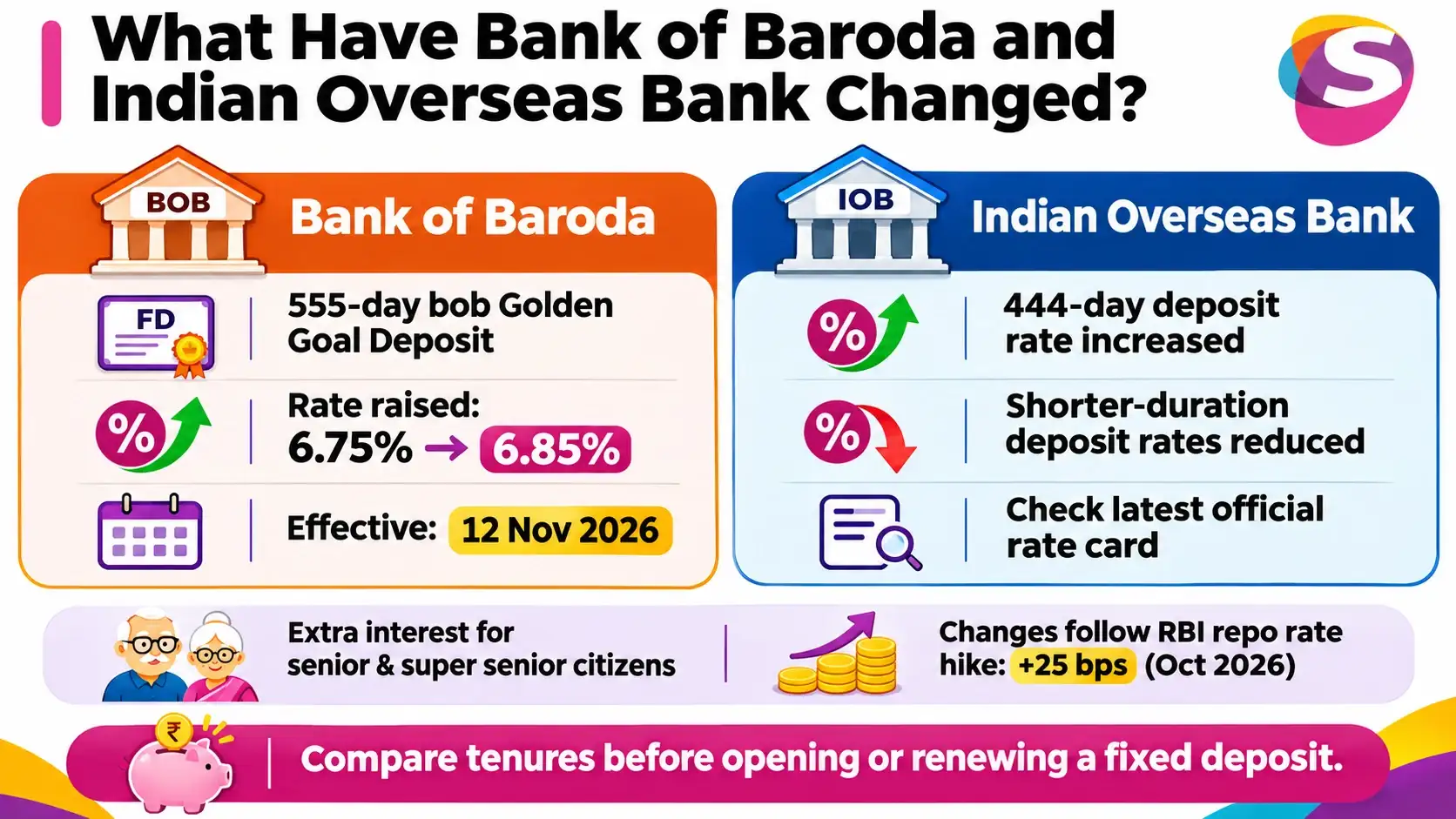
Bank of Baroda (BoB) and Indian Overseas Bank (IOB) have revised their fixed deposit interest rates in November 2026, changing returns available to savers across selected investment tenures. Bank of Baroda increased the rate on its special 555-day bob Golden Goal Deposit Scheme by 10 basis points, from 6.75% to 6.85% for general customers, effective November 12. Indian Overseas Bank raised the rate on its 444-day deposit while reducing rates on shorter-duration deposits. Both banks offer additional interest to eligible senior and super senior citizens. The changes come after the Reserve Bank of India’s 25-basis-point repo rate increase in October 2026.
Key Takeaways
- Bank of Baroda increased the interest rate on its special 555-day fixed deposit from 6.75% to 6.85%.
- The revised Bank of Baroda rate took effect on November 12, 2026.
- Indian Overseas Bank increased the rate on its 444-day deposit but reduced rates on shorter-duration deposits.
- Both banks provide additional interest for eligible senior and super senior citizens.
- The changes follow the Reserve Bank of India’s 25-basis-point repo rate increase in October 2026.
- Savers should compare rates for their preferred tenures before opening or renewing fixed deposits.
What Have Bank of Baroda and Indian Overseas Bank Changed?
Two public sector banks in India, Bank of Baroda (BoB) and Indian Overseas Bank (IOB), have revised their fixed deposit (FD) interest rates in November 2026, adjusting the returns available to customers across selected deposit periods.
The changes are not uniform. Bank of Baroda has increased the interest rate on its special 555-day fixed deposit scheme, while Indian Overseas Bank has raised the rate on its 444-day deposit and reduced rates on shorter-duration deposits.
The revised rates come amid a series of FD rate changes by banks following the Reserve Bank of India’s (RBI) 25-basis-point repo rate hike in October 2026.
For savers, the revisions create different opportunities depending on how long they are willing to keep their money deposited. Customers considering a new fixed deposit or renewing one that is approaching maturity may benefit from comparing the revised offers.
However, the headline rate alone does not determine which deposit is most suitable. The investment period, additional interest for senior citizens, premature withdrawal conditions and tax treatment can all affect the final return.
How Much Has Bank of Baroda Increased Its Fixed Deposit Rate?
Bank of Baroda has increased the interest rate on its special 555-day fixed deposit, known as the bob Golden Goal Deposit Scheme.
The bank raised the rate by 10 basis points, from 6.75% to 6.85% for general customers. The revised rate came into effect on November 12, 2026.
A basis point is one-hundredth of a percentage point. Therefore, a 10-basis-point increase represents a rise of 0.10 percentage points.
For a depositor, the change means that eligible new deposits under the special scheme can earn a slightly higher interest rate than before.
The adjustment is specific to the 555-day scheme. It should not be interpreted as an increase across every fixed deposit tenure offered by Bank of Baroda.
Customers should therefore check the bank’s current rate card to establish the applicable rate for their preferred investment period.
What Has Indian Overseas Bank Changed?
Indian Overseas Bank has also revised its fixed deposit rates, but its adjustments differ from those made by Bank of Baroda.
The bank increased the interest rate on its special 444-day deposit while reducing rates on shorter-duration deposits.
This means customers looking for a medium-term deposit may find the revised 444-day offer more attractive, while those who prefer shorter investment periods may receive lower returns than under the previous rates.
The available source material does not provide the exact revised interest rates for the 444-day deposit or the affected shorter tenures. Depositors should consult Indian Overseas Bank’s latest official rate card before making a decision.
The distinction matters because fixed deposit rates are tenure-specific. A higher rate on one special deposit does not necessarily mean that the bank offers better returns across its entire range of products.
Why Are Banks Revising Fixed Deposit Rates?
Fixed deposit rates are influenced by several factors, including the central bank’s monetary policy, banks’ funding requirements and competition for customer deposits.
The Reserve Bank of India’s October 2026 repo rate increase of 25 basis points provides important context for the latest revisions.
The repo rate is the rate at which the central bank lends short-term funds to commercial banks against eligible securities. Changes in this rate can influence borrowing costs and the interest rates banks offer on deposits and loans.
When policy rates increase, banks may adjust deposit rates to attract funds from savers. However, the response is not always immediate or uniform. Individual banks consider their liquidity needs, funding costs, market conditions and competition before changing their rates.
This helps explain why Bank of Baroda and Indian Overseas Bank have made different adjustments across their deposit tenures.
The latest revisions also form part of a wider trend of rate changes among Indian lenders. Other banks mentioned in the supplied material include HDFC Bank, ICICI Bank and Kotak Mahindra Bank.
What Do the Changes Mean for Savers?
The impact depends largely on whether a customer is opening a new deposit, renewing an existing one or already holding a fixed deposit.
Customers opening new fixed deposits
People planning to open a new FD can compare the revised rates and select a tenure that matches their savings goals.
For example, a customer considering Bank of Baroda’s 555-day scheme can now access the revised 6.85% rate for general customers, subject to the bank’s applicable terms.
Customers considering Indian Overseas Bank should compare the revised 444-day offer with other available tenures before committing their money.
Customers renewing maturing deposits
People whose fixed deposits are approaching maturity may be affected by the new rates when they renew.
The interest rate applicable to a renewed deposit is generally the rate available on the renewal date, rather than the rate originally offered when the previous deposit was opened.
This makes it important to compare current offers before automatically renewing an FD.
Customers with existing fixed deposits
Existing fixed deposits generally retain the interest rate agreed when they were booked until maturity, subject to the deposit’s terms and conditions.
Therefore, a bank increasing or reducing its current FD rates does not automatically change the interest rate on an existing deposit.
Customers should also avoid breaking an existing FD in a hurry simply to access a newly advertised rate. Premature withdrawal penalties and lost interest could reduce or eliminate the benefit of switching.
Context is everything. Stay ahead of shifting trends with today’s market updates, and uncover emerging opportunities using the Serrari Group Market Index and Marketplace. Then, take control of your own financial future by exploring our Money & Life Reset Transformation Blueprint ™ to build stronger habits, create better systems, and design a path toward lasting wealth.
How Much Can a Small Interest Rate Difference Affect Your Savings?
Even a small difference in fixed deposit rates can influence the amount of interest earned, particularly when the deposit amount is large or the investment period is long.
Consider a simple illustration of ₹100,000 deposited for one year using straightforward annual interest calculations:
Illustrative FD rate
Interest earned in one year
6.0%
₹6,000
6.5%
₹6,500
7.0%
₹7,000
7.5%
₹7,500
At these illustrative rates, a difference of 0.5 percentage points translates to approximately ₹500 in additional annual interest on a deposit of ₹100,000.
For a deposit of ₹1 million, the same difference would represent approximately ₹5,000 in additional annual interest.
These figures are illustrations, not quotations of the current rates offered by either bank. Actual FD returns depend on the applicable rate, deposit tenure, compounding frequency and bank terms.
The comparison demonstrates why savers should examine the rate applicable to their specific deposit period rather than choosing a bank based only on its highest advertised rate.
What Should Senior Citizens Consider?
Both Bank of Baroda and Indian Overseas Bank offer additional interest to eligible senior citizens and super senior citizens on qualifying deposits.
This is important because older savers may rely on fixed deposit interest to supplement retirement income or meet regular expenses.
An additional interest benefit can increase the return received compared with the standard rate available to general customers.
However, the applicable benefit may depend on the bank’s eligibility criteria, deposit amount and tenure. Customers should confirm the exact rate and conditions before opening an account.
Senior citizens should also consider how frequently they need access to their savings. A deposit offering a higher rate may not be suitable if the money could be needed before maturity and early withdrawal would result in a penalty.
The Bigger Picture
The latest revisions by Bank of Baroda and Indian Overseas Bank show how banks adjust their deposit offerings in response to changing monetary conditions and competition for savings.
For banks, fixed deposits are an important source of funding. For customers, they offer a way to earn a predetermined rate of interest over an agreed period, subject to the deposit terms.
The two banks’ different approaches also demonstrate why savers need to compare products by tenure. Bank of Baroda has increased the rate on its 555-day special scheme, while Indian Overseas Bank has raised its 444-day rate and reduced rates on shorter-duration deposits.
These changes do not necessarily make one bank more attractive across all deposit periods. The best option depends on the customer’s investment horizon, eligibility for additional interest and need for liquidity.
Why Does This Matter Now?
The revisions matter because savers planning to open or renew fixed deposits need to account for changing interest rates.
The October repo rate increase has provided a backdrop for adjustments across the banking sector, but individual banks are making different decisions about the rates they offer.
For customers, this creates a reason to review deposit options before locking in their money. A small difference in interest rates can become more significant as the deposit amount or investment period increases.
The next development to watch is whether other banks follow with further adjustments and how the latest rates evolve as monetary policy and banks’ funding requirements change.
Frequently Asked Questions
1. Which fixed deposit rates have Bank of Baroda and Indian Overseas Bank revised?
Bank of Baroda increased the rate on its special 555-day bob Golden Goal Deposit Scheme from 6.75% to 6.85% for general customers. Indian Overseas Bank increased the rate on its 444-day deposit while reducing rates on shorter-duration deposits.
2. When did Bank of Baroda’s revised fixed deposit rate take effect?
The revised 6.85% interest rate on Bank of Baroda’s 555-day special deposit scheme took effect on November 12, 2026.
3. Do the revised rates affect existing fixed deposits?
Generally, no. Existing fixed deposits retain the interest rate agreed when they were opened until maturity, subject to the deposit terms. The revised rates normally apply to eligible new or renewed deposits.
4. Do senior citizens receive higher fixed deposit interest rates?
Yes. Both Bank of Baroda and Indian Overseas Bank offer additional interest to eligible senior citizens and super senior citizens on qualifying deposits. Customers should check each bank’s rate card and eligibility conditions for the exact benefit.
Your financial future isn’t something you wait for—it’s something you build.
The real question is: when do you begin?
Move beyond simply staying informed.
Navigate the markets with clarity—track trends through the Serrari Group Market Index, uncover opportunities in the Serrari Marketplace, and build practical knowledge with our Curated Wealth Builder Platform.
Stay connected to what truly matters.
Get daily insights on macro trends and financial movements across Kenya, Africa, and global markets—delivered through the Serrari Newsletter.
Growth opens doors.
Advance your career through professional programs including ACCA, HESI A2, ATI TEAS 7 , HESI EXIT , NCLEX – RN and NCLEX – PN, Financial Literacy!🌟—designed to move you forward with confidence.
See where money is flowing—clearly and in real time.
Track Money Market Funds, Treasury Bills, Treasury Bonds, Green Bonds, and Fixed Deposits, alongside global and African indexes, key economic indicators, and the evolving Crypto and stablecoin landscape—all within Serrari’s Market Index.