
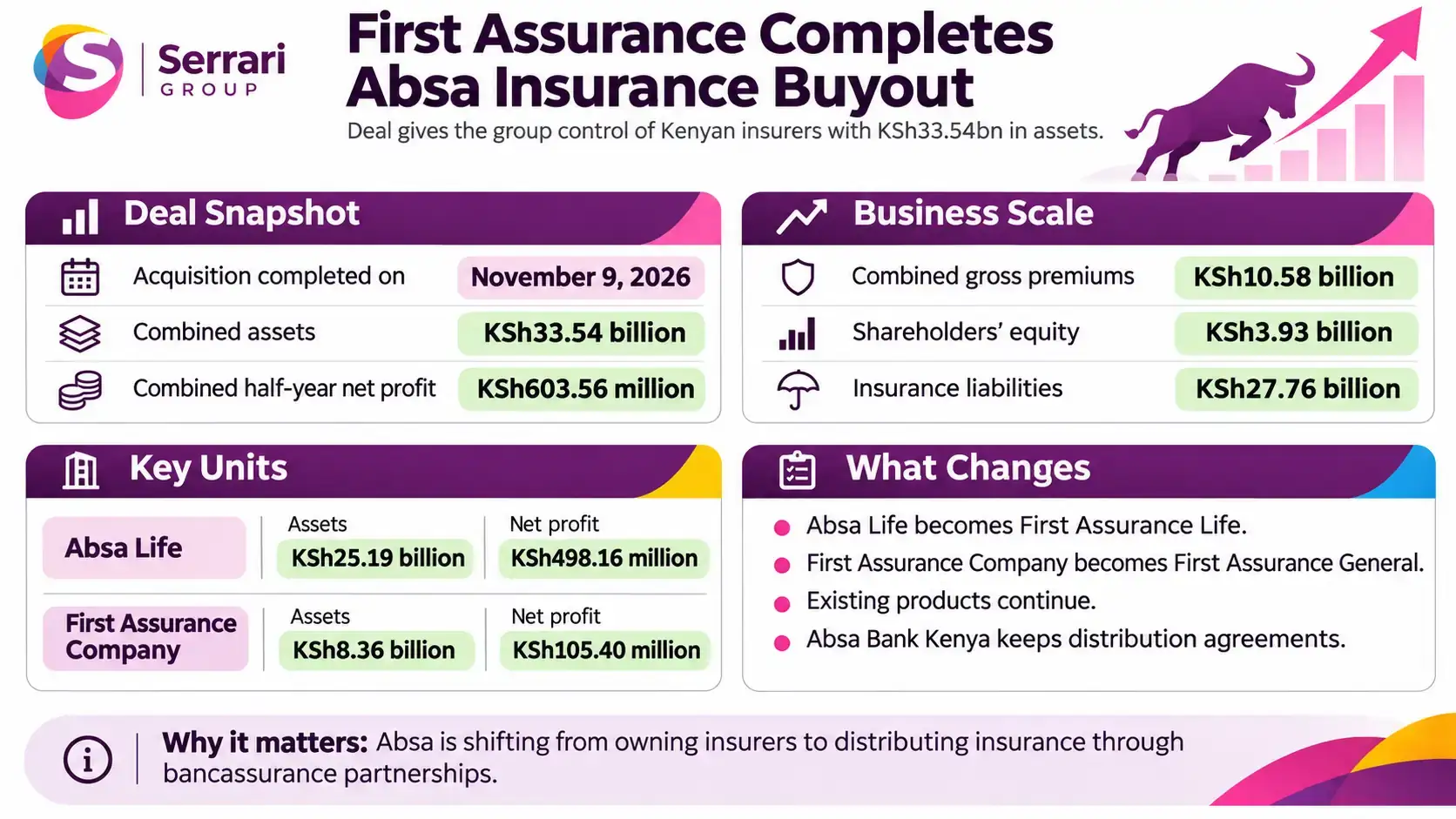
First Assurance Investments Limited has completed its acquisition of Absa Group’s stake in First Assurance Holdings, bringing two Kenyan insurance businesses with a combined KSh33.54 billion in reported assets under its control. The November 9, 2026, announcement closes a chapter that began when Barclays Africa acquired a controlling stake in First Assurance in 2015. More importantly, the transaction reflects a strategic change in how Absa wants to earn money from insurance: selling policies through its banking network rather than owning the companies responsible for underwriting them. For policyholders, the insurers say existing products and services will continue; for the new owner, the real challenge is turning a sizeable asset base and premium income into sustainable underwriting profits while protecting customers’ long-term claims.
Key Overview
- Acquisition completed: First Assurance Investments acquired Absa Group’s entire shareholding in First Assurance Holdings after regulatory approvals and other closing conditions.
- Combined financial scale: The two insurers reported about KSh33.54 billion in assets, KSh10.58 billion in gross premiums and KSh603.56 million in net profit for the six months ended June 2026.
- Life insurance dominates: Absa Life Assurance Kenya accounted for approximately KSh25.19 billion in assets and KSh498.16 million in half-year profit.
- General insurance faces pressure: First Assurance Company made KSh105.40 million in overall profit despite a reported KSh56.58 million underwriting-account loss.
- Names will change: The businesses will become First Assurance Life and First Assurance General, with a six-month reference to their former Absa affiliation.
- Distribution continues: Absa Bank Kenya will retain existing arrangements to distribute the insurers’ products even though the banking group has sold its ownership interest.
Why Absa Is Exiting Insurance Ownership in Kenya
The completed ownership transfer is not evidence that Absa has abandoned the insurance market. Rather, the group is changing where it participates in the industry’s value chain. Under a bancassurance model, a bank can use its branches, relationship managers and digital channels to distribute insurance products while a separate insurer holds the policies, manages investment assets and remains responsible for claims and insurance liabilities.
That distinction matters because underwriting and distribution carry different risks. An insurer needs sufficient capital to support its obligations and must absorb fluctuations in claims, pricing and investment performance. A distributing bank can generate fee income from arranging policies without directly owning all those insurance risks. The economics depend on the relevant agreements and regulations, but the model can be less capital-intensive than maintaining insurance subsidiaries.
Absa’s 2025 financial disclosures explicitly described bancassurance partnerships as a more sustainable approach to generating non-interest income in its African regional markets. The group disposed of insurance operations in Botswana, Zambia and Mozambique during the first half of 2025. Kenya’s transaction therefore extends an established regional strategy rather than representing a sudden retreat prompted by one difficult quarter.
The shift also offers management a way to simplify a sprawling financial-services portfolio. Running banks and insurers together can create cross-selling opportunities, but it adds regulatory complexity and requires capital, actuarial oversight and specialist management. Absa appears to be prioritising the commercial benefits of insurance distribution without continuing to own those operations in the same way.
What the KSh33.54 Billion Asset Base Actually Represents
The two companies’ combined figures show a significant insurance operation, but headline assets should not be confused with money available to the buyer. The first-half industry statistics and accompanying financial reporting indicate approximately KSh33.54 billion in combined assets, KSh3.93 billion in shareholders’ equity and KSh27.76 billion in insurance contract liabilities.
An insurance balance sheet is different from that of an ordinary trading company. Much of an insurer’s investments and other assets exist to back commitments to policyholders. Life insurers, in particular, collect premiums today against benefits that may become payable many years later. Insurance contract liabilities therefore represent a central consideration in assessing financial strength, not an incidental deduction from an attractive asset total.
This is why the acquisition does not mean First Assurance Investments can freely deploy KSh33.54 billion into other ventures. The assets are held within regulated insurance businesses, and their use is constrained by claims obligations, solvency requirements and investment rules. A more relevant question is whether the businesses can maintain capital buffers, manage their investment portfolios and generate enough earnings to meet future obligations.
Absa Life, the larger business, reported KSh25.19 billion in assets and KSh498.16 million in net profit during the first half of 2026. It generated KSh6.78 billion in gross premiums and had closing life funds of about KSh21.96 billion. Those numbers demonstrate scale, but the quality and duration of its liabilities, persistency of policies and investment returns will influence its performance under new ownership.
Why Profitability Matters More Than Premium Growth Alone
First Assurance Company, the general insurer, reported approximately KSh8.36 billion in assets and KSh105.40 million in half-year net profit, alongside KSh3.80 billion in gross premiums. Yet its traditional underwriting account recorded a KSh56.58 million loss, reflecting pressure in areas including commercial motor, industrial fire and engineering insurance.
That contrast illustrates an important insurance-sector risk: a company may make an overall accounting profit even when its core underwriting activities lose money. Investment returns and other income can offset claims and operating costs for a period, but they cannot be assumed to compensate for poor insurance pricing indefinitely. Rising repair bills, claims severity, fraud, reinsurance charges or competitive discounting can all put general insurance margins under pressure.
For the new owners, the priority is therefore not merely expanding the customer base. It is strengthening risk selection, premium pricing, claims management and cost discipline. The group’s combined KSh603.56 million half-year profit is encouraging, but investors and policyholders should track the sustainability of those earnings rather than extrapolate six-month performance into a guaranteed annual result.
The figures also need to be read carefully: gross premiums, insurance revenue and net profit measure different aspects of the businesses and are not interchangeable. Similarly, the combined figures describe the operating insurers, not the transaction’s undisclosed purchase consideration.
Context is everything. Stay ahead of shifting trends with today’s market updates, and uncover emerging opportunities using the Serrari Group Market Index and Marketplace. Then, take control of your own financial future by exploring our Money & Life Reset Transformation Blueprint ™ to build stronger habits, create better systems, and design a path toward lasting wealth.
What Changes for Customers and Absa Bank Kenya
The completion statement says existing insurance products and services will not be affected by the change of shareholder. Absa Life Assurance Kenya will be renamed First Assurance Life, while First Assurance Company will adopt the First Assurance General name. Both businesses will use the description “Formerly an Absa Group Company” for six months as customers adjust to the new branding.
For policyholders, the practical issue is continuity of the insurer’s legal obligations. A change of shareholder or brand does not, by itself, cancel an insurance contract. Customers should nevertheless retain their policy documents, confirm official contact and payment details during the rebranding and continue following established premium-payment and claims procedures. Any product-specific changes should be communicated through the insurer’s formal channels rather than assumed from the sale announcement.
The existing relationship with Absa Bank Kenya also remains in place. That allows customers who obtain insurance through the bank to continue using an established distribution channel, even though Absa Group will no longer control the underwriting companies. It also preserves a commercial link between the two sides, which could be important for maintaining premium inflows and customer relationships during the transition.
For Absa, that means its exit from ownership is not necessarily an exit from insurance-related earnings. Its banking franchise can continue selling policies and earning income under distribution agreements, subject to the terms of those arrangements. For First Assurance, access to a major bank’s network may help preserve sales while the company develops its independent brand identity.
Why the Deal Reverses an Earlier Expansion Strategy
The change is particularly striking when compared with the original acquisition. In 2015, Barclays Africa agreed to purchase a 63.3% controlling stake for approximately KSh2.2 billion, together with an additional capital commitment of around KSh700 million. At the time, ownership of an established general insurer was seen as a way to diversify the bank’s financial products and expand beyond traditional lending.
Eleven years later, the logic has changed. The advantages of distributing policies remain, but the banking group no longer considers direct ownership of these Kenyan underwriting businesses essential to its strategy. That reversal reflects a wider question facing financial conglomerates: whether owning every stage of a financial product produces enough additional return to justify the capital, regulation and management attention involved.
The exact consideration for the new sale was not disclosed in the companies’ completion announcement. Although reports have placed its value at approximately KSh3 billion, that estimate should not be treated as a confirmed transaction price or used to calculate Absa’s investment return without further information. Differences in capital injections, dividends, ownership structures and the timing of cash flows would complicate any comparison with the 2015 acquisition in any case.
The Bigger Picture for Kenya’s Insurance Industry
The transaction returns control of two sizeable insurers to First Assurance Investments, an existing shareholder, while preserving their relationship with one of Kenya’s major commercial banks. That combination could offer a smoother operational transition than a complete separation of ownership and distribution. However, future results will depend on governance, actuarial discipline and customer service rather than ownership nationality alone.
It also highlights how banks can remain important competitors and partners in insurance without owning insurers outright. Distribution through banking channels provides access to customers and can reduce the cost of reaching them, while specialist insurers remain responsible for pricing, policy administration and claims. The model may become increasingly attractive wherever the capital demands of underwriting outweigh the benefits of vertical integration.
For Kenya’s regulator, the central concern remains the protection of policyholders and the financial soundness of insurers, regardless of who owns the shares. The insurance supervisory framework provides a continuing basis for assessing performance, claims and capital adequacy after a transaction closes.
The immediate story is the completion of a corporate buyout. The more important story is the separation of insurance manufacturing from banking distribution, and whether the new First Assurance group can improve underwriting performance while sustaining policyholder confidence. Customers are being promised continuity, Absa is keeping a route to insurance income, and First Assurance Investments is assuming responsibility for businesses whose long-term value depends on meeting claims, maintaining capital and delivering consistent profits.
Sources: Capital FM / Absa Group / Insurance Regulatory Authority / Hivileo / Business Daily Africa / Africa Business Insight / People Daily
Your financial future isn’t something you wait for—it’s something you build.
The real question is: when do you begin?
Move beyond simply staying informed.
Navigate the markets with clarity—track trends through the Serrari Group Market Index, uncover opportunities in the Serrari Marketplace, and build practical knowledge with our Curated Wealth Builder Platform.
Stay connected to what truly matters.
Get daily insights on macro trends and financial movements across Kenya, Africa, and global markets—delivered through the Serrari Newsletter.
Growth opens doors.
Advance your career through professional programs including ACCA, HESI A2, ATI TEAS 7 , HESI EXIT , NCLEX – RN and NCLEX – PN, Financial Literacy!🌟—designed to move you forward with confidence.
See where money is flowing—clearly and in real time.
Track Money Market Funds, Treasury Bills, Treasury Bonds, Green Bonds, and Fixed Deposits, alongside global and African indexes, key economic indicators, and the evolving Crypto and stablecoin landscape—all within Serrari’s Market Index.