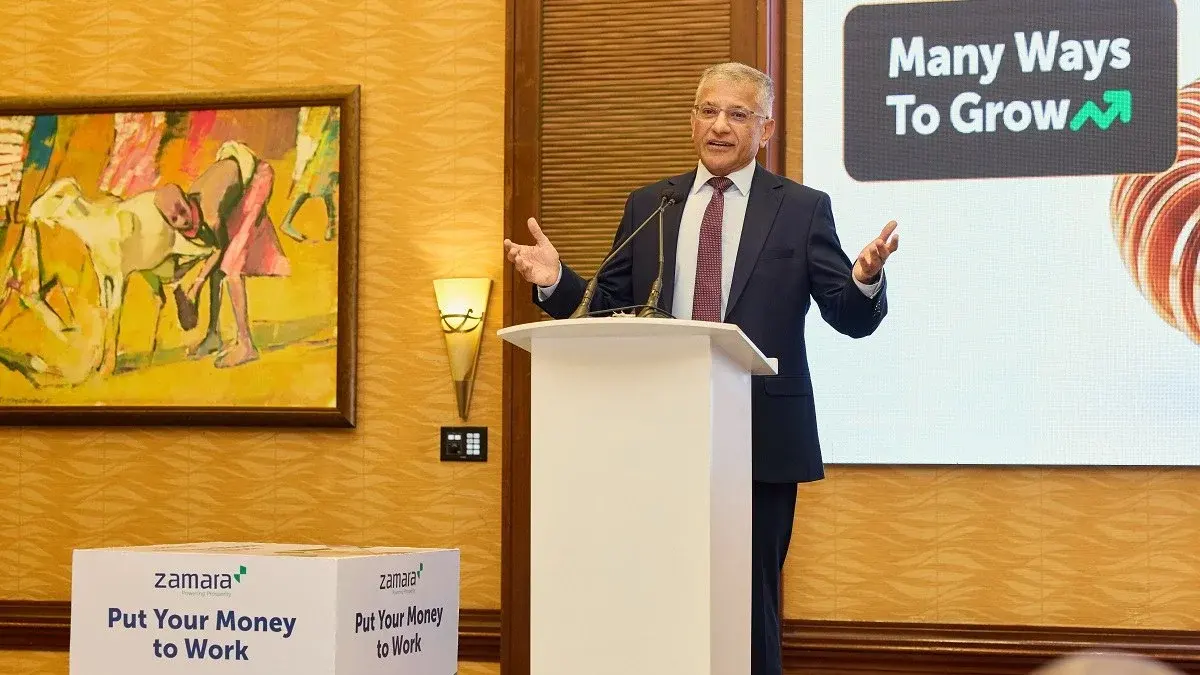
Zamara Group launched its investment business on November 26, 2026, introducing four unit trust funds after receiving regulatory approval from the Capital Markets Authority. The new division has accumulated KSh2.2 billion in assets under management since accepting investments in May, reflecting early demand for its products. The expansion comes as Kenya’s collective investment schemes approach KSh1 trillion in assets, with investors increasingly exploring fixed-income and diversified investment strategies alongside traditional money market funds. For Zamara, the move creates an opportunity to extend its established pensions and insurance relationships into everyday wealth management while competing for a growing pool of household and institutional savings.
Key Overview
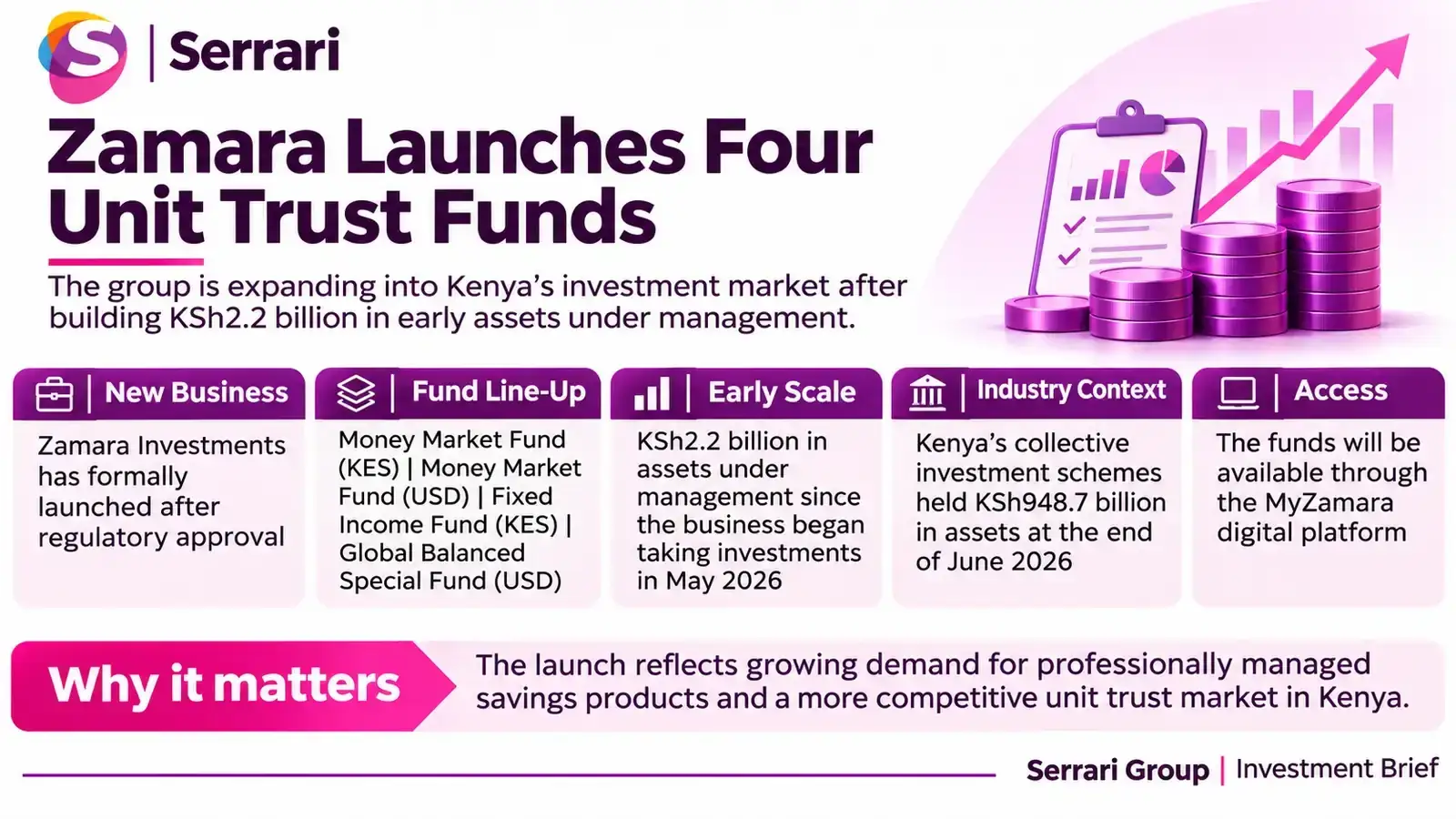
- Zamara Investments formally launched on November 26, 2026, with four unit trust funds.
- The business reports KSh2.2 billion in assets under management since May 2026.
- The portfolio comprises two money market funds, a fixed-income fund and a global balanced special fund.
- Kenya’s collective investment scheme assets reached KSh948.7 billion in June 2026, up approximately 11.4% from March.
- The funds will be accessible through the MyZamara digital platform.
- Standard Chartered Bank serves as trustee and custodian, according to the launch announcement.
Why Zamara Is Expanding Beyond Pensions and Insurance
The launch of Zamara Investments represents a strategic expansion for a group that has spent more than three decades providing retirement, actuarial and insurance-related services. Instead of concentrating primarily on financial protection and retirement security, the company is establishing a broader presence in the management of investable savings.
The commercial rationale is that customers have financial needs extending beyond retirement. A salaried employee may need to accumulate an emergency reserve, save for a property purchase and build long-term wealth simultaneously. A business may require a vehicle for managing temporary cash surpluses while maintaining adequate liquidity for operating expenses.
Pension products cannot necessarily address these requirements because they are designed around retirement objectives and may be subject to restrictions on accessing accumulated savings. Insurance products, meanwhile, primarily provide protection against specified risks rather than a comprehensive investment solution.
Introducing unit trusts gives Zamara a mechanism for serving these additional needs without requiring customers to establish relationships with entirely separate financial providers. Its existing distribution relationships and experience in financial services could reduce the cost of reaching potential investors, although success will depend on product competitiveness and customer retention.
The expansion also creates a potential source of recurring management fee revenue. Unlike revenue generated from a single transaction, asset management income can grow alongside the value of assets managed. However, the launch does not disclose the division’s profitability, and its reported assets should not be confused with revenue or earnings.
A Market Approaching KSh1 Trillion
Zamara’s entry coincides with a substantial expansion of Kenya’s collective investment industry. The second-quarter unit trust market review records assets of KSh948.7 billion in June 2026, compared with KSh851.7 billion three months earlier.
That represents an increase of approximately KSh97 billion in a single quarter. Although changes in asset values can reflect both investment performance and net subscriptions, the scale of the increase demonstrates how quickly the market has expanded.
An independent assessment of asset management growth places the industry’s December 2025 assets at approximately KSh756.3 billion, meaning the market grew by about 25.4% during the first half of 2026 alone.
The expansion gives new fund managers an opportunity to attract first-time investors rather than relying exclusively on persuading customers to leave established competitors. Nevertheless, it also intensifies competition over management charges, returns, service quality and digital accessibility.
Zamara’s reported KSh2.2 billion under management provides an initial operating base. It does not establish the business’s current market share because that figure relates to November while the available industry total relates to June. Nor does it disclose how assets are distributed among the four funds.
The more consequential question is whether the group can translate its established financial services relationships into sustained investment inflows without compromising investment discipline or service quality.
Context is everything. Stay ahead of shifting trends with today’s market updates, and uncover emerging opportunities using the Serrari Group Market Index and Marketplace. Then, take control of your own financial future by exploring our Money & Life Reset Transformation Blueprint ™ to build stronger habits, create better systems, and design a path toward lasting wealth.
What the Four Funds Offer Different Investors
The four-fund product range covers both Kenyan shillings and US dollars, allowing the business to address different investment horizons and currency requirements.
Fund
Broad investment category
Principal considerations
Zamara Money Market Fund (KES)
Shilling-denominated money market
Liquidity, variable yields and credit risk
Zamara Money Market Fund (USD)
Dollar-denominated money market
Dollar liquidity, yields and exchange-rate exposure
Zamara Fixed Income Fund (KES)
Shilling-denominated fixed income
Interest rate movements, credit quality and duration
Zamara Global Balanced Special Fund (USD)
Dollar-denominated diversified special fund
Market volatility, permitted exposures and investment horizon
Money market funds generally invest in shorter-term interest-bearing instruments. Their relatively short investment duration can make them relevant to cash management, although redemption terms and capital risks vary by product.
Fixed-income funds may hold longer-dated debt securities, potentially creating opportunities for income and capital appreciation. They can also experience declines in value when market yields rise or borrowers encounter financial difficulties.
A global balanced special fund introduces a different investment proposition. Depending on its approved mandate, it may provide exposure to a wider range of markets and asset classes than a conventional money market portfolio. The fund’s name alone does not establish its actual allocations, leverage permissions or liquidity arrangements.
The launch materials reviewed do not establish comparable current yields, total expense ratios, minimum subscriptions or redemption timelines for all four products. These details remain important when evaluating how the funds differ from competing offerings.
Why Dollar-Denominated Investments Are Becoming More Important
The inclusion of two dollar-denominated products is particularly significant given the growth of Kenya’s foreign currency collective investment market.
According to foreign currency fund statistics, assets in these funds increased from KSh95.9 billion in March 2026 to KSh110.5 billion in June, measured in shilling equivalents.
Demand for dollar investments can arise from several sources. Families planning to pay overseas tuition fees, businesses importing goods and investors seeking international diversification may all have reasons to hold assets in foreign currencies.
Matching the currency of an investment with a future payment obligation can reduce exposure to adverse exchange-rate movements. However, for investors whose income and expenses are entirely in shillings, dollar investments introduce additional currency risk.
A strengthening Kenyan shilling can reduce the domestic currency value of dollar holdings even when the underlying fund generates positive dollar returns. Conversely, shilling depreciation can increase their translated value. Changes in reported foreign currency fund assets may also reflect exchange-rate movements rather than subscriptions alone.
For Zamara, offering products in both currencies broadens its potential customer base and reduces dependence on a single investment category.
Competition Is Moving Beyond Money Market Yields
Kenya’s unit trust industry has historically attracted considerable attention through money market funds. Their accessible structure and relatively straightforward income proposition have helped introduce many households to professionally managed investments.
As the industry expands, fund managers are increasingly competing through product diversification rather than relying exclusively on short-term savings vehicles.
The November regulatory approvals for additional investment funds illustrate this continuing expansion of the product universe, giving investors access to a wider range of strategies.
The shift creates opportunities but also increases the importance of financial literacy. A fund offering a higher historical return may carry materially different risks from a money market fund, including greater exposure to market volatility, credit events or restrictions on withdrawals.
Fund managers therefore face the challenge of explaining risk-adjusted performance and investment objectives rather than competing solely through headline percentages. Transparent reporting becomes particularly important when products have different currencies, benchmarks and investment horizons.
Digital Distribution and Investor Protection
Making the funds available through MyZamara could reduce administrative barriers for existing customers and help the group expand beyond traditional distribution channels. Digital platforms can simplify account access and investment monitoring, potentially making smaller recurring contributions more practical.
However, convenience must be accompanied by safeguards. Kenya’s collective investment scheme regulations establish requirements governing the operation and oversight of these products, including the responsibilities of key service providers.
The announced appointment of Standard Chartered Bank as trustee and custodian introduces institutional oversight and asset safekeeping functions distinct from portfolio management. These arrangements do not eliminate investment losses or guarantee returns.
For the wider economy, the expansion of pooled investments can channel savings into government securities, corporate debt and other eligible assets. This can broaden sources of financing, although the economic benefits depend on where funds actually allocate their capital.
Zamara’s launch ultimately reflects a growing market in which retirement planning, insurance and investment management are becoming increasingly interconnected. The company’s ability to compete will depend less on the number of funds it launches than on whether it delivers transparent pricing, consistent service and investment outcomes aligned with customers’ needs. As Kenya’s collective investment industry approaches the trillion-shilling threshold, those factors will become increasingly important to sustaining investor confidence.
Sources: Bizna Kenya / Cytonn Research / Agusto & Co. / Precursor / The Star / Capital Markets Authority
Your financial future isn’t something you wait for—it’s something you build.
The real question is: when do you begin?
Move beyond simply staying informed.
Navigate the markets with clarity—track trends through the Serrari Group Market Index, uncover opportunities in the Serrari Marketplace, and build practical knowledge with our Curated Wealth Builder Platform.
Stay connected to what truly matters.
Get daily insights on macro trends and financial movements across Kenya, Africa, and global markets—delivered through the Serrari Newsletter.
Growth opens doors.
Advance your career through professional programs including ACCA, HESI A2, ATI TEAS 7 , HESI EXIT , NCLEX – RN and NCLEX – PN, Financial Literacy!🌟—designed to move you forward with confidence.
See where money is flowing—clearly and in real time.
Track Money Market Funds, Treasury Bills, Treasury Bonds, Green Bonds, and Fixed Deposits, alongside global and African indexes, key economic indicators, and the evolving Crypto and stablecoin landscape—all within Serrari’s Market Index.