Circle, the issuer of the USDC stablecoin, has signed a memorandum of understanding (MoU) with Turkish digital asset platform Paribu to explore the expansion of stablecoin adoption and blockchain-based financial services in Turkey. Signed on 24 November 2026 at Circle’s headquarters in New York, the non-binding agreement covers potential financial products built on Circle’s Arc blockchain, real-world asset tokenisation, institutional digital asset custody, and joint education and research initiatives. The agreement builds on Paribu’s existing integration of Arc and its support for USDC transactions. However, it does not commit either company to launching specific products or services.
Key Takeaways
- Circle and Paribu signed a non-binding MoU on 24 November 2026 to explore opportunities for USDC and blockchain-based financial services in Turkey.
- The agreement covers potential products built on Circle’s Arc blockchain, real-world asset tokenisation and institutional digital asset custody.
- Paribu already supports USDC deposits and withdrawals through Arc, while its institutional custody division has integrated the network.
- Arc uses USDC to pay transaction fees and advertises transaction finality in under a second.
- The agreement is exploratory: no specific product launches, investment commitments or implementation timelines have been announced.
Circle and Paribu Seek to Expand Stablecoin Adoption in Turkey
Circle and Turkish digital asset platform Paribu have signed a memorandum of understanding to explore opportunities for wider USDC adoption and the development of blockchain-based financial services in Turkey.
The agreement was signed on 24 November 2026 at Circle’s headquarters in New York by Paribu founder and CEO Yasin Oral and Circle co-founder, chairman and CEO Jeremy Allaire.
The companies will evaluate potential financial products and services built on Arc, Circle’s Layer 1 blockchain network. Their areas of cooperation also include real-world asset tokenisation, institutional digital asset custody, and joint research, education and developer initiatives focused on stablecoins and blockchain infrastructure.
Circle said the agreement was executed through Circle International Bermuda Limited, an affiliate of Circle Internet Group licensed by the Bermuda Monetary Authority to conduct digital asset business.
Allaire said: “Building the infrastructure for the onchain economy is central to our vision for the internet financial system.”
However, the agreement is not a confirmed product launch or a financial commitment. It establishes a framework for the two companies to assess potential opportunities and determine whether further initiatives can be developed.
What the Agreement Covers
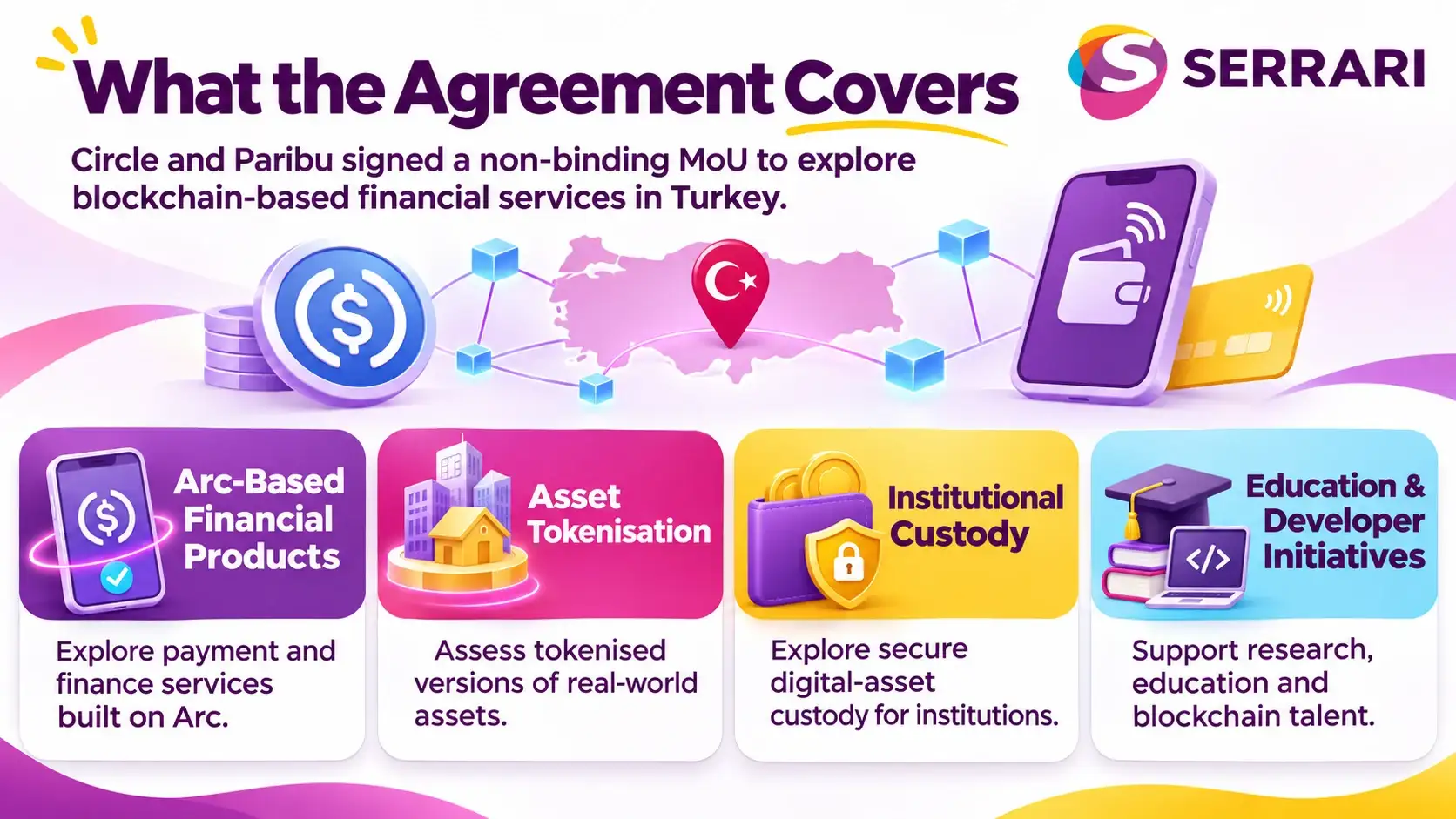
The MoU identifies several areas where Circle and Paribu could work together.
1. Financial products built on Arc
The companies will explore financial products and services that could operate on Arc. This includes assessing how the network could support stablecoin-based financial activity and other blockchain applications in the Turkish market.
2. Real-world asset tokenisation
The agreement includes exploring the tokenisation of real-world assets. This involves representing traditional assets, such as securities or commodities, as digital tokens on a blockchain.
Tokenisation can enable assets to be represented and transferred through blockchain infrastructure. However, the agreement does not identify which specific assets the companies may target or announce any products that are ready for deployment.
3. Institutional digital asset custody
The companies will also explore institutional custody services. These are safekeeping arrangements designed to help organisations and large investors hold digital assets securely.
This area builds on Paribu’s existing institutional services through Paribu Custody, which already incorporates Arc into its infrastructure.
4. Education, research and developer initiatives
Circle and Paribu also intend to explore joint education, research and developer programmes. These initiatives would focus on stablecoins and blockchain-based financial infrastructure in Turkey.
The emphasis on education and development suggests that the partnership is not limited to financial products. It also creates room to explore the technical knowledge and infrastructure needed to support wider adoption.
Context is everything. Stay ahead of shifting trends with today’s market updates, and uncover emerging opportunities using the Serrari Group Market Index and Marketplace. Then, take control of your own financial future by exploring our Money & Life Reset Transformation Blueprint ™ to build stronger habits, create better systems, and design a path toward lasting wealth.
Why Arc Is Central to the Partnership
Arc is Circle’s Layer 1 blockchain, designed to support stablecoin-based financial activity and onchain applications.
Its public mainnet launched on 16 September 2026. The network supports 22 fiat-backed stablecoins, including TRYB, which is pegged to the Turkish lira, alongside tokenised investment products.
One of Arc’s distinguishing features is its transaction-fee structure. Rather than requiring users to acquire a separate native cryptocurrency to pay network fees, Arc uses USDC.
The network also advertises transaction finality in under a second. The transaction fees are described as below US$0.01 and refer to sub-second deterministic finality.
These features are relevant to financial institutions and businesses considering blockchain-based payments and asset transfers. Using a stablecoin for network fees may simplify the transaction process for participants already operating with USDC, while faster transaction finality could support applications that require transactions to be confirmed quickly.
Arc has also attracted participation from established financial and technology companies. Its institutional validators include BlackRock, Mastercard, Visa, Intercontinental Exchange and Standard Chartered.
Its ecosystem already includes several tokenised investment products, including BlackRock’s USD Institutional Digital Liquidity Fund (BUIDL), Circle’s USYC and tokenised offerings from Janus Henderson.
This existing activity gives Circle and Paribu an infrastructure base to explore rather than having to establish an entirely new blockchain relationship from the beginning.
Paribu’s Existing Integration Provides a Starting Point
The agreement extends an existing relationship between the two companies.
Paribu was among Arc’s launch partners in Turkey and has supported USDC deposits and withdrawals through the network since its public availability. Its institutional custody division, Paribu Custody, has also integrated Arc into its infrastructure.
This means the MoU builds on technical integration that is already in place. The next step, if the companies proceed, would be to assess whether additional products and services can be developed around that infrastructure.
Founded in 2017, Paribu has gradually expanded beyond cryptocurrency trading into institutional financial services, digital asset custody and capital markets.
In late 2024, the company introduced Paribu Custody, built around its proprietary ColdShield security technology. The system incorporates multiple layers of protection for digital assets held on behalf of clients.
Its expansion into capital markets followed in October 2025, when Turkey’s Capital Markets Board granted establishment approval to Paribu Yatırım Menkul Değerler A.Ş., allowing the group to establish a presence in the country’s capital markets sector.
Two months later, Paribu acquired CoinMENA, a cryptocurrency exchange operating in the Middle East and North Africa. The acquisition formed part of its expansion into regulated markets outside Turkey.
According to Paribu CEO Yasin Oral, the group now has a presence across three MENA markets, while its Turkish subsidiaries hold a combined 7 billion Turkish lira in paid-in capital.
Paribu has also worked with international fintech companies. In October 2024, it partnered with Mesh, a payments infrastructure provider backed by PayPal Ventures, to connect users with external cryptocurrency platforms and self-custodial wallets such as MetaMask.
The Circle agreement therefore fits into Paribu’s wider expansion into institutional services and financial infrastructure.
Circle’s Broader Push into Institutional Stablecoin Services
The partnership also aligns with Circle’s efforts to integrate its stablecoins into business payments and institutional financial applications.
In October 2026, Circle partnered with SAP-backed payments firm Tereina to introduce stablecoin payments into SAP’s enterprise software. Arc was designated as the preferred blockchain for the initial payment workflows.
The integration is intended to allow eligible businesses using SAP Pay to make payments in USDC and EURC alongside existing settlement methods.
Circle has also expanded its cross-chain transfer infrastructure to support native transfers of EURC, its euro-pegged stablecoin, and cirBTC, a Bitcoin-backed digital asset, across selected blockchain networks.
Its third-quarter financial results, published on 4 November 2026, also illustrate the scale of activity around USDC.
Circle Q3 metric
Reported figure
Change
USDC onchain transaction volume
US$13.9 trillion
+49% year-on-year
USDC market share
27%
—
Revenue and reserve income
US$864.9 million
+17% year-on-year
Circle Payments Network annualised volume
US$41.3 billion
—
The growth in USDC transaction volume and Circle’s payments network activity provides context for its efforts to expand stablecoin use beyond cryptocurrency trading.
The agreement with Paribu adds another potential route into institutional financial services, this time through a local digital asset platform with an existing presence in Turkey.
Why Turkey Matters to the Partnership
Turkey is an important market for the companies to explore because the agreement brings together a dollar-pegged stablecoin, a local digital asset platform and blockchain infrastructure that also supports a Turkish lira-pegged stablecoin.
One of the supplied reports noted that the Turkish lira was under pressure when the agreement was announced, with the US dollar trading above 50 lira.
Dollar-denominated stablecoins such as USDC can provide users with access to a digital asset designed to maintain a value linked to the US dollar. However, their use does not remove the risks associated with digital assets, including regulatory, custody and operational risks.
The presence of TRYB on Arc also demonstrates that the network supports stablecoins linked to currencies beyond the US dollar.
For Circle, working with Paribu offers a potential route to reach users and institutions through an established local platform. For Paribu, the agreement creates an opportunity to explore additional services built on Arc as it expands its custody and capital-markets activities.
The opportunity, however, remains conditional. The MoU does not confirm that new USDC products will be launched in Turkey, nor does it establish a timeline for commercial deployment.
The Bigger Picture: Stablecoins Move Further into Financial Infrastructure
The Circle-Paribu agreement reflects a broader development in digital finance: stablecoin issuers and digital asset platforms are increasingly exploring applications beyond cryptocurrency trading.
Stablecoins are digital assets designed to maintain a stable value relative to a reference currency or asset. USDC, for example, is pegged to the US dollar.
Their potential applications include payments, settlement, transfers and access to tokenised financial products. As more businesses and financial institutions explore these uses, the infrastructure supporting stablecoins becomes increasingly important.
Arc is part of this infrastructure-focused approach. Rather than operating only as a blockchain for cryptocurrency transactions, it is designed to support stablecoin payments and institutional financial applications.
The presence of traditional financial institutions and tokenised investment products in its ecosystem illustrates the growing overlap between conventional finance and blockchain-based services.
Real-world asset tokenisation is another important part of this development. By representing traditional financial assets as digital tokens, financial institutions can explore new ways of issuing, holding and transferring investments.
However, tokenisation does not automatically make an asset safer, more liquid or more accessible. Its effectiveness depends on the underlying asset, legal ownership arrangements, regulation, custody and the infrastructure used to process transactions.
The Circle-Paribu agreement is therefore part of a wider effort to test how blockchain infrastructure can support existing financial services and potentially create new ones.
Why Does This Matter Now?
The agreement matters because stablecoin adoption is increasingly being explored as a financial infrastructure issue, rather than simply a cryptocurrency trading opportunity.
For Circle, the partnership could strengthen USDC’s presence in Turkey and create opportunities to connect its blockchain infrastructure with institutional services offered by a local platform.
For Paribu, it could support its expansion into custody, capital markets and blockchain-based financial products. Its existing Arc integration gives the companies a starting point for evaluating these opportunities.
For financial institutions and businesses, the areas under discussion — including tokenised assets, custody and stablecoin-based services — are relevant to the development of digital financial infrastructure.
But the immediate significance should not be overstated. The MoU is non-binding, and the companies have not announced a specific product, investment amount, revenue target or commercial launch date.
The real test will be whether the two companies can turn the framework into services that meet regulatory requirements and address practical needs in the Turkish financial market.
Outlook
Circle and Paribu will explore potential financial products built on Arc, institutional digital asset custody, real-world asset tokenisation and joint education and research initiatives.
Their existing technical relationship provides a foundation for this work, particularly through Paribu’s support for USDC deposits and withdrawals and its integration of Arc into Paribu Custody.
The next developments to watch will be whether the companies announce specific products, identify institutional partners or establish implementation timelines.
Regulatory approval will also be important, particularly for services involving digital asset custody, tokenised financial products and stablecoin-based financial activity.
For now, the agreement represents a strategic step towards exploring wider USDC adoption and onchain finance in Turkey. Whether it leads to commercially available services will depend on the outcome of the companies’ discussions and the regulatory environment.
Frequently Asked Questions
1. What is the Circle and Paribu agreement about?
Circle and Paribu signed a non-binding MoU to explore wider USDC adoption, financial products built on Arc, real-world asset tokenisation, institutional digital asset custody, and joint education and research initiatives in Turkey.
2. What is Arc blockchain?
Arc is Circle’s Layer 1 blockchain designed to support stablecoin-based financial applications. It uses USDC to pay transaction fees and advertises transaction finality in under a second.
3. What is Paribu’s role in the partnership?
Paribu is Circle’s local digital asset platform partner in Turkey. It already supports USDC deposits and withdrawals through Arc, while its institutional custody division, Paribu Custody, has integrated the network.
4. Does the agreement mean new USDC products will launch in Turkey immediately?
No. The MoU is non-binding and establishes areas for exploration. The companies have not announced confirmed product launches, investment commitments or commercial implementation dates.
Your financial future isn’t something you wait for—it’s something you build.
The real question is: when do you begin?
Move beyond simply staying informed.
Navigate the markets with clarity—track trends through the Serrari Group Market Index, uncover opportunities in the Serrari Marketplace, and build practical knowledge with our Curated Wealth Builder Platform.
Stay connected to what truly matters.
Get daily insights on macro trends and financial movements across Kenya, Africa, and global markets—delivered through the Serrari Newsletter.
Growth opens doors.
Advance your career through professional programs including ACCA, HESI A2, ATI TEAS 7 , HESI EXIT , NCLEX – RN and NCLEX – PN, Financial Literacy!🌟—designed to move you forward with confidence.
See where money is flowing—clearly and in real time.
Track Money Market Funds, Treasury Bills, Treasury Bonds, Green Bonds, and Fixed Deposits, alongside global and African indexes, key economic indicators, and the evolving Crypto and stablecoin landscape—all within Serrari’s Market Index.