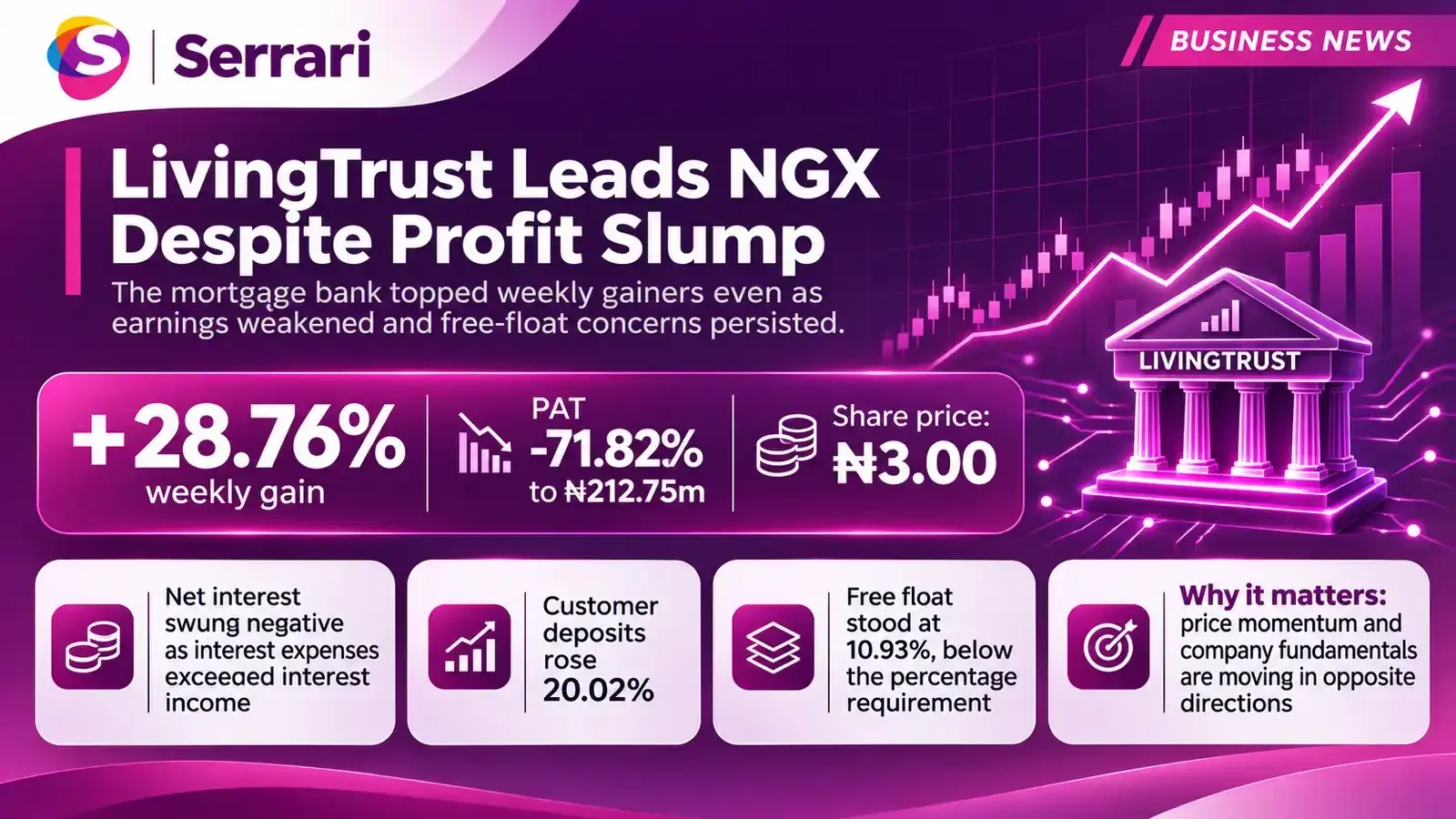
LivingTrust Mortgage Bank Plc led the Nigerian Exchange (NGX) weekly gainers for the period ended November 20, 2026, advancing 28.76% to ₦3 per share despite a sharp deterioration in profitability. Its nine-month net profit declined 71.82% to ₦212.75 million as interest expenses overtook interest income and credit impairment charges increased. The rally followed a substantial sell-off, while the lender’s limited public shareholding raises questions about trading liquidity and the sustainability of its recovery. The divergence illustrates why rising share prices and improving banking fundamentals are not necessarily the same thing.
Key Overview
- LivingTrust gained 28.76% in the week ended November 20, against a 1.83% decline in the NGX All-Share Index.
- Nine-month profit after tax fell from ₦755.01 million to ₦212.75 million.
- Net interest income deteriorated by approximately ₦1.18 billion, turning negative.
- Customer deposits expanded by 20.02%, while net customer loans declined by 1%.
- Public free float stood at 10.93%, with the bank reporting compliance in monetary value but not percentage terms.
- At ₦3 per share, the mortgage lender was valued at approximately ₦15 billion.
Why LivingTrust rallied against a falling market
LivingTrust’s recovery was unusually strong given the direction of Nigeria’s equity market. The weekly market review recorded a 1.83% decline in the benchmark index, while LivingTrust outperformed the broader market by approximately 30.59 percentage points. Chellarams and International Breweries also registered substantial gains, but neither matched the mortgage lender.
The starting point matters. LivingTrust had fallen from ₦2.86 to ₦2.33 during the preceding week, according to its recent trading performance, leaving the stock positioned for a potentially sharp reversal. Its subsequent rise to ₦3 translated into a gain of only 4.90% relative to the price before that earlier decline.
The mathematics illustrate why a large percentage rebound does not necessarily represent an equally large improvement in longer-term shareholder returns. A depressed starting price magnifies the percentage effect of any subsequent recovery.
The advance developed across several sessions. By November 18, the stock had risen to ₦2.81 even as the wider exchange experienced another sell-off. It subsequently reached ₦3 and held that level on Friday.
A rebound from recent lows, renewed buying interest and limited available share supply offer plausible explanations for the magnitude of the move. However, the reviewed disclosures do not establish a specific corporate announcement or identifiable investor motive as the definitive catalyst. The rally should therefore not be presented as proof that the bank’s earnings have recovered.
Funding costs undermine the mortgage banking model
The most important weakness in LivingTrust’s results is the reversal of its interest margin. Mortgage lenders generally depend on the difference between what they earn on loans and other interest-bearing assets and what they pay to attract deposits and other funding.
The bank’s nine-month financial statements reveal a fall in interest income from ₦3.59 billion to ₦2.48 billion, alongside an increase in interest expenditure from ₦2.88 billion to ₦2.94 billion. The resulting net interest deficit of ₦465.43 million compares with a surplus of ₦712.26 million a year earlier.
The decline in interest receipts was much larger than the increase in interest expenses. This distinction matters because the problem cannot be explained solely by more expensive funding. Restoring the interest margin also requires improving the income generated by the asset portfolio.
For a mortgage lender, this can be particularly challenging when existing loans are priced differently from newly mobilised deposits. Funding liabilities may reprice sooner than longer-duration assets, creating a mismatch. That is a possible mechanism rather than a confirmed explanation for LivingTrust’s particular funding arrangements.
Other operating income provided an important buffer, but relying on alternative income streams to compensate for a negative interest result raises questions about earnings durability. A lender that consistently spends more on interest than it receives must either improve asset yields, reduce funding costs or generate enough recurring non-interest revenue to cover the difference.
The decline in reported earnings was consequently much steeper than the contraction in gross revenue. Gross earnings fell 5.56%, whereas pre-tax profit dropped 69.14%. This is an example of how a relatively modest revenue decline can generate a disproportionately large reduction in profits when operating and funding costs remain difficult to reduce.
Context is everything. Stay ahead of shifting trends with today’s market updates, and uncover emerging opportunities using the Serrari Group Market Index and Marketplace. Then, take control of your own financial future by exploring our Money & Life Reset Transformation Blueprint ™ to build stronger habits, create better systems, and design a path toward lasting wealth.
Deposit growth is not translating into stronger returns
LivingTrust’s balance sheet presents a contrasting picture. Assets reached ₦37.03 billion at September 30, up from ₦32.21 billion at December 2025. Deposits rose to ₦27.29 billion, but net customer lending slipped to ₦16.79 billion.
Using the reported balances, the simple net customer loans-to-deposits ratio declined from approximately 74.6% to 61.5%. This is an analytical measure, not a calculation of the bank’s regulatory liquidity or lending ratio.
The falling ratio indicates that deposit growth exceeded expansion in the net loan portfolio. While greater funding availability can support future mortgage originations, it does not automatically create profitable lending opportunities. New deposits may carry interest obligations even before they can be deployed into sufficiently remunerative assets.
Management must also avoid responding to margin pressure by relaxing credit standards. Expanding lending merely to increase interest receipts could create larger losses later if borrowers struggle to service their obligations. Conversely, maintaining conservative credit standards may protect the balance sheet while limiting near-term income growth.
Credit risk has already become more consequential. Impairment charges rose from approximately ₦7.43 million to ₦170.49 million, as detailed in the interim financial disclosures, adding pressure to profitability. Impairment expenses represent recognised credit-loss estimates and do not necessarily mean that the entire amount has already become an actual cash loss.
For borrowers, the broader implication is that lenders facing this combination of funding and credit pressures may become more selective about new mortgage applications or seek higher lending yields. Whether LivingTrust will change its lending terms remains to be established.
Why limited free float matters to shareholders
The bank’s ownership structure is another important consideration when interpreting its stock market performance. Four substantial shareholders collectively control approximately 88.04% of issued equity. After excluding other relevant holdings, the public free float amounts to approximately 546.59 million shares.
The exchange’s free-float rules distinguish between the Growth Board’s Entry and Standard segments, with percentage benchmarks of 10% and 15% respectively, alongside monetary-value provisions. LivingTrust itself reports that its percentage falls short of the applicable requirement while its September free-float valuation of approximately ₦1.72 billion satisfies the value criterion. This should not be interpreted as confirmation of an imminent suspension or delisting.
Limited free float can amplify price movements because the supply of shares readily offered for sale may be relatively small. It can also make exiting a substantial position difficult when demand weakens. Importantly, free float measures eligible public holdings, not the number of shares actually available for immediate purchase.
The November 20 daily trading records show that 219,347 LivingTrust shares changed hands across 32 transactions. That volume represented approximately 0.04% of its reported public float. A single day’s activity cannot establish typical liquidity, but it demonstrates why turnover deserves attention alongside headline returns.
Filing delays and the valuation challenge
LivingTrust previously experienced delays in publishing financial reports while awaiting regulatory approval of its 2025 audited accounts. The earlier filing extension explained that the sequencing of annual and quarterly submissions complicated timely disclosure.
Timeliness matters because shareholders need current financial information to distinguish temporary operating setbacks from structural deterioration. Delayed disclosures can increase uncertainty even where the delays have a stated regulatory explanation.
At ₦3 per share, the bank’s five billion issued shares imply a market capitalisation of ₦15 billion. Against September equity of approximately ₦5.19 billion, that represents a price-to-book ratio of around 2.89 times. Annualising nine-month profit mechanically produces an illustrative price-to-earnings ratio of roughly 53 times; this is not a forecast and does not account for seasonal earnings changes.
Those valuation measures demonstrate how demanding the current share price could become if earnings remain depressed. A sustainable improvement in profitability would change the picture, but the share-price recovery alone cannot establish that such an improvement is underway.
LivingTrust’s next financial disclosures will therefore matter more than its position on a weekly gainers table. The central questions are whether interest income can recover, funding costs can be controlled, credit losses can stabilise and ownership-related liquidity concerns can be addressed. The wider lesson for Nigeria’s equity market is that price momentum, accounting profitability and the ability to trade shares are separate dimensions of investment performance.
Sources: AIICO Capital / Nigerian Tribune / Nairametrics / Nigerian Exchange / AfricanFinancials / FinancialFilings / GTI Research / MarketScreener
Your financial future isn’t something you wait for—it’s something you build.
The real question is: when do you begin?
Move beyond simply staying informed.
Navigate the markets with clarity—track trends through the Serrari Group Market Index, uncover opportunities in the Serrari Marketplace, and build practical knowledge with our Curated Wealth Builder Platform.
Stay connected to what truly matters.
Get daily insights on macro trends and financial movements across Kenya, Africa, and global markets—delivered through the Serrari Newsletter.
Growth opens doors.
Advance your career through professional programs including ACCA, HESI A2, ATI TEAS 7 , HESI EXIT , NCLEX – RN and NCLEX – PN, Financial Literacy!🌟—designed to move you forward with confidence.
See where money is flowing—clearly and in real time.
Track Money Market Funds, Treasury Bills, Treasury Bonds, Green Bonds, and Fixed Deposits, alongside global and African indexes, key economic indicators, and the evolving Crypto and stablecoin landscape—all within Serrari’s Market Index.