Eurozone private-sector activity continued expanding in November 2026, with the flash composite Purchasing Managers’ Index (PMI) unchanged at 51.7. However, the stable regional reading concealed a widening divide between Germany, where industrial demand accelerated, and France, where business activity contracted more sharply. With inflation running at twice the European Central Bank’s target and business confidence deteriorating, the recovery faces an increasingly difficult combination of uneven demand, expensive credit and limited fiscal flexibility. The divergence raises questions about whether Europe’s largest economies can sustain a balanced expansion heading into 2027.
Key Overview
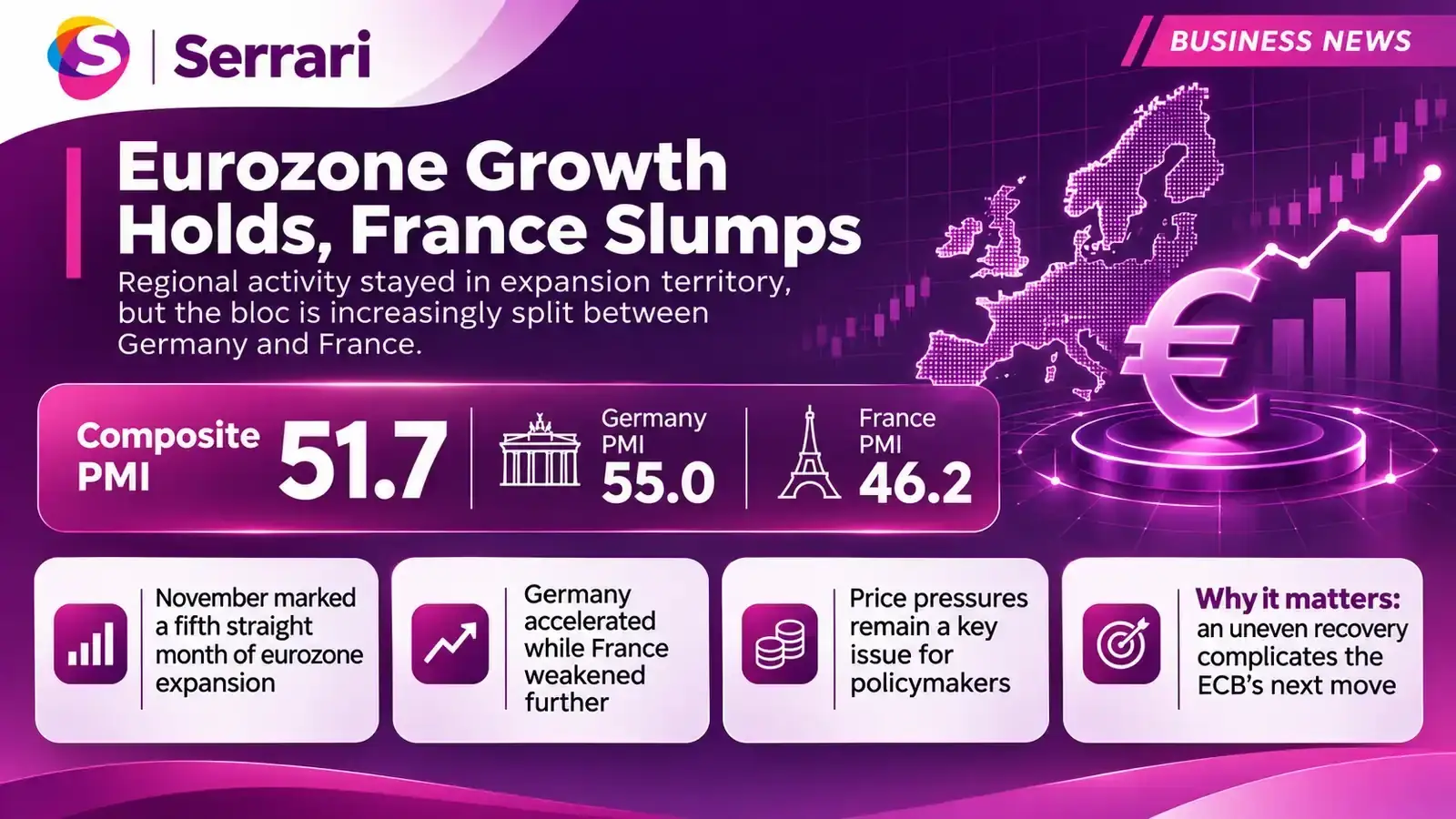
- The eurozone composite PMI held at 51.7, marking a fifth consecutive month of expansion.
- Germany’s composite PMI reached 55.0, its strongest reading since March 2022.
- France’s composite PMI declined to 46.2 from 46.6, widening the gap with Germany to 8.8 index points.
- The eurozone manufacturing PMI rose to 52.9, while the services PMI slipped to 51.2.
- Eurozone annual inflation reached 4.0% in October 2026, twice the ECB’s target.
- Economists expect a December increase in the ECB deposit rate from 2.50% to 2.75%, although the decision is not guaranteed.
Why steady eurozone growth conceals a widening economic divide
The November business survey offers a more complicated picture of Europe’s economy than its headline reading suggests. An unchanged composite PMI indicates that activity continued expanding at a broadly similar pace to October, but it does not establish that the recovery is becoming more geographically balanced or resilient.
The November survey analysis associates the latest regional readings with quarterly GDP growth of around 0.3%. That estimate follows the official third-quarter GDP release, which recorded a 0.4% quarterly expansion across the currency union.
The PMI is a diffusion index, measuring whether surveyed businesses report improvement, deterioration or unchanged conditions. A reading above 50 signals expansion, but 51.7 does not mean economic output increased by 1.7%. Preliminary survey readings can also be revised and cannot substitute for official national accounts.
Germany’s acceleration has become particularly important because activity elsewhere is less encouraging. A stronger contribution from the largest economy can compensate statistically for weakness in another major member, even while households and businesses in that weaker economy experience deteriorating conditions.
This distinction has policy consequences. A central bank responding to aggregate growth may see sufficient resilience to maintain restrictive financing conditions, whereas businesses in contracting economies may already need relief. November’s figures make that tension increasingly visible.
Germany’s industrial rebound gains from investment demand
Germany’s latest business activity survey showed its composite index rising from 53.4 to 55.0, reflecting improvements across manufacturing and services. The stronger performance offers evidence that parts of Europe’s industrial base are benefiting from changing patterns of global capital expenditure.
Artificial intelligence infrastructure requires more than semiconductors and software. Data centres need electrical equipment, cooling systems, specialised machinery and reliable power infrastructure. Defence investment similarly creates demand for industrial components, engineering services and production equipment. Germany’s established manufacturing capabilities give it opportunities to participate in these supply chains.
The European Commission’s autumn economic assessment identifies global AI and electrification expenditure as support for European goods exports. This is important because European companies can benefit from overseas technology investment even when domestic technology spending remains relatively subdued.
Industrial orders can also generate secondary demand for freight, maintenance, engineering consultancy and information technology services. Such connections help explain why a manufacturing recovery can lift portions of the services economy without requiring a simultaneous consumer spending boom.
However, a recovery concentrated in selected investment-intensive industries remains exposed to changes in capital budgets. If technology companies reduce infrastructure expenditure or governments delay procurement, suppliers may experience weaker orders. Germany’s recent improvement is therefore encouraging, but the durability of that growth depends partly on whether demand broadens beyond its current drivers.
Context is everything. Stay ahead of shifting trends with today’s market updates, and uncover emerging opportunities using the Serrari Group Market Index and Marketplace. Then, take control of your own financial future by exploring our Money & Life Reset Transformation Blueprint ™ to build stronger habits, create better systems, and design a path toward lasting wealth.
Why France faces a greater risk of recession
France’s November composite reading of 46.2 indicates a sharper deterioration in private-sector conditions than October’s 46.6. With the economy having contracted in the third quarter, another quarterly GDP decline would meet the commonly used definition of a technical recession. The survey itself does not establish that such a recession has already occurred.
Weak domestic demand is particularly concerning because businesses can postpone investment when the outlook for taxation, regulation or customer spending becomes uncertain. Ahead of an election period, firms may prefer preserving cash to committing to projects whose returns depend on future economic policy.
The French economic forecast published on November 17 projects GDP growth of just 0.4% in 2026 and 0.6% in 2027. It identifies weaker investment and expensive energy among the obstacles to recovery, while projecting a government deficit of 5.5% of GDP this year and public debt of 119.2% of GDP.
This creates a difficult feedback loop. Weak activity reduces tax receipts and can increase demand for public assistance, while high borrowing requirements limit the government’s ability to provide additional stimulus without increasing fiscal risks. Spending restraint may improve the budget over time but can also suppress demand in the near term.
For households, uncertainty about employment and purchasing power can encourage precautionary saving. For businesses, reduced customer expenditure can weaken revenues and make recruitment or expansion less attractive. These decisions reinforce one another, potentially prolonging the downturn even if individual companies are behaving prudently.
France’s weakness also matters to neighbouring countries. Lower demand for imports and intermediate goods can affect suppliers across Europe’s integrated market, limiting the extent to which Germany’s industrial recovery can remain insulated from its trading partners.
Persistent inflation complicates the ECB’s December decision
The inflation backdrop makes Europe’s uneven recovery especially difficult to manage. The October consumer price release put eurozone annual inflation at 4.0%, with energy prices rising 21.0% and services prices increasing 3.3%. Both the level of headline inflation and the composition of price pressures matter for monetary policy.
An interest-rate increase cannot directly produce more energy or reduce the international price of imported fuel. It can, however, restrain credit growth and spending, limiting the extent to which initial cost increases spread into broader prices and inflation expectations.
The risk is that tighter policy also depresses activity in sectors already struggling. Housing construction, property transactions and businesses dependent on external financing are particularly sensitive to changes in borrowing costs.
The ECB’s October monetary policy decision kept the deposit facility rate at 2.50%, following earlier increases. In a November survey of economists, all 71 respondents anticipated a December increase to 2.75%. That consensus is a forecast rather than a commitment from policymakers.
A common interest rate also produces different consequences across economies. The effect depends on debt maturity, the prevalence of variable-rate loans, bank lending standards and the financial strength of borrowers. A company enjoying rising industrial orders may absorb higher financing costs more readily than a service business facing declining sales.
November’s slower increase in surveyed selling prices provides some encouragement, but a moderation in the pace of increases is not equivalent to falling prices. Policymakers must assess whether that moderation persists before concluding that inflation is returning sustainably towards target.
Why employment and confidence matter more than the headline PMI
The November regional business report described broadly unchanged employment across surveyed firms and a fourth successive decline in year-ahead confidence. These indicators raise questions about whether businesses expect current demand to justify additional hiring and investment.
An economy can produce more without generating proportionately more employment, particularly when growth is concentrated in capital-intensive manufacturing. Rising output may reflect greater utilisation of existing machinery, productivity improvements or additional hours rather than new jobs.
For households, employment security is an important determinant of spending. Even workers who retain their jobs may defer major purchases if they believe future income is uncertain. This can weaken consumer-facing businesses and make the services recovery less dependable.
The next test for the eurozone is whether new orders translate into sustained output, hiring and investment across a wider range of countries. For financial markets, the December rate decision will matter alongside sovereign borrowing costs and the evolution of inflation expectations. For businesses trading with Europe, the composition of demand may matter more than the regional average: industrial suppliers and consumer-facing exporters could encounter very different conditions.
The eurozone is not experiencing a uniform downturn, but neither is its expansion uniformly strong. Germany’s recovery offers a source of resilience, while France’s contraction and persistent inflation expose the limitations of relying on that strength alone. A durable recovery will require broader demand, greater investment confidence and a credible path back to price stability.
Sources: S&P Global / Eurostat / Reuters / Continuum Economics / European Commission / European Central Bank
Your financial future isn’t something you wait for—it’s something you build.
The real question is: when do you begin?
Move beyond simply staying informed.
Navigate the markets with clarity—track trends through the Serrari Group Market Index, uncover opportunities in the Serrari Marketplace, and build practical knowledge with our Curated Wealth Builder Platform.
Stay connected to what truly matters.
Get daily insights on macro trends and financial movements across Kenya, Africa, and global markets—delivered through the Serrari Newsletter.
Growth opens doors.
Advance your career through professional programs including ACCA, HESI A2, ATI TEAS 7 , HESI EXIT , NCLEX – RN and NCLEX – PN, Financial Literacy!🌟—designed to move you forward with confidence.
See where money is flowing—clearly and in real time.
Track Money Market Funds, Treasury Bills, Treasury Bonds, Green Bonds, and Fixed Deposits, alongside global and African indexes, key economic indicators, and the evolving Crypto and stablecoin landscape—all within Serrari’s Market Index.