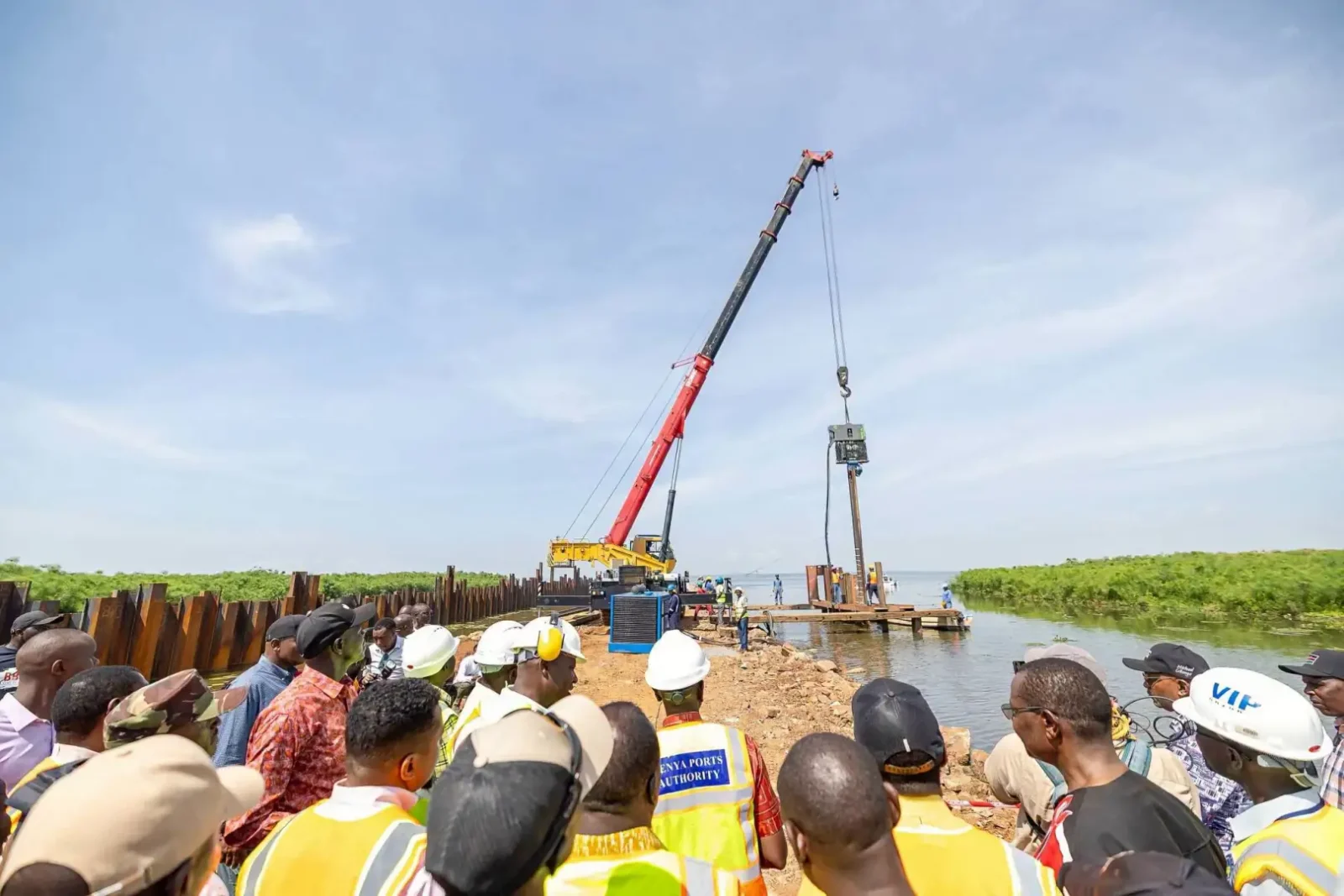
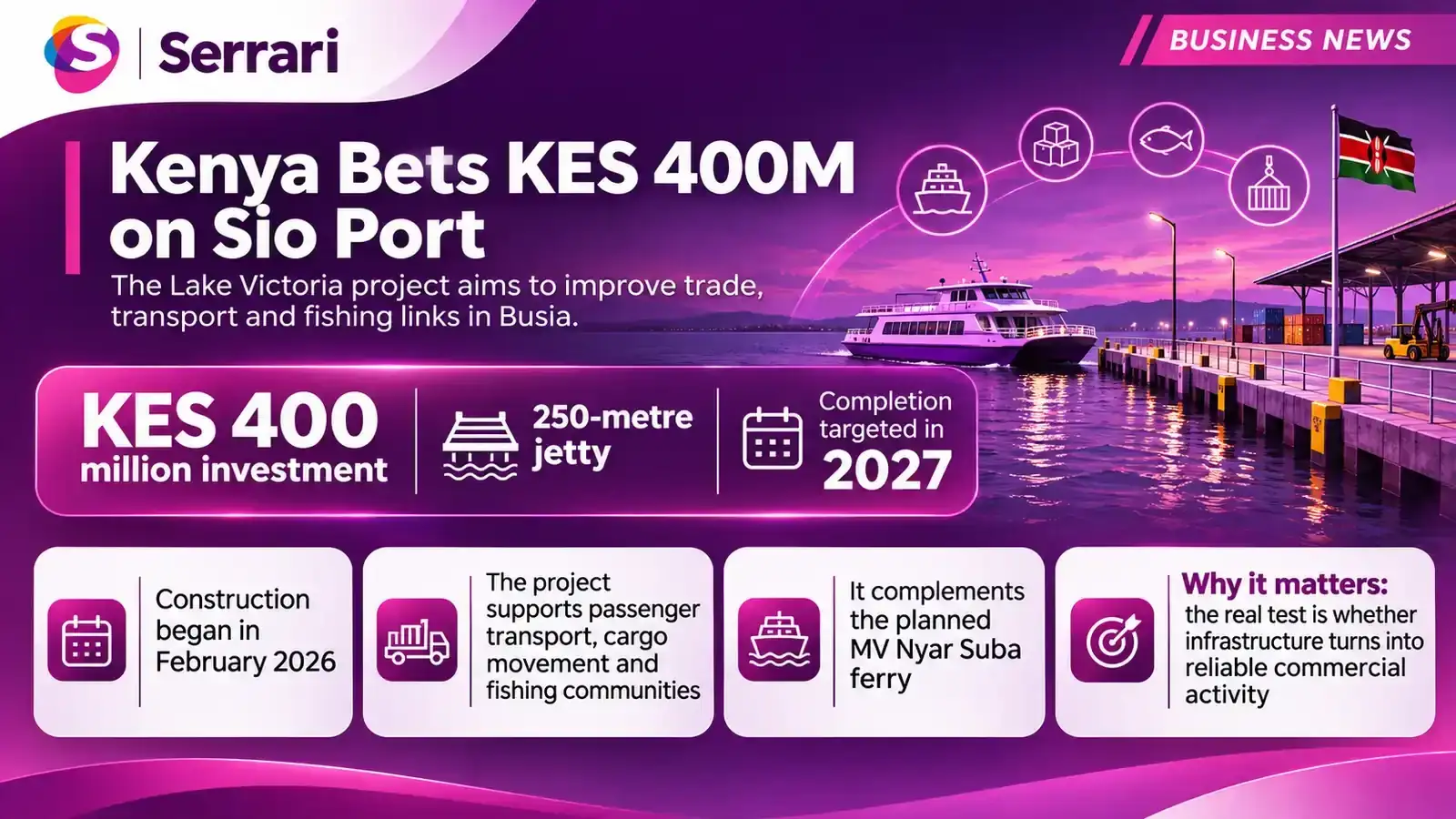
Kenya is investing KES 400 million in the redevelopment of Sio Port in Busia County, seeking to improve inland water transport and connect western Kenya more effectively with regional markets. The project includes a 250-metre jetty, land reclamation and supporting infrastructure, with completion expected in 2027. Implemented by the Kenya Ports Authority (KPA) through Kenya Shipyards Limited, the investment complements a wider programme of lake-port development and ferry construction. Its economic success will depend on reliable transport services, affordable freight charges, connections to inland markets and the ability to turn improved infrastructure into sustained commercial activity.
Key Overview
- Kenya is committing KES 400 million to redevelop Sio Port in Funyula, Busia County.
- Construction began in February 2026, with completion expected in 2027.
- The project includes a 250-metre jetty, reclamation and supporting infrastructure.
- Kisumu Port handled approximately 459,000 tonnes of cargo in 2025, compared with 4,300 tonnes in 2017.
- The planned MV Nyar Suba ferry is designed to carry 74 seated passengers alongside either 10 lorries or 13 saloon cars.
- Fishing, agriculture, passenger transport and regional commerce stand to benefit if regular and affordable services materialise.
Why Kenya is reviving Sio Port
The redevelopment of Sio Port addresses a longstanding mismatch between western Kenya’s economic geography and its transport infrastructure. Communities along Lake Victoria have access to a natural waterway connecting three East African countries, yet the commercial usefulness of that waterway depends on safe landing facilities, reliable vessels and connections to inland markets.
President William Ruto inspected the project during his western Kenya tour on November 20, 2026. Subsequent reporting on the redevelopment on November 23 highlighted its intended role in strengthening trade and economic connectivity. The investment is part of a wider effort to develop inland maritime infrastructure rather than concentrate port investment exclusively on the Indian Ocean coast.
For businesses in Busia, the underlying issue is the cost of reaching customers. A journey that is geographically short across water can require a much longer route by road. Where commercially viable water services exist, traders gain an alternative that may reduce transport expenditure and improve delivery times.
The official construction update published in May described reinforced concrete infrastructure, shoreline protection and removal of invasive aquatic vegetation as components of the redevelopment. These improvements matter because dependable docking and navigability are prerequisites for attracting regular commercial operators.
The investment also reflects the need to bring economic infrastructure closer to smaller communities. A major cargo terminal may serve national trade efficiently without adequately addressing the transport needs of fishermen, small-scale farmers and passengers living far from that terminal. Feeder ports can help bridge that gap.
Kisumu’s cargo growth explains the wider investment strategy
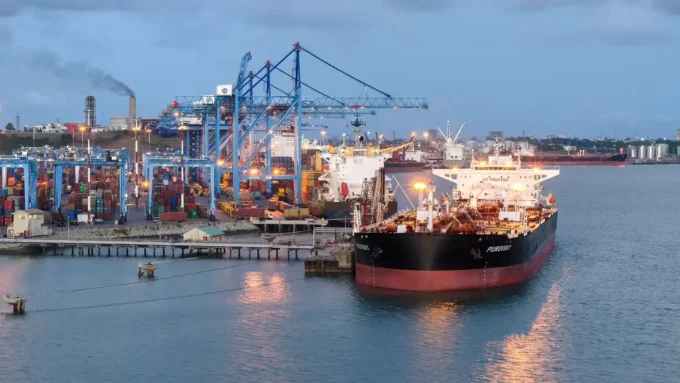
The commercial case for developing Lake Victoria’s smaller ports is strengthened by the recovery already recorded at Kisumu. According to a July 2026 port performance update, Kisumu handled approximately 459,000 metric tonnes of cargo in 2025, compared with around 4,300 tonnes in 2017. The expansion followed improvements to berthing capacity, water depth and cargo storage.
That increase demonstrates that lake transport can attract meaningful cargo volumes when infrastructure and commercial demand align. However, Kisumu’s performance should not be treated as a forecast for Sio Port. The two facilities have different market catchments, handling requirements and potential cargo profiles.
Kisumu functions as a major regional freight gateway, whereas smaller ports can connect surrounding communities to larger transport networks. The small-port development programme includes facilities at Homa Bay, Mfangano, Muhuru Bay and Kendu Bay, among others, reflecting a phased approach to improving lake connectivity.
The economic logic is similar to a transport network built around a central hub and multiple feeder routes. Smaller facilities can aggregate passengers and cargo, while larger terminals provide access to wider distribution systems. This can improve vessel utilisation and create more opportunities for return cargo, reducing the financial burden of journeys made without paying freight.
Nevertheless, duplication of infrastructure without sufficient demand would undermine the investment case. Route planning, cargo forecasts and coordination between ports will determine whether the network achieves economies of scale.
How lake transport could reduce the cost of doing business
Water transport can be especially useful for goods that are heavy relative to their value, including agricultural inputs, construction materials and bulk produce. A vessel capable of carrying several trucks may consolidate movements that would otherwise require separate road journeys. The potential savings depend on distance, vessel loading, fuel consumption and terminal charges.
Consider an illustrative trader transporting 10 tonnes of goods. If total road delivery costs amount to KES 4,000 per tonne and a combined water-and-road alternative costs KES 3,000 per tonne, the trader saves KES 10,000 per shipment. At 100 comparable shipments annually, the saving would reach KES 1 million. These figures illustrate the commercial mechanism; they are not published Sio Port freight rates or a forecast of actual savings.
Importantly, the relevant comparison is the entire door-to-door journey. Moving goods by water may appear cheaper until loading fees, road transfers, storage and waiting time are included. For perishable cargo, delays can outweigh any apparent freight saving.
The regional inland-waterway strategy illustrates how Kenya, Uganda and Tanzania are pursuing alternatives to road-only freight through port improvements and vessel investment. Reducing dependence on a single transport mode can also give businesses greater flexibility when roads become congested or disrupted.
For Sio Port, the opportunity is not necessarily to replace road transport. It is to combine water and road services in ways that make particular journeys more efficient.
Context is everything. Stay ahead of shifting trends with today’s market updates, and uncover emerging opportunities using the Serrari Group Market Index and Marketplace. Then, take control of your own financial future by exploring our Money & Life Reset Transformation Blueprint ™ to build stronger habits, create better systems, and design a path toward lasting wealth.
Fishing communities need more than a modern jetty
The fisheries sector provides an important commercial rationale for the project. Kenya’s recent fisheries earnings figures show that freshwater fish production increased from 86,527 tonnes in 2024 to 125,374 tonnes in 2025, with its value rising from KES 14.5 billion to KES 28.6 billion. Lake Victoria is a principal source of freshwater catches, although these national figures cover other freshwater fisheries as well.
A modern landing facility can reduce the difficulties associated with transferring fish from boats to vehicles and improve access for buyers. More predictable connections could allow traders to reach a wider market before fresh produce loses quality. Better market access can also strengthen fishermen’s bargaining position by reducing dependence on a limited number of local buyers.
However, a jetty alone cannot establish a functioning cold chain. Ice production, refrigeration, hygienic handling, affordable electricity and dependable onward transport are essential if businesses are to preserve fish quality over longer distances. These facilities represent potential complementary investments, not confirmed components of the KES 400 million construction budget.
Environmental sustainability is equally important. The recent fisheries conservation concerns underscore why investment in landing infrastructure must be accompanied by responsible fisheries management. Expanding market access without protecting fish stocks could intensify pressure on the resource that supports local livelihoods.
The economic objective should therefore be to increase the value retained from each sustainably harvested catch, rather than simply encourage greater extraction.
Why the new ferry matters to Sio Port’s commercial viability
Infrastructure generates economic value when people and businesses use it. The planned introduction of MV Nyar Suba offers a potential link between the investment in landing facilities and actual passenger and freight services.
The November ferry development update reported that the 29-metre vessel was approximately 95% complete, with delivery targeted for early December 2026. Its stated capacity is 74 seated passengers and either 10 lorries or 13 saloon cars, with planned services involving Homa Bay, Muhuru and Sio Port.
A scheduled ferry could make transport more predictable for businesses and passengers. Vehicle-carrying capacity is particularly useful because it allows cargo to remain on a truck during the water segment, potentially reducing repeated handling. Actual loading configurations will depend on approved vessel limits and operating procedures.
The ferry’s delivery does not guarantee immediate service at every planned destination. Landing facilities must be ready, routes must be approved and operators must establish schedules and safety arrangements. Commercial viability will also depend on passenger demand, freight volumes, maintenance costs and the availability of affordable fares.
For traders, regular departures may be more valuable than occasional inexpensive sailings. Reliability allows businesses to plan inventory, manage working capital and fulfil delivery commitments without maintaining excessive safety stocks.
What will determine the return on Kenya’s KES 400 million investment?
Sio Port’s longer-term value should be assessed through measurable economic outcomes rather than construction completion alone. Direct financial returns may come from port charges and related services, while wider benefits could include lower logistics costs, improved market access, employment and greater private investment. Those benefits are distinct from revenue collected by the port operator.
Cross-border services will require customs and immigration arrangements, maritime safety compliance and coordination with neighbouring countries. A completed domestic pier does not automatically become an authorised international border crossing. Road connections to trading centres will also influence how much of Busia’s agricultural and commercial activity can use the facility.
Once the project is operational, indicators such as passenger numbers, cargo tonnage, vessel frequency, freight costs and delivery times will offer a stronger basis for evaluating success. Maintenance expenditure and environmental performance must also be tracked to ensure that early improvements remain sustainable.
Kenya’s KES 400 million investment ultimately seeks to turn Lake Victoria from an underused transport opportunity into a more dependable commercial connection for western Kenya. If Sio Port can attract consistent demand and integrate with the wider lake transport network, it could help retain more economic value in Busia. If services remain irregular or unaffordable, the infrastructure risks falling short of its intended purpose. The real test begins after construction.
Sources: The Star / Ministry of Defence / Kenya News Agency / Kenya Ports Authority / Business Daily / Pulse Kenya
Your financial future isn’t something you wait for—it’s something you build.
The real question is: when do you begin?
Move beyond simply staying informed.
Navigate the markets with clarity—track trends through the Serrari Group Market Index, uncover opportunities in the Serrari Marketplace, and build practical knowledge with our Curated Wealth Builder Platform.
Stay connected to what truly matters.
Get daily insights on macro trends and financial movements across Kenya, Africa, and global markets—delivered through the Serrari Newsletter.
Growth opens doors.
Advance your career through professional programs including ACCA, HESI A2, ATI TEAS 7 , HESI EXIT , NCLEX – RN and NCLEX – PN, Financial Literacy!🌟—designed to move you forward with confidence.
See where money is flowing—clearly and in real time.
Track Money Market Funds, Treasury Bills, Treasury Bonds, Green Bonds, and Fixed Deposits, alongside global and African indexes, key economic indicators, and the evolving Crypto and stablecoin landscape—all within Serrari’s Market Index.