Investors choosing between Vanguard Short-Term Treasury ETF (VGSH) and iShares 1–5 Year Investment Grade Corporate Bond ETF (IGSB) face a trade-off that becomes more important when interest rates and economic expectations shift. VGSH concentrates on short-dated US government securities and charges slightly less, while IGSB holds thousands of investment-grade corporate bonds and offers a higher trailing distribution yield. That extra income is compensation for risks that government debt largely avoids, including weakening corporate balance sheets and widening credit spreads. Neither fund guarantees principal, and short maturities reduce rather than eliminate price fluctuations. The relevant question is not which fund advertises the highest yield, but which set of risks fits the investor’s time horizon and need for liquidity.
Key Overview
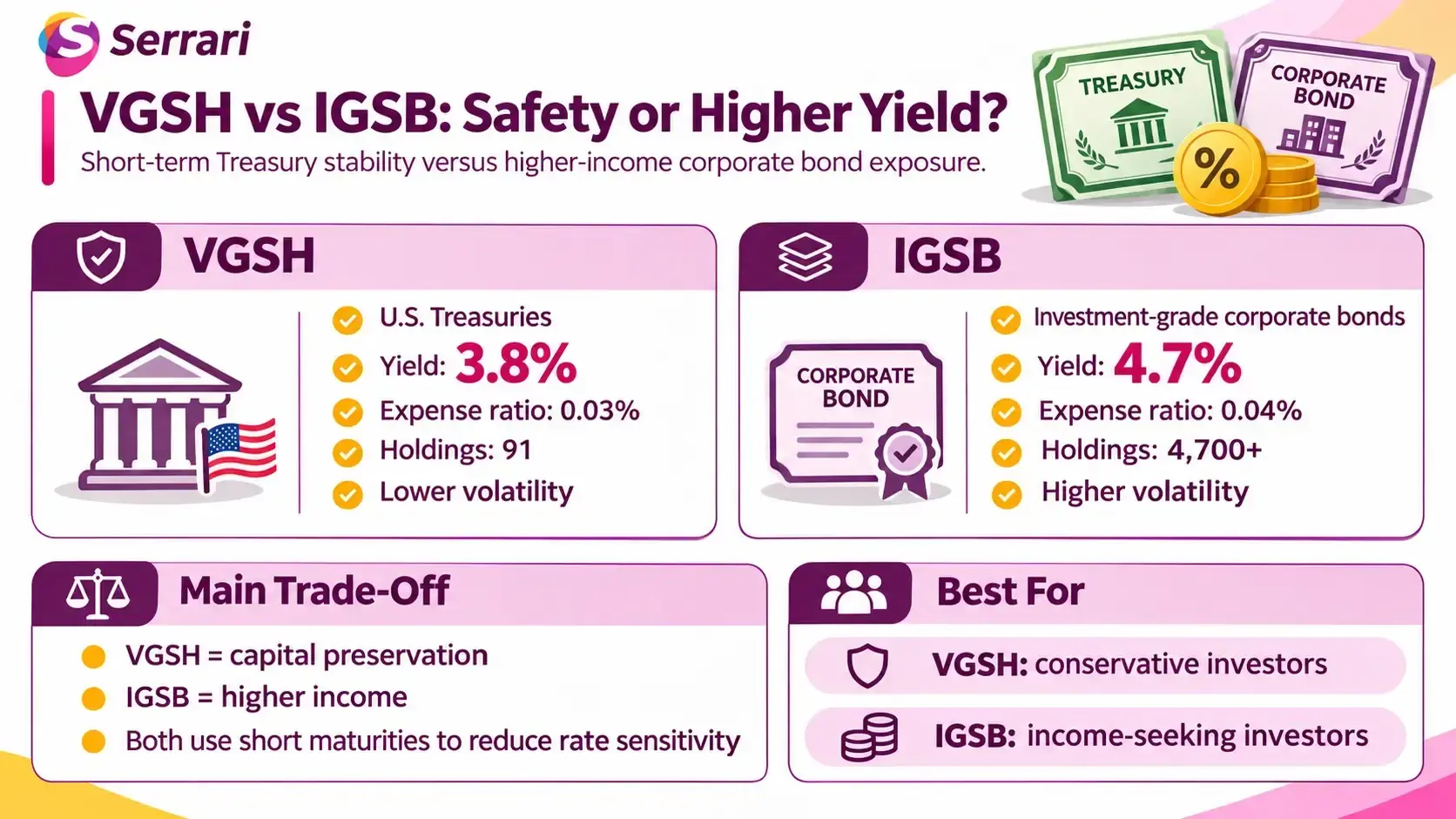
- Income: The November 19 comparison put IGSB’s trailing distribution yield at 4.7%, versus 3.8% for VGSH, a gap of 0.9 percentage points.
- Costs: VGSH charges 0.03% annually, compared with IGSB’s 0.04%—a difference of $1 per $10,000 invested per year before other trading costs.
- Holdings: VGSH focuses on US Treasury debt, while IGSB holds roughly 4,800 investment-grade corporate securities, spreading company-specific risk across issuers.
- Interest-rate exposure: VGSH’s reported average duration was around 1.8 years in its September factsheet; IGSB’s effective duration was 2.63 years on November 18.
- Main choice: VGSH emphasizes credit quality and stability; IGSB seeks additional income by accepting corporate credit risk and somewhat greater rate sensitivity.
Why IGSB Pays More Than the Treasury Fund
The higher yield on IGSB is not a free enhancement to a near-identical product. It arises because the funds lend to fundamentally different borrowers. VGSH follows the US Treasury 1–3 year bond market, purchasing obligations backed by the US government’s ability to meet its debt commitments. IGSB follows an index of investment-grade corporate issues, which exposes investors to the financial health of businesses even when those businesses carry relatively strong credit ratings.
Corporate borrowers generally must offer additional compensation because their earnings, leverage and ability to refinance can deteriorate. A company can continue paying its bonds during normal conditions but face growing pressure when sales weaken, borrowing costs climb or lenders become more cautious. The difference between a corporate bond’s yield and that of a comparable government security is known as its credit spread. Investors earn that spread for taking credit risk, but they can also lose market value when spreads widen.
The November 19 fund comparison reported trailing distribution yields of 4.7% for IGSB and 3.8% for VGSH. On a simple, illustrative $10,000 holding, those percentages correspond to approximately $470 and $380 in annual distributions, a $90 difference before taxes and changing payout rates. The calculation is not a forecast: trailing yields reflect prior distributions relative to recent share prices and can change.
That distinction becomes especially important when comparing income figures. IGSB’s fund data for November 18 showed a 4.70% trailing 12-month yield but a 5.47% 30-day SEC yield. These are different measurements, not conflicting promises. Investors should compare like-for-like yield methodologies and observation dates before deciding that the advertised income advantage will persist.
Why the Risk Gap Is Bigger Than the Fee Gap
Both ETFs have exceptionally low headline operating charges. VGSH’s expense ratio is 0.03% and IGSB’s is 0.04%, according to the published fund information and corporate ETF prospectus. For $10,000 invested over a full year, the stated rates imply approximately $3 and $4 in fund operating costs, assuming a stable balance. Brokerage charges, bid-ask spreads and investor-specific taxes can add to the total cost of ownership.
A one-dollar annual fee difference is much smaller than the possible impact of interest-rate moves or corporate credit concerns. When investors require higher yields from existing bonds, bond prices generally fall. Duration estimates how sensitive a bond portfolio may be to such changes. VGSH’s September factsheet reported average duration of about 1.8 years, while IGSB reported an effective duration of 2.63 years on November 18.
Under a simplified scenario in which relevant yields rose one percentage point, duration alone would suggest an approximate 1.8% price decline for VGSH and 2.63% for IGSB, before income, convexity, trading effects and any changes in credit spreads. These are illustrations rather than predicted returns. IGSB also faces credit-spread movements that can amplify losses when companies’ perceived borrowing risks rise.
Historical risk measures point in the same direction, though they cannot guarantee future outcomes. The November comparison reported five-year maximum drawdowns of 5.70% for VGSH and 9.46% for IGSB. A maximum drawdown measures the decline from a prior peak to a subsequent trough over the measured period. It captures what an investor might have endured if forced to sell at an unfavorable time, rather than the amount eventually lost by everyone who held the investment.
What Thousands of Corporate Bonds Can—and Cannot—Protect
IGSB’s nearly 4,800 holdings make it much more diversified by individual security than VGSH, which holds fewer than 100 Treasury issues. The broad portfolio reduces dependence on the fortunes of any single corporate borrower. The fund’s index rules also concentrate on investment-grade, fixed-rate dollar bonds with remaining maturities between one and five years, helping avoid the longer-term and lower-rated segments of the bond market.
But diversification across companies does not eliminate the risk that many corporate bonds fall together. During a recession scare, investors can demand larger risk premiums across entire sectors. Even solvent companies may see their bond prices decline as buyers move toward government securities. Credit downgrades can increase pressure on a bond well before a default becomes likely.
VGSH has a different concentration: its holdings are overwhelmingly obligations of the same sovereign borrower. For someone prioritizing minimal corporate default exposure, that is a deliberate feature, not necessarily a flaw. Nevertheless, an ETF holding government bonds is not equivalent to keeping money in an insured bank deposit or holding a specific Treasury note to maturity. The ETF has a fluctuating market price and continuously maintains its target maturity range.
The fund’s shares can therefore be worth less on the day an investor needs cash. A US Treasury security carries the US government’s credit backing; the market value of an ETF holding Treasury securities does not carry a promise that the buyer’s original investment will be returned intact.
Context is everything. Stay ahead of shifting trends with today’s market updates, and uncover emerging opportunities using the Serrari Group Market Index and Marketplace. Then, take control of your own financial future by exploring our Money & Life Reset Transformation Blueprint ™ to build stronger habits, create better systems, and design a path toward lasting wealth.
Why Short-Term Bonds Matter When Rates Change
Short-maturity funds occupy a useful position between cash-like investments and longer-duration bond portfolios. They typically experience smaller price swings from interest-rate changes than long-dated bonds, while offering distributions from securities with maturities extending beyond overnight cash instruments. Yet the two funds are not identical in maturity exposure: VGSH targets Treasury obligations with one to three years remaining, whereas IGSB spans one to five years of corporate debt.
If market interest rates decline, existing bonds can appreciate, and the fund may benefit from capital gains in addition to distributions. But as old bonds mature and proceeds are reinvested at lower rates, future income may eventually decrease. Conversely, rising rates can initially depress prices while creating opportunities for the portfolio to reinvest at higher yields. The overall result depends on timing, duration and how long investors stay invested.
Corporate spreads introduce an additional variable. IGSB could outperform if Treasury yields are relatively stable while confidence in corporate borrowers improves. It could underperform even during falling government yields if deteriorating economic conditions cause credit spreads to widen substantially. Consequently, the question is not simply whether the Federal Reserve will cut rates. Investors must also consider what falling rates would signal about growth and corporate creditworthiness.
Tax Treatment and the Real Income Investors Keep
The after-tax comparison can differ from the headline yield comparison, particularly for US taxpayers. Interest from US Treasury obligations is generally exempt from state and local income taxes, while remaining subject to federal tax. Distributions attributable to corporate bond interest generally do not receive that same Treasury-related state-tax treatment. The allocation of an ETF’s distributions to eligible Treasury interest can require fund reporting and may depend on state rules.
That means VGSH’s lower quoted payout could be relatively more competitive for an investor living in a high-tax US state than the raw yield gap suggests. For an investor outside the United States, withholding rules, local tax treatment and currency movements may alter the result further. Tax residence matters more than the fund’s brand name.
Non-US investors must also consider that both funds are US-dollar assets. An investor measuring wealth in another currency could earn positive dollar distributions yet experience a loss when converting proceeds back into the home currency. Currency risk is separate from the underlying bonds’ credit and duration risks.
Which ETF Fits the Investment Goal?
The decision becomes clearer when the money’s purpose is defined. For a relatively cautious allocation where an investor values high-quality government credit and expects to need funds within a few years, VGSH may be a more suitable starting point. Its lower fee and shorter duration reinforce that defensive role, although they do not eliminate market losses or make the fund appropriate for every near-term cash obligation.
IGSB may be attractive to someone with more flexibility about when to sell, who wants higher ongoing income and can tolerate corporate-bond price fluctuations. The large number of holdings helps limit dependence on individual companies, but the entire portfolio can still respond negatively to a worsening credit cycle.
Investors should evaluate total return rather than compare distribution percentages alone. In the source comparison, IGSB’s five-year hypothetical $1,000 investment grew to approximately $1,135, versus $1,108 for VGSH, with distributions reinvested. That historical result shows why accepting additional risk can sometimes be rewarded, but the performance difference is modest enough that one poorly timed sale could change the outcome for an individual investor.
The broader lesson is that short-term fixed-income ETFs are not interchangeable substitutes for cash. Their yields reflect different mixes of interest-rate exposure, credit risk and portfolio construction. In a market where rate expectations and business conditions can change quickly, choosing between VGSH and IGSB should begin with a question about downside tolerance—not a search for the largest payout.
Sources: The Motley Fool / Vanguard / iShares / BlackRock / U.S. Securities and Exchange Commission
Your financial future isn’t something you wait for—it’s something you build.
The real question is: when do you begin?
Move beyond simply staying informed.
Navigate the markets with clarity—track trends through the Serrari Group Market Index, uncover opportunities in the Serrari Marketplace, and build practical knowledge with our Curated Wealth Builder Platform.
Stay connected to what truly matters.
Get daily insights on macro trends and financial movements across Kenya, Africa, and global markets—delivered through the Serrari Newsletter.
Growth opens doors.
Advance your career through professional programs including ACCA, HESI A2, ATI TEAS 7 , HESI EXIT , NCLEX – RN and NCLEX – PN, Financial Literacy!🌟—designed to move you forward with confidence.
See where money is flowing—clearly and in real time.
Track Money Market Funds, Treasury Bills, Treasury Bonds, Green Bonds, and Fixed Deposits, alongside global and African indexes, key economic indicators, and the evolving Crypto and stablecoin landscape—all within Serrari’s Market Index.