Visa is extending its stablecoin-based prefunding capability into Asia-Pacific through its Visa Direct payment platform. The initiative is being piloted with Singapore-based digital payments company dtcpay, allowing eligible clients to use supported stablecoins to fund cross-border payouts. Recipients, however, will continue receiving conventional fiat currencies through their bank accounts, cards or digital wallets.
Stablecoin infrastructure provider Triple-A is also supporting the regional expansion by handling stablecoin processing, currency conversion, compliance screening and settlement. The move follows Visa Direct’s transition to commercial stablecoin prefunding in the United States with Inyo Global in October 2026.
Key Takeaways
- Visa is extending its stablecoin-powered prefunding capability into Asia-Pacific through its Visa Direct platform.
- Singapore-based dtcpay is the pilot partner, using stablecoins to prefund cross-border fiat payouts.
- Triple-A is providing infrastructure services, including token processing, currency conversion, compliance screening and settlement.
- Recipients will continue receiving ordinary fiat currencies rather than stablecoins.
- Visa Direct’s network connects more than 18 billion endpoints globally.
- The Asia-Pacific initiative follows the commercial rollout of USDC prefunding with Inyo Global in the United States in October 2026.
Visa Extends Stablecoin-Powered Payments into Asia-Pacific
Visa is expanding the role of stablecoins in international payments by enabling eligible clients in Asia-Pacific to use supported digital tokens to fund cross-border payouts through its Visa Direct platform.
Announced on November 18, 2026, the initiative introduces stablecoin-based prefunding into the region’s payment infrastructure. The capability is being piloted with dtcpay, a Singapore-based digital payments company, as Visa looks to connect blockchain-based payment infrastructure with its established global money movement network.
The development represents another step in the integration of digital assets into conventional financial services. Rather than requiring recipients to receive or hold stablecoins, the arrangement allows businesses and payment providers to use them to fund transfers before beneficiaries receive payments in traditional currencies.
Visa Direct connects businesses and financial institutions to a network of more than 18 billion endpoints globally. These include bank accounts, cards and digital wallets, providing a broad infrastructure for moving money across borders.
Under the new arrangement, eligible clients can transfer supported stablecoins to a payment provider in advance. The funds are then used to support payouts through Visa Direct, while recipients continue receiving payments in the relevant fiat currency.
Stablecoin-based prefunding can give clients greater flexibility in managing short-term liquidity and funding payout activity, Visa said in its announcement.
The company believes this approach can help businesses manage the movement of money across different markets while maintaining the familiar payment experience expected by recipients.
How Visa’s Stablecoin Prefunding Model Works
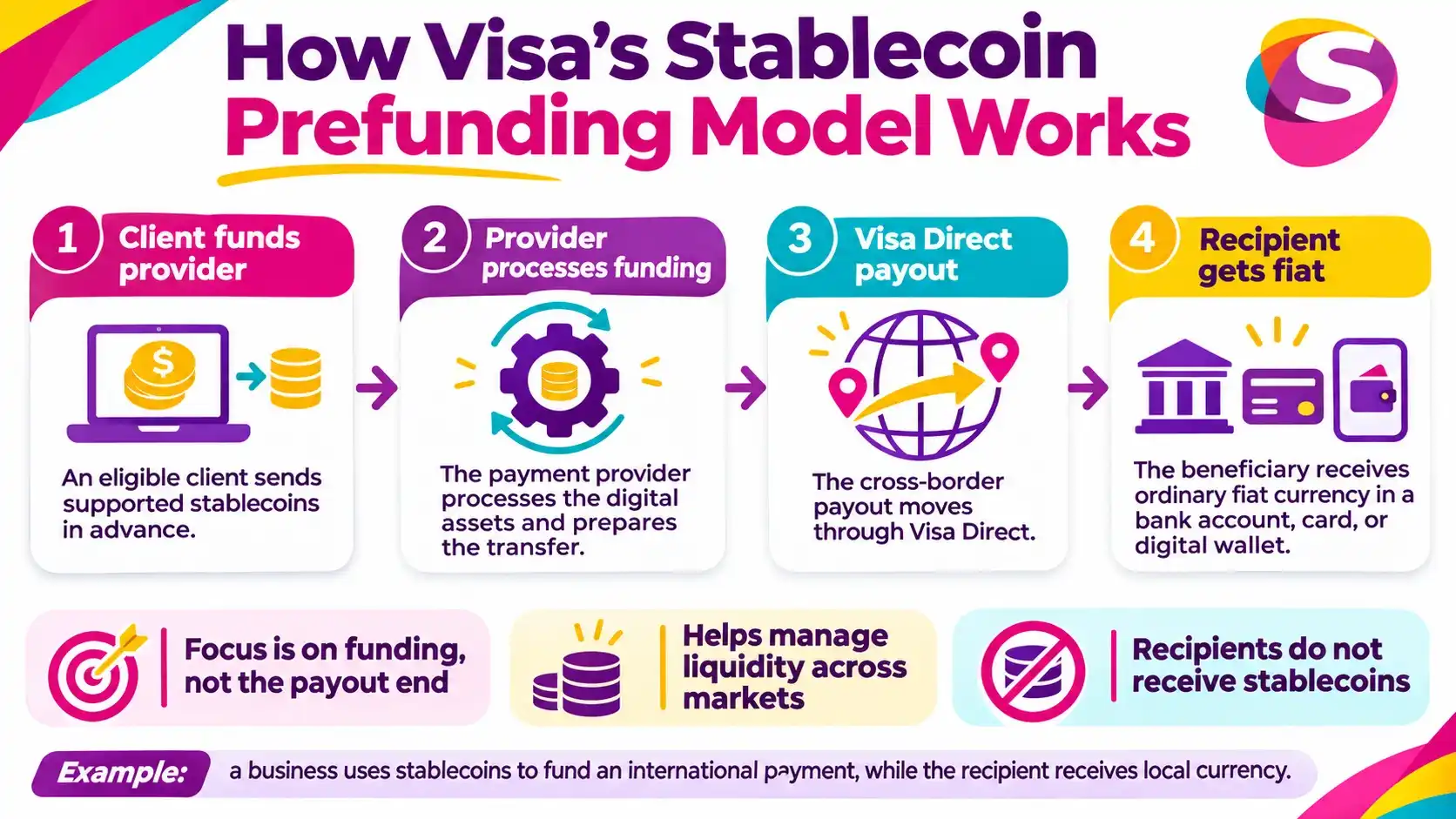
The new capability focuses on the funding stage of a cross-border payment rather than changing how beneficiaries receive their money.
Traditionally, businesses and payment service providers rely on conventional banking channels to fund international payouts. This can involve managing liquidity across different currencies, banking systems and time zones. Where banking channels are unavailable, businesses may face delays in arranging the funds needed to complete transfers.
Stablecoin prefunding introduces another way to supply that liquidity.
In the Visa Direct model, an eligible client uses supported stablecoins to fund a payment provider ahead of a payout. The provider processes the digital assets and makes the necessary arrangements for the transfer to proceed through Visa Direct. The recipient then receives the payment in fiat currency.
For example, a business in one country that needs to pay a supplier or worker in another market could use stablecoins to fund the payment provider. The provider would process the funding and facilitate the payout through the payment network. The beneficiary would receive conventional money in their local currency rather than having to manage a digital wallet or convert stablecoins themselves.
This distinction is important because the initiative does not mean Visa is replacing traditional currencies with stablecoins at the recipient end. Instead, the digital tokens are being used as a funding mechanism behind the scenes.
Visa’s Global Head of Visa Direct, Vira Platonova, said the long-term value of stablecoins depends on how effectively they connect with existing financial systems.
“Their long-term value lies in how effectively they connect with the financial systems businesses already use,” Platonova said.
She added that Visa is working to bridge traditional financial infrastructure and on-chain systems, allowing clients to incorporate emerging forms of value into their existing operations.
The company also clarified that access to the capability depends on client eligibility and geographical availability. Visa itself does not provide the regulated digital-asset services involved. Those services are delivered independently by licensed partners.
dtcpay Leads the Asia-Pacific Pilot
Visa has selected dtcpay as its pilot partner for the regional expansion.
The Singapore-based digital payments company will use supported stablecoins to prefund cross-border fiat payouts through Visa Direct. Its participation provides an initial use case for connecting digital-asset funding with an established international payment network.
dtcpay is authorised by the Monetary Authority of Singapore (MAS) as a major payment institution. Its licence covers activities including cross-border money transfers, digital payment token services and electronic money issuance.
The regulatory framework is relevant because stablecoin-related payment services involve more than simply transferring digital tokens. Providers must also address requirements relating to customer protection, compliance, transaction monitoring and the handling of digital assets.
The pilot is therefore structured around licensed payment providers and infrastructure partners rather than Visa independently offering digital-asset services.
There is also an important distinction between the stablecoins used in the pilot and the currency received by the beneficiary. While the funding process uses digital tokens, the final payout remains in fiat currency.
dtcpay has separately indicated that it is using USDC to prefund payouts through Visa Direct. This provides an example of how the arrangement may work in practice, although Visa’s own announcement did not identify all the stablecoins that will be supported across the broader Asia-Pacific programme.
Triple-A Provides Stablecoin Processing and Settlement Infrastructure
Alongside dtcpay’s participation, stablecoin infrastructure provider Triple-A has announced its involvement in supporting the regional expansion.
Triple-A’s role includes stablecoin processing, currency conversion, compliance screening and settlement. These services help payment service providers connect digital-asset funding with the processes required to complete conventional cross-border payouts.
The company said its infrastructure enables payment providers to fund Visa Direct transfers even when traditional banking channels are closed.
This is particularly relevant in Asia-Pacific, where international payments can involve several currencies, banking systems and time zones. Payment providers operating across different markets need to maintain sufficient liquidity to meet payout obligations, even when their usual banking arrangements are unavailable.
Triple-A’s infrastructure is intended to provide additional flexibility in managing these funding requirements.
Eric Barbier, founder and Chief Executive Officer of Triple-A, said the region accounts for a significant share of international payment activity.
“Asia Pacific accounts for nearly a third of global cross-border payment flows,” Barbier said.
He added that payment providers must navigate multiple currencies, banking systems and time zones when funding transfers across the region. The collaboration brings stablecoins into existing payment infrastructure, giving providers more flexibility in managing liquidity and funding international payments.
Triple-A’s involvement also highlights the importance of infrastructure providers in the development of stablecoin-based payment services. While a stablecoin can represent the digital funding asset, additional services are needed to process transactions, convert currencies, screen payments and complete settlement.
Visa’s announcement identifies dtcpay as the pilot partner but does not name Triple-A in its own release. Triple-A has separately described its role in the regional integration.
Context is everything. Stay ahead of shifting trends with today’s market updates, and uncover emerging opportunities using the Serrari Group Market Index and Marketplace. Then, take control of your own financial future by exploring our Money & Life Reset Transformation Blueprint ™ to build stronger habits, create better systems, and design a path toward lasting wealth.
From US Commercial Production to an Asia-Pacific Pilot
The Asia-Pacific initiative builds on Visa’s earlier work to introduce stablecoins into its payment infrastructure.
Visa began exploring stablecoin prefunding and payout applications through Visa Direct in 2025. The objective was to determine how digital tokens could support cross-border funding, liquidity management and international money movement.
In October 2026, the company announced that stablecoin-enabled prefunding had moved into commercial production in the United States through Inyo Global.
The rollout allowed eligible banks, fintech companies and money transfer operators to fund cross-border payouts using USDC in near real time. Inyo Global became the first Visa Direct processor to offer the service commercially.
The US launch marked a transition from experimentation to an operational payment service. The expansion into Asia-Pacific now brings the capability to another major international payments market, although the regional initiative remains at the pilot stage.
Visa has also explored other stablecoin-related applications. In August 2026, it announced an arrangement with on-chain infrastructure provider Zerohash to expand stablecoin capabilities for eligible clients, including funding merchant accounts and sending stablecoin payouts.
These developments indicate that Visa is exploring several ways to incorporate digital assets into its payment network, rather than limiting their use to one type of transaction.
However, the different initiatives should not be treated as identical. The Asia-Pacific pilot focuses on stablecoin prefunding for fiat payouts, while other arrangements may involve different funding or payout structures.
Why Asia-Pacific Matters for Cross-Border Payments
Asia-Pacific is an important market for international money movement because businesses and individuals regularly send and receive funds across national borders.
The region includes major financial centres, international trade markets and economies with different currencies and banking systems. Businesses operating across these markets may need to make payments to suppliers, employees, contractors and customers in several countries.
These transactions can create working-capital challenges. A business may need to maintain funds in multiple currencies or arrange liquidity before a payment can be completed. Differences in banking hours and payment systems can also affect how quickly funds become available.
Stablecoin prefunding offers an alternative funding mechanism that could help payment providers manage some of these challenges.
For businesses, the potential benefit is greater flexibility in arranging liquidity. For payment providers, it could provide another way to fund payout activity outside conventional banking hours. For recipients, the intended benefit is that the payment experience remains familiar because they continue receiving fiat currency.
Nevertheless, the model’s effectiveness will depend on the availability of supported stablecoins, the regulatory requirements in individual markets, the capabilities of payment partners and the reliability of the conversion and settlement arrangements.
Visa has not announced a timetable for commercial availability across individual Asia-Pacific markets. Access will also depend on client eligibility and geographical restrictions.
What This Means for the Stablecoin Payments Market
Visa’s expansion reflects a broader shift in how financial institutions and payment companies are approaching stablecoins.
Initially associated largely with cryptocurrency trading and digital-asset exchanges, stablecoins are increasingly being explored for practical financial applications, including international transfers, settlement and business liquidity management.
Unlike cryptocurrencies such as Bitcoin, which can experience substantial price fluctuations, stablecoins are designed to maintain a relatively stable value against a reference asset, commonly a traditional currency such as the US dollar.
USDC, for example, is a dollar-denominated stablecoin issued by Circle. Its use in the dtcpay pilot illustrates how a digital token can serve as a funding instrument without becoming the currency received by the final beneficiary.
This distinction could make stablecoin-based payment arrangements relevant to businesses that want to explore blockchain-based infrastructure without requiring their customers or suppliers to interact directly with cryptocurrencies.
For established payment networks such as Visa, the opportunity lies in connecting emerging digital-asset infrastructure with existing financial systems. Instead of requiring businesses to abandon familiar payment channels, stablecoin prefunding can operate alongside those channels.
However, wider adoption will require clear regulatory arrangements, reliable liquidity, effective compliance controls and confidence in the institutions handling digital assets.
The participation of licensed partners is therefore an important part of the model. It separates Visa’s role as a payment network from the regulated digital-asset services provided by its partners.
The Bigger Picture
Visa’s Asia-Pacific expansion demonstrates how stablecoins may increasingly be used as financial infrastructure rather than solely as assets traded within cryptocurrency markets.
The arrangement does not replace bank accounts, cards or conventional currencies at the recipient end. Instead, it introduces digital tokens into an earlier stage of the payment process, potentially making it easier for businesses and payment providers to arrange the funds needed for international transfers.
The model also highlights the growing importance of partnerships between traditional financial networks, licensed payment companies and blockchain infrastructure providers.
For dtcpay, the pilot provides an opportunity to connect its digital-payment capabilities with Visa Direct’s international network. For Triple-A, the integration demonstrates the role stablecoin infrastructure providers can play in processing and settling transactions. For Visa, it extends its stablecoin strategy into a region with substantial cross-border payment activity.
The key test will be whether these arrangements can operate efficiently, comply with different national regulations and deliver practical benefits beyond what existing payment systems already provide.
Outlook
Visa’s move into Asia-Pacific is another significant development in the integration of stablecoins with conventional payment infrastructure. The partnership with dtcpay provides an initial regional test, while Triple-A’s infrastructure services support the processing and settlement requirements.
The immediate focus will be on the pilot’s implementation, eligible clients and the markets in which the service can operate. Visa has not yet provided a commercial rollout timetable for individual Asia-Pacific countries or identified all the stablecoins that will be supported.
If the model proves effective, it could create additional options for businesses managing international payments and short-term liquidity. It may also encourage other payment providers and financial institutions to explore stablecoin-based funding arrangements.
For now, the initiative remains a pilot rather than a region-wide commercial service. Its longer-term significance will depend on whether stablecoin prefunding can make cross-border payments more flexible while maintaining the regulatory safeguards and familiar fiat payout experience businesses and recipients expect.
Frequently Asked Questions
1. What has Visa announced in Asia-Pacific?
Visa is extending its stablecoin-based prefunding capability into Asia-Pacific through Visa Direct. Eligible clients will be able to use supported stablecoins to fund cross-border payouts, while recipients continue receiving conventional fiat currencies.
2. Which company is participating in Visa’s Asia-Pacific pilot?
Singapore-based digital payments company dtcpay is Visa’s pilot partner. It will use supported stablecoins to prefund cross-border fiat payouts through Visa Direct.
3. Does the recipient receive stablecoins or ordinary money?
Recipients continue receiving ordinary fiat currency through bank accounts, cards or digital wallets. Stablecoins are used at the funding stage of the transaction, not as the currency delivered to the beneficiary.
4. What role does Triple-A play in the arrangement?
Triple-A provides stablecoin processing, currency conversion, compliance screening and settlement services. Its infrastructure helps payment service providers fund Visa Direct transfers, including outside traditional banking hours.
Your financial future isn’t something you wait for—it’s something you build.
The real question is: when do you begin?
Move beyond simply staying informed.
Navigate the markets with clarity—track trends through the Serrari Group Market Index, uncover opportunities in the Serrari Marketplace, and build practical knowledge with our Curated Wealth Builder Platform.
Stay connected to what truly matters.
Get daily insights on macro trends and financial movements across Kenya, Africa, and global markets—delivered through the Serrari Newsletter.
Growth opens doors.
Advance your career through professional programs including ACCA, HESI A2, ATI TEAS 7 , HESI EXIT , NCLEX – RN and NCLEX – PN, Financial Literacy!🌟—designed to move you forward with confidence.
See where money is flowing—clearly and in real time.
Track Money Market Funds, Treasury Bills, Treasury Bonds, Green Bonds, and Fixed Deposits, alongside global and African indexes, key economic indicators, and the evolving Crypto and stablecoin landscape—all within Serrari’s Market Index.