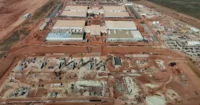
USA Rare Earth (NASDAQ: USAR) is confronting a widening gap between its strategic ambitions and the financial performance investors can measure today. The stock closed at $7.13 on November 16, 2026, down 12.6% from the previous session’s $8.16 close, after an analyst downgrade highlighted supply constraints and delayed growth expectations. Although the company has started commercial rare earth shipments from Brazil, sold its first magnets in Oklahoma and produced specialist oxide samples in Colorado, quarterly revenue remains small relative to the capital committed to its expansion. A price-to-book ratio of roughly 0.6 may appear attractive, but the central question is whether the assets recorded on the balance sheet can generate sufficient cash flows to justify their carrying values.
Key Overview
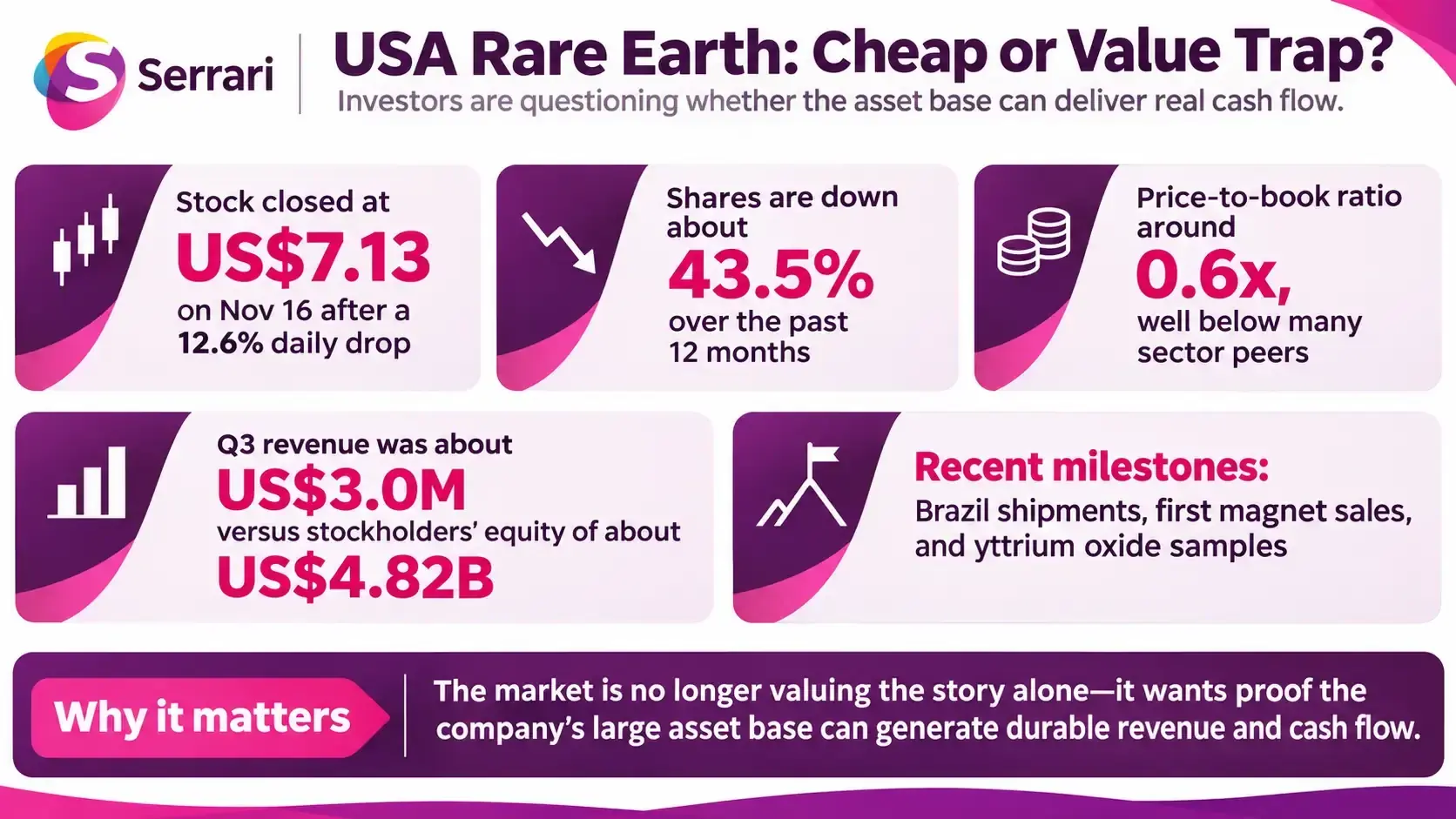
- Share-price pressure: USAR closed November 16 at $7.13, compared with $8.16 on November 13, following a downgrade and concerns over manufacturing inputs.
- Valuation discount: The original valuation screen placed the stock near 0.6 times book value, below the cited sector and peer averages, but that measure is not a standalone fair-value estimate.
- Financial gap: Third-quarter revenue was approximately $3.0 million, despite major operational and acquisition milestones.
- Balance-sheet scale: September 30 filings reported approximately $4.82 billion in stockholders’ equity and $1.09 billion in unrestricted cash and cash equivalents.
- Key investment test: The company must turn shipments, magnet qualification and planned capacity into repeatable sales, margins and operating cash flow.
Why USA Rare Earth Stock Fell Despite Operational Progress
USA Rare Earth’s latest selloff illustrates a familiar problem for businesses building capital-intensive industrial supply chains: announcing progress is not the same as demonstrating commercial economics. The company’s shares closed at $7.13 on November 16, a 12.6% decline from the previous trading session. The $8.16 price cited in earlier commentary was the November 13 close, not the most recent one.
The immediate trigger was a November 16 decision by William Blair analyst Neal Dingmann to downgrade the shares to Market Perform from Outperform. The downgrade drew attention to shortages of feedstock, the raw materials needed to keep processing and magnet-making equipment operating, and to the possibility that meaningful sales and margin improvements will take longer than expected.
This matters because USA Rare Earth is attempting to connect several technically demanding stages of production. Mining and concentrating rare earths, separating individual elements, producing metals and alloys, and manufacturing qualified permanent magnets are different businesses. A disruption at one stage can restrict output elsewhere, even if plants at the other stages are ready.
The downgrade followed disappointing financial results. In its November 9 quarterly release, the company disclosed revenue of just $3.0 million for the three months to September 30. That figure is modest for a business investing heavily in acquisitions, processing capacity and magnet manufacturing. Investors are therefore being asked to value a substantial future production platform before the associated revenues are fully visible.
The distinction is crucial. A major new facility, government-supported contract or successful materials sample may reduce technical or commercial uncertainty. None automatically guarantees sustained factory utilization, customer acceptance, profitable pricing or attractive returns on capital. Those unresolved steps help explain why the market can react negatively even while the company’s operating announcements appear encouraging.
Does a 0.6 Price-to-Book Ratio Mean the Stock Is Cheap?
The original valuation analysis put USA Rare Earth’s price-to-book ratio near 0.6, against cited metals-and-mining and peer comparisons of approximately 2.0 and 2.6 respectively. Those comparative multiples are snapshots rather than fixed benchmarks and depend on the constituents and measurement dates used. At the newer November 16 closing price, a ratio based on unchanged book equity and share count would be lower than at $8.16.
Price-to-book compares a company’s equity market capitalization with the accounting value of net assets. A reading below one means investors value the common equity at less than reported stockholders’ equity. It does not mean an investor buying shares could sell the company’s assets for their recorded amounts or recover the difference.
The company’s September 30 balance sheet listed approximately $6.95 billion of assets, $2.13 billion of liabilities and $4.82 billion of stockholders’ equity. But those assets are not simply cash and readily tradable machinery. They included around $3.46 billion of mineral interests, $745 million of property, plant and equipment, $233 million of other intangible assets and $135 million of goodwill.
The scale of mineral interests reflects the importance of acquisitions and resource valuations to the balance sheet. Such values depend on assumptions about reserves, recoveries, market prices, development schedules and future economics. If operating conditions deteriorate, some recorded amounts may prove less economically productive than expected. Conversely, successful development could create value beyond current accounting measures.
There is also a timing issue. A September 30 equity balance is compared with a November market price, while the company continues spending money and executing its projects. Issuance of additional shares, changes in financial liabilities, further transactions or impairments can alter the denominator and the value attributable to existing common shareholders. For that reason, price-to-book should be tested against cash flow, project economics, capital requirements and possible dilution.
The apparent discount is better understood as a measure of market skepticism than as proof of a bargain.
Context is everything. Stay ahead of shifting trends with today’s market updates, and uncover emerging opportunities using the Serrari Group Market Index and Marketplace. Then, take control of your own financial future by exploring our Money & Life Reset Transformation Blueprint ™ to build stronger habits, create better systems, and design a path toward lasting wealth.
Where the Company’s Growth Story Has Become Tangible
The bearish interpretation is not the only plausible one. USA Rare Earth has made meaningful advances in creating an integrated rare earth supply chain outside Asia, a market where reliable processing and magnet capacity are strategically important.
Its September combination with Serra Verde brought a producing Brazilian operation into the group. According to the company’s operational update, Serra Verde completed the first stage of its optimization program, began commercial-scale shipments of mixed rare earth carbonate in October and recorded sales in November. The operation is ramping toward 4,000 tonnes a year of total rare earth oxide capacity, with a further 2,400-tonne expansion targeted by the end of 2027.
In Oklahoma, the Stillwater facility made its first commercial sales of neodymium-iron-boron magnet blocks in September. At Wheat Ridge, Colorado, the company produced samples of separated oxides, including yttrium, for customer testing and qualification. These are concrete steps toward a broader mine-to-magnet operation, although initial sales and qualification samples are not the same as a mature production run-rate.
Government involvement strengthens the commercial rationale but should not be confused with guaranteed shareholder returns. The company described a government-backed offtake financing structure associated with Serra Verde, including a long-term buyer arrangement. Such support may improve demand visibility and access to financing, yet execution costs, delivery obligations and profitability still matter.
The bull case rests on integration creating more dependable material supply, faster qualification, higher utilization and eventually stronger margins. The bear case questions the time, capital and operational complexity needed to achieve those outcomes. Both cases can acknowledge the same milestones while assigning them very different present values.
Cash Reserves Offer Protection, Not a Profitability Guarantee
Liquidity is a meaningful advantage. USA Rare Earth reported approximately $1.16 billion of cash, cash equivalents and restricted cash at September 30, including about $1.09 billion in cash and cash equivalents. This provides a substantial financial cushion while industrial projects are completed.
Nevertheless, the cash flow disclosures showed $219 million of net cash used in operating activities during the first nine months of 2026, alongside approximately $385 million used in investing activities. A large cash balance can fund growth, but its durability depends on the pace of expenditure, additional financing and the arrival of meaningful receipts from customers.
The third-quarter income statement also requires careful interpretation. The company recorded positive GAAP net income attributable to shareholders, yet reported an adjusted net loss of approximately $126 million. The difference was heavily influenced by non-cash fair-value changes in financial instruments. That is why a single reported profit figure would give an incomplete picture of the underlying commercial operation.
For shareholders, the practical risk is that costs and investment requirements rise faster than revenues. If a facility takes longer to ramp, customers delay qualification or input shortages persist, projected cash flows move further into the future. Even when the long-term opportunity remains intact, the present value of those expected cash flows falls as the wait lengthens and uncertainty increases.
The Bigger Picture: Strategic Minerals Versus Investment Returns
Rare earths are essential inputs for high-performance magnets used in defense equipment, industrial automation, transport and energy technologies. Building alternative supply chains can have national-security value because mining alone does not eliminate dependence on concentrated separation, refining and magnet-making capacity.
USA Rare Earth’s challenge reflects this wider industrial reality. Strategic demand can encourage policy support and capital investment, but building an integrated supply chain is slow and costly. Technical qualification, specialized equipment, feedstock availability and customer contracts must all align before production can scale economically.
The distinction between strategic importance and stock-market value is therefore particularly relevant now. Investors can believe that diversified rare earth supplies are necessary while still questioning whether an individual company’s current shareholders will earn attractive returns after years of spending, financing and execution risk.
Several indicators will determine whether the present discount narrows: quarterly revenue growth, repeat magnet orders, reliable feedstock supplies, progress toward Serra Verde’s production targets, operating cash consumption and clear evidence of improving gross margins. Any revised timetable or funding need should be weighed against those developments rather than against headline announcements alone.
What Investors Should Watch Next
The market is no longer simply judging whether USA Rare Earth can assemble a valuable portfolio of assets. It is beginning to demand evidence that those assets can function as one commercially effective business. The November selloff, following weak quarterly sales and a downgrade, reflects concern about that transition rather than an outright rejection of the company’s strategic potential.
A valuation below reported book equity creates the possibility of upside if projects perform as planned and recorded assets produce durable cash flows. It also signals a real risk that accounting values and ambitious capacity targets may not translate into proportionate shareholder earnings. For now, the decisive issue is not how far USAR has fallen, but how quickly its growing industrial footprint can generate recurring revenue and cash flow without disproportionate new costs or dilution.
Sources: USA Rare Earth / U.S. Securities and Exchange Commission / Yahoo Finance / StockStory / Investing.com / Simply Wall St
Your financial future isn’t something you wait for—it’s something you build.
The real question is: when do you begin?
Move beyond simply staying informed.
Navigate the markets with clarity—track trends through the Serrari Group Market Index, uncover opportunities in the Serrari Marketplace, and build practical knowledge with our Curated Wealth Builder Platform.
Stay connected to what truly matters.
Get daily insights on macro trends and financial movements across Kenya, Africa, and global markets—delivered through the Serrari Newsletter.
Growth opens doors.
Advance your career through professional programs including ACCA, HESI A2, ATI TEAS 7 , HESI EXIT , NCLEX – RN and NCLEX – PN, Financial Literacy!🌟—designed to move you forward with confidence.
See where money is flowing—clearly and in real time.
Track Money Market Funds, Treasury Bills, Treasury Bonds, Green Bonds, and Fixed Deposits, alongside global and African indexes, key economic indicators, and the evolving Crypto and stablecoin landscape—all within Serrari’s Market Index.