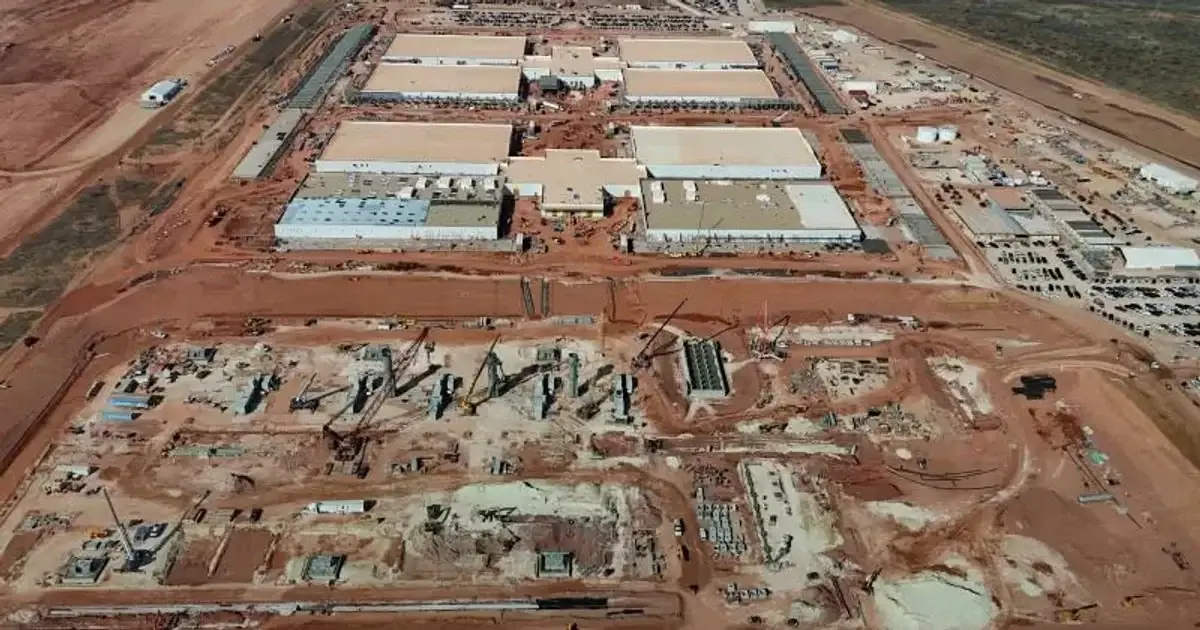
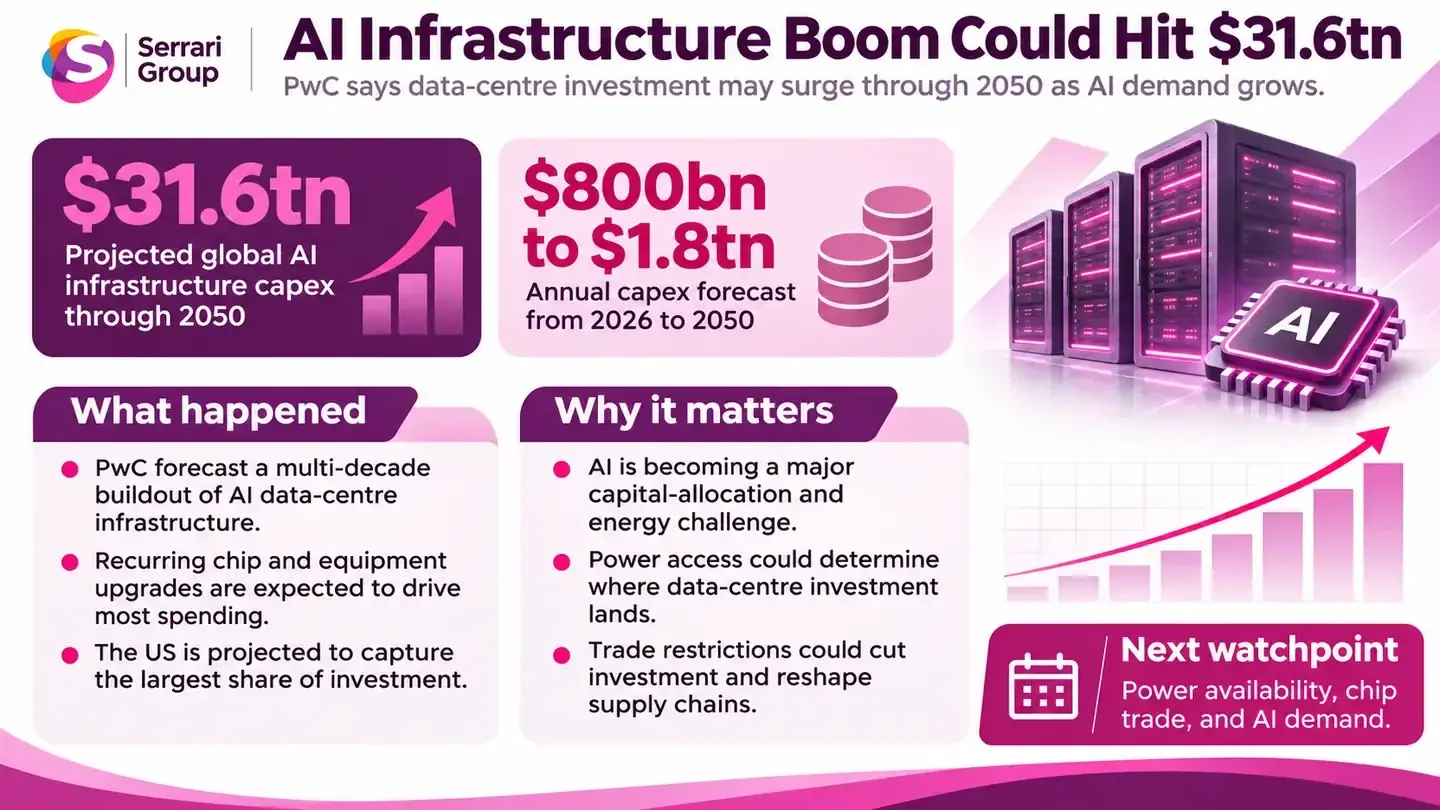
Global data centre capital expenditure could reach $31.6 trillion between 2026 and 2050 as artificial intelligence transforms demand for computing power, according to a September 2026 forecast by PwC. The spending cycle is expected to accelerate rather than fade after the first wave of construction because expensive AI chips, servers and networking equipment must be replaced repeatedly. Annual expenditure is projected to increase from roughly $800 billion in 2026 to $1.8 trillion by 2050, but electricity access, semiconductor trade restrictions and national data policies could determine which economies benefit. The forecast highlights a major investment opportunity alongside a difficult question: can revenue from AI services, and the power systems supporting them, grow quickly enough to justify decades of spending?
Key Overview
- $31.6 trillion is the central forecast for cumulative global data centre capital expenditure through 2050, not money already committed or spent.
- Annual capital expenditure is projected to increase from about $800 billion in 2026 to $1.1 trillion in 2030 and $1.8 trillion in 2050.
- ICT equipment is expected to account for 93% of annual expenditure by 2050, up from 70% in 2026, as chips and servers undergo repeated replacement.
- The United States could attract $15.1 trillion, or about 48% of global spending; Asia-Pacific is projected to receive $8.2 trillion.
- Severe chip-trade disruption could reduce cumulative investment to $25.5 trillion, while a stronger digital-sovereignty push could redirect spending and reduce the total to $29.5 trillion.
- Reliable electricity and sufficient grid connections could prove more decisive than access to investment capital alone.
Why AI Investment Could Keep Rising for Decades
The scale of the forecast reflects a change in what businesses purchase when they invest in computing infrastructure. Traditional data centre projects require substantial spending on land, buildings, cooling equipment and electrical connections. Once constructed, those physical assets can operate for many years. Advanced AI facilities add a different financial obligation: powerful processors and associated systems can become commercially outdated long before the building reaches the end of its useful life.
The Global Data Centre Outlook, developed using modelling commissioned from Oxford Economics across 46 countries and territories, assumes servers and other information and communications technology equipment are refreshed approximately every four to six years. Over a 20-year operating life, a facility may consequently require several major technology upgrades rather than one initial investment.
This helps explain why the report projects annual spending to more than double by 2050. It estimates that every dollar spent on constructing data centre facilities effectively commits the wider market to about $12 of subsequent technology expenditure. The expected increase in equipment’s share of investment, from 70% to 93%, makes the boom unusually sensitive to chip pricing, technological progress and utilisation rates.
The business case also differs between training AI models and running them. Training can be concentrated in large computing clusters where power and hardware are available. Inference, the process of using models to deliver services, may need to operate closer to customers for reasons involving speed, privacy and legal requirements. Growing AI adoption therefore creates demand for both large centralised facilities and smaller regional capacity.
Yet the $31.6 trillion estimate is not guaranteed. The forecast’s adoption scenarios range from approximately $22 trillion to almost $50 trillion. Faster deployment of AI across businesses could push investment towards the upper end, while weaker demand could leave expensive facilities underused. Spending on computing infrastructure is therefore a bet not only on better models, but also on customers being willing to pay for the services those models produce.
Electricity Is Becoming the Decisive Bottleneck
The biggest constraint may be outside the technology industry. A data centre cannot operate its processors without continuous electricity, and a site with financing and permits may still be delayed if utilities cannot supply enough power. Transformers, transmission lines and substations often take longer to install or expand than the computing systems they are intended to support.
The scale of the challenge is reflected in updated global electricity projections. Data centres consumed about 485 terawatt-hours of electricity in 2025, with demand projected to approach 950 terawatt-hours by 2030. That would represent roughly 3% of global electricity consumption, while AI-specific facilities are expected to expand particularly quickly.
Electricity availability also changes the competitive geography of the industry. Locations with reliable grids, competitively priced generation, sufficient land and strong connectivity can become attractive even if they are not established technology hubs. Conversely, countries with large AI markets may struggle to build capacity quickly if network upgrades and planning approvals fall behind demand.
There are consequences for households and other industries. A cluster of facilities can create jobs, demand for construction and opportunities for electricity suppliers, but it can also require costly grid investments. Whether those costs raise or reduce bills depends on tariffs, the utilisation of new generation assets and how fairly infrastructure expenses are allocated. Power availability is thus an economic and regulatory issue, not merely an engineering one.
Why the United States Is Positioned to Capture Almost Half
The projected geographic distribution remains highly unequal. The United States is expected to attract around $15.1 trillion of cumulative expenditure, representing 48% of the total. The broader Americas region is projected to receive $16.5 trillion, compared with $8.2 trillion in Asia-Pacific and $5.6 trillion in Europe.
The US advantage comes from an established combination of large cloud providers, AI model developers, semiconductor expertise, investment capital and enterprise customers. Each reinforces the others: developers need computing infrastructure, cloud operators buy chips at scale, and existing technical ecosystems attract further projects. This concentration can also make the US vulnerable to power bottlenecks, rising construction costs and changes in AI demand.
China and India account for much of Asia-Pacific’s prospective demand because of their population size and expanding digital economies. Europe’s growth prospects are more constrained by electricity and planning pressures, although requirements to store certain data within national or regional borders could support local facilities. The Middle East, projected to attract approximately $1.1 trillion, is using coordinated energy and infrastructure investment to compete for globally mobile computing workloads.
Africa’s projected cumulative expenditure is much smaller, at around $255 billion. The regional assessment nevertheless identifies South Africa as an established hub and Kenya, Nigeria and Ghana as promising emerging markets. Much of Africa’s opportunity lies in foundational digital infrastructure that can support cloud services and business connectivity regardless of how quickly advanced AI demand develops. That makes reliable power, connectivity and practical investment rules essential for capturing a larger share.
Context is everything. Stay ahead of shifting trends with today’s market updates, and uncover emerging opportunities using the Serrari Group Market Index and Marketplace. Then, take control of your own financial future by exploring our Money & Life Reset Transformation Blueprint ™ to build stronger habits, create better systems, and design a path toward lasting wealth.
Export Controls Could Wipe $6 Trillion From Investment
The forecast also illustrates how geopolitical decisions can affect what is physically possible to build. High-end AI processors depend on highly specialised semiconductor supply chains. Restrictions on exports or access to critical inputs can delay projects even where financing and demand are available.
Under a scenario involving severe restrictions on advanced-chip trade, modelled investment falls to $25.5 trillion through 2050, around $6.1 trillion below the central forecast. Annual expenditure could be roughly half the baseline by 2030 before supply chains adapt and activity recovers. The scenario is not a prediction that these restrictions will necessarily occur; it demonstrates how dependent the investment cycle is on the international movement of specialised hardware.
A different scenario examines countries seeking greater control over sensitive data and computing capacity. Governments may favour infrastructure within their borders for public services, healthcare, finance or national security purposes. In that case, the overall investment total declines more modestly to $29.5 trillion. The more important change is location: capacity shifts away from some established international hubs towards markets with domestic demand but less existing infrastructure.
The difference matters for investors. Trade disruption can destroy or defer potential activity, while sovereignty policies can create new regional winners without eliminating most underlying demand. Both forces could lead to duplication of facilities and higher costs, but the resulting investment opportunities would be distributed differently.
Who Pays for the Boom—and Who Bears the Risk?
The forecast is also a financial challenge. Data centre operators must fund buildings, energy systems and rapidly depreciating technology while securing enough customers to cover their capital costs. Long-term contracts with creditworthy users can make projects more bankable, but those contracts do not remove technology obsolescence, electricity-price or refinancing risks.
The latest energy-sector assessment indicates that capital expenditure by five major technology companies exceeded $400 billion in 2025 and was expected to rise substantially in 2026. As requirements grow, projects are increasingly likely to rely on external financing and capital markets alongside corporate balance sheets. That makes interest rates, debt structures and investor appetite important drivers of the build-out.
For shareholders, the key question is whether profits from AI applications and cloud services eventually justify the infrastructure being installed. More efficient chips could reduce the cost per AI task while also stimulating greater use. But if competition pushes service prices lower faster than demand increases, investors may find that high utilisation does not automatically deliver attractive returns.
For policymakers, attracting projects should therefore not mean offering open-ended incentives. Economic benefits need to be weighed against electricity-system costs, water demand, land use and the possibility of overbuilding. Stronger infrastructure can benefit the wider economy, but the public should not automatically bear the downside of speculative private investment.
The Bigger Picture: AI Is Becoming a Physical Infrastructure Race
The $31.6 trillion outlook marks a shift in how artificial intelligence should be assessed. It is no longer only a competition over algorithms, software subscriptions or the most capable models. It is increasingly a race to finance processors, strengthen electricity networks, secure supply chains and decide where sensitive information will be processed.
That is why the forecast matters now. Decisions about transmission upgrades, chip access and data regulation are being made years before their full economic effects become visible. Countries that solve these problems early may attract durable investment and build more competitive digital economies. Those that delay could find that growing local demand is served from infrastructure located elsewhere.
Still, the forecast should be read as a range of possible outcomes rather than a promise of spending. The central test through 2050 will be whether real demand for AI services can sustain repeated investment cycles without imposing excessive costs on electricity consumers or producing large amounts of unused capacity. The next phase of the AI boom will depend as much on the economics of energy and infrastructure as on breakthroughs in computing.
Sources: PwC / International Energy Agency
Your financial future isn’t something you wait for—it’s something you build.
The real question is: when do you begin?
Move beyond simply staying informed.
Navigate the markets with clarity—track trends through the Serrari Group Market Index, uncover opportunities in the Serrari Marketplace, and build practical knowledge with our Curated Wealth Builder Platform.
Stay connected to what truly matters.
Get daily insights on macro trends and financial movements across Kenya, Africa, and global markets—delivered through the Serrari Newsletter.
Growth opens doors.
Advance your career through professional programs including ACCA, HESI A2, ATI TEAS 7 , HESI EXIT , NCLEX – RN and NCLEX – PN, Financial Literacy!🌟—designed to move you forward with confidence.
See where money is flowing—clearly and in real time.
Track Money Market Funds, Treasury Bills, Treasury Bonds, Green Bonds, and Fixed Deposits, alongside global and African indexes, key economic indicators, and the evolving Crypto and stablecoin landscape—all within Serrari’s Market Index.