Nubank and Mercado Pago temporarily restricted cryptocurrency transfers in Brazil on November 6, 2026, following disruptions involving external technology providers. Nubank suspended deposits and withdrawals before restoring the services at 10 p.m. the same day. Mercado Pago also blocked some transfers to external wallets and reported delays in incoming deposits. Both companies assured customers that their assets remained protected. The incidents highlight how cryptocurrency platforms depend on third-party providers for risk monitoring, anti-money laundering checks and other essential services.
Key Takeaways
- Nubank temporarily suspended cryptocurrency deposits and withdrawals in Brazil on November 6.
- The company restored the affected services at 10 p.m. that evening.
- Mercado Pago restricted some transfers to external wallets following an incident involving a risk monitoring and anti-money laundering service provider.
- Both companies said customer assets and information remained protected.
- Neither company identified the external provider responsible, and there is no confirmation that both disruptions involved the same company.
- The incidents expose the operational risks created by fintech companies’ reliance on external cryptocurrency infrastructure.
Why Did Nubank and Mercado Pago Suspend Cryptocurrency Transfers?
Two of Latin America’s largest fintech platforms, Nubank and Mercado Pago, temporarily halted cryptocurrency deposits and withdrawals for customers in Brazil on Friday, November 6, 2026, following disruptions involving external technology providers.
Nubank, the brand under which Nu Holdings operates, suspended cryptocurrency deposits and withdrawals for customers in Brazil. Mercado Pago, the financial services arm of Mercado Libre, also blocked certain transfers to external wallets as a precaution.
The disruptions were linked to external providers supporting services such as transaction monitoring, risk assessment and compliance screening.
In a statement released on November 6, Nubank said “all customer assets and information remain protected.” The company also clarified that the issue was unrelated to its own infrastructure and did not compromise customer security.
Mercado Pago provided more detail about its disruption, linking the problem to instability at an entity supplying risk monitoring and anti-money laundering (AML) services.
Neither company identified the affected provider, and there is no confirmation that the incidents originated from the same company.
Has Nubank Restored Its Cryptocurrency Services?
Yes. Nubank subsequently restored deposits and withdrawals at 10 p.m. on November 6, according to its subsequent update.
The suspension had temporarily prevented customers from moving digital assets into and out of the platform. However, other cryptocurrency products continued operating normally during the disruption.
Nubank serves approximately 120 million customers in Brazil, although it did not disclose how many cryptocurrency users were affected.
The restoration allowed customers to resume using the affected transfer services. However, the company did not publicly identify the external provider responsible for the disruption.
For customers, the incident demonstrates that access to cryptocurrency holdings can be temporarily restricted even when a platform maintains that the assets themselves remain secure.
Why Is Mercado Pago Still Facing Cryptocurrency Transfer Delays?
Mercado Pago also restricted cryptocurrency transfers on November 6 after identifying instability at a provider responsible for risk monitoring and anti-money laundering services.
The company temporarily blocked some transfers to external wallets as a precaution. It also warned that incoming cryptocurrency deposits could be delayed.
Mercado Pago said “deposits will be credited automatically once service is restored.”
Unlike Nubank, which confirmed that its affected services had resumed, Mercado Pago had not publicly confirmed full restoration in the latest November 7 reports.
The distinction is important: the restrictions were not presented as evidence that customer funds had been stolen or lost. Instead, the company limited certain transactions while the external service disruption was being addressed.
The company did not provide a confirmed timeline for the full restoration of all affected services.
How Can a Third-Party Provider Disrupt an Entire Crypto Platform?
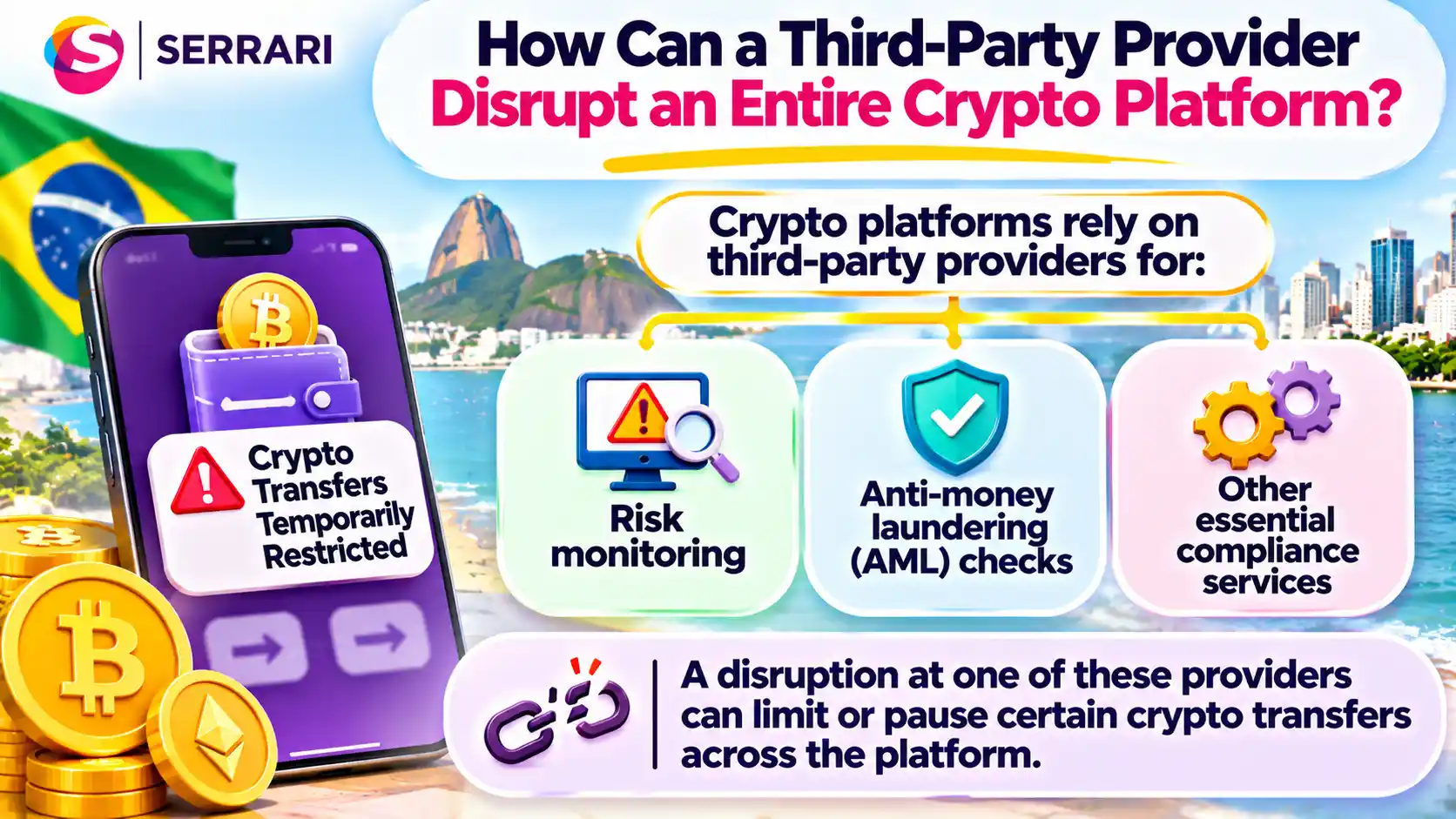
Cryptocurrency platforms depend on more than their own applications, servers and blockchain connections. They often rely on specialised external companies to perform essential functions, including:
- Risk monitoring: Identifying unusual transaction patterns and potentially suspicious activity.
- Anti-money laundering screening: Checking transactions and customers against compliance requirements.
- Transaction verification: Supporting the assessment and processing of transfers.
- Custody and infrastructure: Providing services that help platforms manage and safeguard digital assets.
When one of these providers experiences instability, a fintech company may be unable to verify or process transactions as required.
As a result, the platform may temporarily restrict deposits, withdrawals or transfers until the affected service is restored.
This explains how Nubank could suspend transfers while maintaining that its own infrastructure was unaffected. The disruption occurred further along its service chain.
The incidents also show that the availability of a cryptocurrency platform depends partly on the reliability of the external companies supporting its operations.
Context is everything. Stay ahead of shifting trends with today’s market updates, and uncover emerging opportunities using the Serrari Group Market Index and Marketplace. Then, take control of your own financial future by exploring our Money & Life Reset Transformation Blueprint ™ to build stronger habits, create better systems, and design a path toward lasting wealth.
Are the Disruptions Linked to Recent Crypto Security Breaches?
There is no confirmed evidence connecting the disruptions at Nubank and Mercado Pago to recent cryptocurrency security breaches.
The incidents occurred during a week of heightened security concerns across the crypto sector.
Binance experienced a major hacking incident, with reports citing approximately $6.3 billion in stolen cryptocurrency. The exchange subsequently suspended some withdrawal services before gradually restoring them.
Brazilian exchange Mercado Bitcoin also reported a separate security incident on November 2, 2026. The company identified approximately $48.5 million in suspicious transfers and indicated that it would absorb a loss of around $40 million.
However, the available information does not establish that the problems affecting Nubank and Mercado Pago were caused by either incident.
The distinction matters because a third-party service disruption and a direct security breach are different operational risks. One can interrupt access to services without necessarily involving the theft or compromise of customer assets.
Could External Provider Failures Become a Bigger Risk for Fintech Companies?
The incidents highlight a vulnerability that extends beyond cryptocurrency exchanges.
Digital financial platforms increasingly depend on external technology companies to deliver services efficiently and meet regulatory requirements. These partnerships provide specialised expertise, but they also create dependencies that may affect the availability of customer services.
MercadoLibre had already acknowledged this type of exposure in its 2025 annual filing, noting that disruptions affecting external cryptocurrency service providers could prevent customers from accessing trading, custody and transfer functions.
Nubank and Mercado Pago’s experiences illustrate how that risk can materialise.
Even when a fintech company maintains secure internal systems, a problem at an external provider can still interrupt customer transactions.
For financial institutions, this makes third-party risk management increasingly important. Providers must be assessed not only for their technical capabilities but also for their operational resilience, security controls and ability to maintain services during disruptions.
The Bigger Picture: Why Does This Matter Now?
The temporary restrictions at Nubank and Mercado Pago reveal an important challenge facing the expanding digital asset industry: the security and reliability of cryptocurrency services depend on an interconnected network of technology providers.
The restoration of Nubank’s transfers shows that some disruptions can be resolved relatively quickly. However, Mercado Pago’s reported delays demonstrate that recovery timelines may differ between platforms.
For customers, the incidents underline the difference between holding digital assets and having uninterrupted access to transfer them. Even when funds remain protected, operational disruptions can temporarily limit what users can do with their holdings.
For fintech companies, the events reinforce the need to strengthen third-party oversight, establish contingency arrangements and ensure that critical services can continue operating when external providers experience problems.
As cryptocurrency adoption expands across Latin America, the reliability of the infrastructure supporting digital asset transactions will become increasingly important to customer confidence and the wider financial ecosystem.
Frequently Asked Questions
1. Why did Nubank suspend cryptocurrency deposits and withdrawals?
Nubank temporarily suspended deposits and withdrawals on November 6, 2026, following a disruption involving an unnamed external service provider. The company said its own infrastructure was unaffected and customer assets remained protected.
2. Has Nubank restored cryptocurrency transfers?
Yes. Nubank confirmed that deposits and withdrawals were restored at 10 p.m. on November 6, 2026.
3. Why did Mercado Pago restrict transfers to external wallets?
Mercado Pago identified instability at a third-party provider responsible for risk monitoring and anti-money laundering services. It restricted certain transfers as a precaution and warned that incoming deposits could be delayed.
4. Were the Nubank and Mercado Pago disruptions caused by hacking?
There is no confirmed evidence linking the disruptions to the separate Mercado Bitcoin and Binance security breaches. The companies attributed their interruptions to problems involving external service providers.
Your financial future isn’t something you wait for—it’s something you build.
The real question is: when do you begin?
Move beyond simply staying informed.
Navigate the markets with clarity—track trends through the Serrari Group Market Index, uncover opportunities in the Serrari Marketplace, and build practical knowledge with our Curated Wealth Builder Platform.
Stay connected to what truly matters.
Get daily insights on macro trends and financial movements across Kenya, Africa, and global markets—delivered through the Serrari Newsletter.
Growth opens doors.
Advance your career through professional programs including ACCA, HESI A2, ATI TEAS 7 , HESI EXIT , NCLEX – RN and NCLEX – PN, Financial Literacy!🌟—designed to move you forward with confidence.
See where money is flowing—clearly and in real time.
Track Money Market Funds, Treasury Bills, Treasury Bonds, Green Bonds, and Fixed Deposits, alongside global and African indexes, key economic indicators, and the evolving Crypto and stablecoin landscape—all within Serrari’s Market Index.