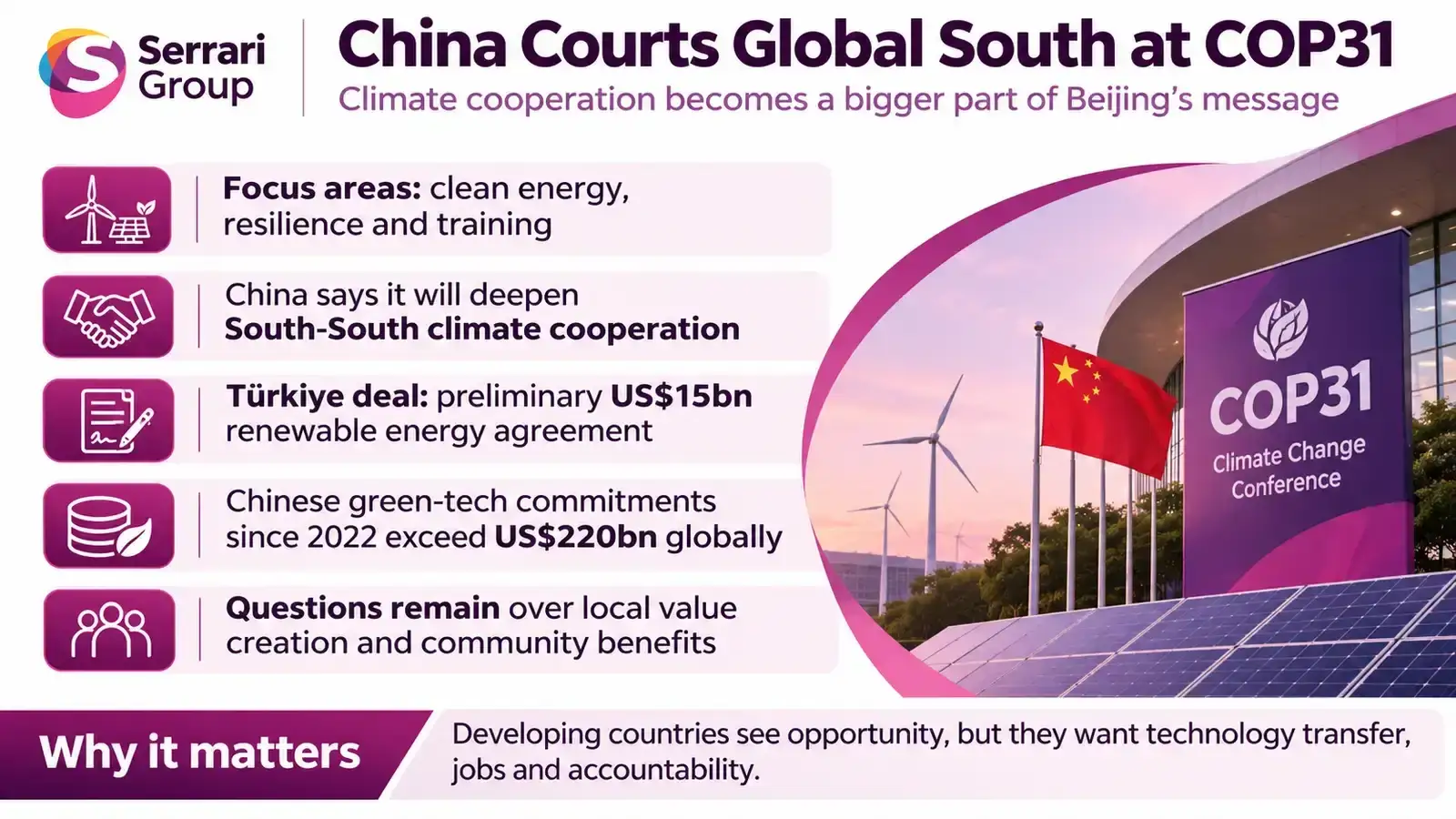
China has placed cooperation with developing countries at the centre of its climate diplomacy at COP31 in Antalya, Türkiye, promising greater collaboration in renewable energy, climate resilience and technical training. The strategy combines Beijing’s diplomatic ambitions with the international expansion of its clean technology industries. A preliminary US$15 billion renewable energy agreement with Türkiye illustrates the commercial opportunities accompanying this shift. For African and other developing economies, Chinese investment could accelerate access to affordable energy and industrial technology, but the ultimate economic benefits will depend on financing terms, technology transfer, environmental safeguards and the extent to which local communities participate in value creation.
Key Overview
- Chinese Vice President Han Zheng prioritised South-South climate cooperation at the COP31 leaders’ summit on November 11, 2026.
- China pledged deeper cooperation in clean energy, low-carbon industries, climate adaptation and technical training.
- China and Türkiye signed a preliminary US$15 billion renewable energy agreement covering approximately 7,000 MW of generating capacity.
- Research published in 2025 identified more than US$220 billion in overseas green manufacturing investment commitments across 54 countries since 2022.
- Beijing continues to distinguish voluntary climate assistance from the financing obligations of developed countries.
- African economies face the challenge of converting Chinese investment into domestic manufacturing, skilled employment and mineral value addition.
Why China Is Strengthening Its Global South Partnerships
China’s decision to emphasise South-South cooperation at COP31 reflects the changing relationship between international climate diplomacy, industrial competition and economic development.
In his national statement at the Antalya leaders’ summit, Vice President Han Zheng outlined Beijing’s priorities for international climate action, including wider access to green technologies and stronger cooperation on disaster preparedness.
South-South cooperation broadly describes collaboration among developing countries through investment, knowledge exchange, technical assistance and shared development programmes. For China, this provides a diplomatic framework that positions the country as a development partner while preserving its differentiated status within international climate negotiations.
The approach has become more significant as relationships between major economies grow increasingly complicated. Trade restrictions, industrial competition and disagreements over climate financing have made international cooperation more difficult.
A stronger focus on developing markets gives Chinese companies opportunities to establish commercial relationships outside traditional Western export destinations. It also allows Beijing to demonstrate that its industrial capabilities can contribute to global development priorities.
For partner countries, the attraction is practical. Governments facing electricity shortages, rising infrastructure requirements and climate-related disasters need access to technology and financing that can support immediate development needs.
Nevertheless, cooperation does not eliminate differences in bargaining power. China’s industrial scale and access to capital give its companies considerable negotiating advantages. Developing countries must therefore assess proposed investments according to their own economic priorities rather than assuming that shared diplomatic objectives guarantee equitable commercial outcomes.
Climate Finance Remains a Dividing Line
China’s climate diplomacy also reflects a longstanding disagreement over who should finance the global response to climate change.
The international climate finance framework distinguishes the obligations of developed countries under the Paris Agreement from voluntary support provided by other parties. Beijing has consistently defended this distinction despite its emergence as a major economic and technological power.
At COP29 in 2024, China disclosed that it had provided and mobilised more than 177 billion yuan, equivalent at the time to approximately US$24.5 billion, in climate-related project financing for developing countries since 2016.
That figure is significant, but it should not be interpreted as an equivalent amount of grants. Project financing can involve different instruments, repayment obligations and levels of concessionality.
For countries already experiencing debt-servicing pressures, the structure of climate finance can matter as much as its headline value. A renewable energy project financed through an affordable long-term loan may strengthen economic resilience, while expensive foreign currency borrowing can introduce substantial financial risks.
China’s voluntary approach enables it to expand its international contribution without accepting the same formal financing responsibilities as developed countries. Critics, however, argue that climate financing arrangements should also reflect changing economic capabilities.
For developing countries, the immediate priority is securing accessible resources without undermining fiscal sustainability. Chinese financing can complement existing multilateral and bilateral support, but its effectiveness depends on transparent terms and projects capable of delivering measurable development benefits.
Clean Technology Manufacturing Drives Commercial Expansion
China’s climate cooperation strategy is closely connected to the international expansion of its renewable energy and advanced manufacturing companies.
A 2025 study of overseas clean technology investment identified more than US$220 billion in investment commitments across 54 countries since 2022, spanning technologies including solar power, batteries, wind energy and electric vehicles.
Several commercial incentives underpin this expansion. Intense domestic competition encourages manufacturers to seek new customers overseas, while trade barriers increase the attractiveness of establishing production facilities closer to international markets. Access to raw materials is another consideration for companies developing battery and renewable energy supply chains.
These investments create opportunities for host countries to participate in industries that are likely to become increasingly important to global economic activity.
However, announced investments do not necessarily translate into completed factories. Projects can be delayed, reduced in scale or cancelled because of financing difficulties, regulatory changes or weaker-than-expected demand.
Governments should therefore distinguish between investment announcements, actual capital expenditure and operational production capacity when assessing the economic contribution of foreign manufacturers.
The most valuable investments are those that establish durable commercial relationships with local suppliers, develop transferable skills and create products capable of competing in international markets.
Context is everything. Stay ahead of shifting trends with today’s market updates, and uncover emerging opportunities using the Serrari Group Market Index and Marketplace. Then, take control of your own financial future by exploring our Money & Life Reset Transformation Blueprint ™ to build stronger habits, create better systems, and design a path toward lasting wealth.
Türkiye’s US$15 Billion Agreement Illustrates the Opportunity
One of the most substantial commercial announcements associated with COP31 was the preliminary renewable energy agreement between China and Türkiye, valued at approximately US$15 billion and targeting 7,000 MW of solar and wind generating capacity.
The agreement demonstrates how climate diplomacy can provide a platform for large-scale infrastructure partnerships. For Türkiye, additional renewable generation could reduce reliance on imported fossil fuels and support industrial electricity demand. For Chinese companies, it opens opportunities to supply equipment, engineering services and investment capital.
The financial benefits will depend on implementation. Electricity purchase agreements, grid connection costs, financing structures and construction schedules will influence the commercial viability of individual projects.
Technology transfer arrangements could also allow domestic companies to participate more extensively in the renewable energy supply chain. However, the extent of those benefits will depend on the final contractual arrangements.
A memorandum of understanding is an important starting point, not evidence that the entire investment has been secured or spent. The distinction matters particularly for governments seeking to demonstrate progress towards climate targets and energy security.
Climate Adaptation Offers Benefits Beyond Energy Generation
China’s cooperation programme extends beyond renewable energy infrastructure. At COP31, an upgraded MAZU meteorological warning system was introduced, building on plans to make the technology available to 30 developing countries, according to reporting on the climate cooperation forum.
Early-warning systems can help governments anticipate extreme weather and coordinate responses before disasters cause extensive damage. For agricultural economies, better weather information can also support planting decisions, livestock management and water allocation.
The economic rationale is particularly strong where climate shocks repeatedly destroy infrastructure, disrupt supply chains and reduce agricultural production. Preventing avoidable losses can reduce emergency expenditure and protect household incomes.
However, installing a forecasting system is only one component of effective disaster preparedness. Information must reach communities in accessible formats, local authorities must have resources to respond, and equipment must be maintained over time.
Technical training and institutional capacity are consequently essential to ensuring that climate technology generates lasting benefits rather than becoming an isolated infrastructure investment.
Africa Must Negotiate for Value Addition and Industrial Growth
For African economies, the expansion of Chinese clean technology investment creates an opportunity to move beyond exporting unprocessed commodities.
The China-Africa cooperation action plan for 2025–2027 identifies mineral processing, industrial development and technical skills as areas for deeper partnership.
Countries producing copper, lithium, cobalt and other strategically important minerals could potentially capture more economic value by developing processing facilities and manufacturing capabilities rather than exporting raw materials alone.
A mineral processing facility can generate additional employment, demand for local services and export revenues. However, such investments require reliable electricity, transport infrastructure, specialist skills and access to commercially viable markets.
China’s October 2026 mining cooperation proposals reinforce the stated commitment to industrial value addition and green technology transfer. The challenge for African governments is converting those policy commitments into enforceable commercial arrangements.
For Kenya, opportunities could include renewable energy equipment assembly, electric mobility supply chains and technical services. These are potential industrial opportunities rather than investments confirmed at COP31.
Regional integration could also improve the commercial prospects of manufacturing projects by allowing companies to serve larger markets than individual national economies provide.
Local Communities Will Determine the Credibility of Cooperation
The most significant risk is that agreements presented as mutually beneficial at the national level may deliver uneven outcomes for communities affected by individual projects.
Large mining operations, industrial parks and renewable energy developments can create employment and infrastructure while also generating land-use conflicts, environmental pressures or concerns about working conditions.
These risks are not unique to Chinese investment. They arise whenever large infrastructure projects proceed without effective public consultation, credible environmental assessments and mechanisms for addressing grievances.
Host governments must establish clear requirements for environmental protection, local employment, supplier participation and transparent financial reporting. Foreign investors must also demonstrate that their projects comply with applicable standards and deliver the benefits promised during negotiations.
The economic test of China’s COP31 strategy will therefore extend beyond the amount of capital announced or the number of bilateral agreements signed.
Developing economies stand to benefit from access to affordable clean technologies, industrial expertise and climate resilience infrastructure. But lasting prosperity will require partnerships that strengthen domestic productive capacity rather than merely expand markets for imported equipment.
China’s renewed climate diplomacy offers an opportunity to reshape global green investment flows. Whether that opportunity produces shared prosperity will depend on the quality of implementation, the distribution of economic returns and the accountability of all parties involved.
Sources Used
Chinese Ministry of Foreign Affairs / Dialogue Earth / Springer Nature / Net Zero Industrial Policy Lab / Reuters
Your financial future isn’t something you wait for—it’s something you build.
The real question is: when do you begin?
Move beyond simply staying informed.
Navigate the markets with clarity—track trends through the Serrari Group Market Index, uncover opportunities in the Serrari Marketplace, and build practical knowledge with our Curated Wealth Builder Platform.
Stay connected to what truly matters.
Get daily insights on macro trends and financial movements across Kenya, Africa, and global markets—delivered through the Serrari Newsletter.
Growth opens doors.
Advance your career through professional programs including ACCA, HESI A2, ATI TEAS 7 , HESI EXIT , NCLEX – RN and NCLEX – PN, Financial Literacy!🌟—designed to move you forward with confidence.
See where money is flowing—clearly and in real time.
Track Money Market Funds, Treasury Bills, Treasury Bonds, Green Bonds, and Fixed Deposits, alongside global and African indexes, key economic indicators, and the evolving Crypto and stablecoin landscape—all within Serrari’s Market Index.