




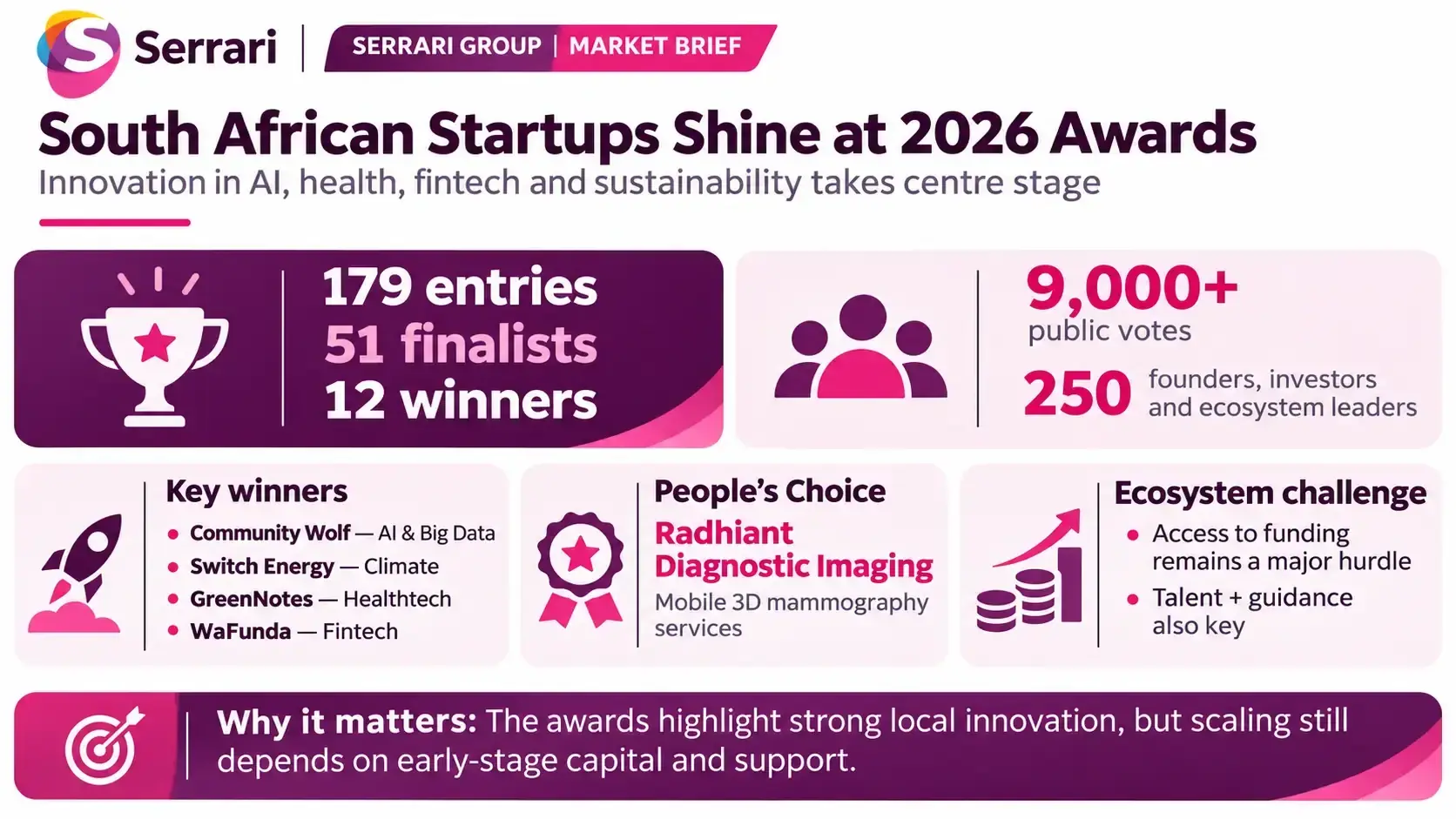
South Africa’s fourth annual Startup Awards celebrated 12 young technology businesses in Cape Town on November 18, 2026, recognising products that address everyday problems in public safety, electricity, healthcare, education, payments and informal employment. The event brought together about 250 founders, investors and ecosystem leaders after 179 entries, 51 finalists and roughly 9,000 public votes. Yet the awards also exposed a harder economic question: why do promising startups struggle to secure the capital, experienced teams and customers needed to grow? Their success suggests that South Africa’s innovation pipeline is becoming more diverse, but recognition alone cannot bridge the gap between a working product and a commercially sustainable company.
Key Overview
- 12 winners: The November 18 ceremony recognised businesses across categories including AI, energy, fintech, health and education.
- Strong participation: Organisers recorded 179 entries, 51 finalists, about 9,000 public votes and a 24-member judging panel.
- Real-world applications: Community Wolf develops safety intelligence, Switch Energy targets energy management and Radhiant Diagnostic Imaging brings mobile breast screening closer to patients.
- Women in leadership: Six winning teams included women co-founders, while three had women chief executives, according to organisers.
- Funding contradiction: Southern African venture investors deployed R2.48 billion across 212 transactions in 2025, but capital was increasingly concentrated in fewer companies.
- Central challenge: Awards can build visibility; business survival still depends on repeat customers, credible economics, skilled employees and finance matched to each stage of growth.
Why the Awards Matter Beyond a Night of Recognition
The fourth South African Startup Awards took place at the Homecoming Centre in Cape Town’s District Six on November 18. The published winners announcement confirms the event’s 12 categories and the competition figures: 179 entries, 51 finalists, approximately 9,000 public votes during a five-day period and 24 judges. Public engagement reportedly more than doubled from the previous year, suggesting greater interest in the entrepreneurs building products outside the country’s largest established businesses.
The numbers are significant not because an award automatically predicts profitability, but because they reveal a pool of early-stage businesses serving markets often neglected by conventional technology narratives. The competition focused on startups with products already in the market rather than ideas alone. That distinction makes their next challenge commercial: moving beyond a convincing demonstration to reliable sales, customer retention and operational delivery.
Several winners are tackling problems whose economic costs are already visible to households and businesses. Community Wolf’s AI and Big Data award recognised technology that converts local safety reports into useful intelligence. Its value proposition is not the use of artificial intelligence by itself. It is the possibility of turning fragmented observations into faster, better-informed responses, although effectiveness must ultimately be judged by measurable outcomes and appropriate data safeguards.
Likewise, People’s Choice winner Radhiant Diagnostic Imaging uses mobile 3D mammography services to reach women near their homes and workplaces, with specialists reviewing scans. Greater geographic convenience could reduce the travel and time costs of accessing screening. Still, clinical quality, affordability, follow-up arrangements and integration with health providers will determine whether this business improves access at scale.
Why Energy and Healthcare Startups Are Gaining Attention
The energy winners reflect South Africa’s continuing need for more flexible electricity systems. Switch Energy won Climate and Sustainability for smart metering, meter-data management and an energy-trading platform. Tavas took the Deeptech award for software intended to manage decentralised energy systems with less manual intervention. The category results and company descriptions show that both products address the management layer of an electricity sector becoming more complex as users adopt distributed generation and alternative supply arrangements.
For a business customer, technology that measures consumption accurately, identifies inefficiencies and coordinates energy sources can make electricity decisions more informed. For grid participants, dependable data and operational control can help manage increasingly distributed generation. Yet neither award establishes that a platform has solved national electricity challenges. Utilities, regulators, system operators and paying customers still determine the pace at which such tools can be deployed.
Healthcare innovation follows a similar logic: founders are targeting the administrative and physical barriers that make care harder to deliver. GreenNotes won Healthtech with a platform supporting South African clinicians from patient intake through billing and claims. Automating repetitive tasks could free clinical time and reduce administrative friction, but the actual value depends on data protection, workflow reliability and adoption by healthcare practitioners.
Together, the winners show why locally focused innovation matters. The addressable problem is not always a new consumer habit waiting to be invented; often it is an expensive, slow or fragmented process already affecting millions of people. Successful startups improve that process sufficiently for individuals, employers or institutions to pay for a solution repeatedly.
Context is everything. Stay ahead of shifting trends with today’s market updates, and uncover emerging opportunities using the Serrari Group Market Index and Marketplace. Then, take control of your own financial future by exploring our Money & Life Reset Transformation Blueprint ™ to build stronger habits, create better systems, and design a path toward lasting wealth.
What Fintech and Education Winners Reveal About Demand
Fintech award winner WaFunda addresses an unusually direct barrier to economic participation: graduates whose qualifications are withheld because of outstanding fees. Its model uses income-share agreements linked to later earnings to help settle education-related debt. The prospect is compelling because access to documentation can affect graduates’ ability to demonstrate qualifications when seeking work.
However, financing students through future income is not risk-free. Affordability, contract transparency, repayment terms and the treatment of graduates with low or unstable earnings matter as much as the initial ability to release a certificate. A business that solves a short-term cash problem must avoid creating an unsustainable long-term repayment obligation.
Other winners demonstrate the value of using technology that customers already know. Zumii’s WhatsApp-based school-supplies concierge allows parents to submit lists for quotes, packing, labelling and delivery. Edufern supplies curriculum-aligned learning resources, including multilingual dictionaries and a teacher portal. AskMandla helps households manage domestic employment paperwork, unemployment insurance, payslips and payments through WhatsApp.
These are different businesses, but they share a market insight: adoption barriers can be reduced when a service fits existing habits. Customers may be more willing to use a familiar messaging channel than install another standalone application. The commercial test remains whether convenience produces repeat use at a price that covers delivery, support and customer acquisition.
VezoPay’s battery-free payment wearables, LEVRA’s AI-based workplace skills simulations and CitiPods’ rest facilities for delivery riders complete a winner group spanning consumer payments, employment assessment and worker infrastructure. Their diversity challenges the assumption that technology entrepreneurship must concentrate exclusively on lending apps or conventional e-commerce.
Why Startup Funding Still Fails to Reach Enough Founders
The central contradiction is that South Africa can have a healthy pipeline of products and an established venture-capital industry while many founders remain unable to secure early financing. Startup Club ZA founder Mathew Marsden identified capital, skilled talent and guidance as persistent barriers. Incubators, grants and technology credits can support experimentation, but they cannot always fund the commercial teams, regulatory work, customer acquisition and working capital required for expansion.
The 2026 venture-capital survey findings make the tension clearer. Southern African investors deployed R2.48 billion across 212 deals involving 91 companies during 2025, compared with 222 deals involving 110 companies the year before. The active portfolio reached 1,529 investments, with approximately R15.45 billion under management. This is not a market without venture capital; it is a market where investors are increasingly directing capital to fewer businesses and follow-on rounds.
That behaviour is understandable. Fund managers must protect investors’ money, and existing companies with demonstrated demand may offer more evidence on which to assess risk. New founders, by contrast, often lack trading histories, collateral, established teams or enough sales to support a conventional valuation. Their need for relatively small initial cheques may not match the economics or mandates of larger investment funds.
The continental picture is similar. A 2025 African venture funding review found that South Africa led Africa in equity funding and equity deal activity, even as early-stage investment remained constrained across the continent. Funding success at national level therefore does not mean capital is evenly available to a pre-Series A startup, especially one serving lower-income consumers or an unfamiliar industry.
For policymakers and investors, the implication is that more total capital is not the only requirement. Early-stage funds, angel syndicates, procurement opportunities, technical assistance and realistic routes to follow-on investment all matter. A founder needs a sequence of support, not simply a cheque awarded at a public ceremony.
Why Women Founders and Broader Participation Matter
Organisers reported that women were represented among the co-founders of half the 12 winning teams and that three winners had female chief executives. These figures are encouraging indicators of representation among the award winners, although a single competition cannot establish how gender participation has changed across the whole South African startup sector.
The business significance extends beyond recognition. Founders from different backgrounds may identify underserved customers and operational obstacles that established companies overlook. Businesses addressing domestic employment, maternal and women’s health, school administration and informal work illustrate the commercial potential of problems often treated primarily as social issues.
The practical question is whether wider visibility leads to wider access to contracts, mentors, investment committees and distribution partnerships. If funding decisions continue to rely on narrow networks, an inclusive awards shortlist may have little effect on who can build a durable business. Transparency around future funding and commercial outcomes would help distinguish meaningful progress from a single year’s headline figures.
What Must Happen After the Awards
The next phase is harder than winning a category. Startups must prove that customers will consistently pay, unit costs fall or remain manageable as demand grows, and operations can expand without sacrificing service quality. Energy businesses need customers and system integration; healthcare businesses need trusted clinical processes; fintech providers need responsible contracts and repayment performance. Each operates in a different market with its own constraints.
For investors, the awards offer a discovery mechanism rather than a substitute for due diligence. For government and established companies, they identify possible suppliers capable of addressing persistent service gaps. For founders, the event can create introductions and credibility, but it does not remove the need to demonstrate traction, governance and financial discipline.
That is why the November 18 awards matter now. They demonstrate that South Africa’s technology ecosystem is producing an expanding range of practical solutions while financing patterns risk favouring businesses already further along the growth curve. The country’s next test is not whether it can recognise promising startups, but whether enough of them can turn useful inventions into lasting companies, jobs and measurable improvements in everyday life.
Sources: Lifestyle & Tech / ITWeb / Independent Online / Disrupt Africa / Southern African Venture Capital and Private Equity Association / Partech
Your financial future isn’t something you wait for—it’s something you build.
The real question is: when do you begin?
Move beyond simply staying informed.
Navigate the markets with clarity—track trends through the Serrari Group Market Index, uncover opportunities in the Serrari Marketplace, and build practical knowledge with our Curated Wealth Builder Platform.
Stay connected to what truly matters.
Get daily insights on macro trends and financial movements across Kenya, Africa, and global markets—delivered through the Serrari Newsletter.
Growth opens doors.
Advance your career through professional programs including ACCA, HESI A2, ATI TEAS 7 , HESI EXIT , NCLEX – RN and NCLEX – PN, Financial Literacy!🌟—designed to move you forward with confidence.
See where money is flowing—clearly and in real time.
Track Money Market Funds, Treasury Bills, Treasury Bonds, Green Bonds, and Fixed Deposits, alongside global and African indexes, key economic indicators, and the evolving Crypto and stablecoin landscape—all within Serrari’s Market Index.