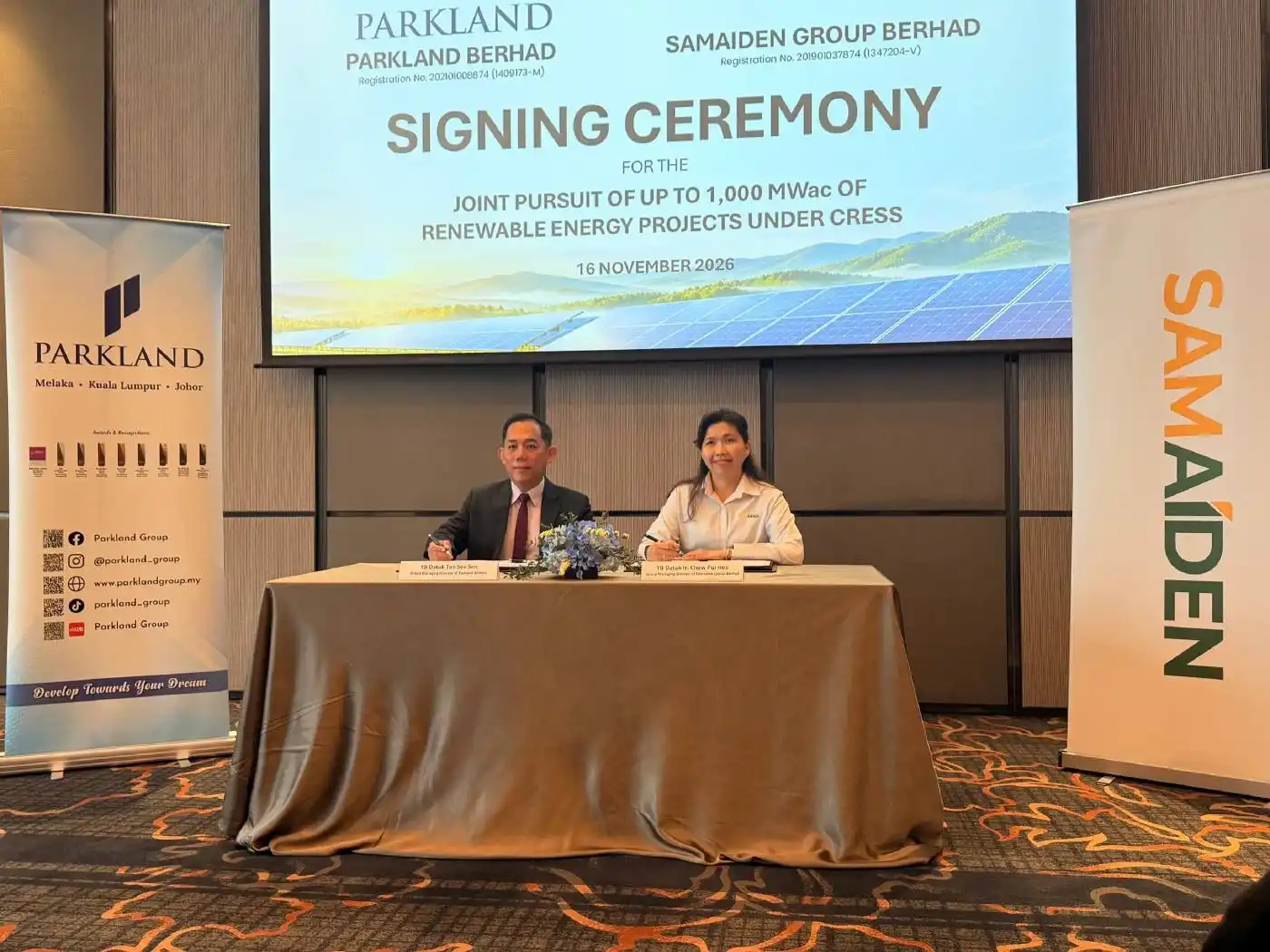
Malaysia’s renewable energy sector could see a major expansion following a memorandum of understanding (MoU) between Samaiden Group Bhd and Parkland Bhd to explore projects with a combined installed capacity of up to 1,000 megawatts alternating current (MWac) across Peninsular Malaysia. The proposed developments will operate under the Corporate Renewable Energy Supply Scheme (CRESS), which allows corporate consumers to access renewable electricity through third-party access to the national electricity grid.
The collaboration brings together Parkland’s land development capabilities and Samaiden’s engineering, procurement, construction and commissioning (EPCC) expertise. The proposed investment is estimated at RM3.5 billion to RM4 billion, with projects expected to begin in mid-2027 and initial earnings contributions anticipated in 2029. However, the developments remain subject to feasibility assessments, regulatory approvals, land availability, corporate offtaker agreements and definitive project agreements.
Key Takeaways
- Samaiden and Parkland have signed an MoU to explore renewable energy projects with an aggregate installed capacity of up to 1,000 MWac in Peninsular Malaysia.
- The proposed projects could involve investments of between RM3.5 billion and RM4 billion.
- The developments will fall under Malaysia’s Corporate Renewable Energy Supply Scheme (CRESS).
- Parkland Renewable Energy will identify and secure suitable land, while Samaiden will provide technical and engineering expertise and serve as the exclusive EPCC contractor, subject to definitive agreements.
- The companies are looking to secure at least 1,214 hectares of land to support the targeted capacity.
- Project development is expected to begin in mid-2027, with construction taking approximately two years and initial earnings contributions anticipated in 2029.
- The collaboration could support Parkland’s ambition to increase renewable energy’s contribution to group profits and Samaiden’s growth in the EPCC business.
Samaiden and Parkland Sign MoU for Up to 1,000 MWac of Renewable Energy Projects
Malaysia’s renewable energy industry is attracting further investment interest as companies explore opportunities to supply businesses with cleaner electricity.
Samaiden Group Bhd’s wholly-owned subsidiary Samaiden Sdn Bhd (SSB) has inked a memorandum of understanding with Parkland Renewable Energy Sdn Bhd to explore renewable energy projects in Peninsular Malaysia with an aggregate installed capacity of up to 1,000 megawatts alternating current (MWac).
The agreement establishes a framework for the two companies to jointly explore renewable energy developments across multiple locations in Peninsular Malaysia. The projects will be undertaken under the Corporate Renewable Energy Supply Scheme (CRESS), which enables corporate consumers to access green electricity through third-party access to the national electricity grid.
These Projects may be developed individually or across multiple locations and phases, subject to feasibility assessments, regulatory approvals and securing suitable corporate offtakers.
The proposed capacity represents a significant development opportunity for both companies. However, the MoU does not mean that all 1,000 MWac of projects have already been approved, financed or committed to construction. Their implementation will depend on the outcome of technical and commercial assessments, the availability of suitable land and the securing of corporate customers.
Proposed Investment Could Reach RM4 Billion
The collaboration could involve substantial investment in renewable energy infrastructure, with the proposed projects estimated to require between RM3.5 billion and RM4 billion.
The total investment for the proposed projects is estimated at between RM3.5 billion and RM4 billion, of which approximately RM3 billion to RM3.5 billion could comprise EPCC contracts.
The estimated EPCC value is particularly relevant to Samaiden because the company is expected to undertake the engineering, procurement, construction and commissioning work for the developments. If it secures the full proposed EPCC scope, the projects could provide a significant source of potential revenue.
However, the actual construction contracts will depend on the size and requirements of each individual project.
Samaiden Group managing director Datuk Chow Pui Hee noted that the scale of construction may require the company to work with other parties to support successful project execution.
“If Samaiden secures the EPCC scope for all the projects, this would represent significant potential revenue for the group.”
She added that the final scope of work would be determined on a project-by-project basis, depending on the construction requirements and the need for additional partners.
The ownership structure, investment arrangements and financing requirements will also be determined separately for each development.
She said the ownership structure and investment arrangements would be determined on a project-by-project basis, depending on each party’s contribution, including land availability and development requirements.
This means the proposed RM4 billion investment should be viewed as an estimated value for the wider project pipeline rather than confirmed expenditure already committed by the two companies.
How the Samaiden-Parkland Partnership Will Work
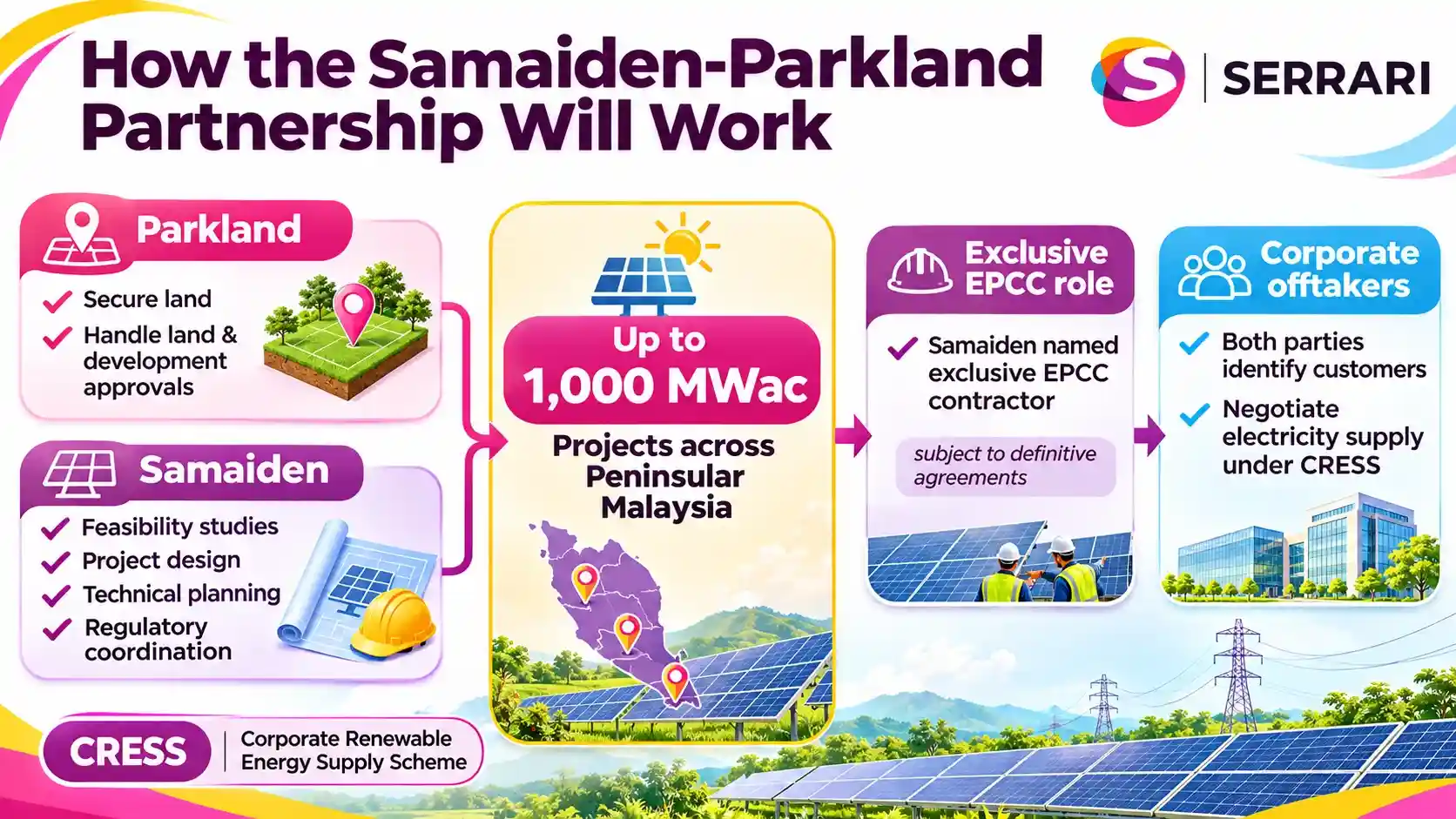
The agreement brings together two companies with different but complementary capabilities.
Samaiden is a renewable energy specialist involved in developing and delivering renewable energy systems and power plants. Its core capabilities include engineering, procurement, construction and commissioning (EPCC).
Parkland, meanwhile, has experience in property development, land development and identifying suitable project sites.
Under the MoU, Parkland Renewable Energy will primarily be responsible for identifying and securing suitable land for the proposed projects. This will include coordinating land-related arrangements and submitting the necessary applications for land-related and development approvals.
Samaiden will contribute its technical and engineering expertise through feasibility assessments, project design, technical planning and coordination of regulatory submissions.
Under the MOU, SSB will contribute its technical and engineering expertise, including undertaking feasibility assessments, project design and technical planning, as well as providing the technical input and coordination required for the CRESS application and other regulatory submissions.
Importantly, Samaiden Sdn Bhd has been designated as the exclusive EPCC contractor for the projects, subject to the relevant definitive agreements.
The two companies will also work together to identify potential corporate offtakers and negotiate electricity supply arrangements under CRESS.
Corporate offtakers are businesses that agree to purchase electricity generated by renewable energy projects. Securing these customers will be an important step in determining whether the proposed developments can proceed.
The projects’ final capacity, ownership structures, financing arrangements, revenue-sharing terms and other commercial details will be negotiated and agreed upon separately.
CRESS: How the Scheme Supports Corporate Renewable Energy Demand
The proposed developments will operate under Malaysia’s Corporate Renewable Energy Supply Scheme (CRESS), a framework designed to allow businesses to access renewable electricity through third-party access to the national electricity grid.
Under this arrangement, renewable energy developers can supply electricity to corporate consumers using the national grid rather than requiring the electricity to be generated and consumed at the same physical location.
This creates opportunities for businesses seeking to increase their use of renewable electricity and make progress towards their sustainability and decarbonisation commitments.
For Samaiden and Parkland, CRESS provides the framework through which the proposed projects could supply renewable electricity to corporate customers across Peninsular Malaysia.
The scheme is particularly relevant as Malaysia continues to attract investment in data centres and other energy-intensive industries, which are expected to increase demand for electricity.
Samaiden’s group managing director highlighted the opportunities created by growing corporate interest in green electricity.
“As more businesses work towards their decarbonisation targets, we see increasing opportunities under CRESS. This MOU provides opportunities to explore potential renewable energy projects under the scheme,” Datuk Ir. Chow Pui Hee said.
The ability to identify corporate offtakers will therefore be important to the commercial viability of the proposed projects. Without suitable customers and agreed electricity supply arrangements, the developments cannot move from exploration into implementation.
Context is everything. Stay ahead of shifting trends with today’s market updates, and uncover emerging opportunities using the Serrari Group Market Index and Marketplace. Then, take control of your own financial future by exploring our Money & Life Reset Transformation Blueprint ™ to build stronger habits, create better systems, and design a path toward lasting wealth.
Parkland Seeks to Expand Renewable Energy as a Source of Income
For Parkland, the collaboration forms part of a wider strategy to expand its renewable energy business and diversify its earnings beyond property development.
The group’s core operations remain focused on integrated township and property developments, which currently account for more than 90% of its bottom line.
However, the company is looking to increase the contribution of renewable energy to its overall business performance.
Parkland group managing director Datuk Tan See Sen said the group aims to expand its renewable energy business into a significant earnings contributor, targeting a 25 to 30 per cent share of group profit by 2030.
The company sees renewable energy as an additional source of recurring income that could complement its existing property development activities.
“While integrated township and property developments remain our core business, part of our business strategies and plans includes developing renewable energy as an additional source of recurring income and diversifying the group’s earnings,” Tan said.
Parkland’s renewable energy ambitions build on its existing involvement in solar power generation through a joint venture with a subsidiary of Hong Kong-listed Xinyi Energy Holdings Limited.
The company has previously participated in the 99.99 MW Large Scale Solar 5 (LSS5) project in Tangkak, Johor.
“Our investment in renewable energy began with the 99.99 MW Large Scale Solar 5 (LSS5) solar project in Tangkak, Johor, undertaken through a joint venture with a subsidiary of Hong Kong-listed Xinyi Energy Holdings Limited. We see this collaboration with Samaiden as the next step in expanding our renewable energy business,” Tan said.
The Tangkak project is approximately 75% complete and is expected to begin commercial operations in the first quarter of 2027.
Parkland Renewable Energy is a joint venture owned 60% by Parkland Bhd and 40% by a subsidiary of Xinyi Energy Holdings Limited.
Samaiden Could Benefit From New EPCC Opportunities
The proposed collaboration also presents an opportunity for Samaiden to strengthen its position in Malaysia’s renewable energy development and construction market.
As the designated exclusive EPCC contractor, the company could secure engineering and construction work associated with the proposed projects, subject to the signing of definitive agreements.
The estimated RM3 billion to RM3.5 billion EPCC component could represent a significant opportunity for the group’s order book if the projects proceed and Samaiden secures the anticipated work.
Chow said Samaiden is targeting an order book of RM1 billion for the financial year ending June 2027, supported by existing projects and potential opportunities under CRESS.
She also indicated that the latest collaboration could support the company’s performance over the financial years 2028 to 2030.
The partnership builds on the existing relationship between the two companies through the Tangkak solar project. Extending their collaboration to projects with a potential combined capacity of up to 1,000 MWac could provide Samaiden with a wider pipeline of renewable energy engineering and construction opportunities.
However, the actual financial contribution will depend on the projects that are eventually approved, the EPCC contracts awarded and the construction work undertaken.
Project Timeline and Land Requirements
The companies are looking to secure at least 1,214 hectares of land to support the targeted renewable energy capacity.
Unlike a development concentrated at a single location, the proposed projects are expected to be spread across multiple sites in Peninsular Malaysia.
Samaiden’s group managing director indicated that the developments would be undertaken across different locations, with the final arrangements depending on land availability and individual project requirements.
The projects are expected to commence in mid-2027, with construction taking about two years and initial earnings contributions anticipated in 2029.
This timeline means the proposed developments are not expected to contribute immediately to the companies’ earnings. Instead, the financial benefits are anticipated to emerge as projects progress through development, construction and eventual operations.
The companies will first need to identify suitable sites, complete feasibility assessments, obtain regulatory approvals and secure corporate offtakers before proceeding with definitive project agreements.
What the MoU Means for the Proposed Projects
Although the agreement outlines the responsibilities of both companies, it does not represent a final commitment to invest in or construct all the proposed projects.
The MoU will remain in effect for 12 months from its execution date, unless extended through mutual written agreement. Either party may also terminate it by giving 30 days’ prior written notice.
The MOU establishes a framework for cooperation and does not oblige either party to provide financing, make any capital investment, acquire or lease any land, or enter into any definitive agreements.
This distinction is important when assessing the scale and certainty of the proposed investment. The 1,000 MWac capacity and RM3.5 billion to RM4 billion estimated investment represent opportunities being explored by the companies, rather than fully secured projects.
The developments remain subject to satisfactory due diligence, technical and commercial feasibility, suitable land availability, regulatory approvals, the securing of corporate offtakers and the execution of definitive agreements.
The Bigger Picture
The Samaiden-Parkland agreement reflects the growing role of corporate renewable energy procurement in Malaysia’s energy transition.
As businesses look for ways to meet decarbonisation commitments, schemes such as CRESS create opportunities for renewable energy developers to connect electricity generation with corporate demand through the national grid.
The proposed collaboration also demonstrates how companies from different sectors can combine their capabilities to develop renewable energy infrastructure. Parkland brings land development experience and access to potential project sites, while Samaiden contributes the technical expertise required to design and construct renewable energy systems.
For Parkland, the opportunity is to diversify its earnings and build renewable energy into a more significant part of its business. For Samaiden, the potential EPCC contracts could strengthen its order book and expand its role in delivering renewable energy projects.
However, the success of the proposed developments will depend on whether the companies can translate the MoU into viable projects, secure the necessary approvals and attract corporate electricity buyers.
Why Does This Matter Now?
Malaysia’s demand for electricity is expected to grow as data centres and other energy-intensive industries expand. At the same time, businesses are facing increasing pressure to address their energy consumption and decarbonisation commitments.
The proposed 1,000 MWac collaboration could help create additional renewable electricity supply opportunities for corporate consumers while opening a new pipeline of development and construction work for the participating companies.
The potential investment of up to RM4 billion also highlights the scale of capital that may be required to develop renewable energy infrastructure across multiple locations.
For investors, the key consideration will be the conversion of the proposed project pipeline into confirmed contracts, approved developments and future revenue.
Outlook
The Samaiden and Parkland collaboration sets out an ambitious plan to explore renewable energy projects with a combined installed capacity of up to 1,000 MWac across Peninsular Malaysia.
With proposed investments estimated at RM3.5 billion to RM4 billion, the developments could create opportunities for both companies to expand their renewable energy operations. Parkland is seeking to make renewable energy a more significant contributor to its earnings by 2030, while Samaiden is targeting an RM1 billion order book for the financial year ending June 2027.
The next milestones to watch include the identification of suitable land, progress in securing corporate offtakers, regulatory approvals and the signing of definitive project agreements.
If the projects proceed as planned, construction could begin in mid-2027, with initial earnings contributions expected in 2029. Until the necessary conditions are met, however, the proposed capacity and investment remain exploratory rather than confirmed commitments.
Frequently Asked Questions
1. What renewable energy projects are Samaiden and Parkland exploring?
The companies are exploring renewable energy projects with an aggregate installed capacity of up to 1,000 MWac across Peninsular Malaysia under the Corporate Renewable Energy Supply Scheme (CRESS).
2. How much could the proposed projects cost?
The total investment is estimated at between RM3.5 billion and RM4 billion. Approximately RM3 billion to RM3.5 billion could comprise EPCC contracts.
3. What are the responsibilities of Samaiden and Parkland?
Parkland Renewable Energy will primarily identify and secure suitable land and coordinate land-related approvals. Samaiden will provide technical and engineering expertise, undertake feasibility assessments and project planning, and serve as the exclusive EPCC contractor, subject to definitive agreements.
4. When are the projects expected to begin contributing to earnings?
The projects are expected to commence in mid-2027, with construction taking approximately two years. Initial earnings contributions are anticipated in 2029, subject to project approvals, land availability, corporate offtakers and definitive agreements.
Your financial future isn’t something you wait for—it’s something you build.
The real question is: when do you begin?
Move beyond simply staying informed.
Navigate the markets with clarity—track trends through the Serrari Group Market Index, uncover opportunities in the Serrari Marketplace, and build practical knowledge with our Curated Wealth Builder Platform.
Stay connected to what truly matters.
Get daily insights on macro trends and financial movements across Kenya, Africa, and global markets—delivered through the Serrari Newsletter.
Growth opens doors.
Advance your career through professional programs including ACCA, HESI A2, ATI TEAS 7 , HESI EXIT , NCLEX – RN and NCLEX – PN, Financial Literacy!🌟—designed to move you forward with confidence.
See where money is flowing—clearly and in real time.
Track Money Market Funds, Treasury Bills, Treasury Bonds, Green Bonds, and Fixed Deposits, alongside global and African indexes, key economic indicators, and the evolving Crypto and stablecoin landscape—all within Serrari’s Market Index.