Renault Group plans to recruit approximately 2,000 employees at its French production plants by 2028 to support growing demand for electric vehicles and commercial vans. The recruitment drive will include 1,650 assembly-line workers, 250 production-support staff and 100 young graduates. At the same time, the automaker plans to reduce up to 1,000 white-collar positions through voluntary departures and early retirement arrangements. The changes form part of its France Industrie FutuREady initiative and include nearly 500,000 hours of employee training to prepare its workforce for developments in robotics, artificial intelligence and electrification.
Key Takeaways
- Renault plans to create approximately 2,000 production-related jobs at its French plants by 2028.
- The recruitment programme includes 1,650 assembly-line workers, 250 production-support employees and 100 young graduates.
- Up to 1,000 office-based positions could be eliminated through voluntary departures and early retirement arrangements.
- Growing demand for electric models such as the Renault 5 and Scénic is contributing to increased production requirements.
- Approximately three-quarters of the 1,650 blue-collar hires are expected to involve temporary workers moving to permanent contracts.
- Renault plans nearly 500,000 hours of training to help employees adapt to robotics, artificial intelligence and electrification.
Why Is Renault Expanding Its EV Production Workforce?
Renault Group is planning to recruit approximately 2,000 production workers at its French production plants by 2028 as demand for electric vehicles and commercial vans increases.
The recruitment drive comes as the French automaker adjusts its industrial workforce to support higher production volumes and changing requirements across the automotive industry.
Renault has ramped up production at its Douai plant from one to three shifts per day within roughly two years, driven by the success of fully electric models such as the Renault 5 and Scénic. The expansion has so far relied heavily on temporary workers, prompting the company to consider offering many of them permanent contracts.
Speaking at a press conference on Monday, November 16, Renault’s Head of Industry, Thierry Charvet, outlined plans to create approximately 2,000 production-related positions over the next two years.
The development reflects the growing importance of electric vehicles to Renault’s manufacturing operations. As demand increases, the company needs more workers to support assembly, production activities and the wider industrial processes required to manufacture its vehicles.
The French automaker’s activity is going strong thanks to its commercial vans and electric vehicles such as the R5, Charvet said.
The recruitment plans also reflect a broader adjustment in the automotive sector, where manufacturers are reorganising production capacity and workforce requirements as electrification changes how vehicles are developed and manufactured.
How Will Renault Distribute the 2,000 New Jobs?
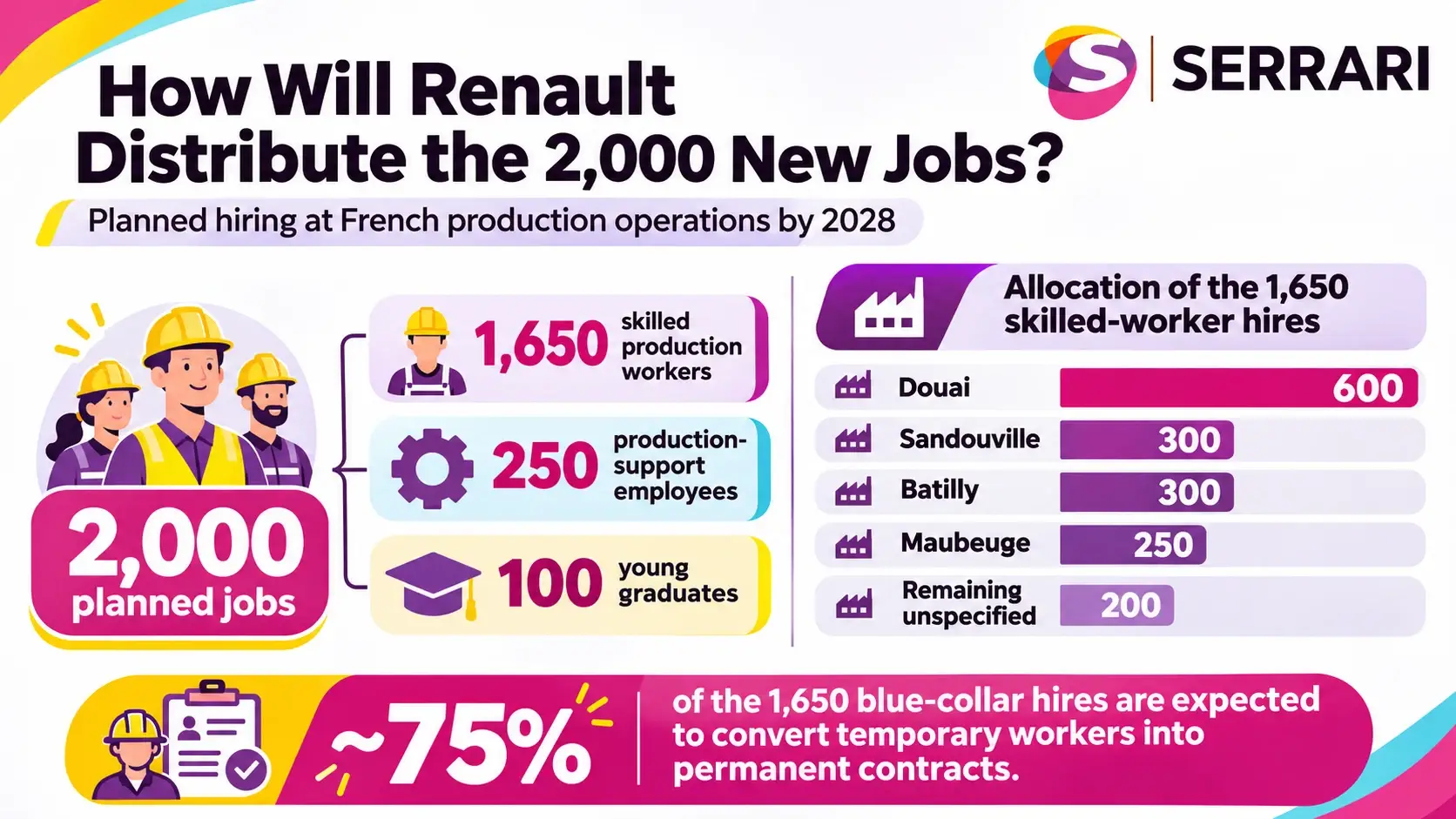
The planned recruitment programme will cover different areas of Renault’s production operations, with the largest share allocated to assembly-line positions.
The company intends to recruit:
- 1,650 skilled production workers: Employees who will work in vehicle assembly and manufacturing.
- 250 production-support employees: Staff who will provide indirect support to production operations.
- 100 young graduates: University graduates entering training programmes designed to develop their skills within the company.
The 1,650 skilled-worker positions will be distributed across several French manufacturing facilities.
Renault production plant
Planned skilled-worker hires
Douai
600
Maubeuge
250
Sandouville
300
Batilly
300
Total specified
1,450
The figures above account for 1,450 of the 1,650 planned skilled-worker positions. The supplied reports do not specify the allocation of the remaining 200 positions.
A significant part of the recruitment drive will involve converting temporary employment into permanent positions. Charvet said approximately three-quarters of the 1,650 blue-collar hires would involve temporary agency workers moving to permanent contracts.
This approach would give Renault an opportunity to retain workers already familiar with its production processes while reducing its reliance on temporary staffing as manufacturing activity expands.
Why Is Renault Cutting Up to 1,000 Office Jobs While Hiring Production Workers?
While Renault is expanding its factory workforce, it is also planning to reduce its administrative and other white-collar positions.
The company expects between 900 and 1,000 employees to leave through voluntary departure arrangements and early retirement measures. The restructuring will affect office-based roles across its French industrial operations, rather than assembly-line workers.
The affected functions are expected to include industrial corporate activities such as supply chain operations and quality control, alongside other office-based positions at Renault’s plants.
Renault does not plan to make redundancies; instead, it intends to offer voluntary severance agreements and early retirement schemes for older employees.
The proposed departures will be arranged through collective contractual termination agreements, known in France as ruptures conventionnelles collectives (RCC), and end-of-career measures for senior employees.
The company is therefore pursuing two workforce changes simultaneously: increasing the number of employees directly involved in manufacturing while reducing certain administrative and industrial support functions.
This reflects a shift in the skills and staffing requirements of its industrial operations. As vehicle production evolves, Renault is seeking to direct more resources towards manufacturing while reorganising functions that support the wider business.
However, the proposals have raised concerns among employee representatives.
The French Democratic Confederation of Labour (CFDT) said it was “very worried” about the plans and described the proposed timetable as a “forced march”. The union expressed concern that departures could begin as early as January 2027, while recruitment would take place across 2027 and 2028.
Negotiations with trade unions are due to begin on November 27, 2026, and participation in the departure programme is expected to be voluntary.
How Will Training Prepare Renault Workers for the EV Transition?
Beyond recruitment and workforce reductions, Renault is planning a major employee training programme to prepare its industrial workforce for technological changes across the automotive sector.
The initiative will comprise nearly 500,000 hours of training, supporting internal job redeployment and helping employees adapt to changing production requirements.
The training will focus on developments including robotics, artificial intelligence (AI) and electrification.
These technologies are becoming increasingly important in vehicle manufacturing. Robotics can support automated production processes, while AI can be applied to industrial operations and production management. Electrification also requires manufacturers to adapt their production activities to the needs of electric vehicle manufacturing.
For Renault, investing in employee training is part of preparing its workforce for these changes rather than relying entirely on new recruitment to fill emerging skills gaps.
The programme also forms part of the company’s wider effort to strengthen its industrial operations in France.
“We want to strengthen the performance of our industrial system in France to guarantee its future,” Charvet said.
The training initiative will therefore play an important role in supporting the transition, particularly as Renault adjusts the balance between traditional automotive production activities and the skills required for electric vehicle manufacturing.
Context is everything. Stay ahead of shifting trends with today’s market updates, and uncover emerging opportunities using the Serrari Group Market Index and Marketplace. Then, take control of your own financial future by exploring our Money & Life Reset Transformation Blueprint ™ to build stronger habits, create better systems, and design a path toward lasting wealth.
What Is Driving Renault’s Changing Production Strategy?
Renault’s recruitment and restructuring plans come amid increasing demand for its electric vehicles and commercial vans, as well as growing competition in the global automotive industry.
The success of models such as the Renault 5 and Scénic has contributed to higher production requirements. The company has also pointed to stronger activity in its commercial van business.
The second source links the increase in European EV sales to higher petrol prices following the US and Israel’s attacks on Iran, which it says have encouraged more consumers to consider electric models.
However, Renault’s workforce changes are not only about meeting immediate demand. The company is also preparing for competition from Chinese automakers, which are putting pressure on established manufacturers through their products and manufacturing capabilities.
Charvet said Renault had previously been somewhat shielded from competition in electric vehicles and commercial vans but had recognised that competitive pressure was approaching.
“In both of these segments, we had been somewhat shielded from competition in recent years, specifically from Chinese companies. But we knew that this competition was coming; we had already seen signs of it at the (October) Paris Motor Show,” he said.
The company had also announced a major restructuring of its engineering division in June, aimed at reducing costs and development times while bringing its performance closer to that of its Chinese competitors.
These developments suggest that Renault’s workforce strategy is part of a broader effort to improve industrial efficiency, respond to competition and adapt its operations to the changing automotive market.
How Does the Recruitment Drive Fit Into Renault’s Wider Investment Plans?
The planned workforce changes form part of Renault’s broader industrial strategy in France, known as the France Industrie FutuREady initiative.
Management presented the programme to trade unions on November 16, with negotiations on the proposed workforce reductions expected to begin later in the month.
The initiative follows Renault’s announcement in October of an investment programme worth more than €10 billion in its home market over the next five years.
The planned investment is expected to focus primarily on electric vehicles and more affordable models.
This investment programme provides wider context for the recruitment drive. Renault is seeking to strengthen its French industrial base while directing investment towards products and technologies expected to shape its future vehicle portfolio.
The combination of new production jobs, workforce training and changes to office-based roles indicates that the company is attempting to reorganise its operations around these priorities.
However, the recruitment and departure proposals remain subject to discussions with trade unions, meaning the final arrangements could depend on the outcome of negotiations.
The Bigger Picture: EV Growth Is Reshaping Automotive Employment
Renault’s plans illustrate how the transition to electric vehicles is influencing employment across the automotive industry.
As manufacturers increase their electric vehicle production, they must adjust their factory operations, workforce composition and employee skills. This can create demand for additional production workers while also changing the requirements for administrative, engineering and support functions.
For Renault, the planned recruitment of 1,650 assembly-line workers and 250 production-support employees reflects the need to support higher manufacturing activity.
At the same time, the proposed voluntary departure of up to 1,000 office-based employees highlights the other side of industrial restructuring: companies are also reviewing how their existing operations are organised and where their workforce is most needed.
The planned 500,000 hours of training are particularly important because the transition requires employees to adapt to new technologies and manufacturing processes.
The development also highlights the competitive pressure facing established European automakers. As Chinese manufacturers expand their presence in the electric vehicle market, companies such as Renault must improve production efficiency, manage costs and maintain the competitiveness of their models.
Why Does This Matter Now?
Renault’s announcement comes at a time when the European automotive industry is adjusting to changing consumer demand, higher competition and the growing importance of electric vehicles.
The planned recruitment programme shows that EV expansion can create employment opportunities within manufacturing, particularly where demand requires factories to increase production capacity.
However, the simultaneous reduction of office-based positions demonstrates that the transition does not necessarily create employment growth across every part of an automaker’s operations.
For workers, the changes could mean new opportunities in production and training, but also uncertainty for employees in affected administrative and support functions.
For the wider EV industry, Renault’s plans offer an example of how traditional automakers are reorganising their workforces to support electrification while attempting to remain competitive.
Outlook: Can Renault Balance EV Expansion and Workforce Restructuring?
Renault’s planned recruitment of approximately 2,000 employees by 2028 signals its intention to strengthen production capacity in France as demand for electric vehicles and commercial vans grows.
The success of the programme will depend on the company’s ability to convert temporary workers into permanent employees, recruit the additional skilled workforce it needs and prepare existing staff for changing manufacturing requirements.
The proposed departure of up to 1,000 office-based employees will also require careful negotiations with trade unions, particularly given concerns raised over the timetable and potential impact on workers.
The next important milestone will be the negotiations scheduled to begin on November 27, 2026. Their outcome will help determine how the voluntary departure arrangements are implemented.
Beyond the immediate workforce changes, Renault’s planned investment of more than €10 billion in France over five years will be important in determining how its domestic manufacturing operations develop.
Ultimately, Renault’s challenge will be to expand electric vehicle production, strengthen its industrial competitiveness and manage the workforce transition without undermining the skills and experience needed to support its future growth.
Frequently Asked Questions (FAQs)
1. How many workers does Renault plan to hire by 2028?
Renault plans to recruit approximately 2,000 employees at its French plants, including 1,650 assembly-line workers, 250 production-support employees and 100 young graduates.
2. Why is Renault hiring more production workers?
The company is responding to growing demand for electric vehicles such as the Renault 5 and Scénic, as well as stronger activity in its commercial van business.
3. Why is Renault planning to cut up to 1,000 jobs while recruiting?
Renault is reorganising its workforce by expanding production-related roles while reducing certain white-collar and administrative positions. The proposed departures will be voluntary and may include early retirement arrangements.
4. How will Renault prepare its employees for the electric vehicle transition?
Renault plans nearly 500,000 hours of employee training to support job transitions and develop skills in areas such as robotics, artificial intelligence and electrification.
Your financial future isn’t something you wait for—it’s something you build.
The real question is: when do you begin?
Move beyond simply staying informed.
Navigate the markets with clarity—track trends through the Serrari Group Market Index, uncover opportunities in the Serrari Marketplace, and build practical knowledge with our Curated Wealth Builder Platform.
Stay connected to what truly matters.
Get daily insights on macro trends and financial movements across Kenya, Africa, and global markets—delivered through the Serrari Newsletter.
Growth opens doors.
Advance your career through professional programs including ACCA, HESI A2, ATI TEAS 7 , HESI EXIT , NCLEX – RN and NCLEX – PN, Financial Literacy!🌟—designed to move you forward with confidence.
See where money is flowing—clearly and in real time.
Track Money Market Funds, Treasury Bills, Treasury Bonds, Green Bonds, and Fixed Deposits, alongside global and African indexes, key economic indicators, and the evolving Crypto and stablecoin landscape—all within Serrari’s Market Index.