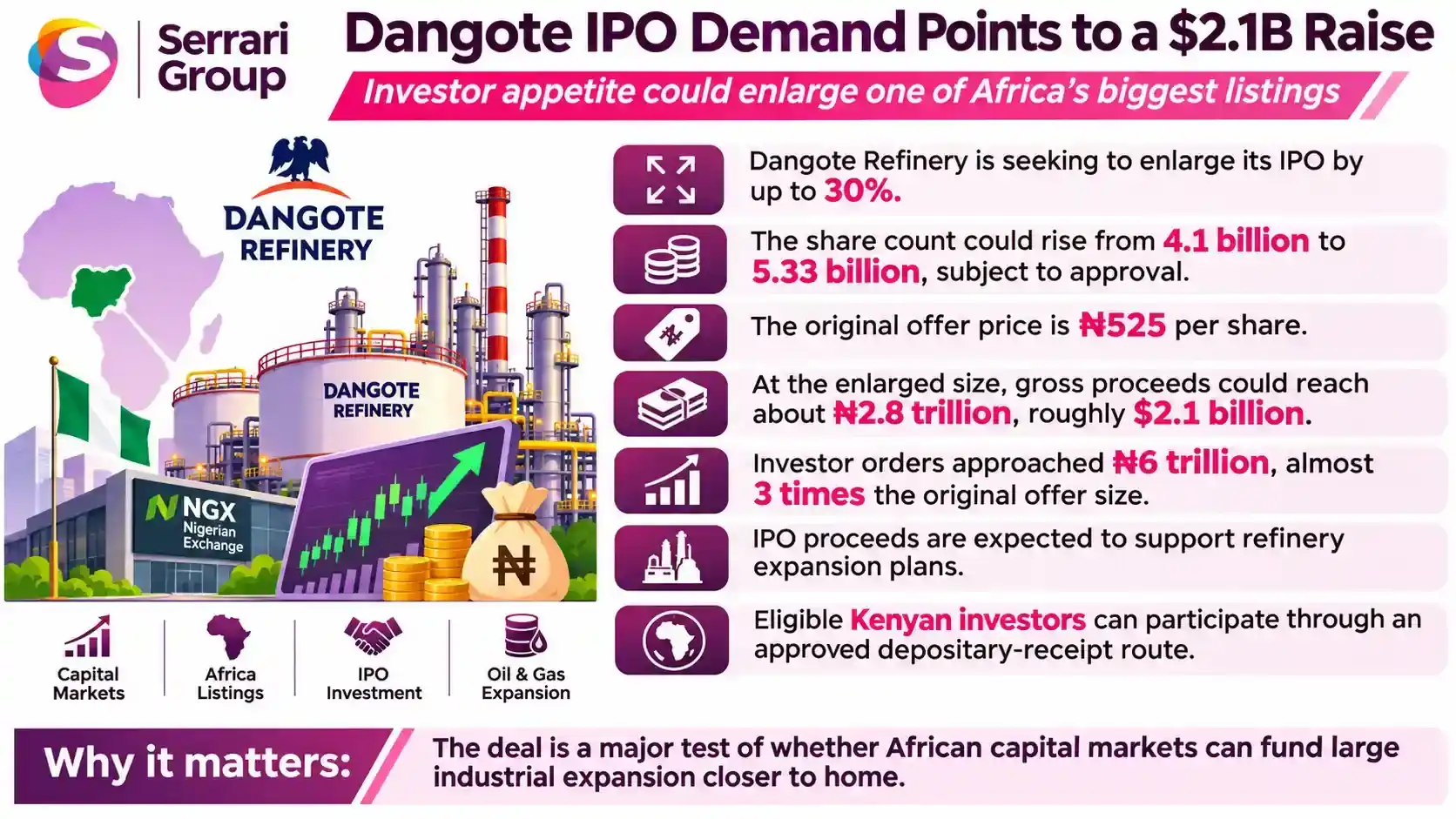
Nigeria’s Dangote Petroleum Refinery & Petrochemicals is seeking to expand its initial public offering (IPO) by as much as 30%, potentially lifting proceeds to about $2.1 billion. The proposed increase reflects demand for one of Africa’s largest industrial assets, but it is not yet a completed transaction: additional shares and final allocations require regulatory clearance. The more important question is why investors are committing capital now. The refinery has moved from an expensive construction project into commercial operations, reported a sharp earnings turnaround in the first half of 2026, and is seeking funding for another major expansion. Its listing could also reshape how African investors access large cross-border equity deals.
Key Overview
- Proposed deal size: Up to 5.33 billion shares, compared with the original 4.1 billion, subject to regulatory approval.
- Investor orders: Nearly ₦6 trillion, approximately 2.8 times the original ₦2.15 trillion offering.
- Offer price: The original fixed price is ₦525 per share; applying it to the maximum expanded share count implies about ₦2.80 trillion in gross proceeds.
- Allocation priorities: Retail investors and Nigerian pension funds are expected to receive more favourable allocations than offshore institutions, although final allotments remain unconfirmed.
- Strategic significance: Proceeds are intended to support a multibillion-dollar capacity expansion, while participation from Kenya and other African markets tests regional investment links.
Why Dangote Wants to Enlarge an Already Oversubscribed IPO
The immediate trigger is an unusually large gap between available shares and investor orders. The refinery initially offered 4.1 billion new shares at ₦525 each, targeting ₦2.1525 trillion, or approximately $1.6 billion at exchange rates used around the deal. Its November 17 proposed expansion would increase the number issued by up to 1.23 billion shares, taking the maximum to 5.33 billion.
At the original price, that enlarged issue would raise approximately ₦2.798 trillion, equivalent to roughly $2.1 billion at the rate quoted in the November 17 report. Demand of almost ₦6 trillion would still exceed the expanded supply by more than two times. This means a larger offer can capture more of the existing demand without eliminating the need to ration shares.
Crucially, the increase is not automatic. The original offer terms and allotment rules permit absorption of up to 30% oversubscription, but require approval from Nigeria’s Securities and Exchange Commission. The prospectus also gives the issuer discretion to allocate shares among investor groups, subject to the approved basis of allotment. Until the regulator clears the final arrangements, the 5.33 billion figure is a proposed ceiling rather than a confirmed allotment.
The timing matters because subscription demand is already known, whereas the final ownership register and first-day market price are not. Expanding an oversubscribed IPO allows the company to strengthen its equity base while investor appetite is visible. It could also increase the number of shares available for trading, potentially improving liquidity once trading begins.
Why Investors Are Backing the Refinery Now
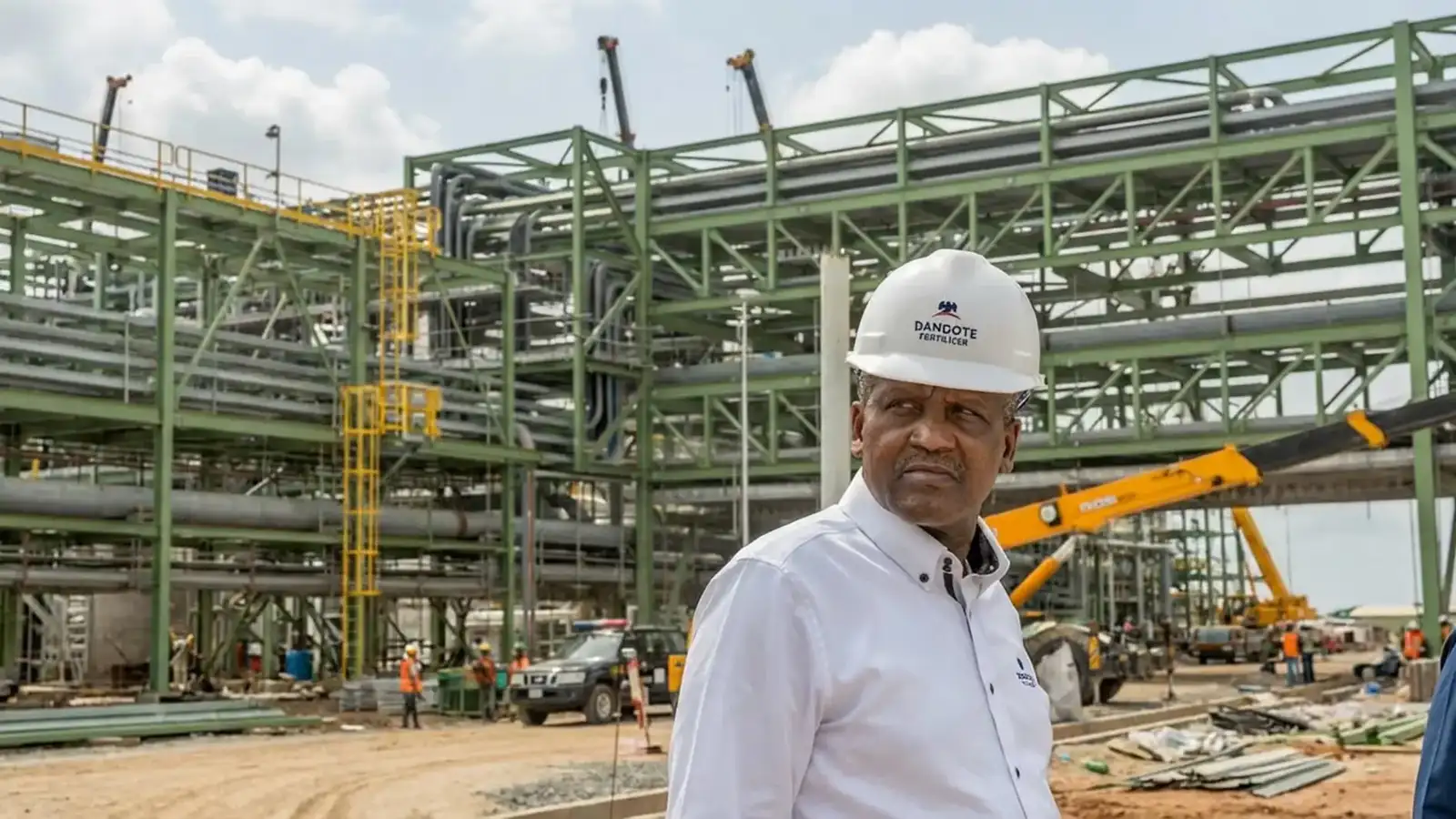
Demand is easier to understand against the refinery’s operational progress. The project began commercial operations in January 2024, completed testing at its 650,000-barrel-a-day nameplate capacity in February 2026, and subsequently reported test throughput of up to 700,000 barrels daily. That progression reduces one major uncertainty: whether a complex, capital-intensive facility can move beyond construction and commissioning into meaningful production.
There is also a clearer earnings case. Figures in the IPO financial statements show revenue of approximately $13.91 billion for the first six months of 2026, compared with $5.56 billion in the corresponding period of 2025. The company recorded about $1.82 billion in after-tax profit in the first half of 2026, after a roughly $476 million loss for the whole of 2025.
Those figures help explain the rush. Investors are looking at a business that has begun converting installed capacity into revenue and profit, rather than purchasing only a promise of future production. Nigeria’s large fuel market, regional export opportunities and petrochemicals operations offer several potential sources of income.
Yet strong recent earnings should not be mistaken for a guaranteed trend. Refining margins can narrow when crude feedstock costs rise faster than selling prices, while maintenance, logistics and financing costs can weaken profitability. First-half results also cannot be mechanically doubled to predict full-year earnings. The investment case depends on whether high utilisation and attractive margins can persist through different oil-market conditions.
What the Extra Capital Will Actually Finance
The IPO is part of a considerably larger capital-raising strategy, not a standalone fundraising event. Ahead of the public offer, the company raised approximately $2.5 billion through two private-placement tranches involving about 7.15 billion shares. Its published expansion programme envisages roughly $14.3 billion of investment to lift refining capacity towards 1.4 million barrels per day by 2029, alongside supporting facilities.
The original prospectus earmarked net IPO proceeds for growth capital expenditure, including refining equipment, utilities, infrastructure and construction. Even a $2.1 billion enlarged gross offer would finance only a portion of the broader plan. Further investment, operating cash generation or other financing arrangements would still be needed, and the expansion schedule is subject to execution and funding risks.
This distinction matters for shareholders. Raising equity can reduce dependence on additional debt for a portion of capital expenditure, but issuing more shares also dilutes the proportional holdings of existing owners. The economic payoff comes only if the investments made with that equity generate sufficient future earnings and cash flow.
The refinery therefore faces two linked tests after listing: continuing to operate its existing plant efficiently and delivering the next construction phase without overruns that erode shareholder returns. Oversubscription demonstrates demand for the security; it does not independently validate the entire expansion budget.
Context is everything. Stay ahead of shifting trends with today’s market updates, and uncover emerging opportunities using the Serrari Group Market Index and Marketplace. Then, take control of your own financial future by exploring our Money & Life Reset Transformation Blueprint ™ to build stronger habits, create better systems, and design a path toward lasting wealth.
Why Local Investors Could Get Shares While Offshore Funds Are Cut Back
The expected allocation pattern is politically and financially significant. People involved in the transaction say retail applicants are expected to receive all the shares they requested, while Nigerian pension funds could receive allocations close to their applications. Large offshore orders would face most of the reductions, with some large subscriptions potentially scaled back proportionately.
That approach is consistent with the offer’s public-ownership objective, although the final result depends on regulatory sign-off. Reserving more shares for local investors could spread the financial benefits of a nationally important industrial asset across a broader domestic shareholder base. Pension-fund participation may also create a longer-term class of institutional owners.
There is a trade-off. International institutions can provide substantial demand, foreign-currency capital and global visibility, but excluding too much of that demand may limit the international breadth of the shareholder register. Conversely, an offer dominated by a small group of large investors could undermine the broader public-participation message.
The transaction is not conventionally underwritten. A special-purpose investment vehicle, Pan-African Refinery Investment SPV, has committed to subscribe for up to $400 million, but that commitment should not be confused with a guarantee that every share in the enlarged issue will be purchased. Its ultimate allocation had not been confirmed in the November 17 reporting.
What the Deal Means for Kenya and African Capital Markets
The IPO is also testing whether a major Nigerian issuer can attract capital across African financial centres without relying exclusively on overseas exchanges. Investors from South Africa, Botswana and Kenya were among the notable regional participants, and South Africa’s Public Investment Corporation was identified among subscribers in the November 17 account.
For Kenya, the story has an additional capital-market dimension. The country’s regulator issued approval for a depositary-receipt structure in October, allowing eligible Kenyan investors to participate through an arrangement organised by Renaissance Capital (Kenya). Such instruments can give investors exposure to shares in a foreign company through a locally accessible market structure, subject to the applicable terms, trading arrangements and risks.
The approval concerns shares in the Nigerian refinery, not ownership in the separate proposed refinery project in Kenya. That distinction is essential because the projects have different investment exposures and should not be treated as interchangeable.
If the transaction succeeds, it could offer a model for distributing future large African issues across borders. But regional participation alone does not ensure seamless trading: custody, settlement, liquidity, exchange-rate conversion and investor protection arrangements must work after the publicity surrounding an IPO has passed.
The Valuation and Listing Risks Investors Must Watch
At ₦525 per share, the initial offer implied an equity valuation in the tens of billions of US dollars, making the listing exceptionally significant for the Nigerian market. The critical question after admission to trading will be whether investors judge that valuation justified by sustainable profits, cash generation and execution of the expansion plan.
The prospectus risk disclosures explicitly identify fluctuating refining margins, operational disruptions, further share issuance, limited secondary-market liquidity and foreign-exchange or repatriation difficulties. For foreign investors, a gain in the naira share price can be partly offset by a weaker naira when returns are converted into their home currency.
Ownership will remain concentrated. An adviser involved in the deal expects Aliko Dangote to retain about 83.5% after the IPO, with state-owned NNPC Ltd’s stake falling to approximately 6.5%. These are expectations rather than a final published shareholder register. The concentration means minority investors will have economic exposure without comparable control over strategic decisions.
There is also no assurance that a heavily oversubscribed offer will trade above its subscription price. IPO orders reflect demand before trading starts; secondary-market prices depend on who is willing to buy and sell once allocations are credited. Investors should therefore watch the approved allotment announcement, confirmed share count, listing timetable and early trading liquidity rather than assuming an immediate premium.
The Bigger Picture: Can African Capital Fund African Industry?
The proposed enlargement matters beyond the headline size. It comes as one of Africa’s largest industrial projects attempts to finance a new growth phase through public and private equity while keeping its principal listing in Nigeria. That is a test of local savings, pension capital and cross-border investor infrastructure as sources of funding for projects traditionally associated with heavy borrowing or external capital.
The transaction could deepen Nigeria’s stock market and offer regional investors exposure to a major refining business. It may also encourage other large privately controlled African companies to consider public markets. Those outcomes, however, depend less on the number of subscriptions today than on what happens after the shares start trading: transparent disclosures, reliable earnings, fair treatment of minority shareholders and disciplined investment spending.
For now, the central development is conditional but consequential. Dangote Refinery has more demand than its original IPO can accommodate and wants permission to turn some of that demand into additional expansion capital. The next decisive milestones are regulatory approval, final allocations and the expected November listing. Those events will establish how much the company actually raises—and whether enthusiasm for a landmark African offering translates into durable shareholder value.
Sources used: Reuters / Dangote Petroleum Refinery / Securities and Exchange Commission Nigeria / Capital Markets Authority Kenya
Your financial future isn’t something you wait for—it’s something you build.
The real question is: when do you begin?
Move beyond simply staying informed.
Navigate the markets with clarity—track trends through the Serrari Group Market Index, uncover opportunities in the Serrari Marketplace, and build practical knowledge with our Curated Wealth Builder Platform.
Stay connected to what truly matters.
Get daily insights on macro trends and financial movements across Kenya, Africa, and global markets—delivered through the Serrari Newsletter.
Growth opens doors.
Advance your career through professional programs including ACCA, HESI A2, ATI TEAS 7 , HESI EXIT , NCLEX – RN and NCLEX – PN, Financial Literacy!🌟—designed to move you forward with confidence.
See where money is flowing—clearly and in real time.
Track Money Market Funds, Treasury Bills, Treasury Bonds, Green Bonds, and Fixed Deposits, alongside global and African indexes, key economic indicators, and the evolving Crypto and stablecoin landscape—all within Serrari’s Market Index.