Nigerian Exchange Group Plc (NGX Group) has acquired a 10% stake in Nairobi Securities Exchange Plc (NSE), expanding its ownership of African stock-market infrastructure beyond Nigeria. Announced on November 16, 2026, the investment has an estimated value of about KSh900 million based on a large October trading session, although NGX has not disclosed the actual purchase price or seller. The timing is significant: Kenya’s exchange operator reported a sharp increase in first-half profits, Nigeria’s stock market has rallied strongly, and regulators are exploring ways for investors to access securities across national borders. The transaction strengthens commercial ties between two markets, but ownership alone will not eliminate the regulatory, currency and settlement barriers that still restrict cross-border investing.
LIVENSE market summarySee NSE data →Key Overview
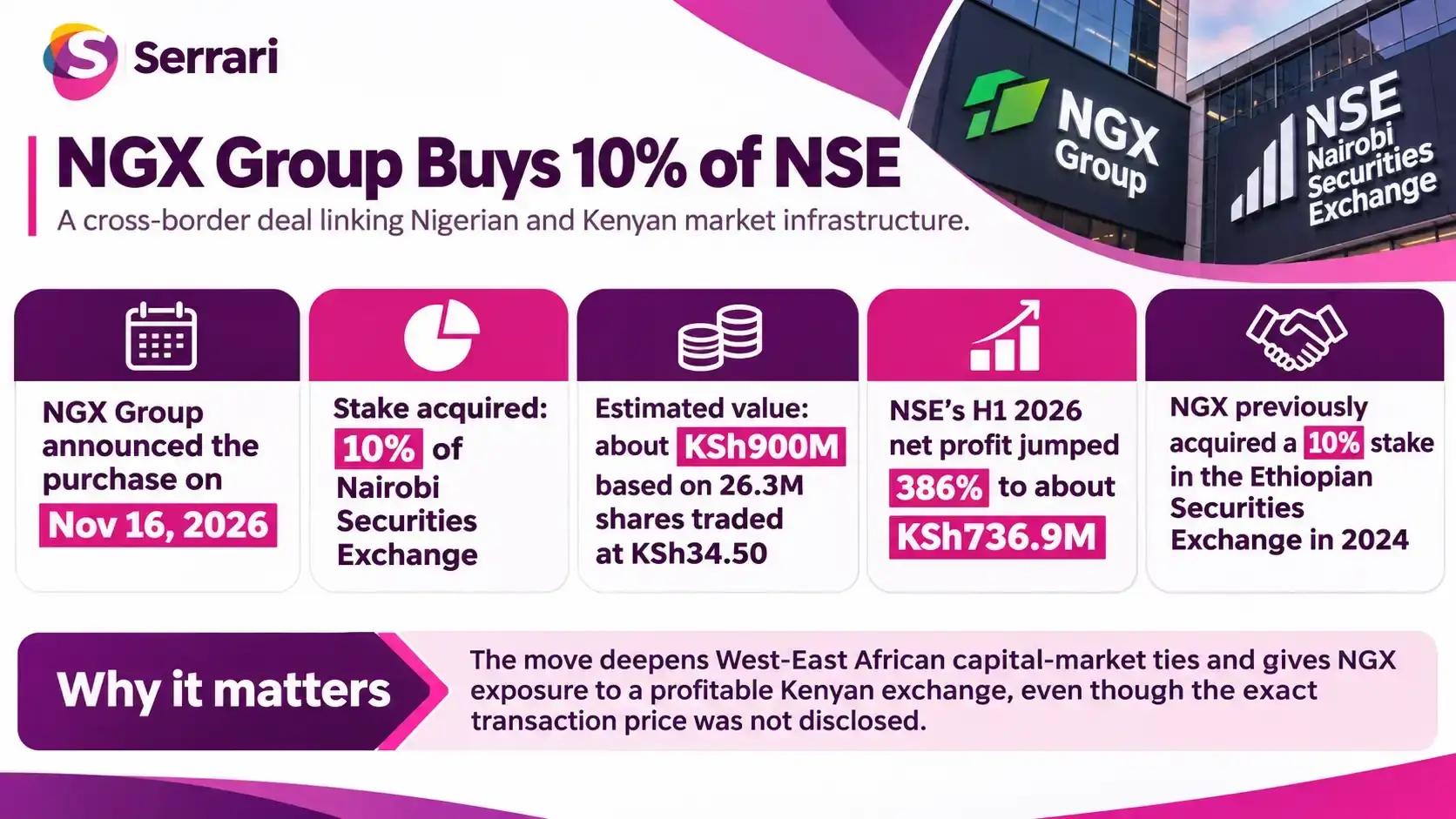
- Confirmed acquisition: NGX Group announced the purchase of a 10% equity interest in the NSE on November 16, 2026.
- Indicative valuation: Approximately 26.3 million NSE shares traded on October 26 at an average KSh34.50, suggesting a roughly KSh900 million value for a 10% holding; the deal’s actual consideration was not disclosed.
- Expansion strategy: The deal follows NGX Group’s 10% investment in the Ethiopian Securities Exchange in 2024.
- Stronger Kenyan earnings: NSE’s first-half 2026 profit after tax rose 386% to KSh736.9 million, supported by greater equity trading activity, including a major Safaricom block transaction.
- Regional capital flows: Kenya has approved a prospectus for a proposed Dangote refinery-linked GDR programme, but any NSE listing remains conditional and has not been identified as part of the NGX acquisition.
- Market momentum: Nigeria’s benchmark All-Share Index was up 62.11% year to date by November 13, with equity market capitalisation near ₦163.80 trillion.
Why NGX Group Is Buying Into Kenya’s Stock Exchange
NGX Group’s November 16 acquisition announcement described the Nairobi investment as part of a strategy to diversify earnings, deepen regional partnerships and participate directly in the growth of African capital markets. For the Nigerian operator, buying equity in an established foreign exchange provides a different exposure from merely signing cooperation agreements with another market.
An exchange earns revenue from activity flowing through its infrastructure. Trading levies, listings, market information and related services can benefit when more companies raise capital and more investors trade. Consequently, a minority interest in the NSE allows NGX Group to participate economically in the Kenyan operator’s results, subject to the ownership rights and distributions attached to the shares.
That matters because the fortunes of Nigeria’s stock market need not move in lockstep with those of Kenya. Different economic cycles, interest rates, currencies, issuers and investor bases can create alternative sources of income. NGX’s expansion also builds on its earlier 10% Ethiopian exchange investment, giving it minority positions in two East African operators.
The strategic logic goes beyond diversification. Owning part of the local exchange can support sustained dialogue on listings, products and infrastructure, potentially making collaboration more durable. It does not, however, confer control over the NSE or automatically create a unified trading platform linking Nairobi and Lagos. Those outcomes would require additional agreements, technical arrangements and regulatory permissions.
Why the KSh900 Million Figure Is an Estimate, Not a Confirmed Deal Price
The investment has been widely associated with a notable trading session on October 26. On that day, approximately 26.3 million NSE shares changed hands at an average of KSh34.50, with the volume corresponding to around 10.1% of the company’s roughly 260.9 million issued shares. The reported block-trade details place the value of that session close to KSh907 million.
A precise 10% holding would represent approximately 26.09 million shares. At KSh34.50 each, the implied value is about KSh900.1 million. This arithmetic explains the headline estimate but cannot establish what NGX paid. Privately negotiated block transactions may be executed at prices that differ from visible market quotations, and the announcement did not identify the selling shareholders, execution date or consideration.
The distinction is important for investors attempting to determine whether NGX paid a strategic premium or obtained the stake at a discount. Without the contractual transaction details, neither conclusion can be supported. What is certain is that a new exchange-operator shareholder now has a direct financial interest in Nairobi’s market performance.
NSE’s Earnings Surge Helps Explain the Timing
The Kenyan exchange has recently demonstrated how strongly its profitability can respond to increased activity. Its first-half 2026 financial performance showed profit after tax rising to KSh736.9 million from KSh151.6 million a year earlier, a 386% increase.
The main driver was equity trading. Equity transaction levy income climbed 476% to KSh770.5 million from KSh133.9 million, helped significantly by a large Safaricom share block trade. Fixed-income revenue increased 22% to KSh187.3 million, while data income rose 29% to KSh75.2 million. These figures demonstrate the operating leverage of an exchange: higher turnover can lift fee income considerably without requiring a proportionate expansion in its underlying market infrastructure.
For NGX, acquiring shares in a profitable exchange during a period of stronger turnover offers exposure to a business already generating earnings rather than solely to a distant expansion plan. Yet investors should avoid treating the first-half profit growth rate as a sustainable annual trend. Block trades can be unusually large and irregular. A more durable improvement would depend on broad trading participation, recurring listings, healthier day-to-day liquidity and demand for market services.
This is also why the acquisition matters to existing NSE shareholders. The entrance of another exchange operator could encourage strategic cooperation and greater attention to market development, but future dividends and share valuations will ultimately depend on earnings quality, capital requirements and governance—not the new shareholder’s identity alone.
Context is everything. Stay ahead of shifting trends with today’s market updates, and uncover emerging opportunities using the Serrari Group Market Index and Marketplace. Then, take control of your own financial future by exploring our Money & Life Reset Transformation Blueprint ™ to build stronger habits, create better systems, and design a path toward lasting wealth.
Nigeria’s Market Rally Creates a Stronger Expansion Backdrop
NGX’s acquisition comes during an exceptional year for Nigerian equities. The Nigerian market’s weekly trading performance to November 13 placed the All-Share Index at 252,269.16 points, representing a 62.11% year-to-date gain. Equity market capitalisation reached approximately ₦163.80 trillion.
The rally does not prove that buying an overseas exchange is financially superior to investing domestically. It does, however, demonstrate the commercial potential of capital-market activity in an environment of stronger investor demand. NGX Group appears to be using that momentum to pursue a broader institutional footprint, rather than relying entirely on its home market for long-term growth.
For Kenya, the investment is a signal that African exchanges themselves see value in owning regional infrastructure. Such participation could eventually support product development, issuer outreach and shared market knowledge. These benefits remain potential outcomes, not completed integration measures.
LIVENSE market summarySee NSE data →What the Dangote GDR Plan Reveals About Cross-Border Opportunities
The deal also arrives as Kenyan regulators support new ways for investors to access shares issued elsewhere in Africa. On October 5, Kenya’s Capital Markets Authority approved a short-form prospectus for a proposed global depositary receipt programme linked to Dangote Petroleum Refinery & Petrochemicals’ Nigerian initial public offering.
A depositary receipt represents an interest in underlying foreign shares and can provide access to companies outside an investor’s domestic market without a conventional direct share purchase. The Dangote offer opened on September 14 and closed on October 13, with its IPO terms specifying 4.1 billion shares at ₦525 each, equivalent to approximately ₦2.15 trillion before considering final allocation.
The proposed Nairobi GDR listing remains subject to successful fundraising, allocation and relevant Nigerian regulatory approvals. The Kenyan approval therefore should not be interpreted as confirmation that the instruments have already begun trading on the NSE. There is also no announced direct connection between the Dangote programme and NGX Group’s acquisition.
Nevertheless, their proximity illustrates why regional exchange relationships matter. African investors often face fragmented rules, account-opening requirements, custody systems and foreign-exchange arrangements when attempting to access neighbouring markets. Deposit receipts and cross-border partnerships can help widen access, but only when operational and regulatory structures are established.
What the Acquisition Means for Investors and African Markets
A 10% shareholding does not immediately change how a Kenyan retail investor buys Nigerian shares or how a Nigerian pension fund accesses Kenyan companies. Investors will still need to consider eligible brokers, available instruments, trading permissions, settlement processes, exchange rates, taxation and the liquidity of any security offered across borders.
The potential longer-term gain is a wider market for capital. Kenyan companies seeking investors beyond East Africa could benefit if exchange relationships eventually make access easier. Nigerian issuers could gain alternative channels to reach regional savings. Investors might obtain new opportunities to diversify beyond domestic sectors and currencies. Exchange operators could attract additional trading, listing and information revenue.
But these opportunities come with risks. Cross-border investment exposes investors to currency movements, differences in disclosure standards, custody arrangements and market liquidity. Minority ownership in an exchange does not remove those risks. Nor does it guarantee that trading costs will fall or that companies will raise funding more cheaply.
For NGX shareholders, the financial test will be whether investments in Nairobi and Addis Ababa contribute earnings and strategic benefits sufficient to justify the capital deployed. For NSE shareholders, the test will be whether the partnership supports recurring market activity rather than a short-lived improvement in sentiment.
The Bigger Picture: From Exchange Partnerships to Ownership
NGX Group’s investment is best understood as a move from regional cooperation toward ownership of market infrastructure. Instead of only facilitating conversations between exchanges, the Nigerian operator has committed capital and taken an economic stake in the success of another African marketplace.
That is significant at a time when African companies need deeper pools of long-term financing and investors are looking for more diverse opportunities. National stock exchanges remain essential institutions, but their growth prospects may increasingly depend on how effectively they attract regional issuers, international capital and new investment products.
The immediate transaction is relatively modest compared with the capitalisation of the markets involved. Its broader significance lies in the possibility of stronger commercial links between West and East Africa. Whether those links become measurable trading flows, new listings and sustainable returns will determine if the deal marks genuine integration or remains principally a strategic shareholding.
Sources: Nigerian Exchange Group / Business Daily Africa / AfricanFinancials / Capital Markets Authority Kenya / Nigerian Exchange / Punch Nigeria / Dangote Petroleum Refinery & Petrochemicals
Your financial future isn’t something you wait for—it’s something you build.
The real question is: when do you begin?
Move beyond simply staying informed.
Navigate the markets with clarity—track trends through the Serrari Group Market Index, uncover opportunities in the Serrari Marketplace, and build practical knowledge with our Curated Wealth Builder Platform.
Stay connected to what truly matters.
Get daily insights on macro trends and financial movements across Kenya, Africa, and global markets—delivered through the Serrari Newsletter.
Growth opens doors.
Advance your career through professional programs including ACCA, HESI A2, ATI TEAS 7 , HESI EXIT , NCLEX – RN and NCLEX – PN, Financial Literacy!🌟—designed to move you forward with confidence.
See where money is flowing—clearly and in real time.
Track Money Market Funds, Treasury Bills, Treasury Bonds, Green Bonds, and Fixed Deposits, alongside global and African indexes, key economic indicators, and the evolving Crypto and stablecoin landscape—all within Serrari’s Market Index.