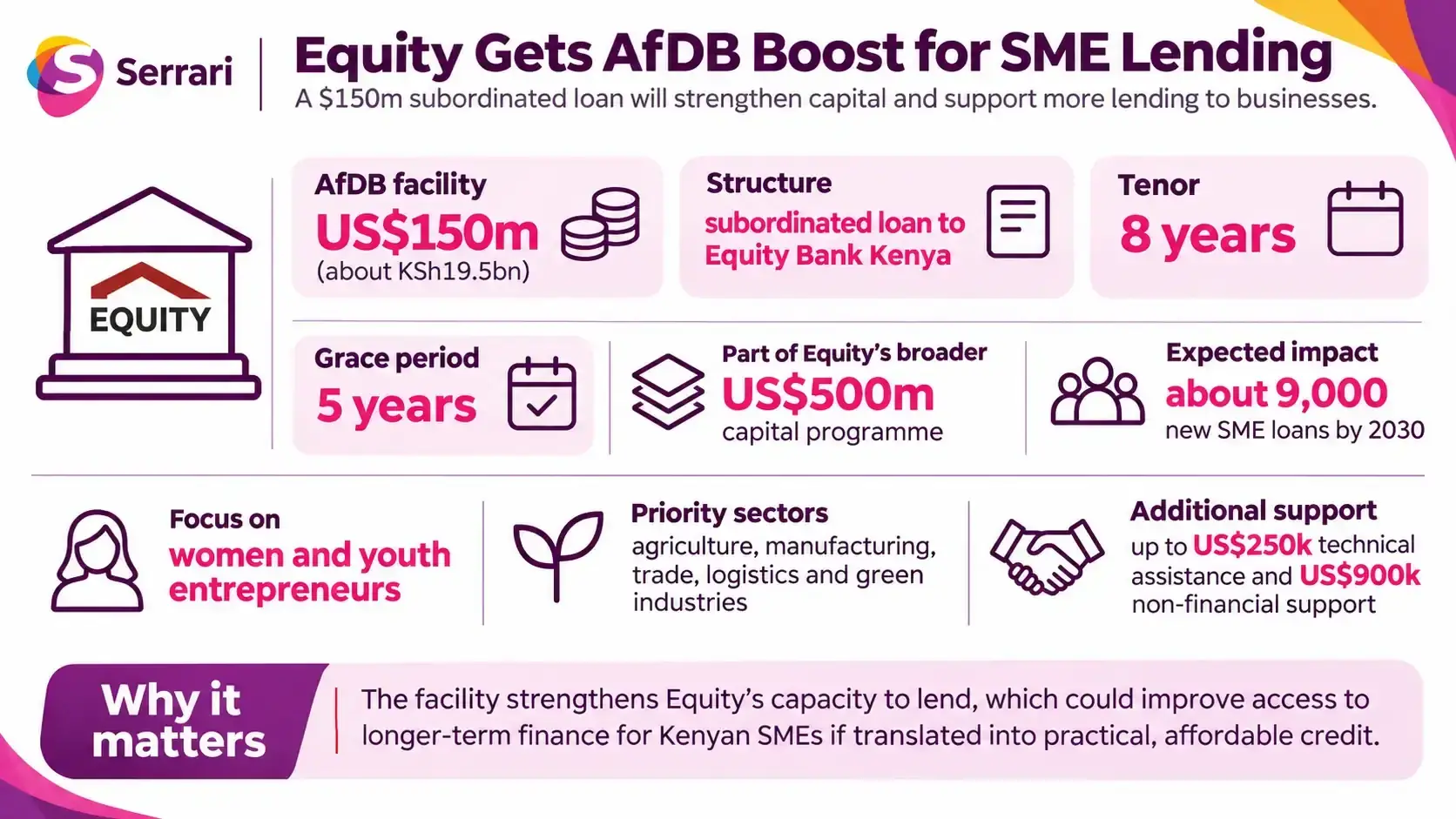
Equity Bank Kenya has secured approval for a US$150 million (approximately KSh19.5 billion) subordinated loan from the African Development Bank (AfDB), designed to strengthen the lender’s capital position and support more long-term financing for small and medium-sized enterprises. Approved on October 30, 2026, and announced on November 9, the eight-year facility forms part of a wider US$500 million capital-raising programme and is expected to contribute to approximately 9,000 new SME loans by 2030. The significance goes beyond the headline sum: by reinforcing a bank already serving a large small-business customer base, the transaction aims to address the scarcity of patient finance for Kenyan firms seeking to buy equipment, expand production and create jobs. Whether it succeeds will depend on affordable borrowing terms, disciplined lending and how effectively women- and youth-led enterprises are reached.
Key Overview
- Facility: The AfDB approved a US$150 million subordinated loan, equivalent to roughly KSh19.5 billion at an illustrative KSh130 per dollar.
- Terms: The financing has an eight-year maturity, including a five-year grace period, and supports Equity Bank Kenya’s wider US$500 million capital programme.
- Lending target: The operation is expected to support approximately 9,000 new SME loans by 2030, with a focus on enterprises owned by women and young people.
- Priority sectors: Agriculture, manufacturing, trade, logistics, renewable energy and climate-resilient businesses are among the intended beneficiaries.
- Additional assistance: Up to US900,000 in envisaged non-financial support through the SME Credit Catalyst Programme.
- Critical distinction: The facility strengthens the bank’s capacity to lend; it is not a direct KSh19.5 billion grant or automatic loan approval for SMEs.
Why Equity Bank Is Raising Long-Term Capital
Kenya’s small businesses frequently need financing for investments that take years, not weeks, to generate returns. A manufacturer buying machinery, a logistics operator acquiring vehicles or a farmer installing irrigation equipment cannot necessarily repay the entire investment from a few months of sales. Yet lenders must assess repayment risk carefully, and short-tenor facilities may be easier to provide than loans matched to long-term investment.
That gap helps explain the AfDB’s financing decision. The bank’s board approved the subordinated facility on October 30, and the development lender announced the decision on November 9. Its stated goal is to expand Equity Bank Kenya’s ability to finance productive businesses and support employment, particularly among women and younger entrepreneurs who can face additional barriers to conventional credit.
The transaction also fits Equity’s own strategy. Its 2025 sustainability disclosures set out an ambition to raise micro, small and medium-sized enterprises’ share of the Kenyan bank’s loan book to 65% by 2030, compared with 56.6% in 2025. More capital provides room to pursue such expansion while managing the risks associated with a larger portfolio.
The proposed financing should not be confused with US$150 million being deposited into an account reserved for individual business borrowers. It is financing to the bank, and the amount of additional credit that ultimately becomes available depends on its capital treatment, liquidity, underwriting standards and borrowers’ ability to repay.
Why a Subordinated Loan Matters More Than Its Headline Size
Subordinated debt ranks behind senior creditors if a bank is wound up. That makes it riskier for the lender providing the funds, but potentially useful to the borrowing bank as a form of longer-term capital support, subject to regulatory eligibility and limits. It can strengthen the capital buffer supporting risk-weighted assets and create additional capacity for credit growth.
The AfDB’s financing framework expressly includes subordinated and other quasi-equity instruments alongside conventional loans and guarantees. In this case, the eight-year maturity and five-year grace period offer a longer funding horizon than many ordinary short-term borrowing arrangements. The grace period is a feature of the bank-level facility, however, and does not mean an SME borrower automatically receives five years without repayments.
Similarly, the KSh19.5 billion equivalent is an approximate conversion of a dollar-denominated commitment, not a guaranteed shilling amount under every future exchange rate. The publicly available announcement does not specify the facility’s interest rate, final drawdown schedule or the exact pricing Equity will charge SMEs. Those omissions matter because cheaper or longer-term wholesale financing only benefits businesses if the improvement reaches them through workable loan tenors and competitive total borrowing costs.
The facility forms part of a broader US$500 million capital-raising programme. That does not establish that the entire programme has been completed or that all funds are available for immediate disbursement. It signals an effort to build lending capacity over time, rather than relying solely on one funding transaction.
Why the Focus on Women and Young Entrepreneurs Matters
Small enterprises account for a substantial share of Kenya’s employment and production, but many cannot offer the collateral, audited statements or long repayment histories traditionally used in commercial credit assessment. Women-owned and youth-led firms can face additional constraints, including smaller asset bases, informal business records and limited access to established banking networks.
The AfDB intends to complement the loan with up to US900,000 in non-financial assistance is envisaged through the SME Credit Catalyst Programme. These amounts should be distinguished from the US$150 million loan: they support advisory work, financial products, digital financing and business capability rather than representing additional lending principal of the same kind.
The practical goal is to improve both sides of a credit relationship. A business with clearer financial statements, stronger cash-flow management and better market information may be more creditworthy. A bank equipped to evaluate smaller or less conventional enterprises may be better able to lend without relaxing essential risk safeguards.
In August, a separate risk-sharing initiative for Kenyan enterprises involving Equity Bank and other financial institutions highlighted how development finance can combine capital with guarantees to support underserved borrowers. That programme is distinct from the AfDB facility, but both illustrate a wider shift toward tackling the underlying reasons banks hesitate to lend rather than merely encouraging larger loan volumes.
Context is everything. Stay ahead of shifting trends with today’s market updates, and uncover emerging opportunities using the Serrari Group Market Index and Marketplace. Then, take control of your own financial future by exploring our Money & Life Reset Transformation Blueprint ™ to build stronger habits, create better systems, and design a path toward lasting wealth.
What 9,000 New Loans Could Mean for Kenya’s Economy
The AfDB expects the operation to support about 9,000 additional SME loans by 2030. It is a forward-looking programme target, not a record of approvals or money already paid out. The number of eventual borrowers may also differ from the number of loans because an enterprise can receive more than one facility.
If carefully deployed, long-term finance can help a food processor buy equipment, a distributor invest in storage or a manufacturer increase capacity to supply regional buyers. Those investments can support employment indirectly through demand for transport, packaging, farming inputs and other local services. But the effects depend on whether businesses invest productively, secure customers and remain financially viable.
There is already a sizeable lending base. In its 2025 impact report, Equity Group said it disbursed KSh404 billion to micro, small and medium-sized enterprises under its development and inclusion programme. The group also reported cumulative entrepreneurship training for 962,924 MSMEs and financial education for about 2.49 million women and young people. These are group-level programme measures and should not be mistaken for a count of unique recipients of the new AfDB financing.
The bank’s existing scale provides distribution infrastructure, customer relationships and experience in lending to smaller enterprises. Yet scale by itself cannot guarantee equitable access. Rural firms, first-time borrowers and businesses operating with thin margins may still struggle unless products are designed around their cash-flow cycles.
How Agriculture and Manufacturing Could Benefit
Agriculture and manufacturing are particularly relevant because they involve investments with uneven or delayed payoffs. Farmers may borrow before a planting season and earn revenue only after harvest. A factory may require months to install machinery and win enough orders to cover the investment. Repayment schedules that ignore these realities can turn an otherwise viable project into a distressed loan.
Longer-term lending can better match financing to productive assets, while advice and risk assessment help banks distinguish feasible investments from projects that are unlikely to repay. Trade and logistics businesses may also benefit from improved working-capital arrangements and financing for vehicles, warehouses or inventory systems.
Green businesses face similar challenges. Climate-resilient agriculture, solar installations and energy-efficient equipment can have attractive lifetime economics but demanding upfront costs. Development-bank participation can help financial institutions build expertise in evaluating such projects. Nevertheless, financing remains debt: businesses must repay under agreed conditions, and not every climate-labelled investment is commercially sound.
The need for better credit access is substantial. An assessment of Kenya’s MSME financing gap estimated unmet demand at nearly 21% of GDP. That points to a structural constraint rather than a temporary absence of loan advertising. Addressing it requires capital, credit information, suitable collateral frameworks, business skills and dependable markets for the goods firms produce.
Why Approval Does Not Guarantee Cheaper SME Loans
For entrepreneurs, the immediate question is whether the facility will produce an accessible loan at a reasonable price. The announcement provides no published standard SME interest rate, application opening date or guarantee of eligibility. Existing bank underwriting will still matter, including cash-flow evidence, financial obligations, sector risk and the ability to service debt.
Borrowers should compare the effective cost of credit, fees, security requirements, repayment frequency and consequences of late payment rather than focusing on a headline promotional rate. A long-term loan may be preferable for equipment that earns revenue over several years, but financing ordinary operating losses with more debt can worsen a business’s position.
The funding also has implications for the bank’s shareholders and depositors. Rapid SME portfolio expansion must be matched with sound underwriting and adequate provisions for loans that may not be repaid. The success of the programme cannot be judged by disbursement volumes alone; asset quality, repayment performance and the number of sustainable enterprises supported are equally important.
The Bigger Picture: Development Finance Is Changing How Banks Lend
The Equity transaction shows how development lenders are increasingly using financial institutions to reach small businesses at scale. Rather than examining thousands of individual applications directly, they support established banks with capital, guarantees and specialised advisory programmes. The model can reach large numbers of customers, although outcomes depend heavily on how each participating lender translates support into its loan products.
For Kenya, the timing matters because businesses need investment in productive capacity, not merely short-term cash to survive the next trading cycle. The AfDB facility could contribute to that transition, especially if more women and young entrepreneurs obtain financing for assets that raise output and income.
Ultimately, the KSh19.5 billion announcement is a measure of potential, not a completed economic outcome. Its real success will be judged by the quality and affordability of loans, the survival and growth of businesses financed, and whether the promised 9,000 new facilities help expand employment and production by 2030. Strengthening a bank’s capital is the starting point; converting that strength into sustainable business opportunity is the test that matters.
Sources
African Development Bank / Equity Group Holdings / International Finance Corporation / Business Radar
Your financial future isn’t something you wait for—it’s something you build.
The real question is: when do you begin?
Move beyond simply staying informed.
Navigate the markets with clarity—track trends through the Serrari Group Market Index, uncover opportunities in the Serrari Marketplace, and build practical knowledge with our Curated Wealth Builder Platform.
Stay connected to what truly matters.
Get daily insights on macro trends and financial movements across Kenya, Africa, and global markets—delivered through the Serrari Newsletter.
Growth opens doors.
Advance your career through professional programs including ACCA, HESI A2, ATI TEAS 7 , HESI EXIT , NCLEX – RN and NCLEX – PN, Financial Literacy!🌟—designed to move you forward with confidence.
See where money is flowing—clearly and in real time.
Track Money Market Funds, Treasury Bills, Treasury Bonds, Green Bonds, and Fixed Deposits, alongside global and African indexes, key economic indicators, and the evolving Crypto and stablecoin landscape—all within Serrari’s Market Index.