Cape Town-based fintech Lumepay has disclosed a $6 million pre-seed funding round to develop cross-border payment infrastructure for African businesses, alongside approximately $10 million in separate capital float intended to support transaction liquidity. The investment closed in early 2026 but was announced in November, after the company launched a digital-asset trading business, rolled out its payments platform and entered Kenya through a locally partnered regulatory arrangement. Its expansion reflects a broader effort to reduce the delays, currency-conversion costs and fragmented banking arrangements that complicate commerce across African borders. The next challenge is demonstrating that a hybrid of conventional banking and stablecoin technology can deliver reliable, compliant and commercially sustainable payments at scale.
Key Overview
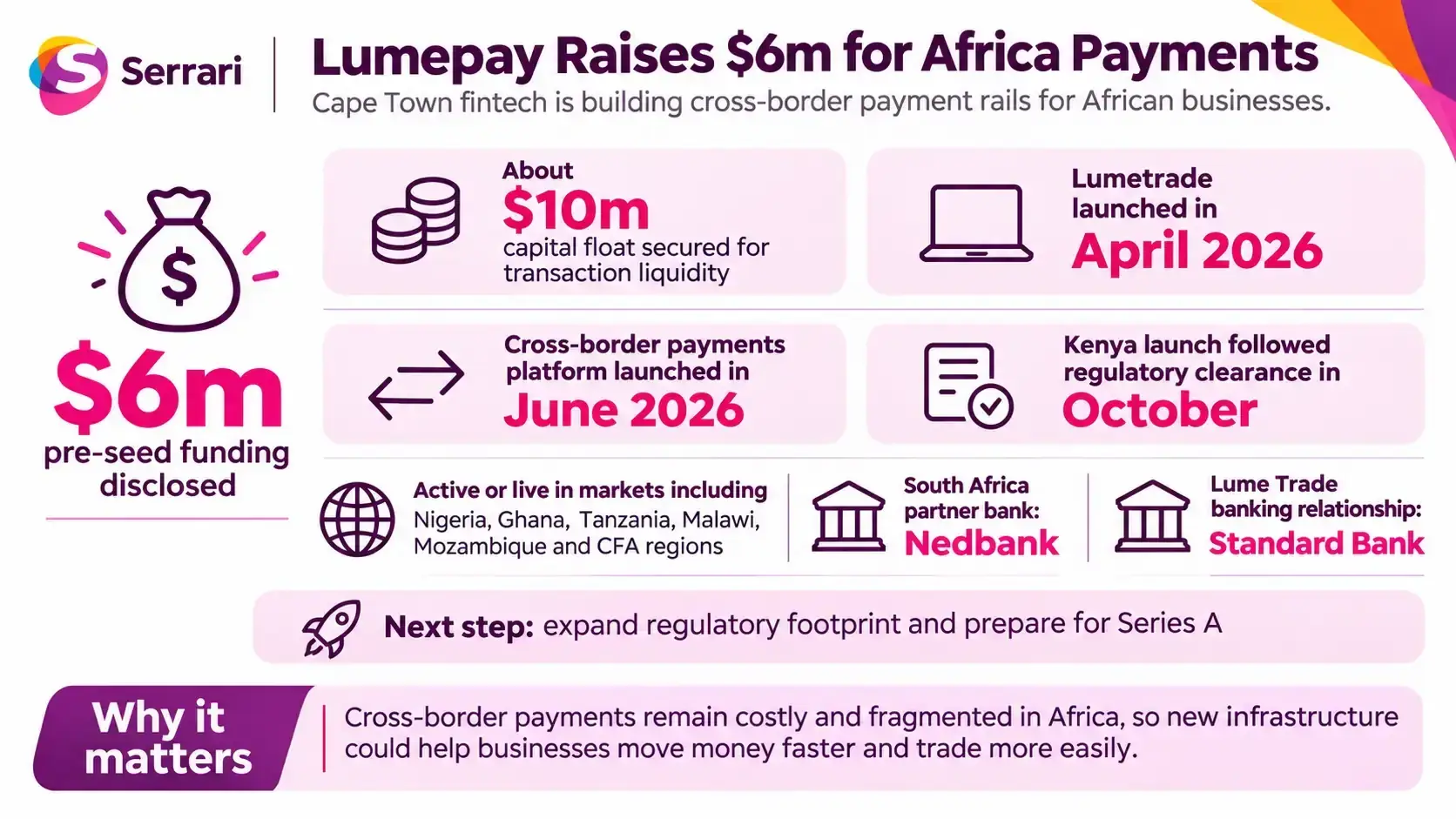
- Funding: Lumepay disclosed $6 million in pre-seed financing from founder-led angel and South African fintech investors; individual backers were not identified in the announcement.
- Liquidity: Approximately $10 million in separately secured capital float supports payment execution and currency availability; it is not additional venture equity funding.
- Product launches: Lumetrade launched in April 2026, followed by Lumepay’s business cross-border payments platform in June.
- Kenyan market: The company says it entered Kenya in October through regulatory clearance and a licensed local partner, offering international supplier-payment corridors.
- Banking relationships: Nedbank sponsors domestic rand collections and disbursements for Lumepay, while Standard Bank supports rand movements for the separate Lume Trade digital-asset business.
- Growth plans: The business is seeking further corridor-specific approvals and preparing for a Series A fundraising round.
Why Lumepay Raised Capital for Cross-Border Payments
For an African importer, the challenge is often not placing an order but paying the overseas supplier predictably. A transfer can involve multiple banks, different documentation requirements, currency conversions and delays before funds reach the beneficiary. These frictions tie up working capital: the importer may need to pay earlier than planned, hold additional foreign currency or postpone shipment while payment confirmation is pending.
The problem is structural. A trade and correspondent-banking assessment explains that intermediary banking relationships enable international payments but have weakened in some developing economies as financial institutions reduce exposure to compliance and operational risks. Losing access to those connections can make trade payments slower or harder, particularly for smaller businesses without extensive banking relationships.
Lumepay’s disclosed pre-seed round is intended to build the technical and commercial infrastructure needed to address that gap. The money has supported payment rails, wallets, security, financial-institution partnerships and regulatory work. Rather than relying on an entirely new financial network, the company is combining established banking arrangements with digital-asset settlement capabilities where suitable.
Timing matters. The $6 million was raised at the beginning of 2026, not received for the first time in November. The latest announcement is therefore a progress report as much as a fundraising story: Lumepay is pointing to products launched and markets entered since investors committed the initial capital.
Why the Separate $10 Million Float Matters
The distinction between investment capital and payment liquidity is especially important. The company says it secured approximately $10 million in capital float alongside the pre-seed round. This amount is intended to support liquidity for customer transactions, while the $6 million fundraising supports business development. It would be misleading to describe the arrangements as a $16 million equity round.
Liquidity is critical in cross-border payments because a company may need to provide one currency immediately while receiving or converting another at a different time. Without adequate prefunding, a seemingly fast payments platform can still experience delays if funds are unavailable at the receiving end. In less liquid currency corridors, the foreign-exchange spread can also overwhelm savings promised by quicker technology.
Management argues that dependable foreign-exchange access is as important as the speed of the software. That proposition is commercially significant: businesses care about the total amount a supplier receives, the time taken, the certainty of settlement and the ability to trace a transaction—not simply the seconds required to submit it.
However, Lumepay has not published enough transaction-level performance information to independently establish average savings, settlement times or the cost of maintaining the float. Those will be useful measures for prospective corporate clients and investors as the company expands.
Why Kenya Is an Important Expansion Market
Lumepay says it began operating in Kenya in October 2026 after obtaining clearance from the Central Bank of Kenya through a local licensed partner. Its Kenyan expansion announcement describes services allowing companies to pay overseas suppliers in currencies such as the Chinese yuan, US dollar and Indian rupee, alongside transfers on African trade routes.
That functionality speaks to importers purchasing machinery, pharmaceuticals, electronics, industrial materials and other products from overseas. More predictable international payments can improve inventory planning, lower the need for precautionary cash balances and help businesses negotiate with suppliers. The value to a particular customer will nevertheless depend on the available corridor, exchange rate, fees and transaction limits.
The regulatory distinction matters. A clearance or letter of no objection involving a licensed local partner is not automatically equivalent to the fintech itself receiving a stand-alone licence for every payment service. Kenya maintains an official directory of authorised payment providers, while regulatory requirements can differ by business model. Companies should verify the contracting entity, its permitted activities and the partner handling their funds before adopting a service.
Lumepay also reports operations or platform availability in Nigeria, Ghana, Tanzania, Malawi, Mozambique and the West and Central African CFA franc zones. That presence should not be confused with identical approvals or payment functionality in every jurisdiction; the business says additional authorisations remain necessary to extend services.
Context is everything. Stay ahead of shifting trends with today’s market updates, and uncover emerging opportunities using the Serrari Group Market Index and Marketplace. Then, take control of your own financial future by exploring our Money & Life Reset Transformation Blueprint ™ to build stronger habits, create better systems, and design a path toward lasting wealth.
Why Banks and Stablecoins Are Being Combined
Lumepay’s strategy sits between conventional cross-border banking and newer digital-asset settlement models. Traditional banks provide regulated access to local currencies and financial systems. Stablecoins, meanwhile, may offer a different way to transfer value between parties or liquidity providers, potentially reducing some intermediary steps where permitted and properly managed.
The company’s funding and product disclosure identifies Nedbank as its sponsoring bank for domestic rand merchant collections and payouts. Separately, its Lume Trade digital-asset business is described as a Category I financial services provider, with Standard Bank supporting rand deposits and withdrawals for institutional clients. These are different operational relationships and should not be interpreted as either bank guaranteeing every Lumepay international transfer.
The hybrid model also introduces risks that businesses must understand. Stablecoin settlement can create exposure to token issuers, redemption conditions, custody arrangements, wallet security and differing national regulations. Even when a digital leg transfers quickly, conversion back into local money and required compliance checks may determine when a supplier can actually use the funds.
For that reason, the question is not whether digital assets can replace banks entirely. It is whether new settlement technology can be integrated into regulated financial systems without sacrificing accountability, consumer protection or dependable access to fiat currencies.
A Wider Race to Fix Africa’s Payment Fragmentation
Lumepay is entering a market already attracting banks, fintech firms and continent-wide infrastructure initiatives. The Pan-African Payment and Settlement System’s operating model is designed to facilitate cross-border payments in local currencies through participating financial institutions, reducing the need for some transactions to be routed through external currencies and banking systems.
The underlying economic opportunity is substantial. A 2026 assessment of African integration identifies fragmented payment systems, transport networks and trade procedures as persistent barriers to regional commerce. It estimates that trade among African economies represents only around 15–20% of the continent’s overall trade, underscoring how much regional market integration remains unfinished.
Improved payments cannot, by themselves, remove customs delays, poor transport links or restrictions on goods and services. They can nevertheless address an essential part of the transaction. For a small manufacturer supplying customers in another African market, reliable receipt of payment can determine whether the business accepts additional orders or can afford to replenish raw materials.
The competition also means Lumepay must offer more than a broad geographical list. Its advantage will depend on the corridors it can serve legally and reliably, the price and transparency of its foreign exchange, and the quality of support when a transaction fails or needs investigation.
What Lumepay Must Prove Before Its Next Funding Round
Lumepay says its two products have attracted about 6,000 businesses and individuals since launch, but this combined figure does not reveal how many are recurring corporate payment clients or how much value has been processed. Revenue, transaction volume, net margins, customer retention and payment-failure rates have not been disclosed sufficiently to assess the durability of its economics.
Its upcoming Series A ambitions will likely sharpen attention on those measures. Investors will want evidence that acquiring business customers does not cost more than those relationships can earn, that liquidity can grow without excessive financing expense and that new market entries do not create unmanageable compliance obligations.
For African traders, the prospective benefit is straightforward: quicker, more transparent and more dependable access to cross-border payments could free up working capital and make regional and international commerce easier. But those benefits must be demonstrated corridor by corridor, rather than assumed from a funding announcement.
Lumepay’s $6 million round therefore reflects a broader transition in African fintech from consumer payment applications toward the infrastructure supporting businesses and trade. Its longer-term importance will not be determined by the amount raised, but by whether it can turn banking partnerships, regulatory permissions and digital settlement technology into measurable improvements in how African companies move money.
Sources
Disrupt Africa / The Paypers / MyBroadband / United Nations Trade and Development / Central Bank of Kenya / Pan-African Payment and Settlement System / World Bank
Your financial future isn’t something you wait for—it’s something you build.
The real question is: when do you begin?
Move beyond simply staying informed.
Navigate the markets with clarity—track trends through the Serrari Group Market Index, uncover opportunities in the Serrari Marketplace, and build practical knowledge with our Curated Wealth Builder Platform.
Stay connected to what truly matters.
Get daily insights on macro trends and financial movements across Kenya, Africa, and global markets—delivered through the Serrari Newsletter.
Growth opens doors.
Advance your career through professional programs including ACCA, HESI A2, ATI TEAS 7 , HESI EXIT , NCLEX – RN and NCLEX – PN, Financial Literacy!🌟—designed to move you forward with confidence.
See where money is flowing—clearly and in real time.
Track Money Market Funds, Treasury Bills, Treasury Bonds, Green Bonds, and Fixed Deposits, alongside global and African indexes, key economic indicators, and the evolving Crypto and stablecoin landscape—all within Serrari’s Market Index.