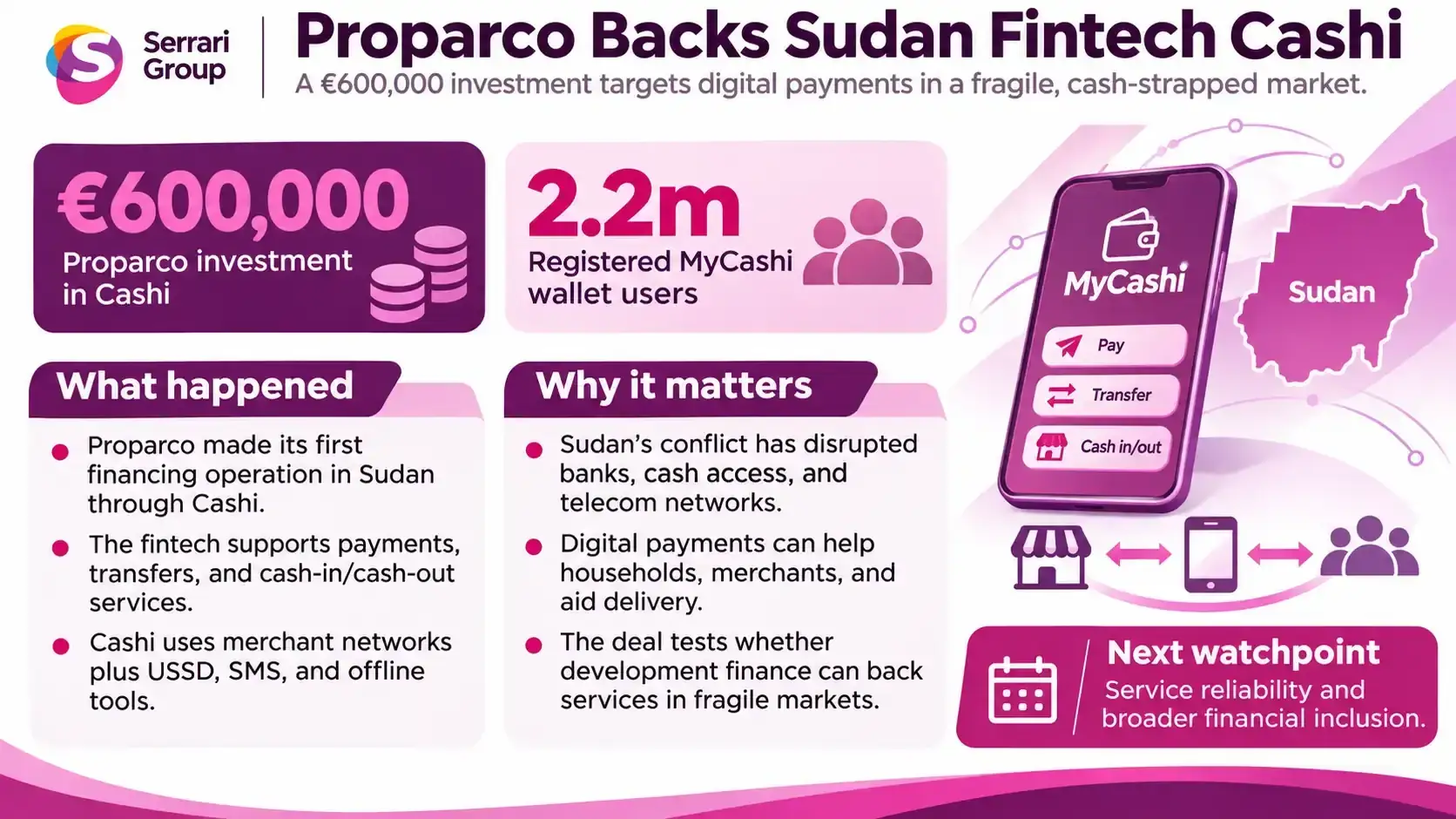
French development finance institution Proparco has made its first financing investment in Sudan, committing €600,000 to payments company Cashi as the country’s conflict continues to damage banking networks and disrupt access to cash. Announced on November 9, 2026, the equity investment supports a business whose MyCashi wallet has reached 2.2 million registered users and which offers alternative payment channels for people facing unreliable internet and limited access to banks. Although modest in size, the deal addresses a critical economic problem: families, merchants and aid agencies still need ways to move money when ordinary financial infrastructure has been damaged. It also tests whether development finance can support commercially sustainable services in an exceptionally fragile market.
Key Overview
- €600,000 investment: Proparco’s first financing operation in Sudan backs the fintech Cashi through an equity investment.
- 2.2 million registrations: Cashi reports that its MyCashi digital wallet has reached 2.2 million registered users; that is not a verified count of monthly active users.
- War-related disruption: Bank closures, cash shortages and interruptions to electricity and communications have made ordinary payments harder.
- Multiple payment channels: Cashi combines merchant-assisted cash transactions with USSD, SMS and offline-card options intended to work around connectivity barriers.
- Humanitarian relevance: More resilient financial channels could help deliver transfers and support local trade, though reliability and coverage still require scrutiny.
- Broader investment signal: The transaction illustrates targeted development financing in conflict-affected markets rather than proof of a general recovery in Sudanese investment.
Why Proparco Is Investing in Sudan During a War
The timing is striking. Sudan has been engulfed in conflict since April 2023, with fighting between the Sudanese Armed Forces and the Rapid Support Forces causing displacement, destroying infrastructure and disrupting businesses. International financiers would ordinarily treat such conditions as reasons to avoid new exposure. Proparco’s decision instead centres on a service that becomes more necessary when established systems fail.
In its November 9 investment announcement, the institution confirmed €600,000 in equity financing for Cashi, founded in 2022 after experience building Sudan’s online marketplace alsoug.com. It presented the transaction as support for financial inclusion and essential payment services in fragile communities, rather than a broad commercial bet on Sudan’s near-term economic recovery.
The distinction matters. An equity investment gives the investor exposure to the company’s business prospects and risks, rather than representing a grant to households or a loan that Cashi must repay on a fixed schedule. Neither the ownership percentage acquired nor the company’s valuation was disclosed in the announcement. It would therefore be misleading to infer how much of Cashi Proparco now owns, or how the deal values the business.
Proparco’s rationale is rooted in the difference between avoiding risk and financing services that reduce risks for others. The institution is supporting a payment network that could help shopkeepers receive money, families transfer funds and aid organisations reach recipients despite broken conventional channels. Success will depend on how widely and reliably those services function, not simply on the symbolic importance of entering a conflict-affected country.
How Sudan’s Banking Crisis Changed Everyday Payments
For Sudanese households, the problem is practical. A salary or remittance has limited value if its recipient cannot withdraw cash, transfer funds or pay a nearby merchant. Conflict has damaged bank branches and payment infrastructure while increasing the dangers associated with travelling to collect money. Cash shortages add another obstacle even when a customer has funds in an account.
A review of Sudan’s humanitarian conditions describes banking disruption, limited physical currency and obstacles to humanitarian payments. Restrictions surrounding a banknote replacement programme compounded shortages, leaving households and aid organisations struggling to access usable cash.
Digital services offer an alternative, but they are not immune to the same crisis. A wallet requires dependable records, secure access, an accepting merchant or agent and, eventually, sufficient liquidity when someone needs physical money. Power cuts, weak networks and agents without cash can turn a successful on-screen transfer into a failed real-world payment.
Cashi’s model attempts to bridge that gap through a network of local merchants where users can deposit and withdraw cash, settle bills and transfer funds. Its additional USSD, SMS and offline-card options are intended to reach people who cannot consistently use smartphone applications. These features matter because service continuity, not technological novelty, is the key selling point in a disrupted economy.
However, offline functionality should not be interpreted as a guarantee that every transaction can be completed and settled without connectivity or cash. Availability will depend on the precise channel, merchant capacity and operating conditions in each location.
Context is everything. Stay ahead of shifting trends with today’s market updates, and uncover emerging opportunities using the Serrari Group Market Index and Marketplace. Then, take control of your own financial future by exploring our Money & Life Reset Transformation Blueprint ™ to build stronger habits, create better systems, and design a path toward lasting wealth.
Why 2.2 Million Wallet Registrations Do Not Tell the Whole Story
Cashi’s reported 2.2 million MyCashi registrations suggest considerable demand for financial alternatives. Yet registrations are not the same as active customers, completed transactions or accounts used regularly for humanitarian payments. The company’s announcement does not provide transaction volumes, active-user rates, profitability or a geographic breakdown of where its network remains accessible.
A November 5 digital-finance assessment provides a useful warning against assuming that access to phones means effective use of mobile money. Among 152 people interviewed in River Nile, Kassala and Gedaref states, 78% owned a phone and 65% used the internet, yet only 36% used a mobile payment application and 10% reported having a digital wallet. The sample is small and covers three states, so those percentages should not be presented as national estimates.
The same assessment found that 59% felt left behind by technology and highlighted concerns around fraud, identification requirements, disconnected payment platforms and poor customer support. A payment service can therefore widen access only when users understand how to protect credentials, challenge failed transactions and convert digital balances into goods or cash.
For Cashi, the investment’s development impact is likely to depend on practical measures such as extending merchant coverage, improving agent liquidity, strengthening consumer protection and building trust among first-time digital users. These are harder outcomes to measure than registrations, but more directly relevant to whether people can rely on the platform.
Could Fintech Payments Improve Humanitarian Aid Delivery?
Humanitarian organisations increasingly use cash and voucher assistance because it can give families flexibility to purchase essentials where markets still function. But cash assistance depends on payment rails and merchants being able to operate. Where physical banknotes are scarce or transport is dangerous, digital transfers and vouchers may be more practical.
An assessment of payment resilience in conflict settings discusses how Sudan’s war disrupted core financial infrastructure and encouraged aid providers to turn to alternative, sometimes externally hosted, transaction systems. Cashi’s tools could potentially serve a similar need by giving beneficiaries additional ways to receive or spend money in areas where traditional services are limited.
That potential should not be confused with evidence of a specific aid-distribution contract or proven programme outcome. Neither the financing announcement nor the reported user total establishes how much humanitarian assistance Cashi has actually processed. Aid agencies would still need to verify recipient identity, protect sensitive information, prevent diversion and confirm that merchants can deliver essential goods.
The opportunity extends to small businesses. If customers can pay local merchants electronically, shops may continue trading when bank branches are closed. For merchants, though, digital balances must remain usable for restocking and supplier payments. A functioning merchant ecosystem is therefore as important as the wallet itself.
A Small Deal With a Larger Development-Finance Test
The €600,000 commitment is modest compared with Sudan’s reconstruction and humanitarian needs. It cannot rebuild the banking system, restore nationwide electricity or replace international aid. Nevertheless, it illustrates a different approach to investment in fragile states: financing a targeted business that provides a service households and enterprises need immediately.
That approach carries material risks. Businesses operating during conflict face staff safety concerns, unreliable communications, payment fraud, liquidity shortages and uncertainty over regulation. A payment network must also manage cybersecurity, safeguard customer funds and avoid excluding people without suitable identity documents or reliable mobile access.
Sudan has made some progress towards restoring formal infrastructure. Authorities reactivated the national electronic payment switch in August 2026, beginning with one bank and plans to reconnect others. This was an important step, but it did not mean that banking services were fully restored nationwide. Private and public systems may eventually complement one another, provided they can exchange payments securely and reliably.
The wider question for development financiers is whether well-designed private investment can maintain essential services when state institutions and conventional lenders are under severe strain. Proparco’s first Sudan operation signals a willingness to test that proposition, but it remains one deal rather than evidence of a wider wave of incoming capital.
For families, the significance is immediate: being able to receive funds and make payments can determine whether food is purchased, rent is paid or a small enterprise stays open. For investors and policymakers, the longer-term test is whether Cashi can turn registrations into safe, consistent and affordable transactions despite the pressures of war. That is why the investment matters now, and why its success should ultimately be judged by service reliability and access rather than by the headline funding amount alone.
Sources: Proparco / United Nations Development Programme / International Monetary Fund / UK Government / Sudan Tribune
Your financial future isn’t something you wait for—it’s something you build.
The real question is: when do you begin?
Move beyond simply staying informed.
Navigate the markets with clarity—track trends through the Serrari Group Market Index, uncover opportunities in the Serrari Marketplace, and build practical knowledge with our Curated Wealth Builder Platform.
Stay connected to what truly matters.
Get daily insights on macro trends and financial movements across Kenya, Africa, and global markets—delivered through the Serrari Newsletter.
Growth opens doors.
Advance your career through professional programs including ACCA, HESI A2, ATI TEAS 7 , HESI EXIT , NCLEX – RN and NCLEX – PN, Financial Literacy!🌟—designed to move you forward with confidence.
See where money is flowing—clearly and in real time.
Track Money Market Funds, Treasury Bills, Treasury Bonds, Green Bonds, and Fixed Deposits, alongside global and African indexes, key economic indicators, and the evolving Crypto and stablecoin landscape—all within Serrari’s Market Index.