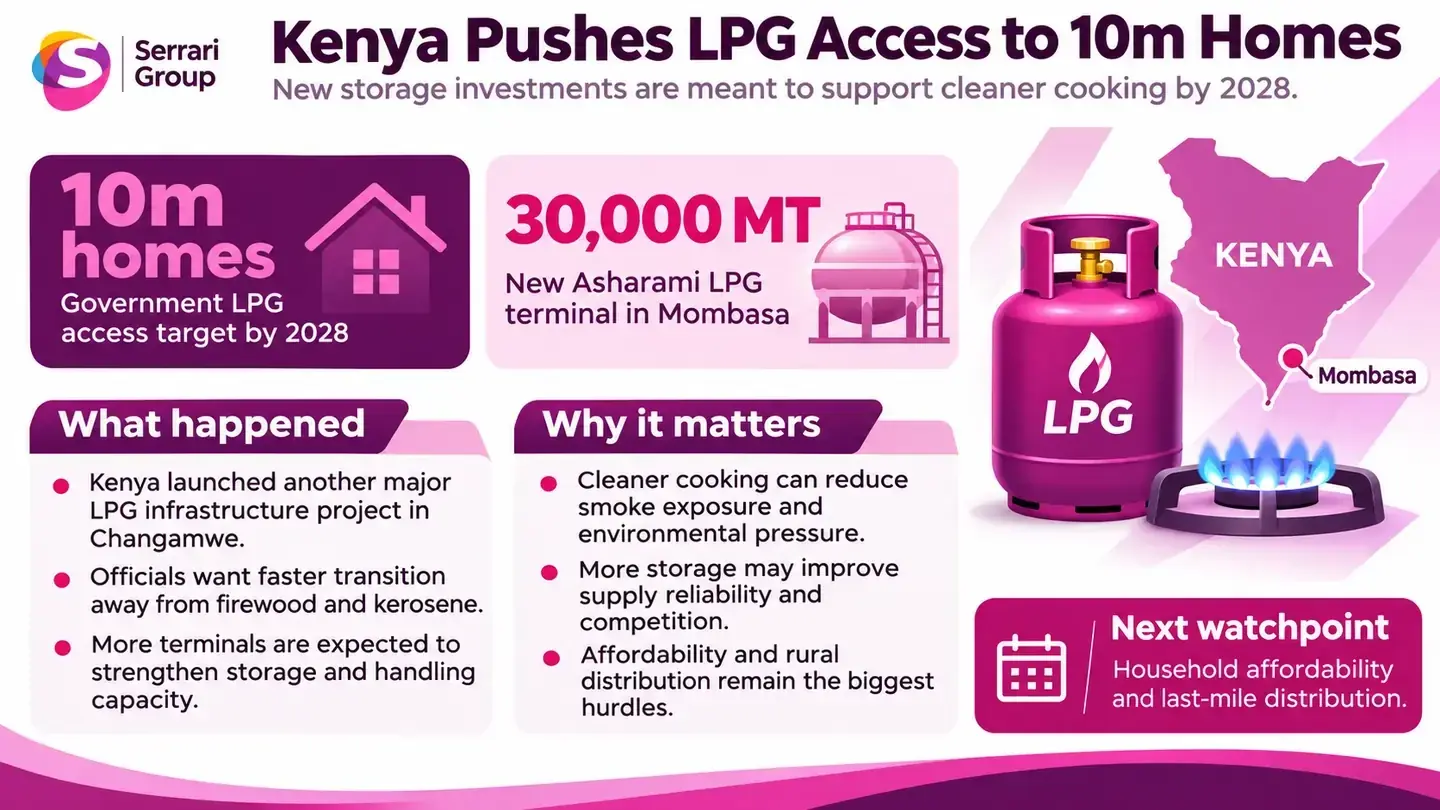
Kenya is seeking to extend access to liquefied petroleum gas (LPG) to 10 million households by 2028, with a new 30,000-metric-tonne storage terminal in Mombasa forming part of a broader push to reduce reliance on firewood, charcoal and kerosene. Petroleum Principal Secretary Kello Harsama announced the ambition at the November 11, 2026 groundbreaking of the Asharami Synergy Kenya facility in Changamwe, which developers expect to complete in approximately 18 months. The investment could improve import logistics and supply reliability, but the policy’s success will depend on whether competition, last-mile distribution and household purchasing power turn greater storage capacity into affordable cooking fuel, especially in rural areas.
Key Overview
- 10 million households: The government’s 2028 ambition concerns LPG access, although reporting about universal piped connections should not be taken as proof that every targeted home will receive a physical gas pipeline.
- 30,000 metric tonnes: Asharami Synergy Kenya is building a new LPG terminal in Changamwe, Mombasa, with an estimated 18-month construction period.
- 9.1 million households: Kenya’s 2024–2028 cooking-transition strategy, drawing on 2022 survey data, estimates this many households relied primarily on traditional cooking fuels.
- Rural gap: About 7.4 million of those households were rural, where distribution networks and household incomes present particularly difficult barriers.
- Multiple investors: Existing and planned facilities involving AGOL, Taifa Gas, Lake Gas and Kenya Pipeline Company are intended to improve import handling and storage.
- Key test: More storage may improve supply resilience, but cannot by itself guarantee lower cylinder refill prices or widespread piped-gas connections.
Why Kenya Is Accelerating Its LPG Expansion
The new target reflects a long-standing gap between Kenya’s clean-cooking ambitions and the fuels used in everyday homes. At the Mombasa terminal groundbreaking, Harsama said the government would work with private investors to expand LPG access by 2028. The announced project is not an isolated facility: it forms part of a larger effort to strengthen storage and reduce constraints on distribution as more households shift away from polluting fuels.
The scale of the problem is substantial. Kenya’s National Cooking Transition Strategy identifies the need to close both supply and affordability gaps while promoting local production, consumer awareness and accountability. The strategy cites 9.1 million households relying on traditional fuels, including 7.4 million in rural areas. The underlying 2022 household survey also finds a striking urban-rural difference in clean cooking: 59% of the urban population used clean cooking technologies, compared with just 6% of the rural population.
That imbalance explains why expanding infrastructure at the port is necessary but insufficient. Imported LPG must move through storage terminals, road transport or other distribution systems, retail outlets and ultimately into kitchens. A weak link anywhere along that chain can keep prices high or leave customers without a dependable supply, even if import volumes increase.
What the Mombasa Terminal Could Change
Asharami Synergy Kenya’s planned 30,000-metric-tonne terminal will increase the infrastructure available to receive and store LPG near Kenya’s principal coastal import gateway. Its managing director, Bayo Sotomi, said construction should take about 18 months. The project joins a developing cluster of facilities, including a 25,000-tonne terminal operated by AGOL, Taifa Gas’s planned 30,000-tonne Dongo Kundu facility and Lake Gas’s completed 10,000-tonne Kilifi terminal, as described in the November 11 project report.
Kenya Pipeline Company is also developing an LPG import, storage and handling facility at the former refinery site in Changamwe. Together, these investments could give importers greater flexibility to receive cargoes, hold reserve stocks and organise supply to distributors. Additional capacity may also reduce some bottlenecks and make it easier for more market participants to compete.
There are limits to what the numbers show. A terminal’s storage capacity measures the amount it can hold at one time, not the annual volume it will handle. Its actual impact will depend on how frequently stocks turn over, marine access, transport links, commercial arrangements and whether the facilities are completed and operated as planned. The projects’ stated capacities should therefore not simply be added together and presented as guaranteed new annual supply.
More importantly, greater domestic storage does not mean Kenya will produce all its LPG locally. It can strengthen the country’s ability to manage imports and disruptions, but reducing reliance on foreign LPG would require a different change in domestic production or fuel sourcing. The government’s language about self-sufficiency is best understood as an ambition for reliable access rather than evidence that import dependence has ended.
Context is everything. Stay ahead of shifting trends with today’s market updates, and uncover emerging opportunities using the Serrari Group Market Index and Marketplace. Then, take control of your own financial future by exploring our Money & Life Reset Transformation Blueprint ™ to build stronger habits, create better systems, and design a path toward lasting wealth.
Will More Investment Make Cooking Gas Cheaper?
For households, affordability is more important than the size of the terminal. LPG users face an initial cost for cylinders, regulators and suitable stoves, followed by recurring refills. A family may want to switch from charcoal or firewood but continue using those fuels when a full gas refill cannot be accommodated within its weekly budget.
Improved storage could lower some logistics costs and increase competition, particularly if independent marketers gain reliable access to import facilities. But the final retail price also reflects international LPG prices, exchange rates, taxes, transport, wholesaler and retailer margins, and the cost of moving cylinders to less densely populated areas. A coastal terminal cannot control all of these factors.
Kenya’s regulator has documented sustained growth in demand: official energy statistics show LPG consumption rising from approximately 365,000 tonnes in 2023 to 415,000 tonnes in 2024. Rising consumption demonstrates growing uptake, but not necessarily universal affordability. Households may also use several cooking fuels in parallel, switching according to price and availability.
Policy success will therefore depend on accessible smaller refill options, safe and competitive retail networks, transparent pricing and measures that reduce the cost of adopting LPG for low-income households. Any subsidy or financing scheme would also need safeguards to ensure the intended users—not intermediaries alone—receive the benefit.
Why Rural Households and Schools Are Central
The hardest part of the transition is likely to be outside Kenya’s major cities. Delivering cylinders to dispersed settlements requires transport, safe storage and sufficient local demand to make distribution viable. Even when households can afford a stove, unreliable refills may encourage them to retain firewood as a fallback. This practice, often called fuel stacking, means that gaining access to LPG does not automatically eliminate reliance on polluting fuels.
The government is also targeting public institutions. The November announcement highlighted an estimated 11,000 schools still relying on firewood. Moving institutional kitchens towards cleaner fuels could reduce smoke exposure for kitchen workers and create more predictable demand for LPG suppliers. Yet schools must budget for ongoing fuel purchases, install appropriate equipment and train staff in safe handling; replacing a stove without financing its operation would provide little lasting benefit.
The health argument is compelling. The latest household-air-pollution assessment estimates that polluting household fuels contributed to 2.9 million premature deaths globally in 2021, with women and children often facing the greatest exposure. LPG is cleaner at the point of use than burning wood, charcoal or kerosene in inefficient stoves, although it remains a fossil fuel and requires careful safety management.
Clean cooking can also reduce time spent gathering fuel and exposure to smoke. However, those benefits emerge only when families use cleaner equipment consistently and can afford to maintain their new cooking arrangements.
Can Kenya Meet the 2028 Deadline?
The timing exposes a potential implementation gap. A terminal expected to take 18 months from November 2026 would reach its projected completion around the first half of 2028, leaving little time before the end-year target for that particular project to influence nationwide household access. Other existing facilities and distribution initiatives would therefore need to carry much of the early expansion.
There is also an important distinction between LPG access and piped LPG connections. Media accounts of the new ambition use both terms, but a bulk import terminal does not create household pipeline networks. Reticulated gas systems require local distribution pipes, building connections and regulation, while cylinder-based supply follows a different investment model. The government has not provided a publicly verified implementation breakdown demonstrating how all 10 million homes would receive piped connections by 2028.
The broader national strategy targets universal access to clean cooking, which can also include electricity, biogas and other qualifying technologies. That is not identical to requiring every household to cook with LPG. Clear definitions and regular reporting will be essential so that progress is measured by actual household use, not only cylinders sold, storage capacity commissioned or projects announced.
Ultimately, the Mombasa investment matters because it addresses one of the physical constraints holding back Kenya’s energy transition. But the economic and public-health payoff will be determined much farther from the port: in rural shops, household budgets and institutional kitchens. If Kenya can combine stronger storage with competitive distribution and affordable refills, the expansion could make cleaner cooking a practical option for millions. If those last-mile barriers persist, even substantial terminal investments may leave the 2028 promise out of reach.
Sources: Kenya Broadcasting Corporation / Kenya National Bureau of Statistics / Ministry of Energy and Petroleum / Food and Agriculture Organization / Energy and Petroleum Regulatory Authority / World Health Organization
Your financial future isn’t something you wait for—it’s something you build.
The real question is: when do you begin?
Move beyond simply staying informed.
Navigate the markets with clarity—track trends through the Serrari Group Market Index, uncover opportunities in the Serrari Marketplace, and build practical knowledge with our Curated Wealth Builder Platform.
Stay connected to what truly matters.
Get daily insights on macro trends and financial movements across Kenya, Africa, and global markets—delivered through the Serrari Newsletter.
Growth opens doors.
Advance your career through professional programs including ACCA, HESI A2, ATI TEAS 7 , HESI EXIT , NCLEX – RN and NCLEX – PN, Financial Literacy!🌟—designed to move you forward with confidence.
See where money is flowing—clearly and in real time.
Track Money Market Funds, Treasury Bills, Treasury Bonds, Green Bonds, and Fixed Deposits, alongside global and African indexes, key economic indicators, and the evolving Crypto and stablecoin landscape—all within Serrari’s Market Index.